
It's the first time in the history of the world.
Last week, AI circles were discussing one thing, but most people only saw half of it.
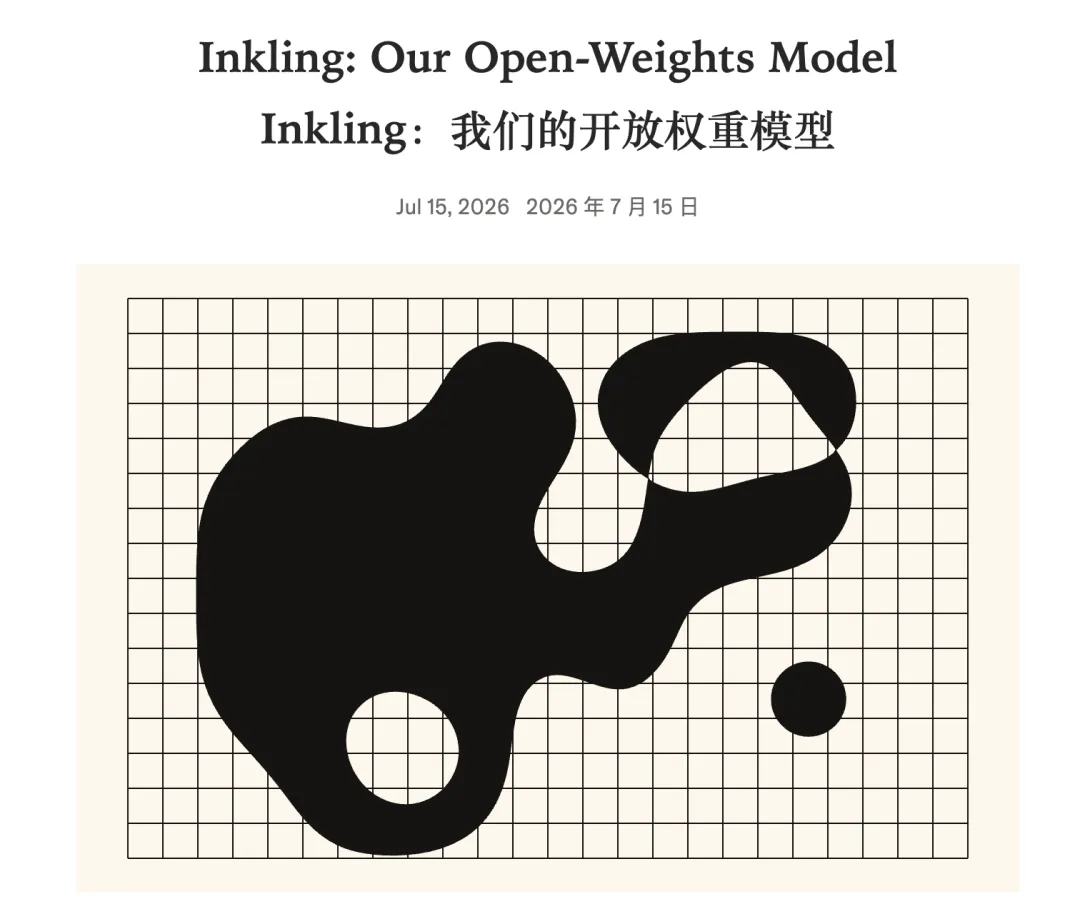
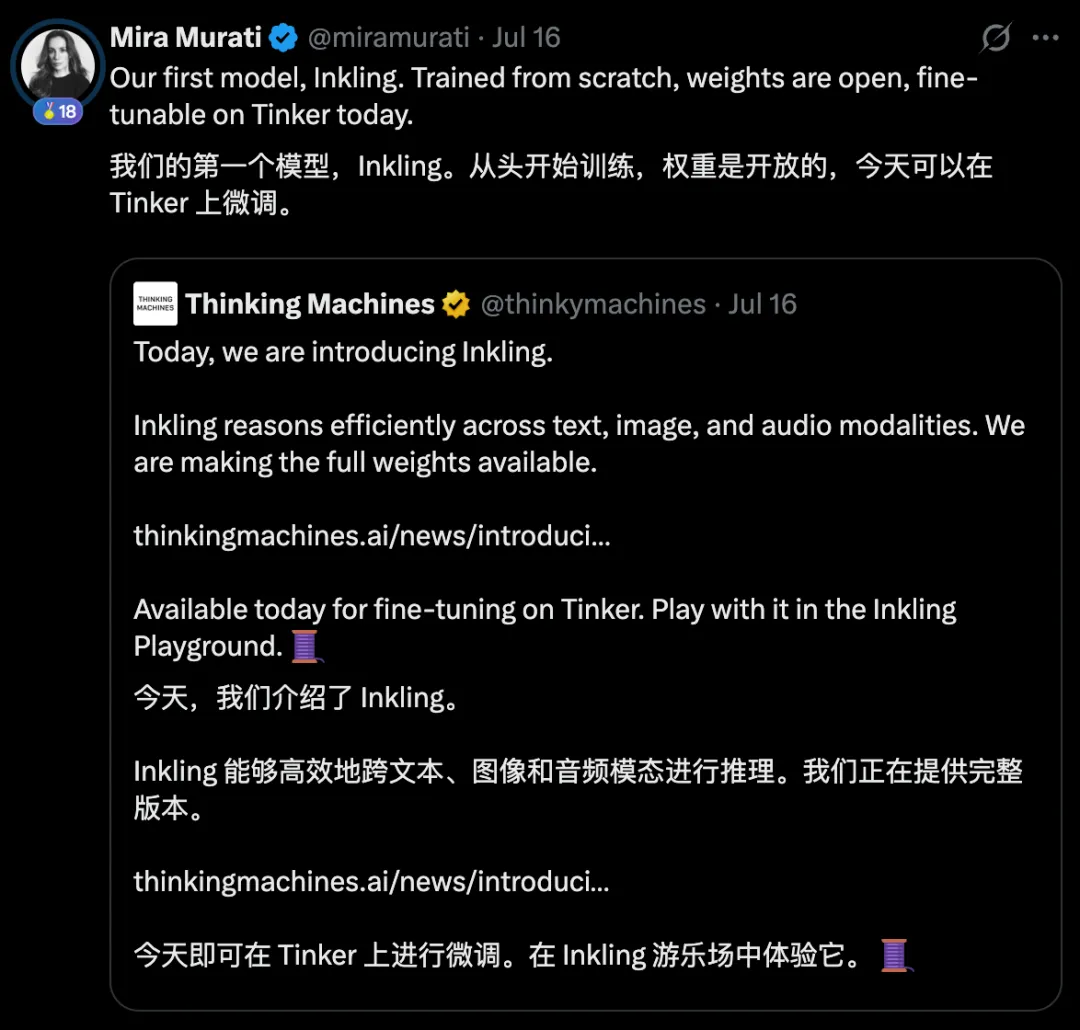
On July 15, Mira Murati, former OpenAI CTO, released the first model of Thinking Machines Lab, Inkling, in San Francisco.
With US$2 billion in financing, 975B Parameters and 100 Elite Teams, Silicon Valley's most sought-after AI startup has finally made a name for itself.
 |  |
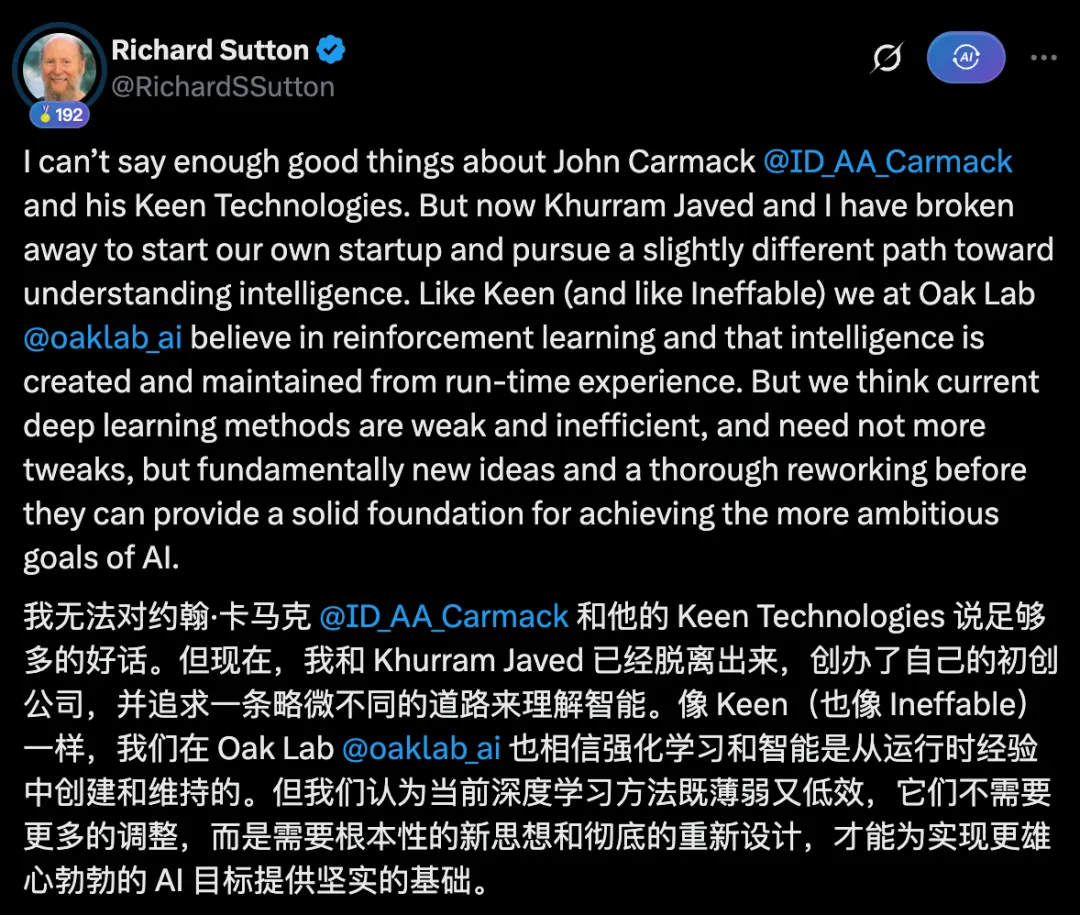
On almost the same day, Richard Sutton, the father of reinforcement learning, announced the founding of the Oak Lab.
The old man's original words were:"Current"Deep learningThe method is fragile and ineffective, and the need is not to fix the fix, but to come back from the ground up".
It's not just Sutton who thinks so. DeepSeek founder Liang Wenqiang gives almost the same judgment.
He compares the development of AI to a first stage: language models, CoT, Agent... and the next stage after Agent is continuous learning.
His view is that the core capabilities of the next generation of models must be the ability to continue learning in order for it to be called the next generation of models.If continuous learning is done first, general intelligence may be easier.
When a technology route is bet on by Turing Prize winners, Silicon Valley's top-rated AI startups and China's most innovative big model founders, it's no longer a technology option but an industry consensus.
The wind has changed.
While everyone was staring at Silicon Valley on the Pacific side, a Chinese laboratory less than a year old gave an unexpected answer on the same track.
Mind Lab has officially released the Macaron-V1.
Mind Lab was founded in October 2025 as a cutting-edge research laboratory under Mindverse Technology. The entire team of more than thirty people, including members from xAI, DeepMind, DeepSeek, ByteSeed, MIT, and Qingdao, completed a $50 million round of A-level financing, followed by the United States, Shenzhen, Redwood China, and China.
Please note this figure: $50 million, which will be used later.
748B Parameters Direct to Strengthening LearningFour LoRAs in a row.Let's look at the model.
Macaron-V1 split into two versions: the flagship versionVenti, the 748B parameter, consisting of the GLM-5.2 base of 744B plus four LoRAs of 1B, the native 2M extends beyond the context;
Standard editionTall35B, based on Qwen-3.6 training, can run on Mac.
But the key is not the parameters in the four LoRAs.
In the past, the LoRA was a "poor alternative" to the all-minor version.
Mind Lab redefines it as:The base model is "common" and LoRA is "personality".
It's like all the iPhones have the same iOS system, but the apps you install, your input patterns, your high-frequency operation, make your iPhone "your iPhone".
Chat is natural sympathy, programming is strictly precise, agents are multi-step planning, generative interfaces are designed to be crammed into a set of parameters and trained to fight each other.
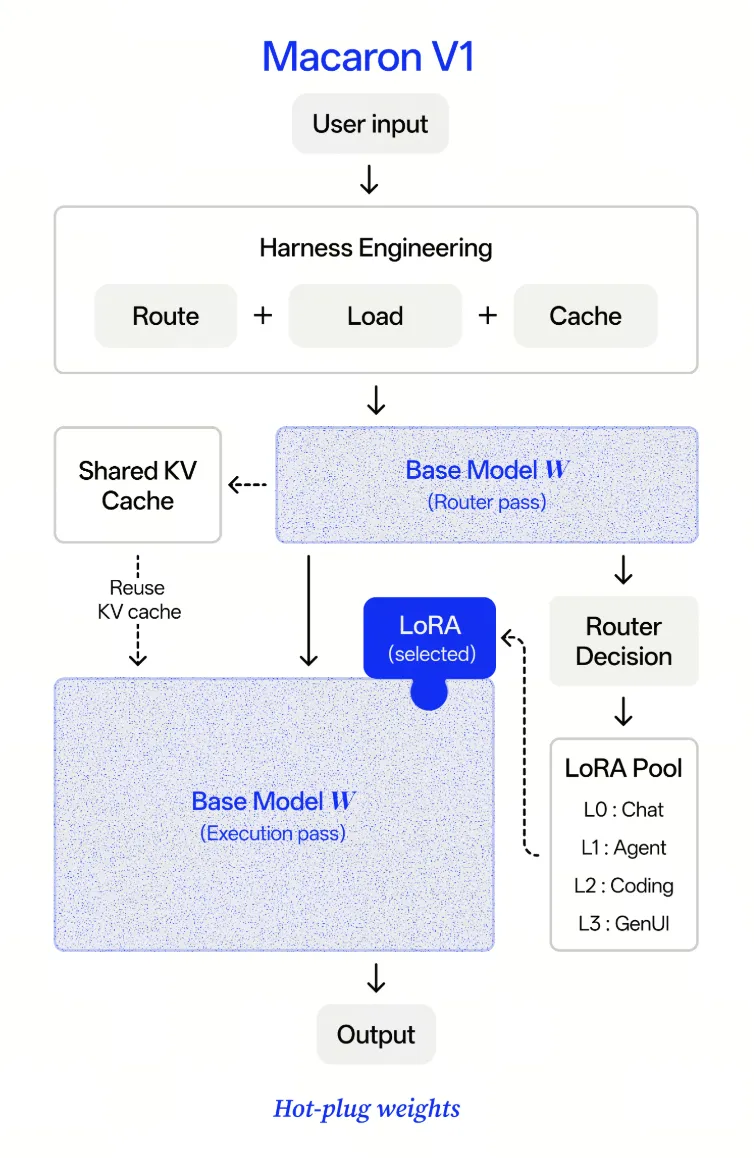
The Macaron-V1's approach is simple and rough: dismantle.
There are four independent LoRAs: Chat, Agent, Programming, GenUI, each with their own training, their own evaluation, their own spin-off.
When the router dynamically switches when it is running, you say "help me set a schedule" and go to Agent LoRA; you say "this code has a bug" and cut Coding LoRA.
The architecture has an official name:Mixture-of-LoRA(MoL)Different skills can be taught independently on a shared platform, combined with flexibility, and called upon. It's not about making a model complete, it's about getting a team of experts to work together.
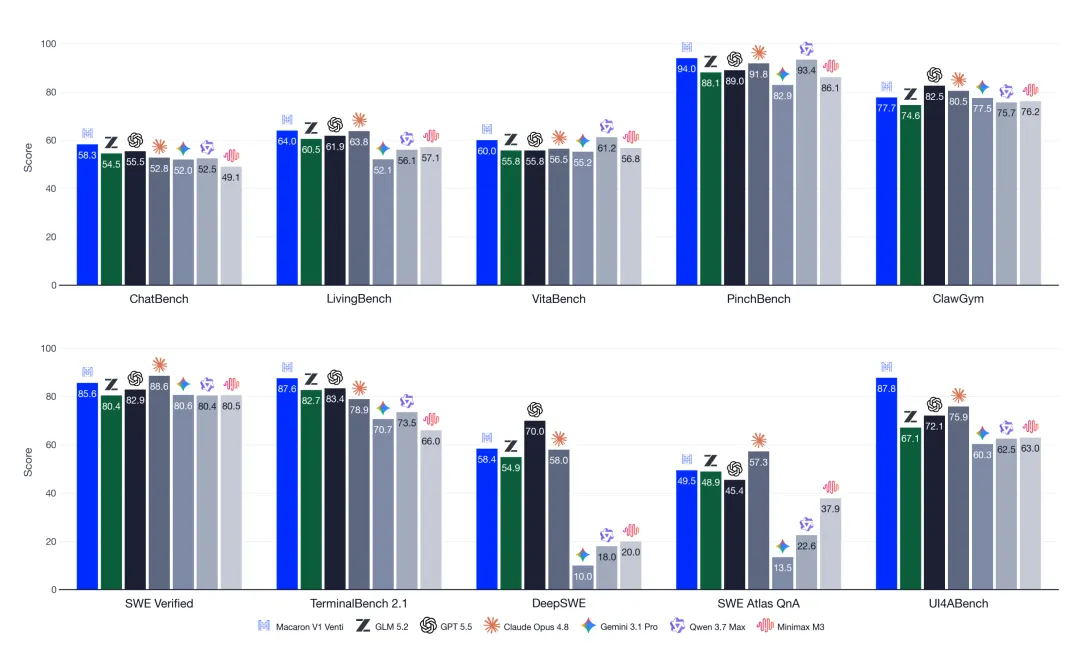
As a result, the Macaron-V1 has not yet reached the level of the most powerful closed-source model in all its capabilities. However, in the overall evaluation, it has been able to level up and even exceed Opus 4.8, GPT-5.5 and Gemini 3.1 Pro in most tasks, particularly in the performance of live-scene code and generative UI directions.
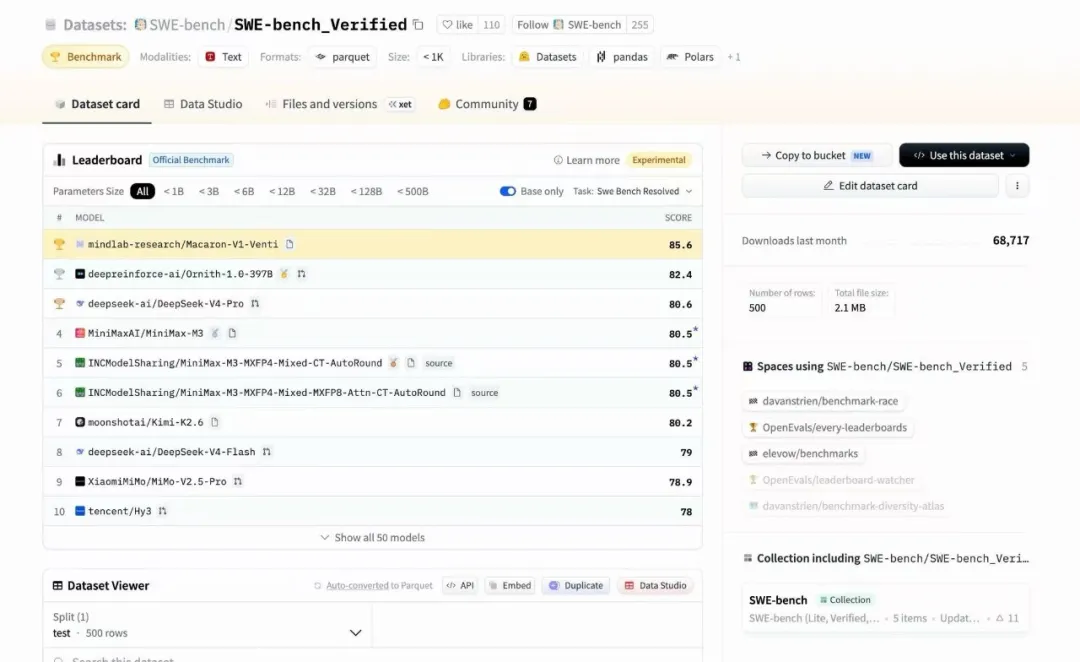
SWE-bench VerifiedOne of the toughest coding capability ratings in the industry, Macaron-V1-Venti topped the list with 85.6 points and finished in second place with 3 points, pushing DeepSeek-V4-Pro ((80.6) ‒MiniMax-M3 ((80.5) ‒Kimi-K2.6 ((80.2) ‒ all behind.
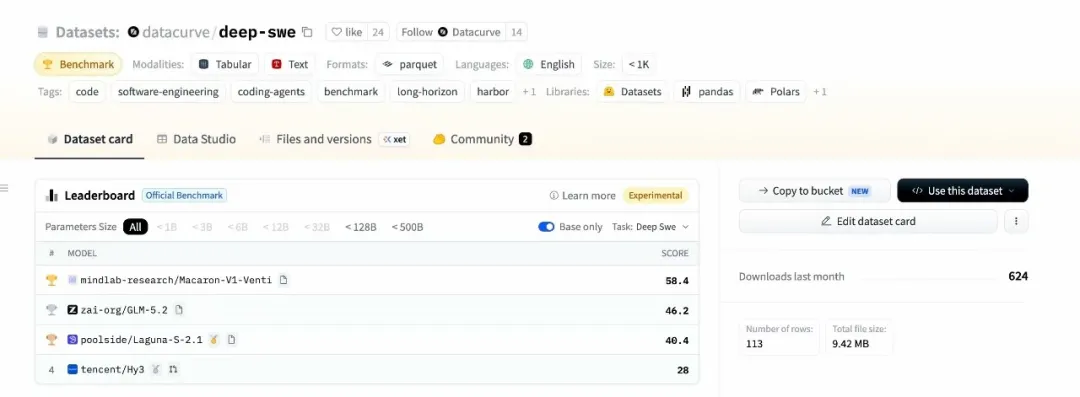
What's even worse is thatDeep-SWEMacaron-V1-Venti scored 58.4 points, second to its base model GLM-5.2 and 46.2 points.The same basement, through LoRAStrengthening LearningAfter training, he scored 12 points.This is the added value that post-training can bring.
What is even more important:Open Weight and Private Deployment.The closed-source model is stronger, and the data is on someone else's servers. The Macaron-V1 allows you to move the model back to your home without giving out a single byte of data.
Andrew shows an example in his WAIC speech: a user takes a disturbed picture of a wizard, sends it past, identifies a model's state, solves an algorithm, generates an interactive 3D restoration guide box that requires visual understanding, algorithms, Agent tool calling, and connects the four capabilities of GenUI.

There is another design that is easy to overlook but extremely hardcore:Model and Harness co-designed.
Most model training and actual deployments are tools interfaces, execution processes, and the real-world after-line environment that are used to train two sets of environments.
From the outset, the Macaron-V1 allowed Harness to train and optimize the model and the production environment, how to call tools, how to operate the terminal, how to run long-distance tasks, and so on and so forth.
Supported REPL Harness enables models to use code-compilation tools, save middle status, and reuse efficient process filters without having to start from scratch each time, reducing repeat calls and context waste.
One word:This is not a talking-only model, it's a functioning intelligence.
Why is it "global only two"?You might say: What's so great about the LoRA subtlety?
It's a wonderful place in two words:The scale。
The 30B model is doing LoRA reinforcement learning, which a lot of teams can do. But the parameters go up to trillions and the difficulty index goes up.
The core challenge is callingDisagreements• Reinforcement learning involves training for feedback gathering and reasoning, and when a trillion-parameter MoE model is sliced onto dozens of GPUs, the training accuracy and reasoning accuracy deviate slightly, the gradient shifts, and the training curve does not blur directly.
Playing an example of a 30-piece chamber orchestra, the sound quality is slightly lower than usual. In exchange for hundreds of symphony orchestras, any instrument that moves, the whole arena is a disaster.
LoRA can be run globally on a trillion-parameter scaleStrengthening LearningThere are only two teams.
One is Mira Murati's Thinking Machines Lab. Another is the Mind Lab.
There's no third.
In December 2025, Mind Lab ran LoRA reinforcement training on a 1.040 trillion ultra-large, sparse MoE model with a total capacity of Kimi K2 models.
This month's LongStraw pushes reinforcement training with fixed GPU computing to 2M. The Macaron-V1 is a concentrated debut of these accumulations.
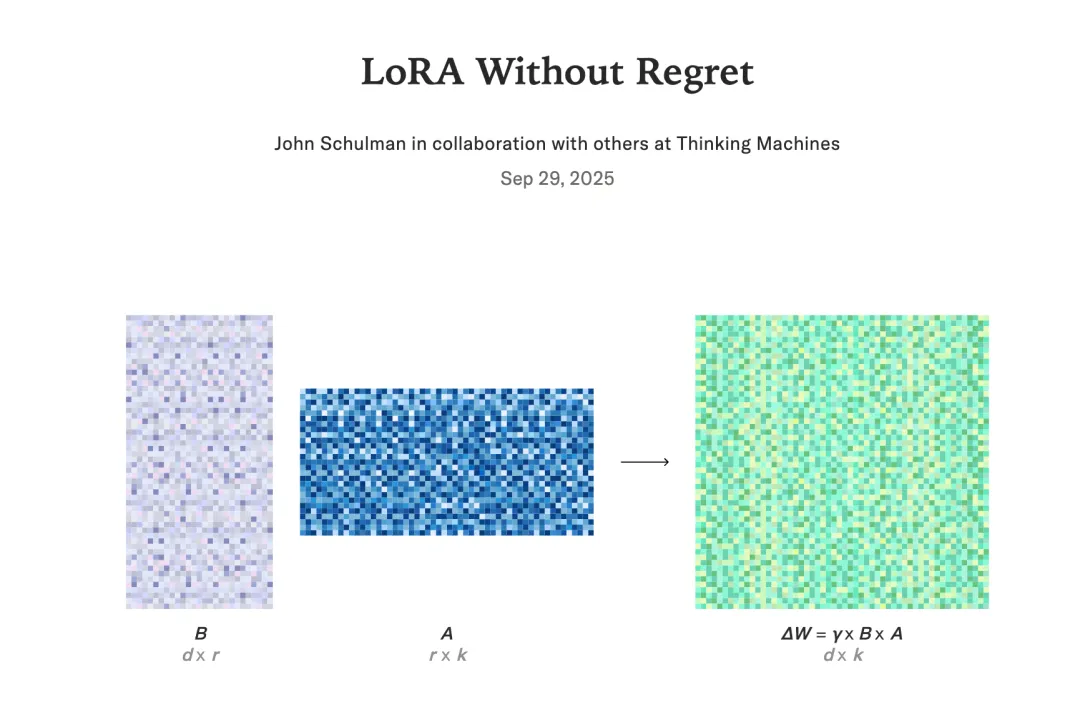
This route goes beyond the Mind Lab. TML chief scientist John Schulman, co-founder of OpenAI, co-inventor of the PPO algorithm, published LoRA without Regret in 2025, and experiments have shown that LoRA is perfectly consistent with full-quantity mitigation in most post-training scenarios.
The industry is also voting for real gold and silver. Last week, Fireworks AI completed a $1.5 billion D round, valued at $17.5 billion, that could accommodate hundreds of LoRAs; Together AI completed a $800 million C round, which has set LoRA as the default mitigation method.
Silicon Valley costs $2 billion to build the base, and it costs a tenth to stand on the shoulders of giants.There's a very interesting contrast here.
Mind Lab and TML follow the same technological path, but the underlying strategy is the opposite.
TML chose itself from a zero-trigger base for various reasons. Inkling's 975B parameter, 45 trillion tokens, but Murati himself admits publicly: "This is not the strongest model at the moment".
Reviews show that Inkling is significantly weaker than Chinese open-source models such as GLM, Kimi and others. From zero to base, they consume significant amounts of energy and computing power.
Mind Lab is the other way around.It doesn't stand on its own, standing directly on the shoulders of China's open-source model ecosystem.
Kimi K2 verified the trillionth parameter LoRA RL, V1-Preview based on GLM-5.1, the official version of Venti using GLM-5.2, and upgraded with Qwen-3.7 tonne per base.
China's open-source model has been rolled up to a global level near SOTA. Take these close to the ceiling basements and push the key capabilities to true SOTA through LoRA reinforcement learning.
You don't have to sow your own wheat to bake the best bread.
How cruel is it?
TML: US$200 billion in funding, a team of 100 people, and a gigawatts-scale computing collaboration, while Inkling's capabilities are still lagging behind GLM-5.2.
Mind Lab: More than 30 people, with less than $50 million in funding, have built a stronger model in multiple dimensions, including Chat, Agent, Coding, etc.
On the LoRAStrengthening LearningIn this regard, Mind Lab may be the world's highest-performing team.
Continuing learning: What makes models smarter?After talking about technology and contrast, we get to the core question:What is Mind Lab up to?
The answer lies in the title of an article published jointly by Richard Sutton and former AlphaGo chief investigator David Silver.Welcome to the Era of Experience。
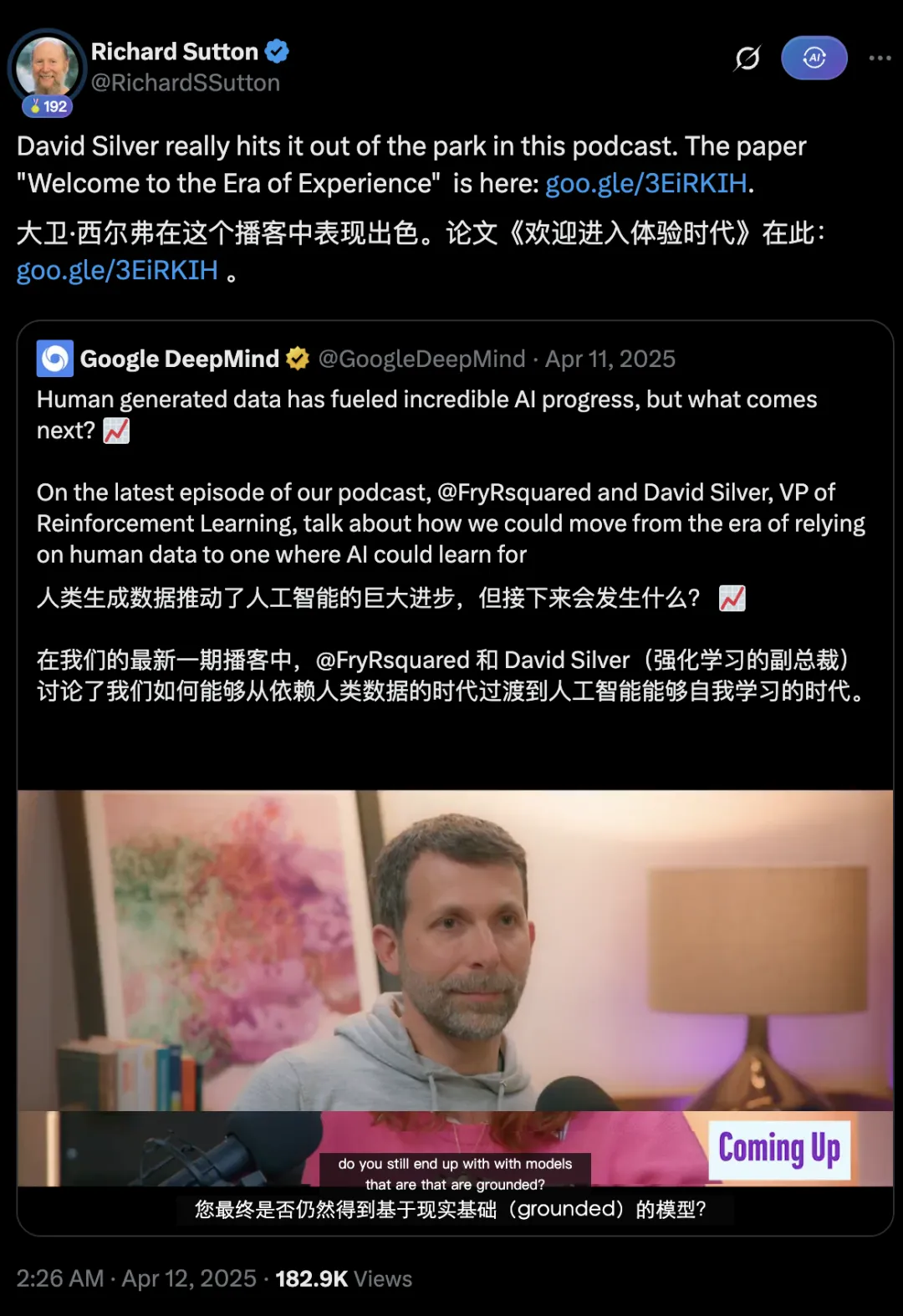
Pre-training is the "Data Age": models learn from existing human texts.
The next era will be the "age of experience": AI's ability to do so no longer comes from existing data, but from long-term actions, feedback and continuous learning by intelligent agents in real environments.
This is the fundamental contradiction of today's big model.It's over and it's over.
One user corrects the same error ten times, and the next model has to re-read the chat log. A coding agent repeatedly fails in the same code library, and failure does not turn into a new capability. The model handles bulk tasks every day, but all experience is lost.
It is just an infinitely repetitive reasoning engine, not a growing body of intelligence.
What Mind Lab has to do is break this dead cycle. Their goal is to create a "experience-intelligent machine" model that will continue to learn in the real world after leaving the lab.
Experience becomes a new skill, a new skill enables it to solve more difficult problems, and more difficult problems bring more rich experience.
It is no longer a result of training, but a process of continuous growth.
LoRA is no longer "a money-saving tool" here, it's a way to save money.It can be written, it can be rewritten, it can evolve independently.。
LoRA carries your preferences, your code style, your business logic. It is not a static patch, it is a memory that grows with interaction.
Experiments have shown that lightweight adaptive modules compressed to less than 0.5% of the base model parameters remain stable, the stronger the reliable base, and the more efficient the small-scale update.
In 2023, founder Andrew and GPT-1 author Karthik Narasimhan published the first work by FireAct to improve the ability of Agents to learn mathematics. After writing the parameters, single execution decreased from 9.0 seconds to 2.7 seconds.
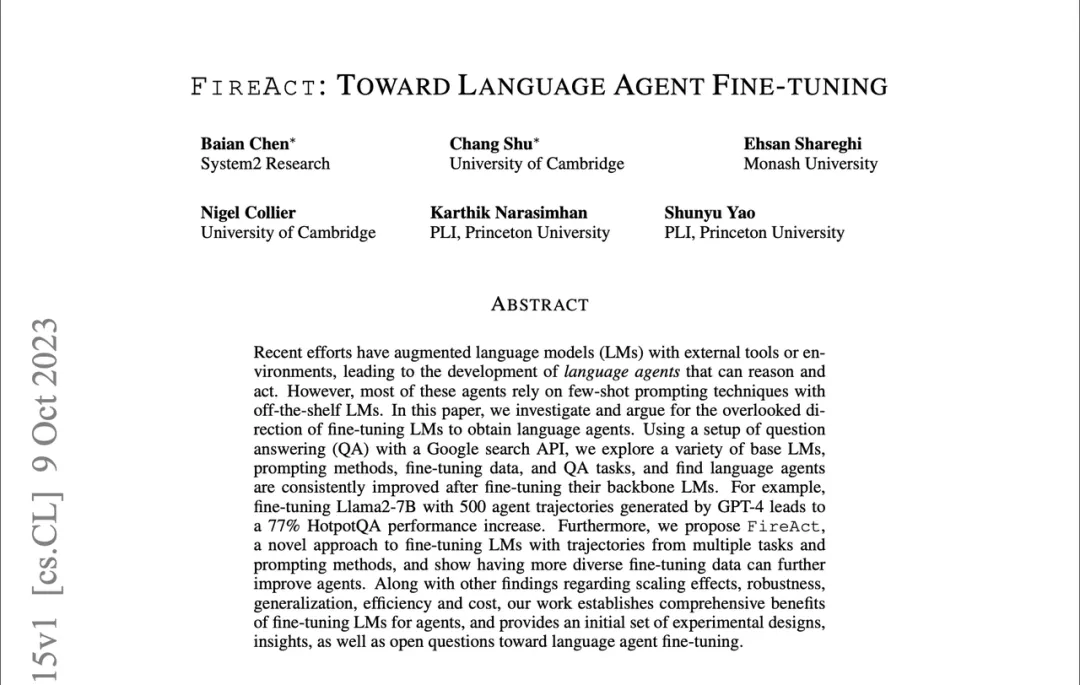
The cost of learning is paid once, and then every time you use it is paid back.From FireAct to Macaron-V1, this logic has been scaled up to trillions of parameters.
Group intelligence: the third scaling curveContinuing learning is only half of the story. The second core psychological concept embodied by the Macron-V1 could be even more disruptive.Group intelligence。
Each model continues to learn in its own way, with different instances going in different directions. Different user feedback, different tasks, different data, shaping different abilities.
This diversity, is it a bug or a feature?
Starting from the same Qwen3-30B base, training objectives and algorithms are perfectly consistent, changing only the data sequence and masking.
The accuracy of the individual adapter on AIME24:36.44%A majority of 198 different adapters voted:48.67%The same adapter is sampled 198 times, with the maximum being:43.78%。
Different "experiences" result in complementarities that cannot be given by a single model. It is not a "multi-test multiple" technique, but a real collaborative effect between different chemistry learning pathways.
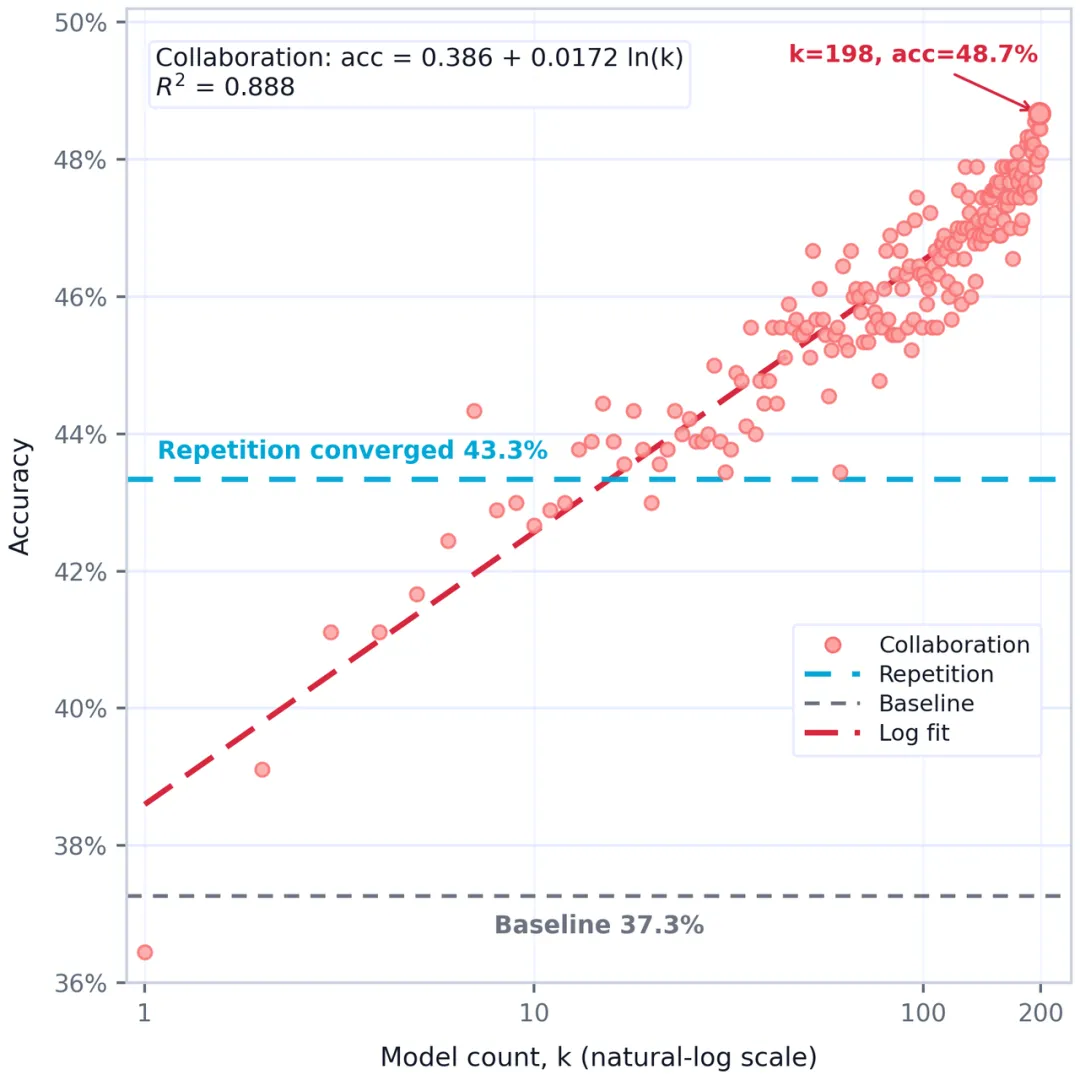
Andrew at WAIC calls thisThe third Scaling Curve。
Article 1: GPT-3 scale parameters with larger parameters lead to higher intelligence.
Article 2: DeepSeek R1 Scale Thinking Tokens, which use more logical tokens for higher intelligence.
Article three:Scale Number of Models: Collaboration between more models leads to higher levels of intelligence.
In the experiment, the number of models increased from a few to 200, improving the linearity of performance on the pair axis. If the curve is formed, the next step is to push from 200 to 20,000 to 2 million.
Mind Lab's self-developed MinT platform has created a million-level addressable LoRA directory. One million LoRAs share the same trillion-parameter base.
Note that this is not a million small models, but a million and one trillion parameters large models.
Humans share more than 99% of the human genome, but almost the same biological basis does not create the same mind. It is the diversity of intelligence and its collaboration that has led to the greatest achievements of human civilization.
US$10 million ARR for two weeks: fastest commercial verificationThe technology routes are beautiful, and the market is free to pay only for PPT.
ResultsTwo weeks, $10 millionARR。
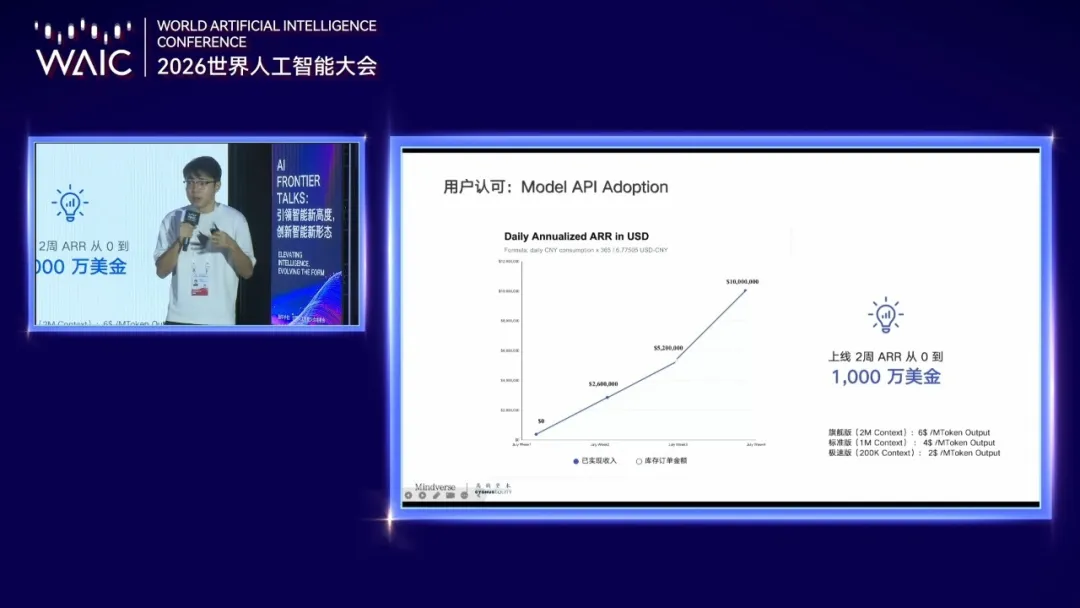
This is likely to be the fastest record of all model companies achieving a $10 million ARR since the first model was released.
Numbers are important, but more importantly, speed. A technical route that can be voted on by customers so quickly with real gold and silver, shows that it solves the real problem, the painful problem.
Mind Lab doesn't just sell Token. Its core business logic is:What customers buy is the model's ability to continually learn and evolve in its own scenarios.
Mobile phone manufacturers incorporate product knowledge into the exclusive LoRA, and headphone companies prefer to write interaction data into the model state, so the core data does not have to be retrained by the base model company.
A leading mobile phone manufacturer, Odysseus, is already on the collaborative list.
The API call structure also illustrates the problem: 20% chat, 30% Agent workflow, 30% code generation, and the remainder of the distribution from GenUI scenarios are balanced, rather than the fake boom from a single outbreak.
The flagship version is $6/million tokens, the standard version is $4 and the ultrafast version is $2.
Mind Lab's vision is one word:I'm going to use Token and I'm going to train Token.
In the end, it's as simple as calling a model. It doesn't require a lot of sales, it doesn't require customization. Continuous learning itself is the ability to scale a model.
The door is open.Richard Sutton has called the "age of experience" in Toronto. Liang believes that continuous learning is necessary to call the next generation a model. Mira Murati built a trillion-dollar parameter LoRA reinforcement learning infrastructure in San Francisco. Fireworks AI is valued at $17.5 billion.
All of them were pushing in the same direction:The model should continue to learn after deployment. LoRA is the key technology to make this possible on a trillion-parameter scale.
Mind Lab is the youngest athlete on the track. But the start-up posture may not be the most efficient, standing on China's open-source ecosystem, with more than 30 people and less than $50 million in funding, with the same technical capabilities as the Silicon Valley 10 billion team.
There is a simple but profound judgment behind this:
The ultimate goal of the big model competition is not "who's training the biggest bottom", but "who's keeping the model smarter".
Pre-training is a once-in-a-lifetime foundation building. Continuous learning is the real guardian river.
The idea behind Mind Lab was to create an experimental machine learning model that would continue to learn in the real world after leaving the lab, the smarter it would be. When enough of this kind of intelligence begins to collaborate, a new pathway to higher intelligence will open up.
Murati pushed this door in San Francisco with $2 billion and a team of 100 people.
The first thing to do is open the door to the Pacific, a young laboratory on China's open-source ecological shoulder.