Most robotic simulators have a clear reference frame.
Learning a snake makes the body a growth rod; learning a dog to put on four legs; learning a caterpillar to make the body move one step at a time. This makes sense, and is very much like the industrial logic we are familiar with: first define the task, then redesign the shape, and finally make the product.
But what if the same robot drilled a narrow hole like a snake today, grows up with its legs crawling across the ground tomorrow, and finally reaches out and grabs something back?
The answer given by the Georgia Institute of Technology team is not to replace robots, but to replace bodies.
Recently, the team published a modular self-reconstructed robot study in SiliconScience Advances, proposing a modular self-reconstructed continuum robot chip called MSRCR.

It has no fixed shape. One module can roll; two modules can spin; three to five modules can reconnect, and crawle and roll, forming a movement similar to that of a limb.
More importantly, these modules are able to release each other, bend their bodies, and then re-capture them from a new perspective, actively changing their shape.
The team even drew for it an evolutionary diversity of shrubs, from soft-deformed worms, snakes, animals with limbs, and movement strategies for different organisms, reorganized into the same robotic platform.
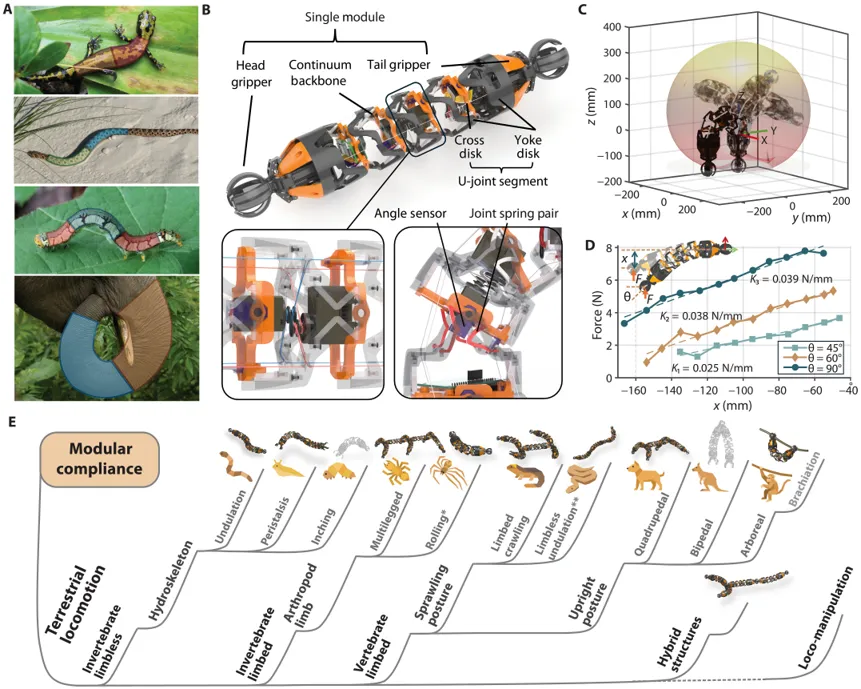
Of course, it's not really evolving. More accurately, what the researchers want to do is to make a robot with multiple bodies.
01.
Let's make the robot's blocks soft.
Modular robots are not a new concept. Its logic is very similar to Lego, which is to dismantle robots into standard modules and reassemble them according to tasks.
However, traditional modules have a natural limit to the amount of sodium tetrahydrate.
The rigidity of the modules is usually limited to a few fixed joints, and the location and direction of the connector is well-defined in advance. To make the robot more agile, it can only continue to add modules, ultimately increasing the complexity of the modules, motors, interfaces and controls.
The MSRCR was first modified in the lower part of the block.
Each module, in the middle, is a flexible continuum skeleton driven by a spinal cord, with a total bending range of about 180°. In other words, a module itself is like a small spine that actively bends.
Both ends are fitted with a special clavicle. This clavicle can both grab something and grab the clavicle of the other module.
One clavicle closes to form a nearly spherical connecting surface, while the other clavicle can hold it from a continuous changing angle. There can be up to four clavicles connected to the same node.
In the past, the module interface was more like a plunger plug into a plunger. Here it's more like two hands clutching each other. The body is no longer clutching up, but clutching out.

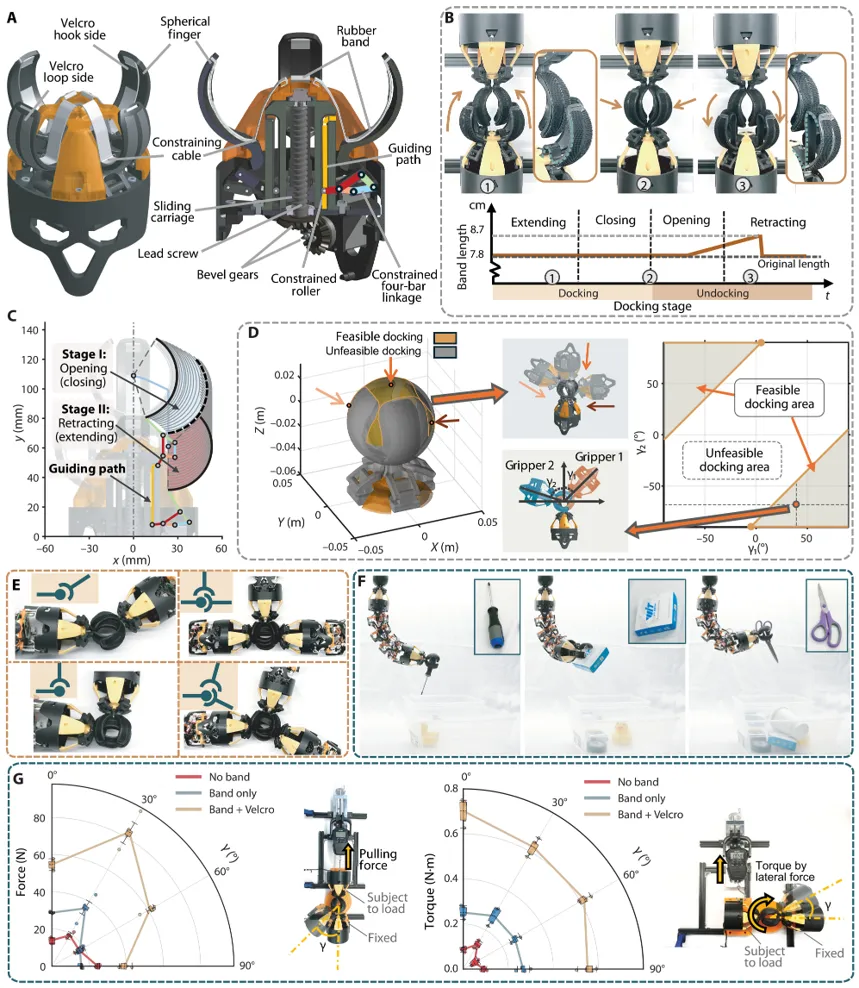
Design and characteristics of all-wheel-drive claw
02.
From rolling to snake walking, a set of body lengths reveals many steps.
After the hardware was set up, the really fun part came.
Instead of giving the robot a standard shape, the researchers studied: What movements will emerge as the body becomes more complex?
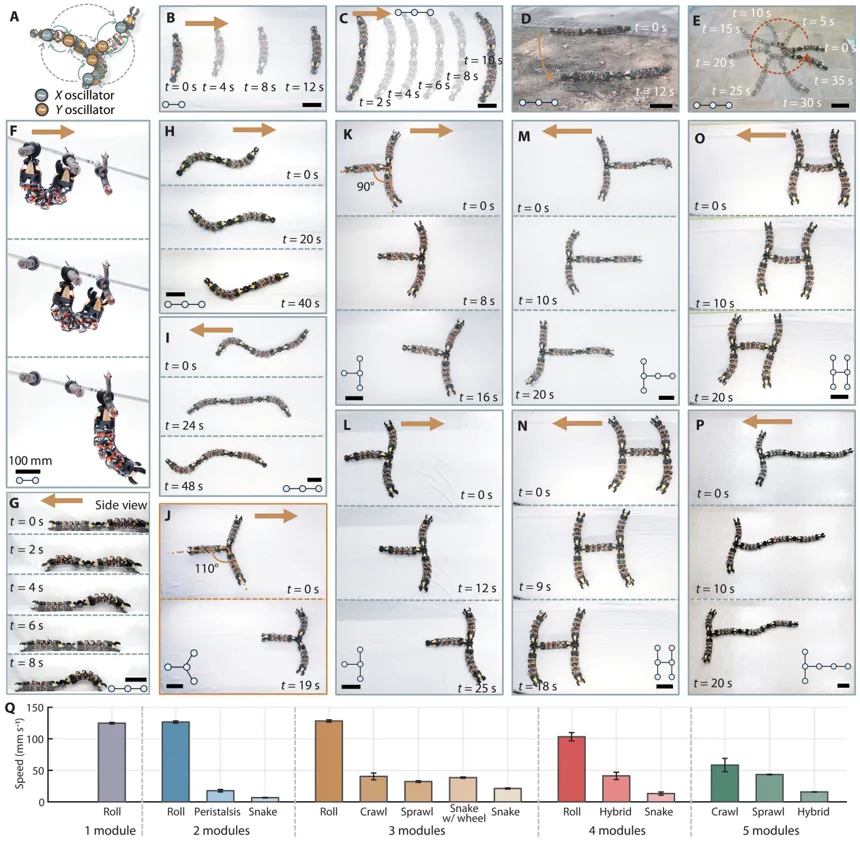
With only one module, the robot can roll at a speed of about 125 mm/s. It can also perform swinging movements similar to that of a crankcase.
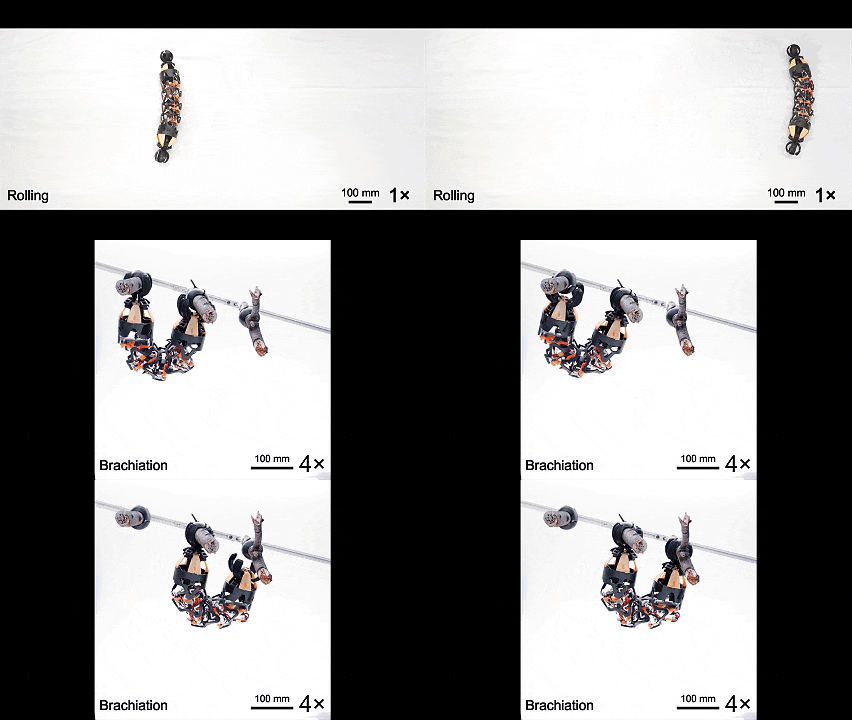
Added to two modules, there can be vibrations and snake-shaped fluctuations.
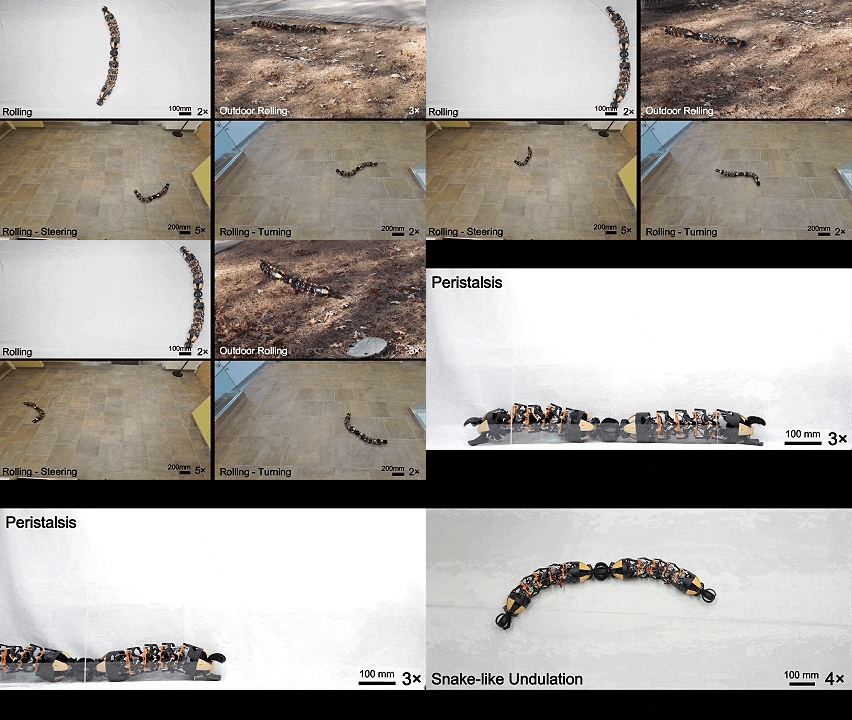
At three modules, the body begins to have a branching structure that can complete crawling, crawling and snake walking. Three of the modules crawled to 40.4 mm/s, crawling to 32.2 mm/s, and snake-shaped movement to 21.26 mm/s.

The four modules can combine crawling arms and tail movements.
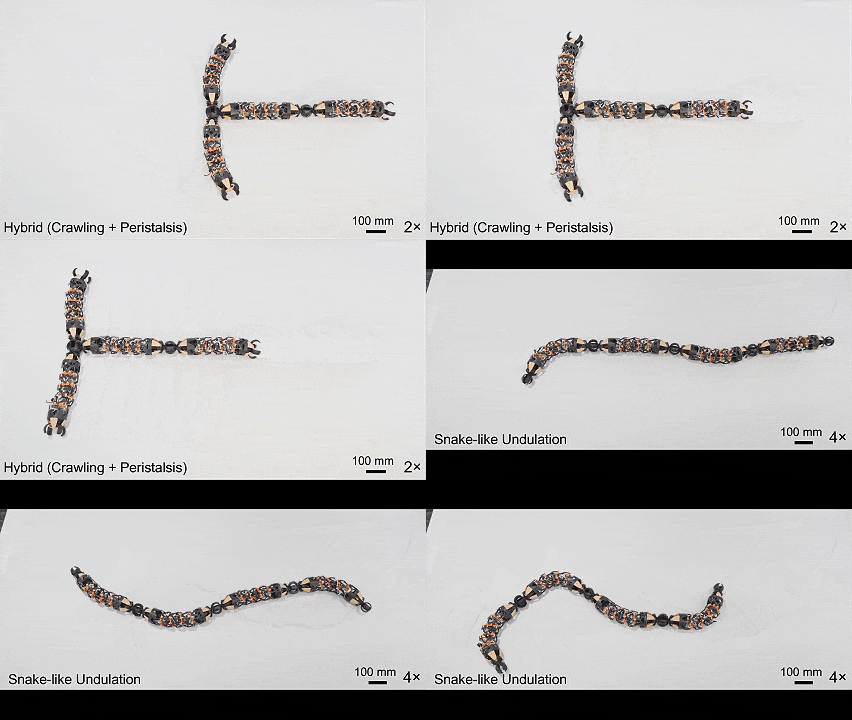
The five modules also feature a mixture of four-legged crawling, crawling and tail-swinging movements.
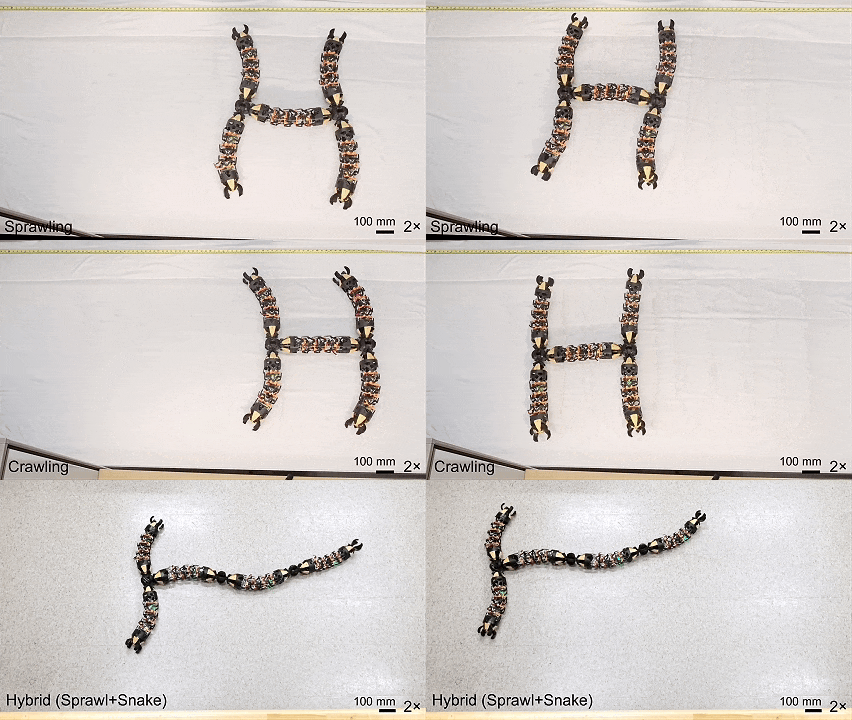
Interestingly, the researchers did not rewrite a control system for each body. They used a unified control framework inspired by the CPG.
Simply put, just adjusting the phase relationships and connectivity between different modules allows the same set of control logics to drive different bodies and generate different steps.
So what this study really wants to build is not how many movements a robot can make, but what kind of body, what kind of movement is appropriate.
03.
I've finally got an algorithm for this.
It's just the first step.
Suppose a three-module crawling robot walks in front of a narrow crevice. It knows that a snake-shaped body is more suitable to pass through. But the question arises: how did this body become a snake?
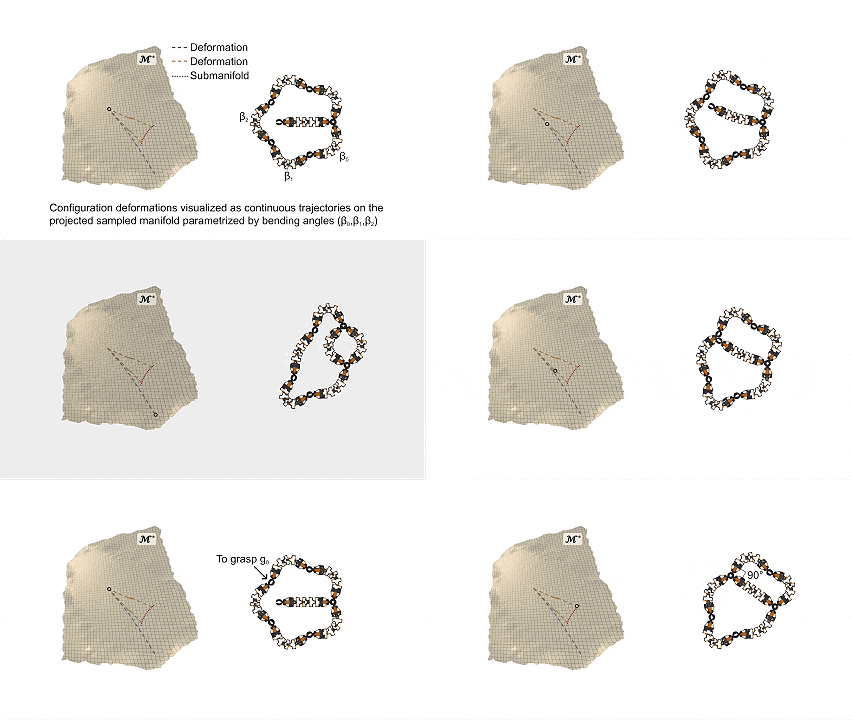
This is much more troublesome than a regular module robot. Because the body curve of the MSRCR is continuous and the angle of coupling is continuous; at the same time, the clutch grabbing the clutch and the clutch loosening the clutch module are also discrete movements.
In a reconstruction, there is simultaneous bending, grabbing, and releasing. Traditionally, it is not enough to record only which module is connected to which module.
The team therefore created a unified set of geometrical topologies that encoded the modules to connect, grasp order, grasp angles and body curvature, and then proposed a HEART-MCTS planner to search for paths from one body to another.
The effect is obvious.
Compared to the IAB-BFS baseline used in the paper, the average planning time of HEART-MCTS was shortened by 59.5%, 82.0% and 94.9%, respectively, in the 3-, 4- and 5-module tasks, and demonstrated planning capabilities for up to 7 modular systems.
The more modules there are, the more difficult the problem is.
Because robots don't just answer questions about who's who, but they also calculate: from what angle? Where's the body going? Will it hit itself? Will it be able to continue moving after it's done?
The real difficulty of deformation is never just to transform your body, but to know how to change it. Here, changing your body is not a word, it is a computational problem in itself.
04.
From being physically changed to being physically active, softness is becoming a skill.
The paper ended up with a very complete set of physical presentations.
Initially, the robot was made up of three modules, shaped like a sphere, that could move forward, backward, turn around, and stretch out tail modules to grab objects and put them in higher containers.
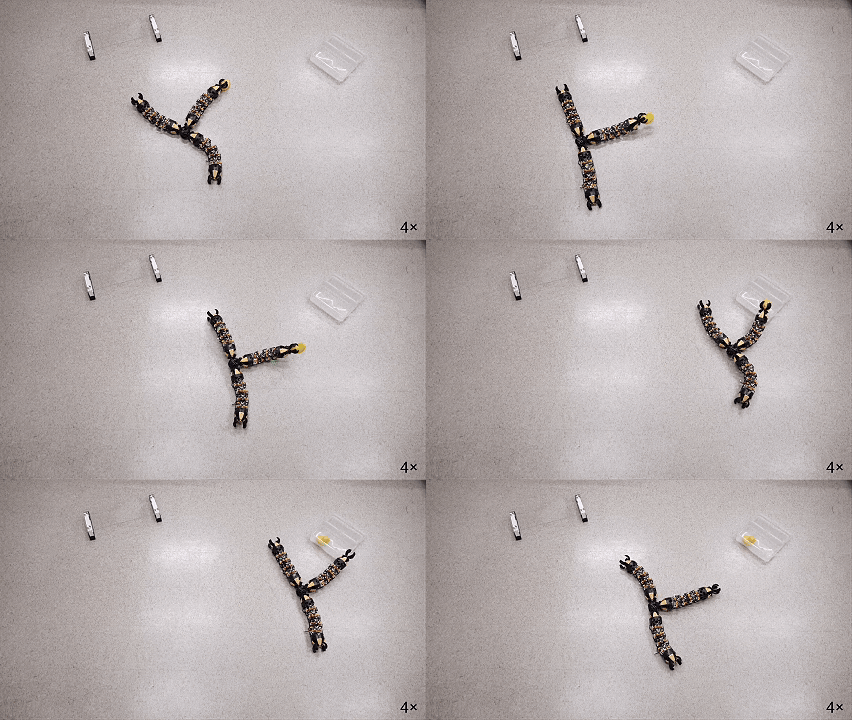
Subsequently, a narrow passage appears in the front, and the original body does not fit. The robot, according to a planned rebuilding sequence, loosens parts of the claws, bends the body, and then grabs its modules again, eventually turning into a snake.
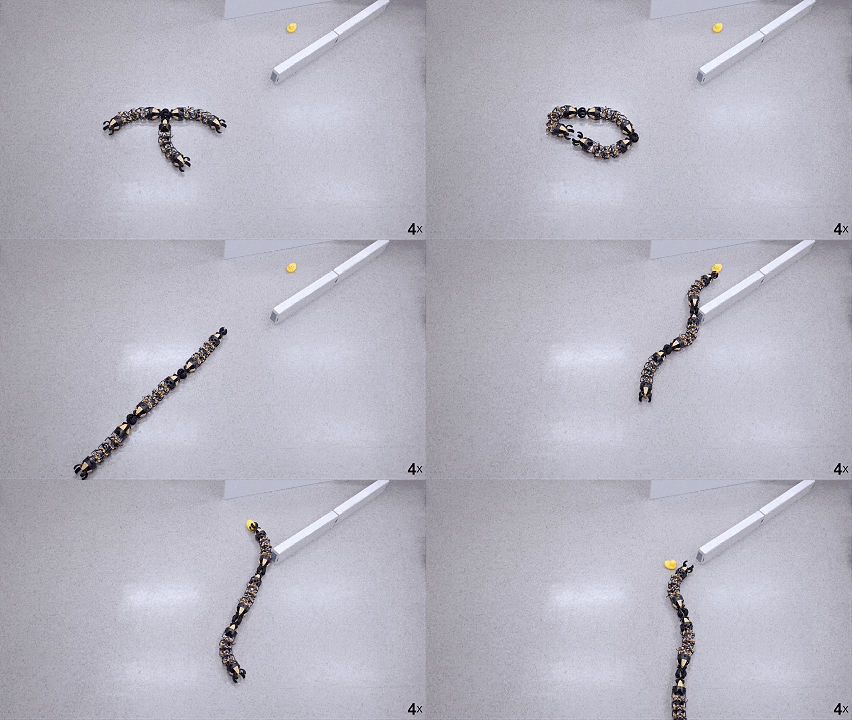
Then it began to fluctuate in the shape of a snake, drilled into the passage, grabbed the target, and then dropped the thing back.
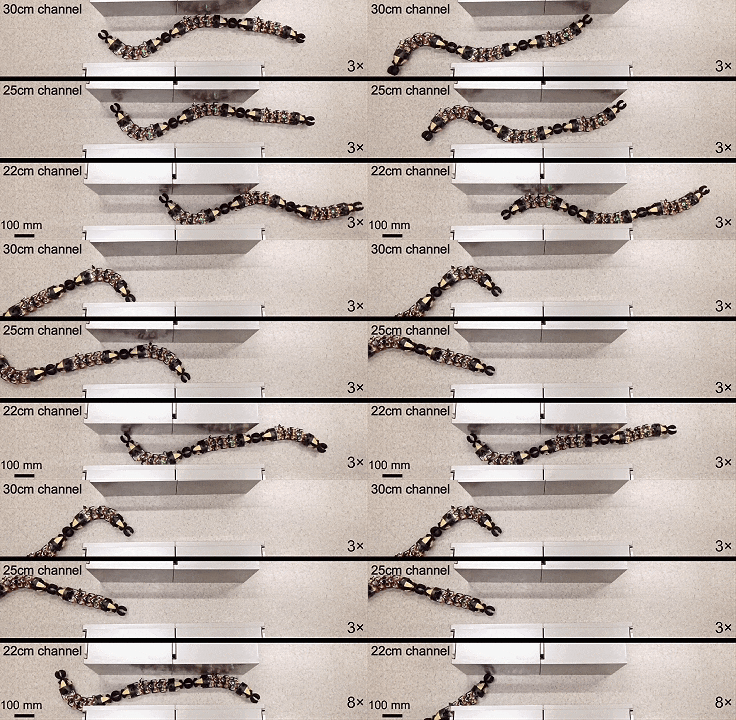
There's a boundary here that has to make it clear that the rebuilding path is not calculated in real-time by the robot, but executed on the hardware after pre-planning.
But it's already completed a very complete link to the motion of the sphincter, the body, the sphincter, the sphincter, and the sphincter.
When the snake-shaped robot faces a path that shrinks from 30 cm to 22 cm, the flexible body can passively compress, change the width of the movement, and continue to pass.
The other group of experiments were more intuitive.
As a result, the flexible drying helps the limbs to coordinate forces, reaching a speed of 43.36 mm/s; rigidity control is only 15.8 mm/s.
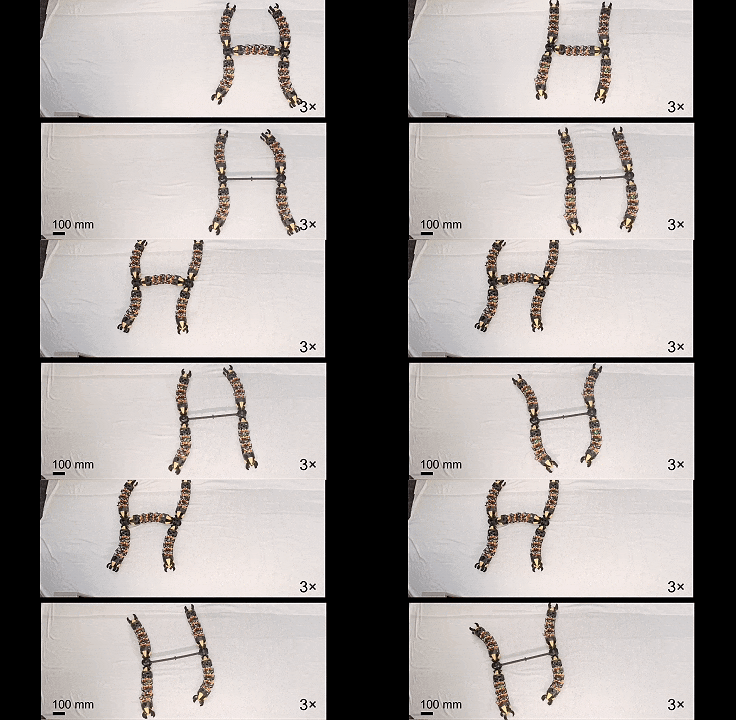
In this way, softness is not only able to change; it is beginning to become a part of the body's ability.
05.
How robots grow up is probably no longer a factory decision
Of course, this is far from the real-world version of the Deformed Diamond.
At present, self-reconstruction planning is mainly confined to the flat environment. After really entering the 3D, the difficulty will increase significantly if gravity, support, collision and connectivity stability are taken into account at the same time.
Flexibleness comes at a cost.
It sacrifices some of its rigidity and carrying capacity, so it is more suitable at this stage for closed-space inspection and narrow-circuit exploration tasks that require shape-adaptation, rather than carrying heavy loads.
But what's really worth noting about this paper is that it might not have been as fast as it is today.
In the past, we used to decide what a robot would look like and then let it learn how to complete a task. MSRCR tried to reverse this order and give the robot a set of bodies that could be reorganized, and then decide what it would look like based on the task.
Opening the ground, it can roll. Encountering a narrow sphere, it becomes a snake. It needs support to reorganize the spherical limbs. It needs operation, and a part of the body can grab something directly.
It's a long way from a true autonomous transformation. But at least, what the robot's body is doing is moving from a factory parameter to a capacity that can be calculated and reorganized.
Open source code:https://zenodo.org/records/20215519
GitHub: