The big language model, it's really getting better now.
On Thursday, Anthropic announced the launch of hardware using the MCP:Model Hardware Standard (MHS), a new standard to help all large model-driven AI (AI) agents safely and quickly manipulate physical devices.
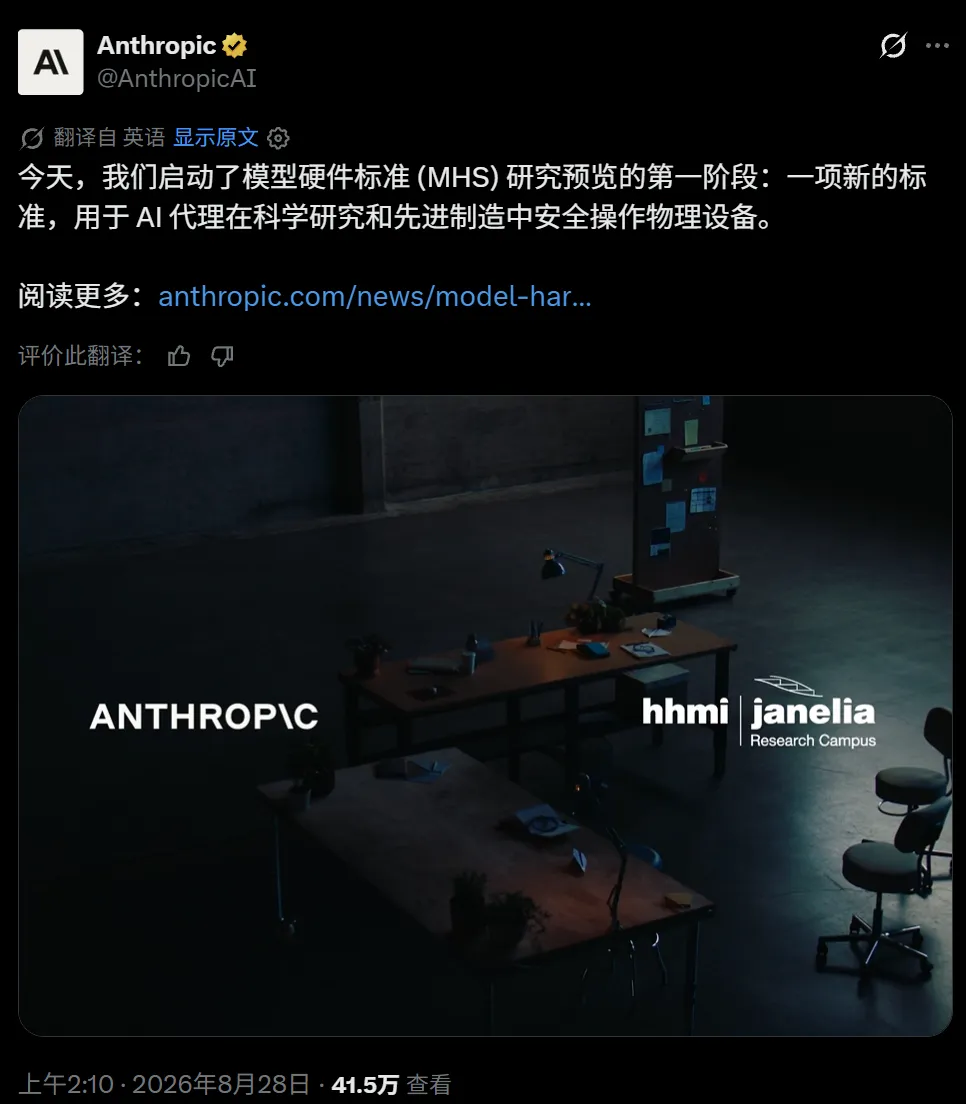
Now, a large model like Claude can operate microscopes, mechanical arms, liquid processors, lasers, and other hardware in the physical world, just like the MCP protocol. This progress is seen as a key step from the digital world to the physical world.
How many people have heard of MCP, an open standard protocol launched by Anthropic in November 2024 that aims to provide a standardized, secure two-way communication interface between large language models (LLM) and external data sources, local files, development tools, and various application services.
The core positioning of MCP is the "USB-C interface in the AI field", which opens up large-scale models with software environments such as GitHub, Slack, local file systems, and databases. With the development of AI technology in recent years, MCP has evolved into an essential reality standard for the entire intelligent ecosystem.
Now Anthropic is also hoping to use MCP through hardware to upgrade this set of standard communications standards to physical hardware, sensors, embedded systems, and test equipment.
The development of MHS began with the collaboration between Anthropic and the Janelia Research Park at Howard Hughes Medical Institute (HHMI) and is now open for research previews by the first scientific research laboratories and advanced manufacturers.
Typically, it takes weeks or even months for a laboratory or manufacturing plant to build and integrate hardware. Most devices cannot communicate directly with each other, requiring experts to build customized integration programs. MHS can shorten this integration to hours or even minutes. In addition, by incorporating AI into these tools, MHS also helps researchers and engineers to more easily coordinate independent, all-weather experiments and workflows. Smart bodies can reason on every step of the experiment, update parameters in real time, and in some cases recover from hardware failures without human intervention.
MHS can be used in conjunction with any device with a programmable interface, it is not related to the type of base model, and any smart body framework can access it using standard protocols, such as MCP.
It is not easy to integrate AI into a system without considering the added difficulty of allowing multiple devices in a lab or factory workshop to communicate with each other. Each device usually has its own programming interface, and there is no standardized method of integration at present.
Now, MHS addresses these challenges by introducing standardized drivers: a software that converts between computer operating systems and hardware devices. MHS drivers use a set of simple basic commands, such as reading (such as obtaining temperature) and writing (such as setting temperature), which can be understood and executed by any hardware device. It allows each device to be detected in a standard format, allowing devices and smart entities to find each other and communicate across networks without using customized "translation programs" between the two.
MHS drives can also help a smartphone understand, use devices that have never been seen before, and provide it with information about machine characteristics that may not be accessed with code alone (such as the weight of a mechanical arm, which is essential for safe operation). Until now, most of this information has been stored in paper manuals, user computers, or as hidden knowledge. However, MHS drives contain labels that allow users to enter this information directly in natural language.
Using the information contained in these labels, the MHS driver automatically generates a reference file containing general characteristics of the device, such as what it can measure, what it can adjust, and what security restrictions will be enforced. The file provides the intelligent body with all the information it needs to operate the device.
Once the devices are connected and the intelligent program understands how to use each device, a method is needed to control the hardware. For MHS, there are three mechanisms: MCP, command line interfaces, and code files (API). They work together, allowing users to coordinate multiple devices through a single line of code.
Once it is able to control the device, it receives the operating data from each device and supervises and directs the work at a high level. The device can sort, monitor results and adjust parameters based on real-time changes in the operating steps of different devices. When the device is required to perform long-running tasks or to operate at speeds beyond its online reasoning capabilities, it can be derived from the driver commands of one or more devices that are linked to a code file. Thus, the device can execute the operation automatically without the intelligent body logging on to each step.
In the process of testing MHS, Anthropic discovered that Claude's interactions with experiments and hardware were as exploratory as scientists in general.
Anthropic observes Claude adjusting the laser and evaluates how the laser beam moves through camera observations, then repeats the process to try to understand the sequence of events. After that, Claude packs the information he learns into a code file and writes a determination script so that the laser can be calibrated without every step of reasoning, so that the entire process can run as a separate command.
In the process of developing the MHS, Anthropic shared this technology with several laboratories and hardware manufacturers in the fields of biotechnology, robotics, quantum computing, and more. In these early projects, we can see that the MHS shortened the time of device integration, improved the rate of iteration in various experimental environments, and facilitated real-time machine operation and failure detection.
Hardware providers and their supporting software companies also have built-in MHS support in their devices so that smart entities can detect and operate devices.
Amazon Cloud Technologies (AWS) provides support for MHS through Strands Robots. It is a library for connecting AI smart bodies to physical devices. During the MHS research preview, AWS will provide participants with a private pre-release version of the Strands Robots software package.
Automata is adding MHS support to its laboratory automation platform, LINQ, for intelligent error handling of instruments in autonomous labs.
Danaher is actively exploring how the functionality supported by MHS enables its smart instruments and autonomous laboratories to scale up biomedical research and development.
Doosan Robotics is using its mechanical arm test MHS to perform automated quality assurance and coordination tasks between multiple robots.
MBF Bioscience is developing an MHS driver for ScanImage, a software program that runs laser scanning microscopes in hundreds of neuroscience labs around the world to integrate AI intelligence into real-time data analysis and experimentation.
QIAGEN is testing the MHS concept through its nucleic acid purification platform, QIAsymphony Connect, to demonstrate how AI-enabled devices can help laboratories eliminate instrument malfunctions faster, guide operators to recovery, improve instrument uptime while reducing the risk of biological samples.
Tecan is adding MHS support to its Fluent Liquid Processing platform so that the AI can directly detect and operate these platforms.
Universal Robots has acquired the rights to use MHS in advance and plans to add support for MHS to its robot platform.
Prior to open source, Anthropic also hopes to further improve the standard.
As a large language model, Claude learns the physical world through text and images, which means that its spatial and physical reasoning capabilities are limited and still require expert supervision. For example, when dealing with a protein sample, researchers at Genetics must guide Claude to identify that the error caused by the sample bubble is a physical failure, not a software error, which can only be mitigated by appropriate physical corrections.
MHS is not currently compatible with hardware that lacks programming interfaces, so Anthropic is working with manufacturers of such devices to integrate MHS drivers into the hardware. Many developers are already using Claude Code to operate individual physical devices. In the next phase of MHS, Anthropic hopes to expand the standard to cover more devices used by developers.
Early adopters included Hugging Face (who are adding MHS support to their LeRobot database) and Raspberry Pi (who are enabling MHS integration in several other products after successful testing with their Camera MHS drivers).
References are given below: