No mapping, no memory, zero training: coding-agents are thrown directly into the house, navigating super-industrial specialized models.
Give it a single-lens camera, four buttons, and nothing else.
A new study by Qi Wu's team from the University of Adelaide has done a somewhat daring thing: using a coding agent -- the Claude Code, the AI tool used to write code these days -- to connect a robot to a stationary location, allowing it to navigate language instructions in an unfamiliar house.
No maps, no memory modules, no pathpoint predictors, no navigation training, not even a line of field code written.
Results: On the most classic R2R-CE benchmark of visual language navigation (VLN), this "naked-run" general agent has a 78% success rate, matching even better than the latest industrial-grade navigation models specially trained with large-scale data.
As a reference: Humans score 94% on this benchmark.
Embodied Agents Take Control: Minimal-Interface Zero-Shot Agents Rival Industrial-Scale Policies in Vision and Language Navigation
arXiv:
The main project page is:jianzhou0420.github.io/mip
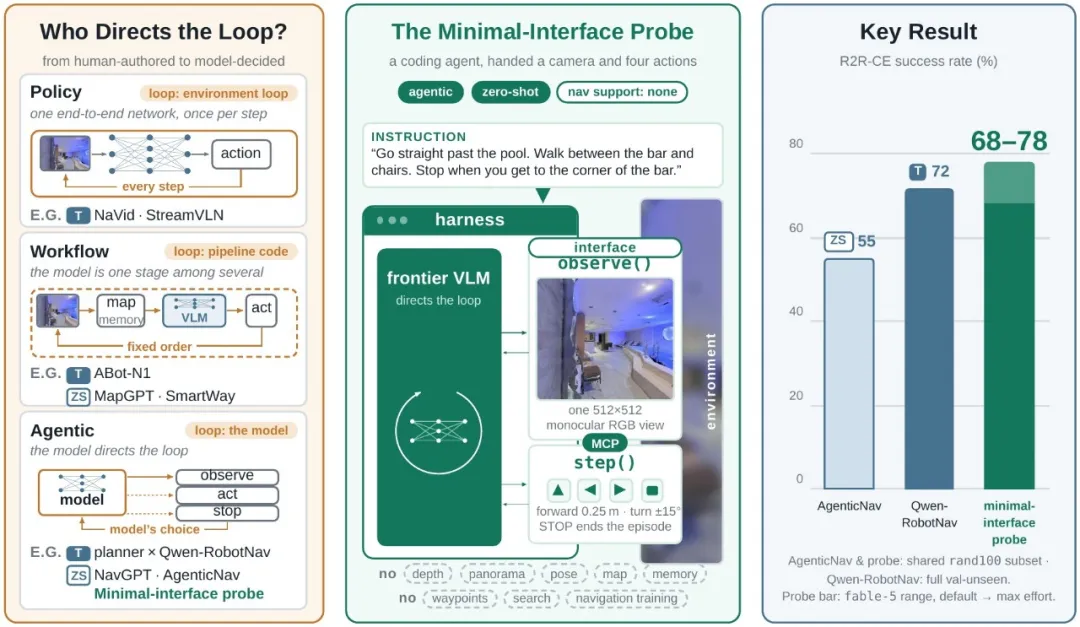
The three routes differ in "who dominates the decision-making cycle": the policy is a network with every step, the workflow is a fixed flow line, and the agentic is the control of the model itself.
Why is this unconscionable?
Visual language navigation is a classic problem with physical intelligence: give a robot a phrase, such as "get out of the bedroom, walk down the hallway, turn right on the pot and stop by the couch", and it must go to a designated location in a house that it has not seen.
In the past, there have been two orthodox routes in this area.
One is to train a dedicated strategy model: NaVid, StreamVLN, NavFoM, which uses mass navigation data to train "what you see is what you get" directly into the model.
The other is engineered zero-sample processes: pioneer NavGPT, and later MapGPT, SmartWay, are not trained, but provide a full set of scales for large models: build maps, store memories, pathpoint predictors, tree searches, step-by-step with fixed processes.
In the middle is a big factory-loving "fast-slow-double system", which trains a slow brain to plan and move quickly. The direction itself is promising, but the current realization is essentially a fixed flow line.
The common premise of these routes is that the GM model itself can't either practice it or build it.
In this paper, the author of the method of detection called MIP, Minimal-Interface Probe, Minimal Interface Probe, is the opposite: removing all the scraps, leaving only two functions:
Observe: Returns a single RGB photo
Step: Take a small step forward / Turn left / Turn right / Stop
Then let the reasoning model decide for itself every step: it looks at the graph, it thinks, it walks, it goes wrong, it discovers, it goes back and back. The paper calls this way of organizing agents embodied control: reasoning models directly control every move, reasoning and control are always aligned.
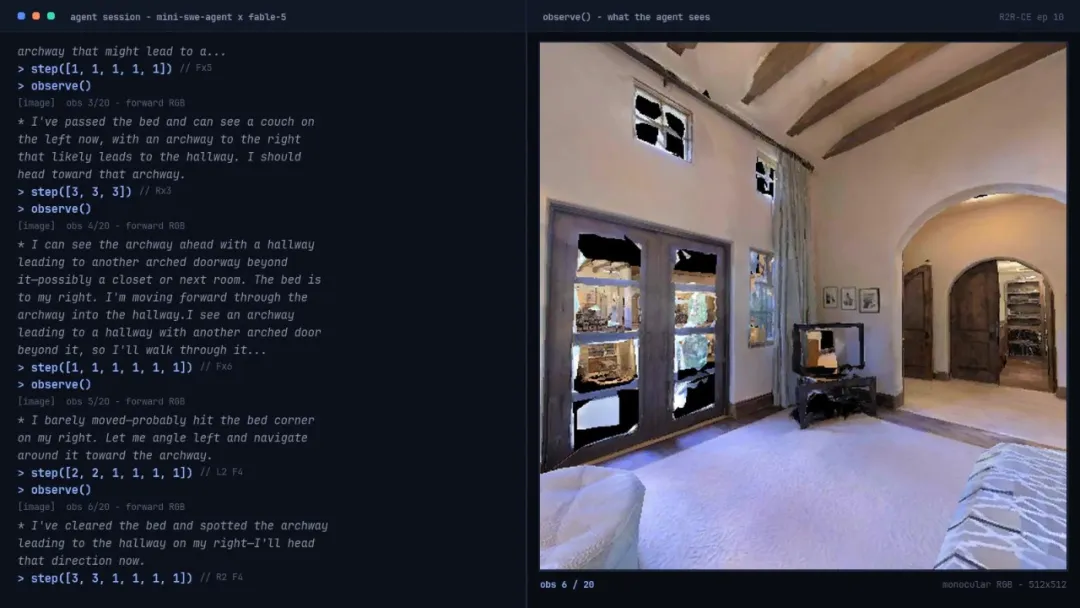
It really does work like this. R2R-CE 10th episode mini-swe-agent × fable-5): on the left is the agent's gradual thinking and step (/observe) calling, on the right is the 512×512 single image it's seeing right now. In the middle is a detail: after hitting the corner of the bed, it finds itself "almost motionless", and then actively turns the angle around.
Scorecard
In R2R-CE val-unseen randomly drawn 100 paths (all zero samples, without any training):
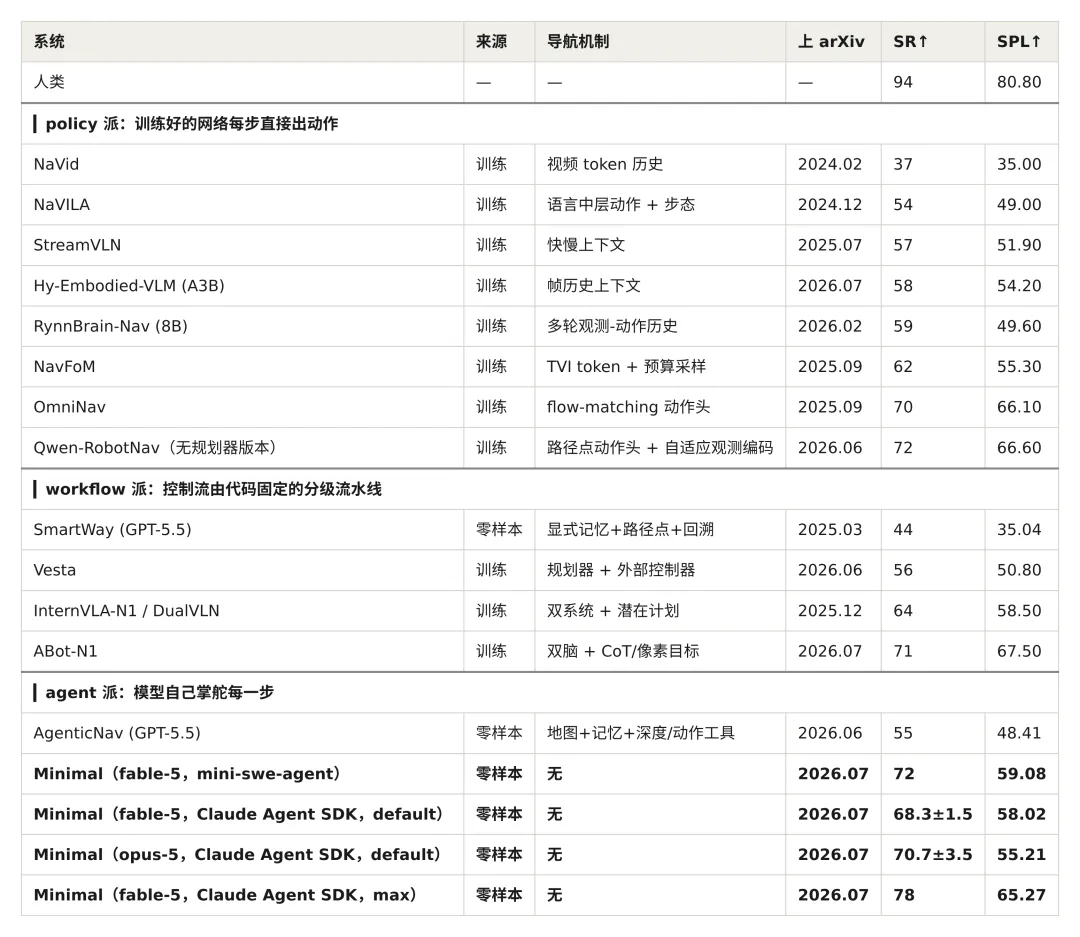
SR = success rate; SPL = success rate weighted by path efficiency, the higher the less routing; "up arXiv" for the first year of arXiv for each system. Routing according to "who controls the decision-making cycle": policy = a trained network that moves directly at each step; workflow = control flow by a code-determined classified flow waterline ((whether end-to-end training is irrelevant); agent = the model itself controls each step.
Notice the list of "navigation mechanisms": other people's houses are filled with various modules, and it's not here.
Three interesting findings
The team ran the entire melting matrix on three mini-swe-agent frameworks (Claude Agent SDK, Codex CLI) x multiple front-end models, concluding very simply:
One, it's the model that determines the outcome, not the framework. Changing the model can pull out more than 20 points, changing the harness with only a few points of difference.
Second, "help" may be helpful. The team tried to force Agent to attach a well-trained pathpoint predictor, and the result was that the weak model did score, and the strong model might fall on tasks that were originally higher than SR. The value of the writing rack decreased as the model's capabilities increased.
When the path point predictor is provided as an optional tool, and the agent decides not to use it, the fable-5 hybrid runs from 68.3 ± 1.5% to 76.7 ± 0.6% in the default thinking file, and the environmental step count is halved to only a quarter of the total running time.
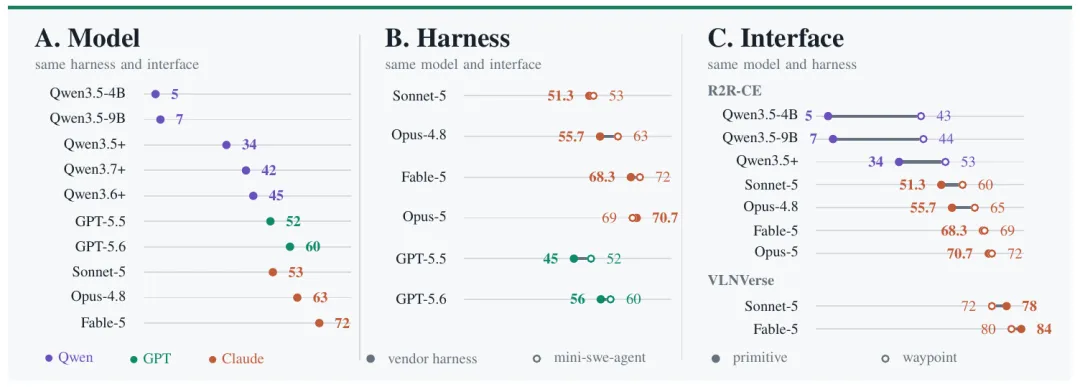
Three melting shafts, one diagram. A: The interface and harness are all motionless, only changing the model, resulting in a 5 point spread to 72 points; B: the same model changes the harness, the gap is only a few points; C: the interface is plugged into the waypoint tool, the weak model canopy, the strong model does not necessarily benefit.
One line, one mission, one run.
What's even more interesting is the universality test: the same set of cycles, the same agent, without any targeted development, directly changing the benchmark:
VLNVerse Finite Particle Navigation: 84% vs. specialized model Qwen-RobotNav 64%
HM-EQA has a self-sustaining questionnaire: 500 questions; self-exploring questionnaire tasks, terminating actions in exchange for answers; prompt is converted to a questionnaire version accordingly: 76.2% vs Qwen-RobotNav with complete planner deployment mode 76.7%
I've been through missions, I've been through simulators, and I'm not broken.
Long-distance navigation or blind spots
The team specifically switched to the longer route, the steeper RxR-CE to run again (the same model, the same framework), the success rate dropped directly to 26%; even if the path point predictor handed it, it climbed only to 39%, 30 points lower than its own score on R2R-CE.
At the same time, the bills are rising: the average time of each episode has increased from 187 seconds to 527 seconds, more than doubling the context. The longer the journey, the thicker the historical observations, one possible reason is that the clues that are really useful have been diluted.
There's also a real plane, and there's also a ride-along.
The team also deployed the same Agent to the U2 Go2 machine dog, running 31 diagnostic missions in two real-life indoor scenarios. These missions were manually designed and generally more rigorous than standard VLN/EQA benchmarks: some instructions were buried with conditional branches to observe the world before judging: "If only one trash can stop past the door and go to the left, it's more than one to go to the elevator at the same time".
It was very profitable: Conditional judgement class "If the door is open"...) 4/4 complete, reporting class 4/4 complete.
The overturning of the car was also honest: the number class 0/2 is fully suspended, the multi-stage task is only halfway through, the camera passes the door without passing it.
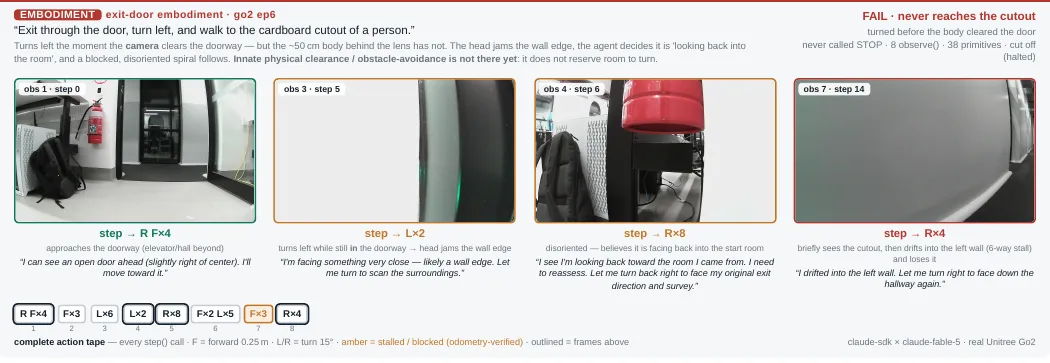
Go2 ep6, "Exit" mission. The camera just searched for the door frame, half a meter long body was not traced: the head card is along the wall, but the agent judges himself "looking back into the room" according to the image, and then completely lost direction.
In 30 cases of failure, 23 agents claimed to have succeeded when they stopped. The error itself was not fatal, and the fatal one was the lack of awareness of the error.
Focusing
General reasoning model + minimal interface, zero-sample navigation has been able to cope with industry-class training strategies
The benefits of maps, memories, searches for these classic writing shelves are being internalized into the model, and forced hanging may even be counterproductive.
The tool should be "selectively delivered to" the agent rather than "fixed".
Long-term, delayed, and context-based growth are still three ways to drive a truly autonomous body: AutoEA, Autonomous Embodied Agent.
The paper was co-authored by Jiang Zhou*, Xunyi Zhao*, Gengze Zhou, Zerui Li, Sihao Lin, Jiajun Liu, Qi Wu*.