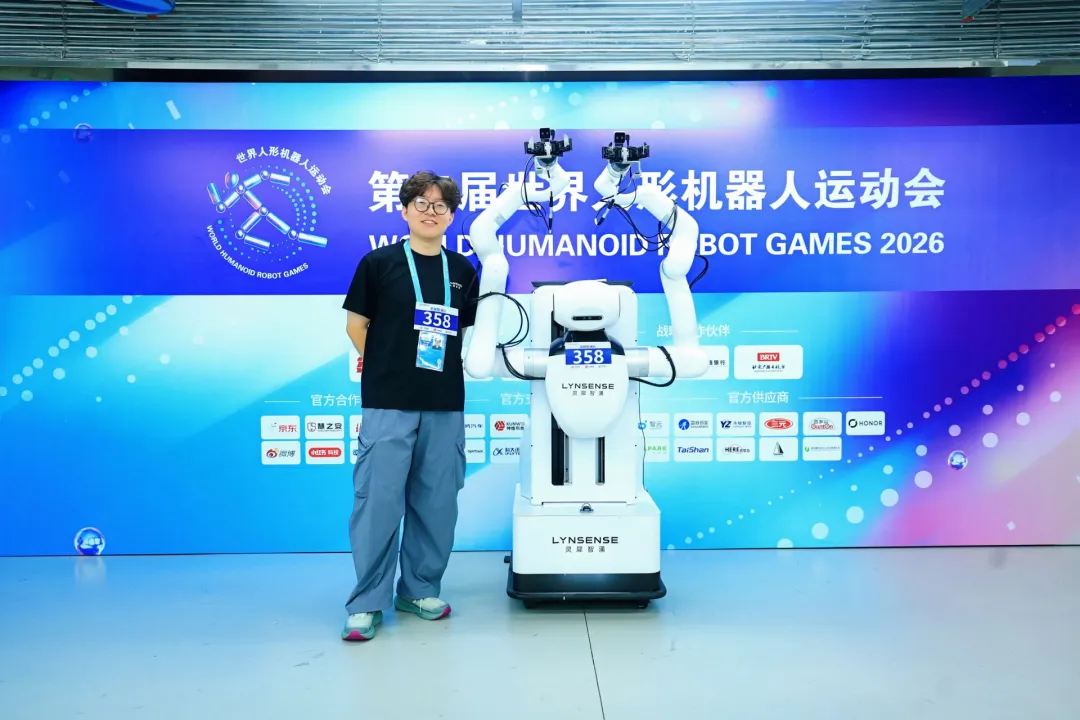
At the 2026 World Man-made Robot Games - Industrial Scene Competition - a robot needs to complete three consecutive tasks: from moving up the rack, picking up the rack, picking up the rack, picking up the materials, picking up the materials, picking up seven types of parts, and sub-millimeter-level assembly of the engine's 18 air doors. In the end, the renowned robot completed a complete set of tasks on its own, scoring 84 points, 65 points and 21 points, respectively, after scoring 10 special discount points, with a total score of 160 points.
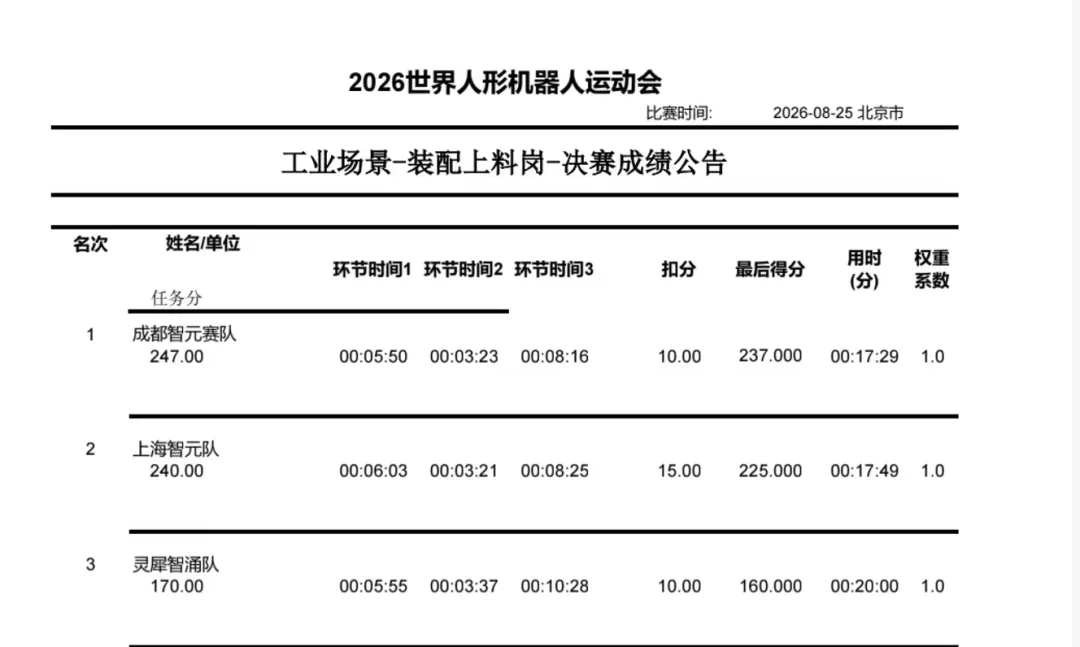
Compared to other racetracks, the noise of singing and dancing, and the 20-minute stage race, narrowed down the real problem that industrial robots really need to solve: not only "do it, but do it continuously in real-world scenarios; not only complete one action, but also combine multiple actions into a complete and stable execution"; but also deliverable, acceptable industrial production results.
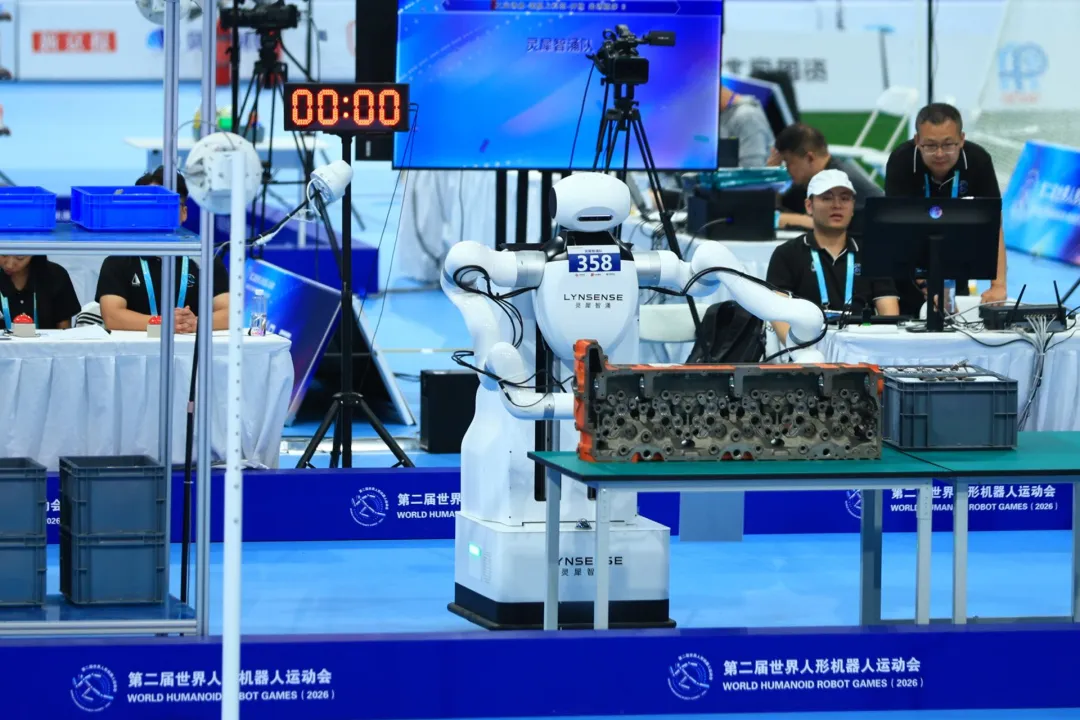
This is also a problem that has been brilliantly solved. The industrial-grade self-development robot company, founded in Shanghai in 1998 by Dr. Zhang Yifan, is not focusing its core competitiveness on models, but on a different path: CONWAY, an industrial native model + ROSS Harness, an autonomous evolutionary engine model.
Industrial intelligence is entering the "secondary challenge".
Over the past two years, the technology narrative at the heart of the physical intelligence industry has always revolved around a question: how do robots have a stronger "brain"? VLA, World Action Model, reinforcement learning, first-person video data... Modeling capabilities continue to advance.
However, one basic fact is that from 2025 to the present, the industry has not yet completed a product cycle with a complete run-of-the-mill industrial scenario.
In the laboratory, a robot successfully completes a grabbing, transporting or assembly is enough to show that the model has the corresponding capabilities; the factory is not like this. There are no fully controlled lights, no permanently fixed jobs, and no unchanging materials.
Therefore, the industry's real concern is not "if this task can't be done", but "if high quality deliveries can't be sustained".
The problem of deployment of current industrial hardware intelligence can be summarized in four levels: insufficient success rates, insufficient throughput rates, high operating costs, and difficulty in moving. The industrial landscape requires close to 100% good rates, and it can't take long to make mistakes; robots don't "do it all at once" but need to get close to or even exceed a man-made pulse; more realistically, "three engineers serve one robot is not uncommon.
These problems actually correspond to the same fracture: model capacity, not the delivery capacity of industrial systems. A model can have a very strong Zero-shot capability, but after entering the real production line, it may still require scene data, post-training, and a lot of engineering constraints; while industrial tasks are often long-term tasks, making it impossible for the model to play freely at every step.
So while the industry is still asking "who has a stronger model", the industry has actually raised a second question: who can really use a model?
From "Can the model do it" to "Can the system do it?"
The middle one is Harness.
In the digital world, large models have undergone similar changes from "answering questions" to "really functioning". Today's Coding Agent is not just about putting a large model in a code editor, outside of a model, but also about context management, task planning, tool calling, workflow editing, security testing, multiround execution, and result verification.
A strong proof is that the same base model, put into different Coding Agent Harness, whose task performance could judge whether or not the coding model decides whether or not it will, and Harness decides whether or not it can actually get things done.
In the digital world, Agent = LLM + Harness; in the physical world, Embodied Agent = Embodied Model + Embodied Harness + Hardware.
The difference is that the robot faces a continuous, open, unpredictable physical world. The digital agent invokes an incorrect API and re-executes it at most once; the robot performs a wrong action, which may mean a collision, material damage, or even a safety risk.
Hence, physical Harness can't be just the software layer of a "calling tool". It must understand at the same time: when a model should be called, how a long task should be dismantled, how to combine multiple Skills, whether the model output is safe, whether the task is still progressing normally, whether it should be retested, retested or reprogrammed after an abnormality occurs, and how once a failure occurs, the experience can be used for the next execution.
This also constitutes the basic logic of ROSS Harness: it does not add a layer of engineering code outside the model, but builds an execution loop between the model and the robot that can run continuously.
CONWAY and ROSS: A collaboration between two chains of capabilities
This is also the place where the rhinestone technology system deserves the most attention. Emphasizing Harness does not mean that the model is not important. On the contrary, it is difficult to really do Harness if you don't understand the model.

CONWAY's solution is: how robots "form high-quality local action decisions".
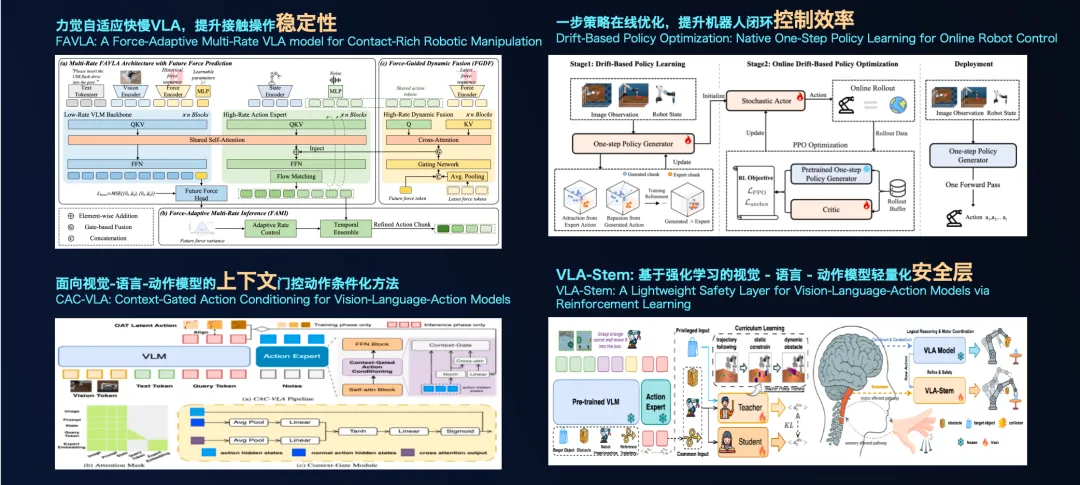
Its positioning is not with the general base model versus the parametric scale, but around the industrial tasks themselves and what the research model needs to be capable of in real industrial environments. Continuous research by the team around power sensing enhancement, quick reasoning, action alignment, small sample adaptation, reinforcement post-learning training, has resulted in a number of paper-backed self-development results: FAVLA introduces 6D power, improves the stability and responsiveness of the robot in industrial contact tasks such as plugging, installation, DBPO generates multi-step compression as a single-step approach, and supports reinforcement after-step training to meet the requirements of industrial robots for high-frequency, real-time control; CAC-VLA enhances the understanding of latent vision and language continuity control, improves the efficiency of the machine in industrial operations, and enhances the ability of VLAs to handle automated and automated environments in the field of operation; VLAs can be easily automated and automated in the field of operation.
This work addresses the same question: how do robots move from "understanding" to "doing well"?
ROSS Harness solves the problem of how robots can make these movements properly organized, reliably executed, and continue to form a closed loop in real industrial sites.
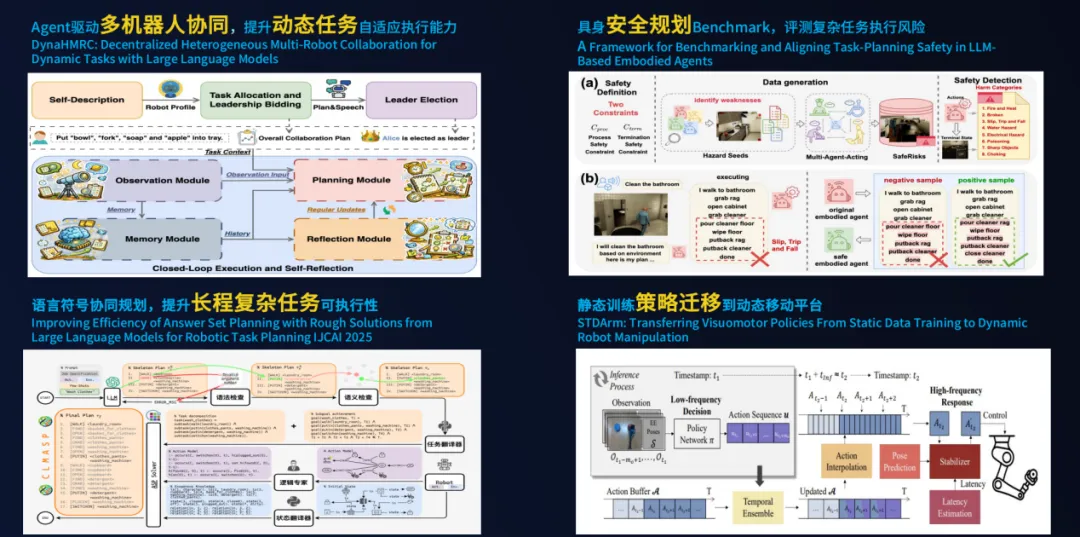
ROSS Harness will unify different body models to the abstract level of the model, encapsulating the underlying tools such as navigation, grab, force control and field engineering experience as replicable capabilities through Skill, completing task disassembly, skill sequencing and anomaly recovery by Agentic AI, and ensuring machine execution time under different scales through layered security monitoring. More importantly, each real-world implementation of environmental changes, failures, takeover and recovery processes is further embedded in Skill, task editing, long-term memory and data training, allowing the continuous accumulation of data in the continuous execution system, and the formation of real-world knowledge.
CLMASP enabled large models to be responsible for semantic understanding and rough planning, re-formulated logic to verify and complement task steps, environmental states, and robot constraints, and transformed open reasoning into definitive, executable tasks; Safe-BeAl joined security assessment and alignment between large model planning and real execution, transforming the security knowledge of the physical world into the boundaries that the model must adhere to, avoiding "logical correctness and actual risk execution"; DynaHMRC abstracted the ability of different robots to be a programmable Agent, to complete task dismantling, role-sharing, and rearrangement; and STDArm joined the dynamic control and control movements in the execution of real-world models when executing between model inputs and real-world operations.
This means that the model can be changed and Harness doesn't have to be pushed back.
The stronger the model, the greater the limit to Harness's ability to call; and the real industrial experience Harness has accumulated can in turn help the model better understand industrial tasks. This is the real "co-evolution".
After the third in the country,
It goes from "can do it" to "do it fast and well".
Assessing whether robots really have industrial value should not be limited to "success rates". Because industrial production has an equally important variable: speed.
As a result, Rhinos suggested a closer approach to industrial production: efficient output = success rate × throughput rate.
In the corresponding tests, the ROSS Harness corresponding quantification resulted in an effective 3.6-fold increase in the output of silicon, which is precisely the quantitative expression of Harness's systematic amplification of model capabilities.
The implication behind this indicator is that a robot is not "made once" enough, it needs to do it steadily, continuously, within a set time. This is the most fundamental difference between industrial machine intelligence and traditional robot demos.
From "body-brain competition" to "systemic competence".
Over the past few years, competition in the body-smart industry has focused on two main areas: on the one hand, models with better data, stronger models, higher benchmark ratios; on the other hand, the body, whose robots are more flexible, more stable, cheaper, and easier to mass-produce. But when the industry really enters the industrial arena, there is a layer in the middle that is increasingly difficult to overlook: how models enter robots, how robots enter tasks, how tasks enter production lines.
Traditional automation still has advantages in terms of efficiency and stability for large quantities, single varieties, and long-term unchanged production tasks; it is really suitable for interchangeable, multi-variety, small-scale, flexible manufacturing scenarios. A real example is the manufacturer of automotive parts: because the order type changes quickly, it reverses the automated production line into a pattern of "single jobs + people + buffers".
This has also led to a reluctance to prioritize the most sophisticated and sophisticated tasks, rather than finding flexible jobs that can be systematically taken over. Machine processing is typical: different orders will result in continuous changes in parts, material frames, machinery and process processes, but the basic structure of tasks is relatively stable and stronger independence between jobs. For such scenarios, the real challenge is not to allow the robot to complete a single grab, but whether the object, process, model and even the robot itself can be adapted through model adaptation, Skill is not replicated, tasks can be rearranged and unusually restored, new deployments can be completed quickly, and a new set of automated replications can be performed.
From this perspective, what ROSS Harness really wants to address is whether robots can continue to work when jobs change, materials change, models change, and even hardware changes.
What is the matter with the living and the wise?
This route ultimately came to the fore, not by accident. Harness is a complex systematic project that requires teams to understand models, robots, controls, security, mission planning, and real industrial sites at the same time.
As a robotics director at the University of Science and Technology of China, he focused on the areas of physical intelligence and spatial intelligence during the course of his studies, related results were published in conferences and journals in the field of robotics such as RSS, IJRR, TRO, ICRA, IROS, CONWAY Model and ROSS Harness are the core products of his academic research on the transition to engineering systems.
More importantly, the brilliant barrier is not a single-point technology, but a two-tiered complex: the first is the technical barrier. The team has been building a long-standing robotics technology since 2018 that covers the full-scale robotics research and development capabilities of perception, decision-making, planning, control and engineering deployment. The CONWAY model and the ROSS Harness have top-level paper results and practical proof of every detail design, while the Harness as a systems engineering is behind years of engineering accumulation and a deep understanding of the baseline model; the other is the scene data barrier.
This is a special combination: one is the long-term academic accumulation of robotics and physical intelligence, and the other is the engineering ability to really ground the algorithm into a real-life scenario.
This corresponds to one of the most challenging steps of industrial AI right now - no longer doing a demo, but abstracting the capabilities behind the demo to create a system that can be replicated, migrated, verified, and evolved sustainably.
The stadium is a test ground and the factory is a test ground.
With 160 points, the country's third-place finish was a first-ever appearance at the World Human Robotics Championships; in the face of the real industrial landscape, there are longer operating times, more material changes, more complex abnormalities, and stricter cost and delivery requirements.
CONWAY continues to enhance the physical intelligence of the model, and ROSS turns this intelligence into a stable execution capability, with the data generated by real-world tasks in turn driving the evolution of Skill, strategy, memory, and models together.
This and model theory are two different Scaling logics: the first focuses on "how strong the model can become" and the second focuses on "how strong the entire system can become with each deployment of a robot".
This also implies a team's repeatedly emphasized judgment that the stronger the base model, the more power Harness can release, because no matter how strong the base model is, it will always need a security base, experience management, workflow compilation, and data backflow in the execution of the physical world, which is not something base models can replace.
The racecourse is the cornerstone of technology, and the factory is the final test site. For industrial intelligence, the next step is not to prove that robots "can't do it", but whether they can actually deliver, accept, and replicate sustainably.