The journal can be published year-on-year, but this journal is not available to every laboratory.
Science Robotics is an internationally recognized leading journal in the field of robotics, published under the auspices of Science Robotics, and the first in the field of long-term impact factor robotics. The publication of results in this journal means that the research has passed the most rigorous peer review in the field, representing the most cutting-edge, breakthrough technological advances in the field today.
In August this year, Samsung Science Robotics launched a special issue on humanoid robots, bringing together the latest research in the field of humanoid robots globally. This issue features only three humanoid company platforms globally: Samsung, Accelerated Evolution, Uber, and Boston Dynamics, representing the forefront of global humanoid robot research.
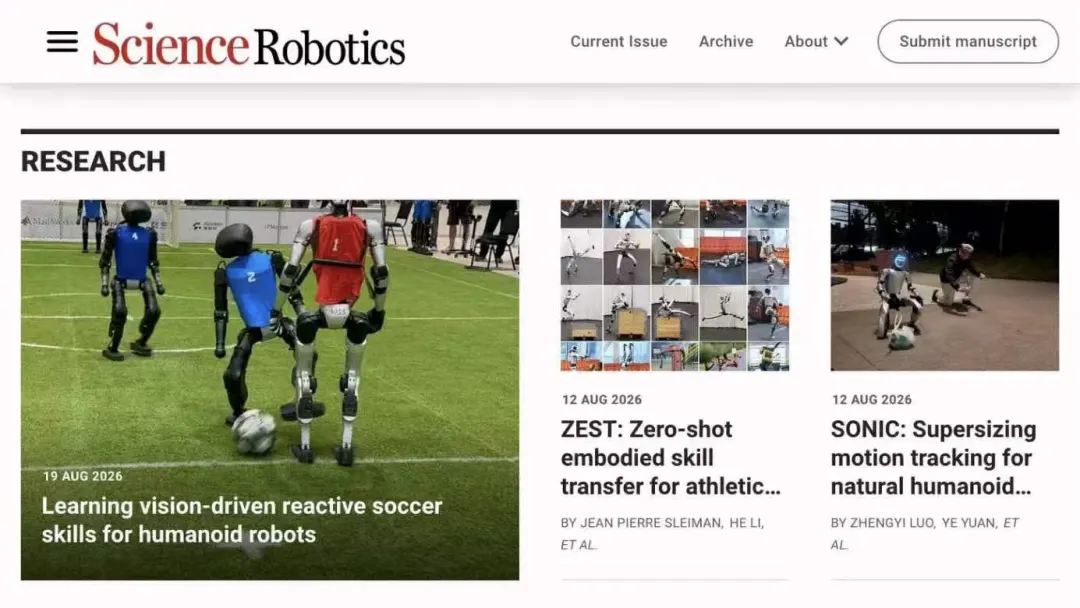
In this special issue, a team of Chinese University of Automation Professors from China's University of Automation, Shenzhen, has published a paper titled "Learning Vision-Driven Reactive Soccer Skills for Humanoid Robots". The paper proposes a set of vision-driven, responsive football skills learning frameworks that allow humanoids to rely solely on on on in-flight vision to continuously locate, chase, adjust patterns, and multi-directional shooting in dynamic environments.
The main page of the project:https://humanoid-kick.github.io/
This work does not stop at a single movement or indicator, it puts visual perception, state estimation, bipedal movement and physical contact into real-life football tasks and into the RoboCup arena to be tested in constantly changing environments and real-life confrontations.
22 years of technological connectivity
The following year, they took part in the RoboCup with their self-developed robots. The early robots were only about 50 cm tall, walked slowly, and had to be protected from falling during the game. For more than two decades afterwards, the Fire Team competed almost every year, growing to over a meter, learning to stand up, run fast, and shoot hard.
The football field has also been a testing ground for the team's long-term testing of vision, decision-making, motion control and machine reliability. Visual recognition slows down by how many milliseconds, where the foot points deviate by how many centimeters, and robots can be shown directly in real-life combat. The team takes the problem back to the lab, modifies the algorithm, and continues to verify the next game. This cycle lasted for more than two decades.
He has long been involved in brain computing and robotic control research. He has been involved in the development of "Heaven Movement" brain chips and the study of unmanned bicycles, which appeared on the cover of Nature and was selected as one of the top ten advances in Chinese science in 2019. From brain computing to robotic football, his focus has always been on how perception, judgement and action run continuously in the same system.
As the years went by, the members of the Fireworks team changed hands a number of times. As the founder of Accelerated Evolution, Chen Chen, who was the third Captain of the Fireworks team, trained in the Internet entrepreneurship after graduating from China, and accumulated a track record as Vice President of Book Products in the byte jump. In 2023, the unforgettable Captain chose to re-launch and founded "Accelerated Evolution".
From its founding in 2004 to its international debut in 2026, the paper has been a technological collaboration spanning 22 years.
Let robots see and react to noise
This paper attempts to solve a problem that has plagued the academic community for years: how can humanoid robots see and react in a real environment full of noise, latency and shadows.
When people play, vision and movement occur almost simultaneously. The eye tracks football, the brain determines distance and direction, and the body continuously adjusts the focus and landing points. Even if the football is temporarily stopped, one can predict its next possible location based on the previous course of motion.
The process requires a camera, algorithm, and joint control, but the difficulty is much greater. The images captured by the camera may be blurred by intense movement, noise and delay in target detection, and the football may run out of sight or be obscured. At the same time, the two-legged robot must maintain balance and decide on its next step in tens of milliseconds.
Traditional programs typically break this process down into several modules. Visual systems recognize football and estimate location, decision modules select movements, motion controllers and drive robots to execute. This method is easy to moderate, but also easy to generate error and delay in gradual transmission, and strategies trained in perfect simulation can cause significant performance declines in the real world due to lighting, noise, and shadows.
The Ming Dynasty team proposed a unified perception - exercise reinforcement learning framework. The core idea is to put visual perception and exercise control under the same optimization goal for end-to-end training.
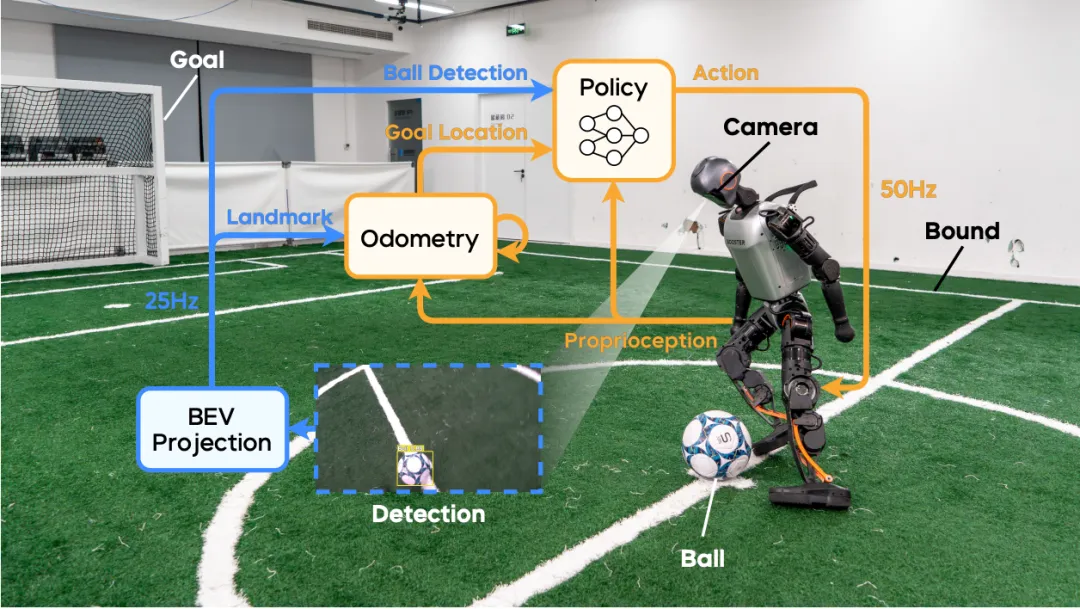
Visual-driven accelerated evolutionary robot control system overview
The research team first developed a virtual sensing system.
They allow real robots to observe football from different distances and perspectives, accumulating about an hour's worth of data, and then controlling it against the real location of the motion capture system's records, thus obtaining perceptual characteristics such as location noise, detecting success rates, updating frequencies and delays.
These features are then simulated. The longer the distance of the football, the greater the noise of the position; the camera view changes the posture of the robot's head. Even if the football appears in the field of view, it may fail to detect for reasons such as motion blur. The visual system is updated at about 25Hz, with an average delay of about 116 milliseconds.
After a short interruption of vision, the controller needs to continue to judge the position and movement trends of football based on previous information.
The strategy reads the past 50 seconds of historical observations and then compresses the information into a 64-dimensional hidden state. In the training phase, the decoder attempts to recover the actual location of the football and the robotic dynamics parameters from the hidden state. This assistive task helps the strategy complete the visual noise and allows it to continue to estimate the target location after the football disappears for a short time.
The Actor responsible for the output actions can only use some of the observations that real robots can access, while the Critic at the training stage can access the full state of the simulation environment to provide additional information to optimize the strategy.
To make the movements more natural, the team also introduced the anti-sport precursor AMP. Training data includes about 76 seconds of human full-directional walking movements and 30 seconds of foot archery movements. The meter is responsible for determining the proximity of robot movements to human demonstrations, and reinforcement learning strategies continue to revolve around chasing and goal optimization.
The mirror symmetry constraint further helped the robot to master the left-footed shot, avoiding narrowing to the one-sided ball. Eventually, finding the ball, chasing the ball, adjusting the drop point and the shot were placed into the same strategy, with the controller issuing joint position instructions at 50Hz.
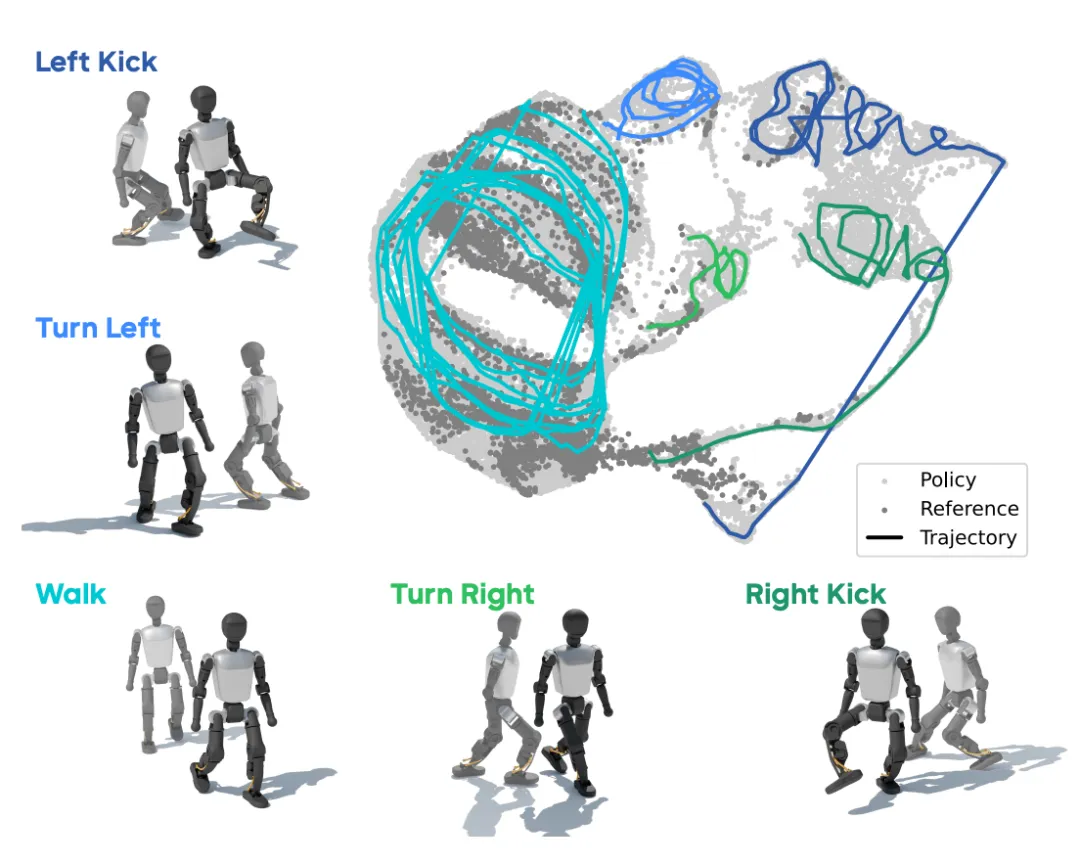
There are five types of action patterns that form the strategy, including left foot arches, straight lines and left turn. Color trajectories generate action for the strategy and gray points refer to human action.
In the course of the training, a lot of autonomous behaviour emerged.
When the ball approaches the edge of the field of view, the robot actively flips and turns, moving the ball back to the field of view. On the edge of the field of play, no football is found, it usually goes to the center of the field and then expands the search range.
The pace also varies with the distance of football. At longer distances, the robot uses a slower pace frequency of about 0.7 to 0.8 seconds per step cycle to maintain a steady observation; when approaching football, the cycle is shortened to 0.3 to 0.4 seconds, minimizing footsteps through shorter, faster pace.
When the goal is located behind the goal, the strategy even generates a rotational radiation movement, with the robot rotating the ball with the support of the leg as the axis, while the other leg bends the ball from the side to the goal, saving time for repositioning.
These changes are ultimately reflected in experimental data.
Within a second of the shot, the error in the position of the football in the original visual observation was 0.344 meters, and after estimating the internal state of the strategy, the error was reduced to 0.186 meters, a reduction of about 46%. In simulation, when the visual detection was briefly interrupted by 0.3 seconds, the robot's touch success rate was still more than 90%, and the goal rate was more than 50%. Faced with static football, learning strategies usually take only about 1.5 seconds from start to touch, and traditional rule systems take about 2 to 5 seconds, with a peak reduction of 64%.
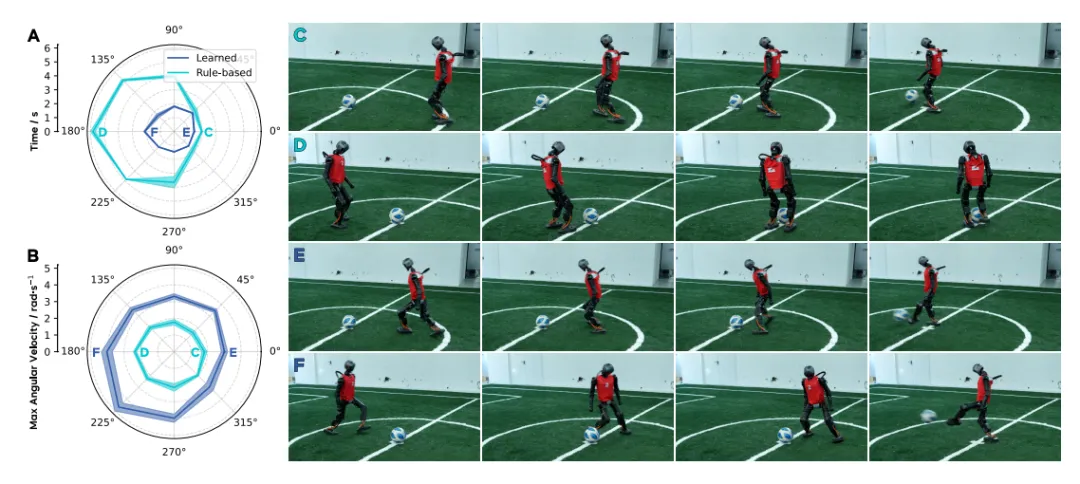
The learning strategy is contrasted with the current RoboCup advanced rule strategy. A•B) The time it takes for the robot to start to touch the ball at different approach angles, as well as the maximum angular velocity in this process. The robot is initially stationary, 1.5 m away from the football. The shadow area represents a standard deviation, and each direction is tested 5 times. C•D) The rule strategy controls the robot forward (0°) and backwards (180°) The typical movements of the robot when playing the ball.
In real-machine tests, the success rate of the robot in the front position is 80% to 90%, the back position is 60% to 70%, and the test does not fall. In the face of rolling football, when the speed of the ball is less than 0.5 meters per second, the strategy can still maintain a success rate of more than 50%, and real-machine experiments show a similar trend.
Note: Reaction shot in the face of a rolling football. A) When the football rolls sideways, the robot moves quickly to the side and completes the shot. In this, i) displays the trajectory of the robot with the football and the corresponding two-legged patterns, ii) displays the robot's continuous action. B) When the football rolls behind the robot, the robot quickly turns and shoots the door. i) and ii) The content shown is the same as a) When the ball rolls sideways. c) When the ball rolls at different speeds.
In 2025, the team won the RoboCup Adult Group Toy League and the World Toy Robot Games, scoring 76 goals in two events, losing only 11 goals. In 2026, the team successfully defended in the RoboCup Large Size competition.
Moving to the next generation of fitness platforms
Learning strategies can be deployed directly from the simulation to the real machine, and algorithms are only one of them. Whether the joint response is consistent, whether the control cycle is stable, whether the sensors and computing units can output results on time, all affect the final performance. Any underlying errors can be amplified in high-speed motion.
The real-world experiments in the paper used accelerated evolutionary humanoid robot platforms. The experiments did not specifically modify the body, football information came from head-mounted cameras, and both perception and control were run on board-mounted computing units. This indicated that domestically produced humanoid robots were already capable of carrying the world's leading-edge in physically intelligent research, with researchers able to focus mainly on algorithms and then deploy training results to real hardware.
The relationship between accelerated evolution and the Fire Team extends from the inheritance of human talent to the technological platform.
In July, Accelerated Evolution released a new generation of its flagship platform, the Booster T2, a professional version featuring the NVIDIA Thor chip with an edge-algorithm of 2070 TFLOPS, which is currently the leading platform in the field of two-legged robotics. Supported Booster Studio will integrate simulation training, algorithm development and real machine deployment into the same development environment.
On August 19, the Booster T2 officially debuted at the World Robotics Congress, showing off its high-explosion debut. Three days later, the 80 Booster T2 completed its decentralized autonomous synthesis at the Opening Ceremony of the Robotics Congress, writing on the floor of the Beijing Games, matching the three event icons, with no remote controls, no mouths, the "brains" of 80 independent decision-makers reaching synthesis at the same time.
Single-sensory closed-loop, multi-machine synchronous arrays rely on the same underlying capabilities: stable core, real-time edge computation, precise motion control. The boundaries of capabilities are constantly expanding as the platform evolves.
From the 50 cm tall, man-made early robots that needed to be able to stand up, to playing autonomously on the pitch today, the 22-year-old Booster T2, written at the opening ceremony, is showing up on an ever-increasing scale, and human robots are also moving from "interactive" to "usable", from single-action to group collaboration.
The link is as follows: