Last night, the lights of the National Speed Skating Hall "Ice Belt" were lit and the second World Robot Games officially opened.
Remember last year's "crashing-growing" robots on the track, who, while struggling to keep their balance and finishing the race, contributed a lot to the scene: lying flat after falling, suddenly landing machines, uncontrollable twisted crawling.
Last year, in addition to running faster, jumping higher, this year robots participated in more sports such as football, table tennis, tennis, cheerleading, swimming, etc. In addition to running faster and jumping higher, there was also a manned tennis match at the opening ceremony.
The first exhibition project at the opening ceremony, the Galaxian General Tennis Robot, premiered on the tennis court, and was accompanied by the tennis champion, Li Liu, a sports experience official.
The two tennis robots first teamed up with two guests to complete the world's first man-made mixed doubles show. Afterwards, the two sides of the net were lined up with tennis robots, and a man-made tennis match was launched, the world's first man-made tennis match between a robot and a human athlete.
Through the video below, you can see the tennis ball flying from opposite sides, the tennis robot pressing down the body, moving horizontally, looking for the hit point; the ball is thrown into the bottom corner, which is adjusted to its position with successive small steps, turning the torso, and then swinging the ball backwards.
The game also featured a small insert. Zhengji continuously changed the landing point, the tennis robot lost its balance while chasing the game and fell face down on the pitch.

It's worth noting that in this game, robots aren't doing their moves in advance to "perform", but actually play independently: they look at the ball, they judge, they move, they flutter.
In the meantime, it looks as if the robot's skills have surpassed those of tennis players who are just entering the game, and it looks as if there will be no need for friends to ask for help, and the robot's companionship can be arranged immediately.
How do robots finish a tennis match?Tennis is a comprehensive challenge for robots.
In a real match, the robot first needs to "understand" the game. In the face of a high-speed flying tennis ball, it needs to judge the direction, speed and prediction of the ball's possible landing point, while combining its own position and opponent's state to determine the next move and the batting strategy.
When the ball flies to the bottom corner, the robot needs to move quickly to the correct position, maintaining physical stability through pace adjustment; when it enters the continuous pull stage, it needs to re-planned the next move based on the results of the previous shot. This means that each shot is not a fixed track set in advance, but a real-time decision-making process.
In this process, the robot also needs to adjust movements, body turns and swing movements according to the different balls, and then restore the body state after the imbalance occurs and continue to participate in the game.
Supporting this process is a self-developed, intelligent, large-scale model of the galactic brain (AstraBrain) developed by Galaxy General. The system attempts to combine "brain" "brain" with neural control to give robots the ability to understand tasks, plan movements and execute actions at the same time.
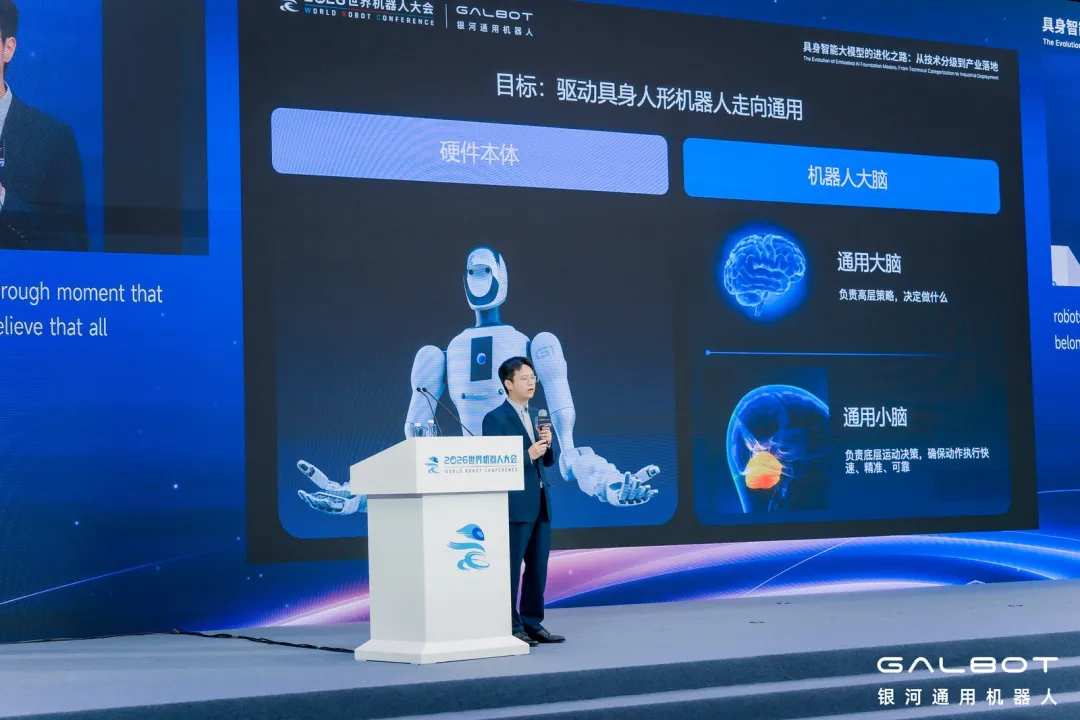
Among them, the "brain" is responsible for understanding and making decisions. In the face of high-speed balls, the robot needs to judge the direction, speed and landing point of the ball, combining the position of the opponent and the state of the game, deciding which way to hit the ball, and how to organize the offense next. In a double-header scenario, it also needs to understand the changes in the position of teammates and opponents, to complete real-time collaboration.
The "small brain" solves how to actually move the body. Tennis balls occur in a very short time, and robots need to maintain dynamic balance during high-speed movements, allowing their legs, tendons, arms and wrists to synchronize, complete running movements, waving and movement corrections.
But letting robots "play tennis" isn't just about solving the problem of sports control. More importantly, how do robots get these sports experiences?
Galaxy General uses a combination of data training and virtual environments to allow robots to learn from human motion data and simulate different ball speeds, landing points and opposition conditions in virtual tennis environments.
Specifically, the Galactic Star Database assumes the role of data generation and training support: on the one hand, it is capable of converting human movements into data that can be learned by robots; on the other hand, it is capable of generating a large number of training tasks in a virtual environment, allowing robots to continue to practice under different competitive conditions.
In the virtual world of tennis, robots can continuously practice hitting and brainstorming, gradually learning the skills of continuous hitting, bottom line movements, and landing control, and then transferring skills formed in virtual environments to real playing fields through Sim2Real technology.

Therefore, a run under the live footage, a return of the ball, involves the synchronization of multiple links, such as data learning, model reasoning and physical control.
From the chessboard to the court, how AI brings intelligence into the physical worldIn 2016, AlphaGo defeated Lee Seung-soo, bringing AI into the public eye for the first time in a sophisticated way. The technological path taken by AlphaGo shows that AI can gradually develop its strategic capabilities through massive data learning and self-exploration in the face of vast tasks in the state space.
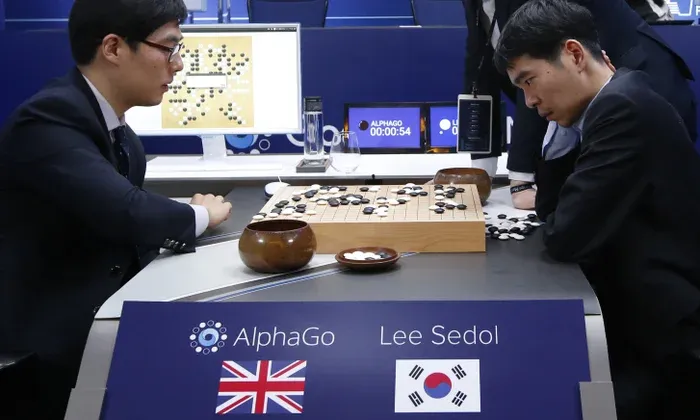
Today, Astra Tennis faces the problem of controlling movement in the physical environment.
Although it is complicated, the game's landing points are always limited to the intersection of the 19th street chessboard; the sporting environment in the real world is more variable. Tennis flies at high speeds, opponents temporarily change lines, and the body of the robot is also affected by physical conditions such as inertia, friction, balance. Whether a decision is actually made depends not only on whether it is accurate, but also on whether the body of the robot can perform the corresponding movements.
At this year's WRC forum, the CTO of Galaxy General announced that tennis is one of the most representative tasks of the humanoid robot, the "AlphaGo moment". Unlike AlphaGo, which handles complex decision-making in a digital environment, robots need to connect perception, learning, decision-making and physical control in high-speed, dynamic physical environments.
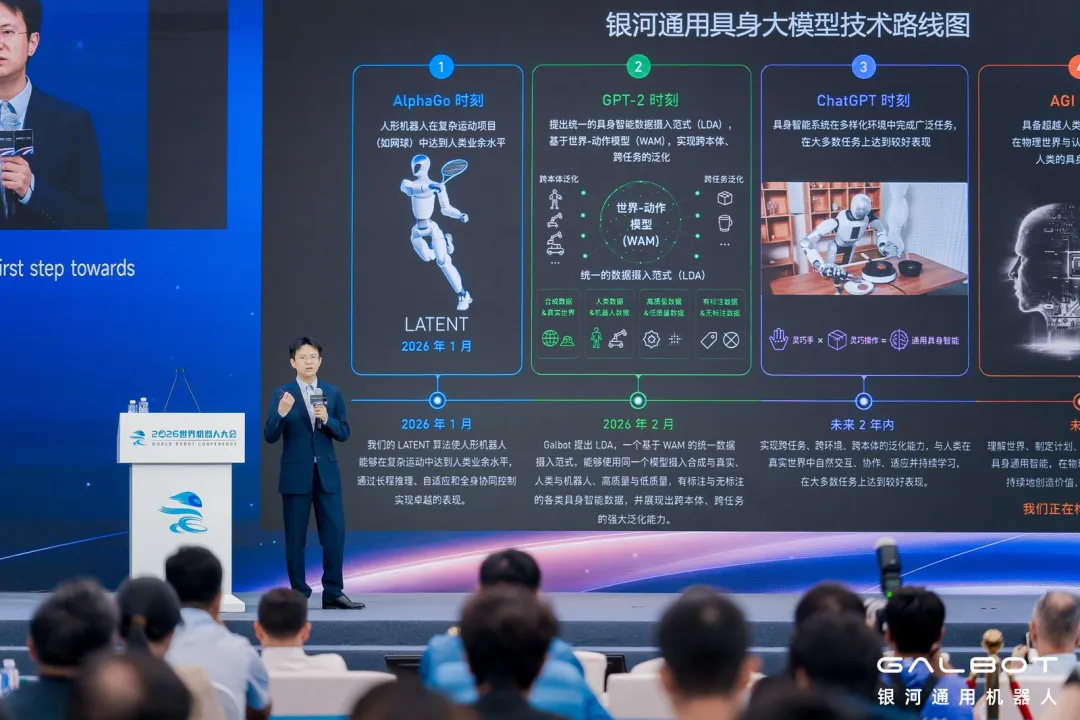
This is in line with the general understanding of "general robots" in the galaxy.
In the forum, Wang Yi mentioned that the "generality" of a humanoid robot is not only to allow a robot to learn as many moves as possible, but also to include the ability to migrate to different bodies, to different tasks, and not to train from scratch every time a robot changes its body.
The two-legged humanoid robot Galbot ET1, which made its first public appearance this year, is a demonstration of this idea. The ET1 is not the same as the previous G1, S1 in physical form, but several robots follow the same AstraBrain path. For robots, this means that "smart" begins to try to unbind with a fixed set of hardware: the body can change and the learned mobility is retained as much as possible.
One of the key technologies is the AstraBrain-WBC, the "general small brain" of the galactic brain. According to Wang, the previous WBC 0.5 has been able to generalize to movements that did not occur in training, while the ET1-powered WBC 1.0 further addresses the question of how to stabilize the mapping of new motions into full-body movements.
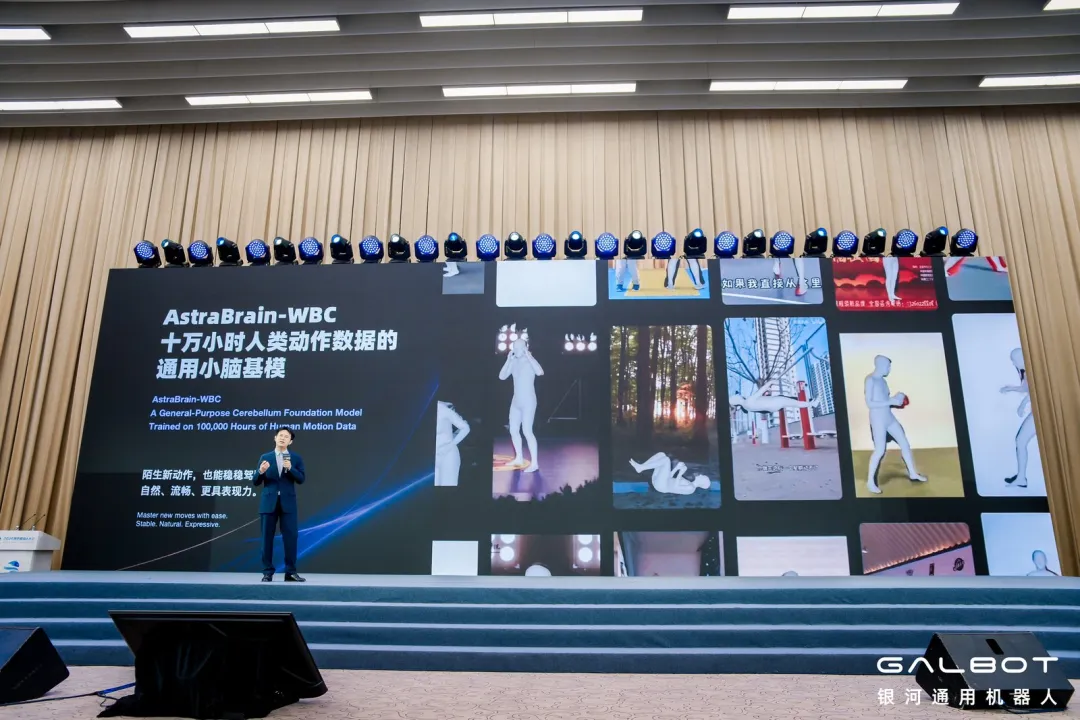
In other words, robots don't have to see every move in advance to know how the body is supposed to move.
This is also one of the problems that human robots need to solve in an open environment. In the real world, it is impossible to list a complete "list of actions" beforehand: today is tennis, tomorrow can be transportation, arrange clothes, and the next day can be replaced with new tools and new tasks.
As a result, the generalization of motion capabilities is placed within the framework of the basic model. According to Wang Yun's introduction to the forum, AstraBrain-WBC uses large-scale human motion data to train. As the size of the data increases, joint tracking errors in robots continue to decrease. Related results show that whole-body motion control also presents a certain Scaling trend: no longer design controllers for each movement separately, but by expanding the size of the data and model capabilities, to improve the generalization capacity of robots when faced with new movements.
At the same time, the source of training data is no longer limited to traditional remote operation.
AstraData is a five-tiered data system that covers Internet data, human action data, synthetic simulation data, real-machine remote control data, and real-machine retrograde data after deployment. Different levels of data play different roles: Internet video and human action provide movement pioneers, simulation data is used to expand training scales, real-machine data complements robot trajectories in the real physical world, and continues to flow and evolve after actual deployment.
This tennis showcases AI attempting to make the transition from "thinking" to "acting", a deeper link between AstraTennis and AlphaGo.
What is the meaning of this verse?A tennis match shrinks the problem of robots entering the real world.
From seeing a tennis ball, to judging a landing point, to moving and hitting the ball, robots need to complete a series of tasks that involve not only algorithms, but also mechanical structure, motion control, data training and interaction with the environment.
In the future, similar capabilities could also be applied to real-world scenarios such as industrial production, domestic services and public services. Different scenarios involve a common problem of how robots perceive and understand the environment and perform their tasks.
A return from a tennis court can also be seen as an attempt to extend physical intelligence from training and experimental environments to real application scenarios.
Finally, hopefully, we can get the robot's price down in the morning!