
It's the first time in the history of the world.
AI doesn't steal anyone's work -- at least not yet.
This conclusion comes from an excerpt recently published by Peter McCrory, Head of Economic Research at Anthropic.
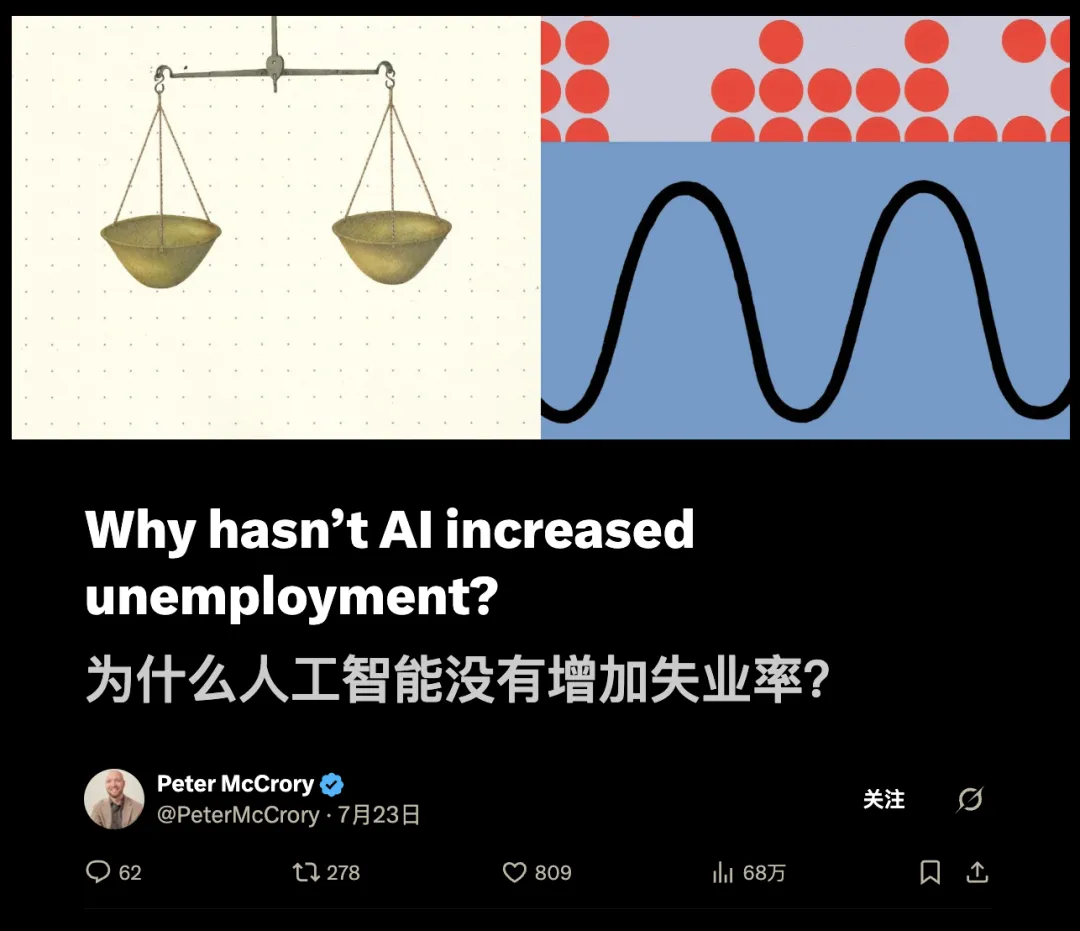
Quality-adjusted AI output grew by more than 2,000% in 2024 and 2025, and about one-fifth of U.S. businesses already use AI in their operations, but the U.S. June unemployment rate remained at 4.2%, coincidentally falling below full employment levels.
McCrory's core judgment is that AI is still a "skill-oriented, workforce-enhancing" technology that amplifies people's abilities rather than replaces them.
At the same time, he gave the judgement a validity period of 12 months.
The data does not lie:It's okay even with AI high exposure.
McCrory pulled a whole data chain to show how stable the U.S. labor market is: unemployment rate is 4.2%, job vacancies and unemployment rates are close to decades high compared to just 1.25 to 54, and the number of unemployed first-time applicants is at a four-year low.
He believes that the overall employment situation in the United States is steadily improving.
The total data is just the beginning, and the grouping contrasts are real.
McCrory and his colleague Maxim Massenkoff have previously done an analysis to isolate Claude from positions that were responding to large numbers of tasks from dynamics to see if their unemployment rates deteriorated faster than other positions.
The answer is no.
According to the latest figures from the Bureau of Labor Statistics, the conclusions remain unchanged.
Recruitment posts for software engineering positions have bounced back since May 2025, rising even higher than the average for other positions.
The only thing worth noticing is the young workers.
McCrory acknowledged that it was indeed difficult for young people to apply for jobs with high exposure to AI, and a paper from the Stanford Digital Economics Laboratory provided similar evidence.
But he also pointed to a context that is easily overlooked: the U.S. has experienced the largest non-recession labor market downturn on record to date, with the "low hiring, low layoffs" pattern being the first to squeeze out early professionals.
If you count the entire bill on AI, there is not enough evidence.
Why didn't they steal the job:In every job there's a link to AI.
McCrory's explanation is based on the fact that more than 18 months of research reporting by Anthropic has led to the following logical chain:
The first layer of facts:In all of the occupational classifications of the U.S. Department of Labor's O*NET, none of the related tasks for any position are systematically completed by Claude.
Every job has an AI-enabled link: interpersonal coordination, face-to-face interaction, interaction with the physical world.
These links, like the short boards of a wooden barrel, both limit AI's increase in overall productivity and make it more valuable for people who can replenish the short boards.
The second layer of fact:The stronger the AI, the higher the demands on those who control it.
Anthropic's January Economic Primitives report found that the more complex Claude's output, the more specialized input users are behind it.
When models make complex economic models, they are often directed by a professional user who can give precise instructions.

The March Learning Curves report showed that after six months with Claude, users were more likely to use it as a thought partner and had higher interaction success rates.
If AI is strong enough to do work independently, this learning effect should not occur.

The third layer of fact:Even in the Age of Agents, human values remained stable.
Anthropic analyzed data from seven months of use of Claude Code and found that mission values continued to rise, but the return on human expertise did not decrease:
The user is responsible for planning and delegating implementation to Claude;
More professional users, higher success rates, and faster recovery when Claude makes mistakes.
The premium for pure programming may be shrinking, but the value of planning, judging and correcting errors has risen.
An interesting piece of evidence comes from the user's own feelings.
In Anthropic's Economic Index survey in June, more than a third of respondents expected AI to do most of their jobs in 12 months, but expected a significantly lower proportion of unemployment as a result.
In contrast, users with higher levels of AI automation are more optimistic about wages and job security.

McCrory was optimistic about his current judgment, but he did not shy away from three future scenarios that could break the current pattern.
They are referred to in the academic literature and industry discussions as software quirks, economic quirks, and cosmic quirks, respectively.

The software is weird.It refers to AI automation innovation itself.
In the past, generic technologies have become more powerful, and internal combustion engines have not created new modes of transportation.
However, AI is directly endowed with general cognitive abilities that can theoretically accelerate its own evolution.
McCrory did discuss this scenario: once the recurring self-improvement (RSI) is established, the improvement of AI capabilities will be out of the rhythm of human control.
The Economic MiracleIt's an economic consequence of software weirdness.
McCrory cites Aghion, Jones and Jones' 2017 model, which states that if the innovation process itself is automated, the Standard Economic Model predicts "unlimited growth in a limited amount of time".
This conclusion sounds like science fiction, but it is a rigorous mathematical deduction.
Cosby's point.They point to another dimension.
An NBER 2025 paper (co-authored by Shahidi, Rusak, Manning, etc.) suggests that when Agent squeezes the transaction costs of searching, negotiating, signing and overseeing to near zero, Ronald Coase's classic 1937 problem will be re-activated once the cost of coordinating the hydrogen market disappears and the reasons for the existence of the enterprise are shaken.
The Agent scenario discussed by McCrory is a natural dialogue with this framework: if Agent changes not only the way production is done, but also the shape of the organization, the impact on the labor market will be far more than "who lost their jobs".
In the face of three oddities, McCrory's line of defense is the same: "The weak link".
The concept is derived from papers by Aghion, Jones and Jones that the upper limits of economic growth are determined not by the best links, but by those that are indispensable but difficult to improve.
As long as there are key tasks that cannot always be automated, be it technical bottlenecks or social constraints, the share of labour income will not collapse and the form of enterprise will not be completely dismantled.
The current status of the programming agent is already validating this logic.
According to McCrory, after the introduction of Agent, the number of lines of code increased by 10 to 20 times, but software releases only increased by 30%, with no increase in the actual use of applications.
Code is just a piece of software production, testing, architectural design, and product judgement. These links are still in the hands of humans, and they are the current "weak links".
McCrory makes a clear prediction:In a year's time, the unemployment rate in the United States will not rise significantly because of AI.
The validity of this judgment is 12 months, and the validation signal is clear to see whether the unemployment rate in AI high-exposure positions is starting to shift away from other positions, and whether the return on human expertise in the Agent scenario is starting to decline.
On the day the two indicators shifted simultaneously, his own analysis framework needed to be corrected.