01.
2026 WRC: Robots headed to the brink of recycling
On August 23, the five-day World Robotics Congress came to a head, and one of the most talked about topics gradually emerged from the hustle and bustle: Human robots, when will they really be in the industry? As this issue becomes more important, so this year's World Robotics Congress is a little less fun than in previous years.
The conference brought together more than 300 enterprises, exhibiting more than 2,000 exhibits and more than 150 new debuts. But more remarkable than the numbers is the change in the stand: single-task scenes such as picking up and collecting items are still surrounded, industrial charges, warehouse transportation, retail services, more complex and more realistic scenes of autonomous betting, etc., are beginning to take a more prominent position.This means that the field of robotics is changing.
In the past few years, the first thing companies have had to prove is that silicon can't make silicon. For example, whether it can grab an item, whether it can accomplish a sufficiently breathing move. By this year, the problem has gradually become that silicon can't do it repeatedly, or elsewhere can't do it.
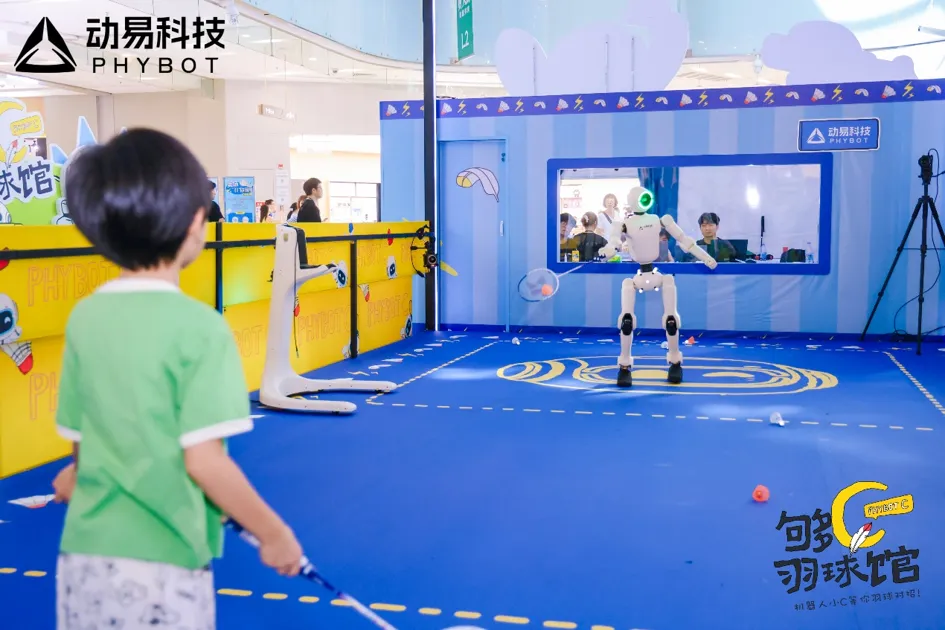
The headquarters of the company is different. Chiu is bringing the Elite G1 Max into the automotive production line, expanding from a few points to more filling jobs; Galaxy General is cutting from the Galaxy Space Station, the Smart Pharmacy, and making retail into deployable closed business units; Uber opts to continue betting on the automobile, 3C and other manufacturing scenarios, allowing the Walker S series to move forward along the delivery, continuous operation and group management; and Easy Technology is bringing binomial robots into feathers, table tennis smart to play sports escort scenarios and check dynamic interaction and move autonomous decision-making and ability.
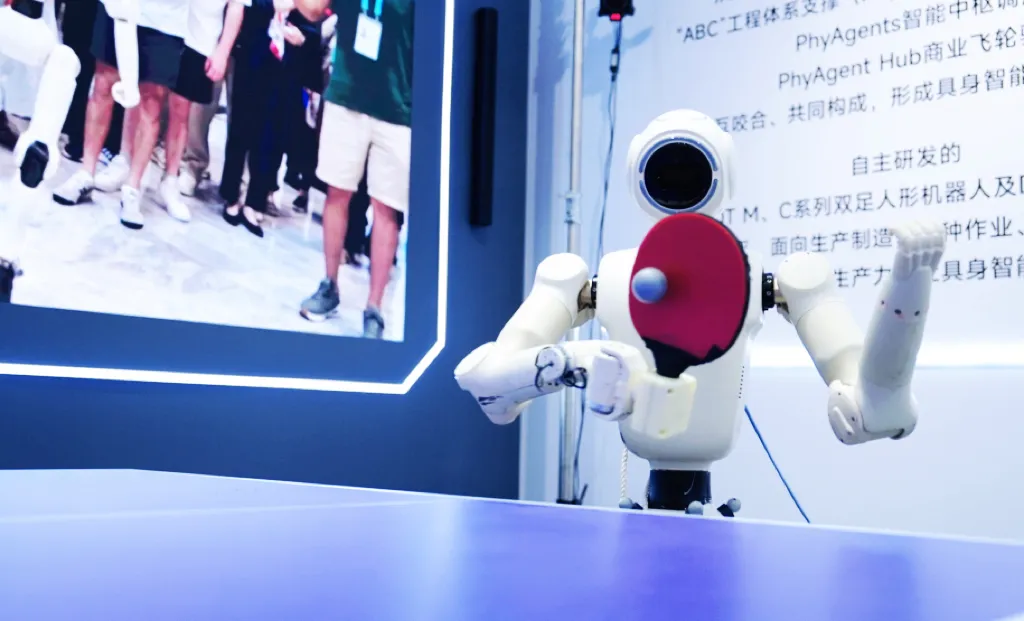
There are different routes, but the goal is the same: how to make one success quickly replicated into a thousand or even ten thousand stable successes.
As robots compete at the next stage, they may no longer be the only ones who make a skill first, but they may have lower marginal costs than those who migrate a new skill.
02.
Why do you have to be physically intelligent, and why do you have to be stuck in a cage?
Why is it so difficult to migrate and reuse the capabilities of robots?
The reason for this is that: a robot switches a computer and the output is still Token compared to an LLM; a robot switches a body and each parameter of the model's output may have a different physical meaning.
The same phrase that moves a step to the right and falls on different bodies, crossing different leg lengths, weights, weights, joint freedoms, deceleration ratios, torque limits and control frequencies. Changing a hand, a claw, the dimensions of the movement vector may also change.
What's more troubling is that bodies, tasks, and environments are often intertwined. Changing bodies, re-adapting states and operating spaces; changing tasks, re-collecting data, adjusting parameters; changing environments, re-processing lighting, friction, shading, timing, and the long-tail variables that humans inject at any time. Hardware can be quickly copied along the BOM, but intelligence has to pay repeatedly for the cost of data collection, simulation, real-machine testing, and engineering optimization.
And now, transnational studies are trying to break down that wall.
For example, the Open X-Embodiment by Google DeepMind, a collaboration between multiple agencies, which brings together 22 robots and more than 1 million real tracks, demonstrates that data from different platforms can be migrated; but new sensors and action spaces still need to be adapted. Until 2026, the academic community is still studying unified action spaces, sub variables, and adapters, which in itself shows that a polymorphic brain is far from being plugged in.
There are roughly three types of solutions currently given by the industry to this situation.
The first class emphasizes universality on the model, Google DeepMind's Gemini Robotics 2, and Physical Intelligence's π-series, which train VLAs with multitasking, multi-natural data to move a set of models across tasks.
The second class consists of a multi-body, operating system and development tool chain as a unified base, more typical of the GO-1 and Linux OS;
The third class, which takes a few business scenarios in depth and then copies data, processes and operating systems, moves from a smart pharmacy to industrial logistics, and that's the way it is.
Compared to the above three types of solutions, EasyTech did not rely solely on model, platform or scenario replication to reduce the cost of migration, but instead started with the robot's own body shell and proposed the Robot for AI shell.
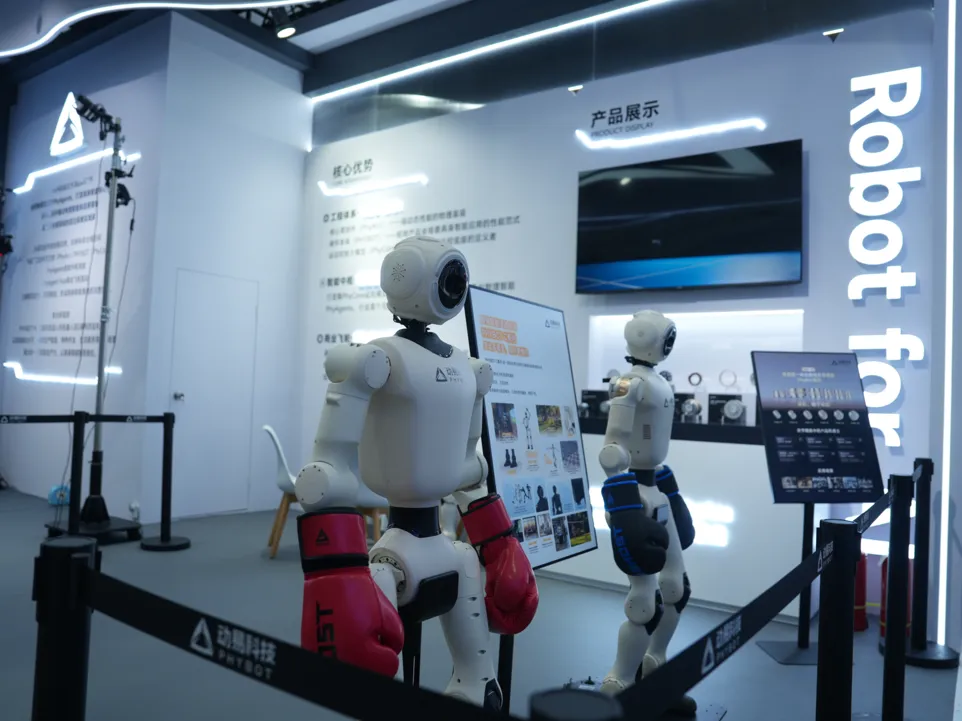
The so-called "Robot for AI" approach is not to add a large model to a typical robot, but to consider how intelligent systems look, calculate, and control at the joint, sensing, computing, and body design stages, and to use easy-to-use PhyAgents, a physically intelligent system that combines top-level decision-making with bottom-level operational control.
The advantage of this route is that when a task is switched from badminton to table tennis, there are fewer reworked parts and more reusable underlying capabilities.
But it's not just about shouting that a synergy of softwares and hard drives can be built, that for a truly multi-tasking smart set to work, businesses must understand the body, operational control and decision-making at the same time, and sharpen the three into one system in the long run.
If this is the case, how does Huawei Technology do this?
The answer lies in the architecture of PhyAgents.
03.
PhyAgents: From Learning to Repeating
According to official reports, its self-developed physical intelligence body, PhyAgens, is made up of decision-making intelligence body PhyAgent in collaboration with the exercise control model PhyCore.
The former is responsible for answering the question of what to do: identify the goal, understand the task, estimate the state and generate strategies; the latter is responsible for answering how the body can do it: translate the strategy into balance, step patterns, joints and momentum control.
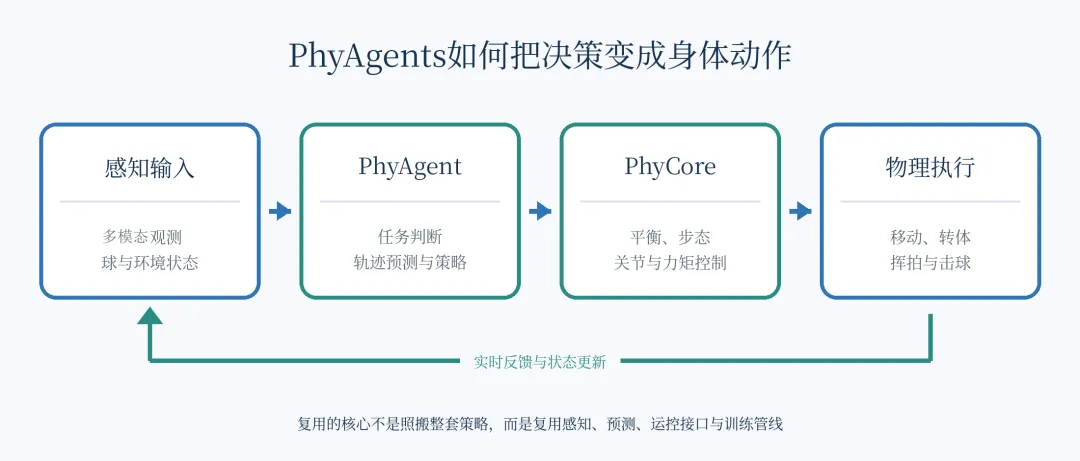 For example, the two-legged humanoid robot PHYBOT C2 must first continuously sense the position of the ball, then use an extended EKF-like state estimation method, combining continuous observation, speeds, trajectories, and landing points; the PhyAgent determines where and when the body moves, and the PhyCore determines when and where the body strikes.
C2's intelligent combat capabilities are learned autonomously through multiple stages of intelligent learning: first through human demonstration to provide initial strategies, then through multi-stage reinforcement learning to expand training in simulation, and finally into real-machine and open-environment correction.
The so-called multiplayer mode does not necessarily replicate the practice of bowling to ping-pong; the speed, timing, and reward functions of the two moves are different, and the task layer still needs training and adjustment; the real thing that can be taken away is the dynamic goal perception, trajectory prediction, overall balance, mobile control, training pipeline, and the interface that is already open between the decision layer and the operational control layer.
This layer of distinction is important: the former is a zero-cost marketing idea of replicating lithium, while the latter is a technically verifiable replica.
His verification trajectory, from the independent R&D results of playing badminton at the end of last year, to the recent emergence of badminton and table tennis skills migration, confirms the feasibility of this architecture: in 2025 the two-legged robot completed the key technical certification of playing badminton in the laboratory; in April 2026, the robot entered the Guangzhou business arena and visited almost a million citizens in July and August.
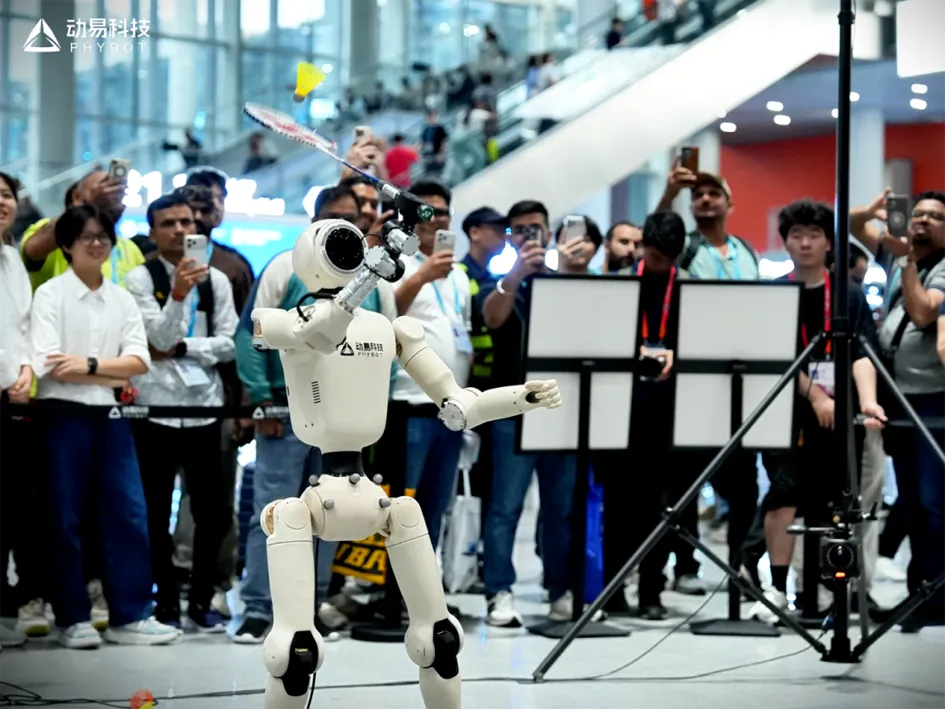
Changes in one-off scenarios, the frequency of interaction, and the difficulty of upgrading, have proven that PhyAgents, an easy-to-use, physically-intelligent system, can enable robots to realise intelligent replication and efficient migration without remote controls or predetermined trajectories.
04.
Hiding the championship's inner workings
This time around, the WRC seems to reveal something:
If the competition of robots moves from one-off demonstration to the ability to replicate, then the amount of technology a company has is not only about how much freedom it has, what moves it can do, but also how much it costs to add a new task, adapt a body, enter a scene, and re-pay.
When it began to be seen, it broke the one-on-one syndrome, reducing the painful cost of migration.
It uses the PhyArc joint module, the PhyYBOT kernel and the PhyCore operational control model to form the underlying engineering system and build the integration technology underpinnings by connecting decision-making and execution with PhyAgents. PhYBOT M1's adaptive overturns the hardware and operational control limits; PhYBOT C2 moves from a pen to a ping-pong game, testing the ability of this smart set to undertake new real-time decision-making tasks.
This ability to make robots move at a lower cost is undoubtedly the highest gold-containing crown in the next stage of industry competition.
Because it determines whether robots can submerge the perception, prediction, balance, operation control and training pipeline, which will dampen the cost of migration and move into the broader business landscape.
According to the Boston Consulting Group (BCG), the current cost of training/deploying a single robot into a new scenario has reached 3.5 times the hardware price, while, depending on the domestic situation, a basic training of the Medium Standard Model No. covering dozens to hundreds of scenarios will be required for limited tasks in factories/shops at a cost of at least over 100 million yuan.
This suggests that the cost of "task migration" by robots is currently much higher than the hardware cost of the robot itself.
Less than two years after its founding, AI, which has not become an industry giant in terms of volume, funding, or scale, is grappling with a core problem of whether robots can scale to replicate.
This characteristic has also made it the industry's best-kept secret.