Recently, Chinese robots have made international headlines again. This time, it's a human-like robot that plays its own game.
It does not rely on external positioning, does not rely on motion capture, and does not have a remote-controlled deep camera on top of its head, which can find the ball itself on the pitch, chase the ball, and shoot the goal in multiple directions. On August 19, a team of Chinese University of Automation Professors from China's Department of Automation Science Robotics published a research paper entitled "Learning Vision-Driven Reactive Soccer Skills for Humanoid Robots" (Learning Vision-Driven Reactive Soccer Skills for Humanoid Robots).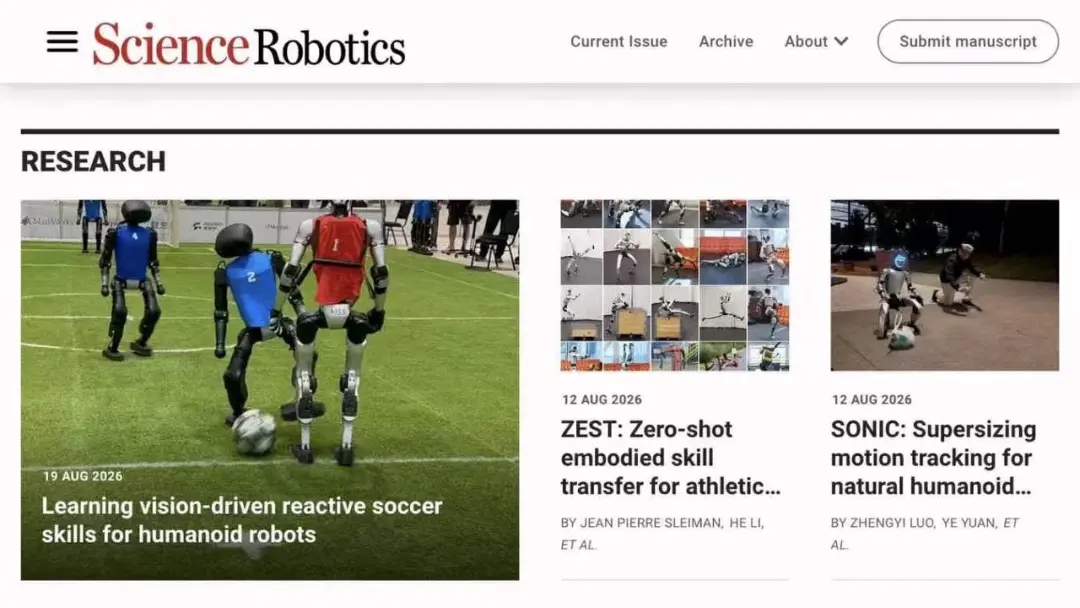
It is worth mentioning that the Science series, affiliated with the American Association for the Advancement of Science (AAAS), is the only sub-series in the series to focus on robotics, with the latest impact factor reaching 26.1, and is consistently ranked in the top tier of global robotics academic journals. Its rigorous academic standards, extremely low enrollment rates, and the ability to publish papers on it mean that the research has been highly recognized by top international peer reviews and is often considered an important milestone in the field.
01.
Soccer: Body-intelligent pump pressure test pump
Football is a pretty tough test for robots.
High-speed ball movement, contact dynamics complexity, changing terrain and lighting, robots need to manage agile motion control and less reliable visual perception in dynamic environments at the same time. Traditional robotic football systems mostly use a modular flow line that controls the ball: first let the visual module look at the ball, then transmit the results to the planning module to the ball, and finally, the control module moves the ball.
This type of architecture is well understood and well-modulated, but the problem is obvious: perception of noise, delay and leakage is amplified along the flow line level. Especially when the robot is close to the ball and needs to quickly adjust the position of the foot, any misplacement can cause it to be empty or biased. More importantly, the visual conditions in the real world are not as good as ideal, with high light, motion blurring, blurring, detecting failures are the norm.
In recent years, deep reinforcement learning has begun to be used in robotic football, but a lot of work is either dependent on the privileged status provided by the motion capture system, or on expensive three-dimensional reconstruction and training for specific scenarios.
02.
It's not that we're trying to make it look good, but that we're trying to make it look bad.
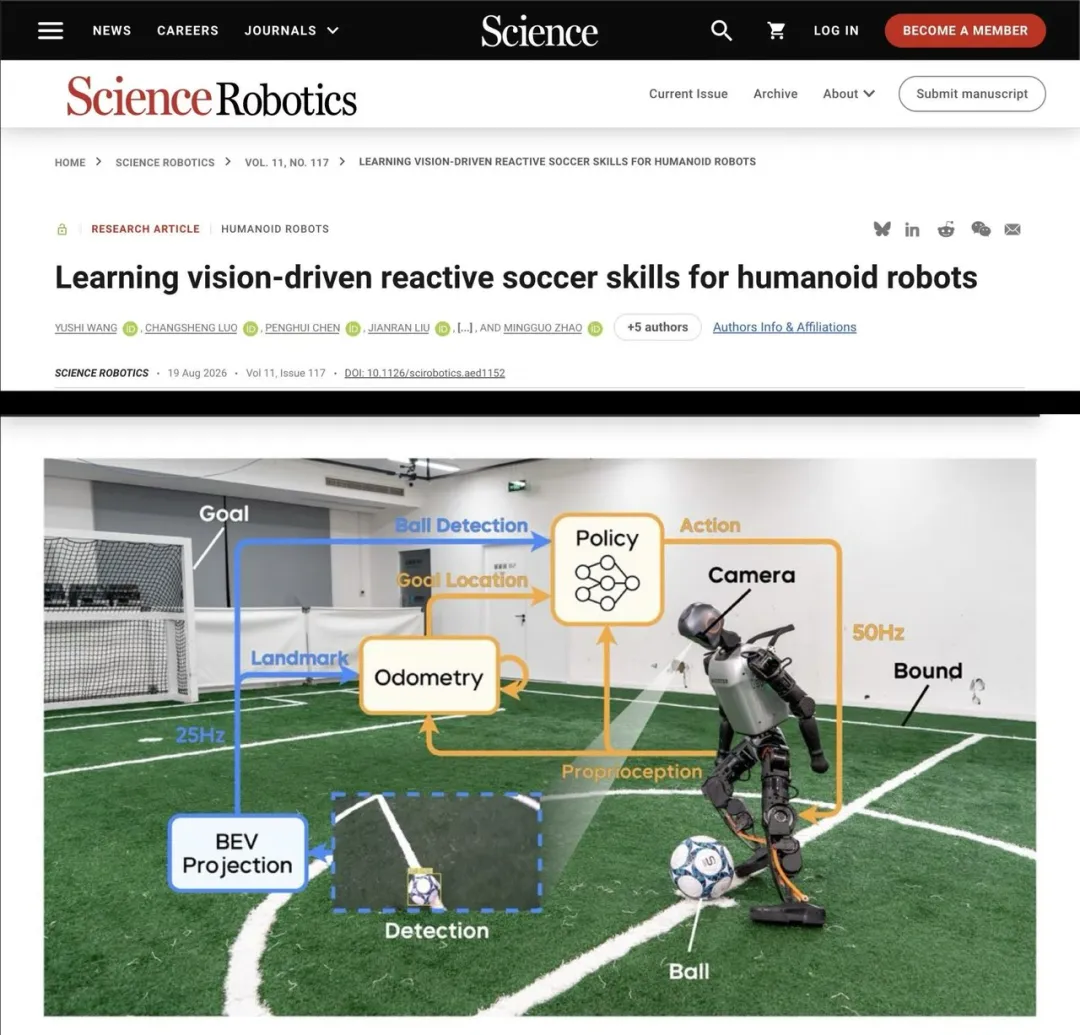
Simply put, the paper's core contribution is a unified perceptual-motion reinforcement learning framework, which is about to implement end-to-end training of visual perception and motion control under the same optimization goal, cutting off all the linkages in the middle of traditional architecture.
What are robots looking at?
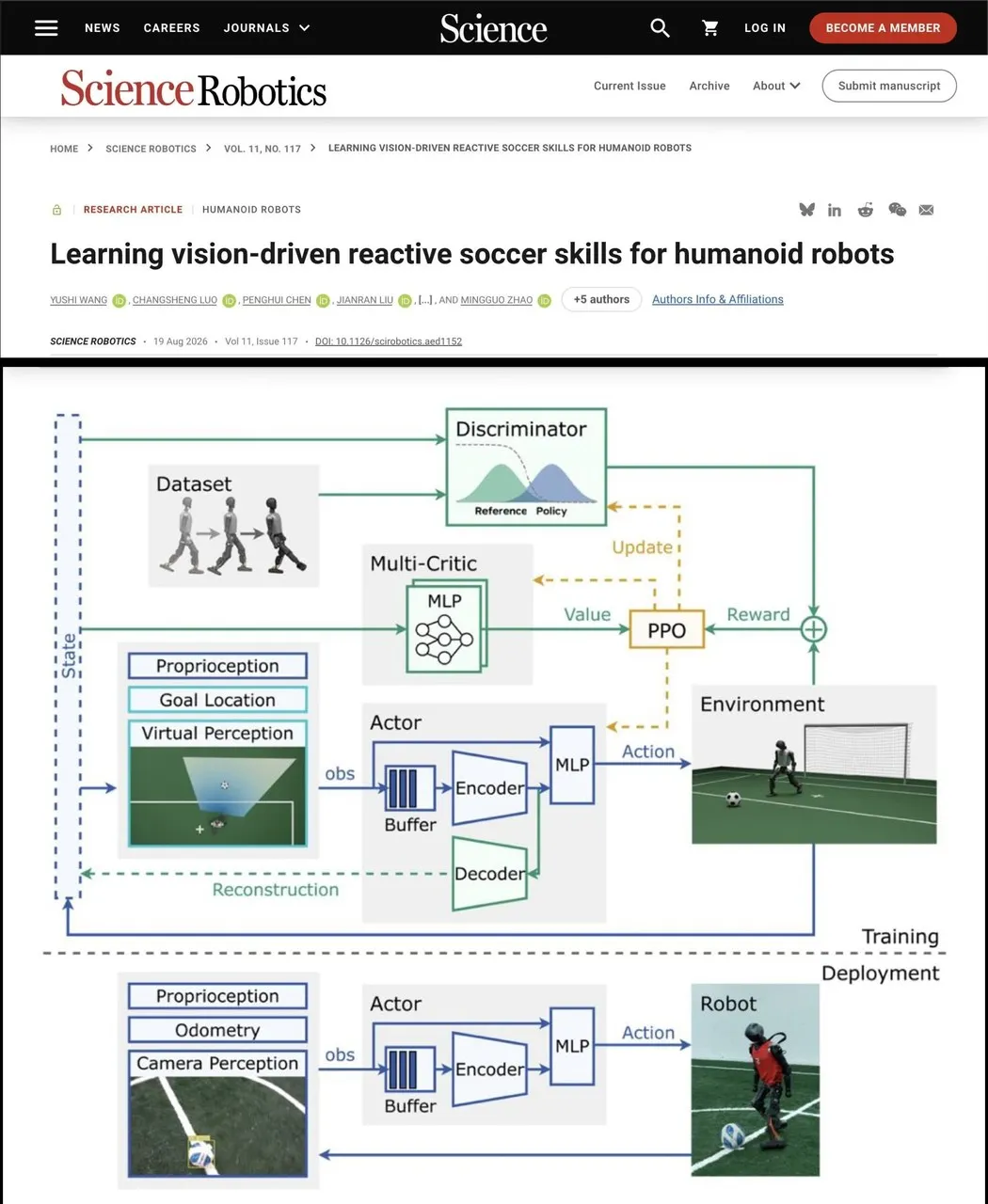
The strategy does not deal directly with primitive high-dimensional images, but instead receives structured clues that are highly relevant to football tasks. For example, where the ball is relative to the robot's position, the center of the ball, where the ball is headed, and the robot's own physical state (joint angle, gesture, etc.). The new framework allows the perception module to no longer pursue "accurately identifying" tasks, but to pursue "what can make robots perform tasks faster and more steadily".
Two key designs that make strategies work even when they're not clear
In order to make the strategy stable enough in the real world, the team introduced two key designs.
The team did not assume that the vision in the simulation was perfect, but deliberately modeled the training on real-world interference, such as noise, delay, etc. They collected visual data from real robots under various conditions, stating the probability of detection, noise distribution, update frequency and delay. For example, the probability of detecting a ball in the field of view is about 90%, meaning that 10 percent of cases may not see the ball; the delay of about 116 milliseconds is not small; the update frequency is about 25 Hz, or 25 times per second, far below the ideal frequency in the simulation.
The strategy is not just to look at the current one, but to enter historical observations of the past 50 tons, a time window of almost 1 second, and then to encode them into a 64-dimensional state of stillness representation. The decoder then reconstructs key information such as the real location of the sphere from this stillness state. This is a bit like a man's ball that predicts the path of the ball based on the information from the previous glance, rather than just staring at the present moment. It forces the strategy to form a lightweight state estimate that can reduce noise perception and compensate.
Meltdown experiments showed that the benefits of the mechanism were apparent. In the last second before the game, the strategy dropped the estimated error of the ball's position from 0.344 m to 0.186 m, while the arc length of the robot's ball foot was only 0.23 m. That is, the strategy could reduce its own estimated error of position to a range smaller than the arc length of the foot, so that the foot could accurately aim at the ball rather than clean the air.
Make the action more like a human, not a machine.
In the sporting style, in order to allow robots to move naturally, the team adopted the anti-sporting (AMP) method.
Simply put, AMP is a key technology used in reinforcement learning to make robotic movements more natural, but it was previously effective almost only in simulation environments, encountering real-world light changes, shadows, and motion blurring. The Ming Dynasty team successfully expanded AMP to the real-world dynamic visual scene for the first time, achieving zero-sample deployments of simulations to real machines, demonstrating that simulations based on simulations can be generalized to real-world visual interference.
In addition, the researchers used a multi-criticism framework to address scarcity of goal rewards. Goals are the ultimate goal, but there are many sub-goals before a goal, which are easy to learn because of scarcity of rewards. Multi-criticism is equivalent to having different evaluators focus on different aspects, such as approaching the ball, adjusting posture, shooting, etc., so that training is more stable.
03.
46% reduction in error and 64% reduction in preparation time
Experimental data demonstrated the effectiveness and robustness of the controller.
In terms of passing the ball, simulations of 8192 tests were carried out near the goal area, with a success rate of about 90 percent. On real robots, the front position has a success rate of about 80 percent to 90 percent in 10 consecutive tests, and the more challenging rear area has a 60 percent to 70 percent success rate. In all real tests, robots remained stable, with no recorded crashes.
Compared to a rule-based benchmark controller, the strategy reduced the error in ballpoint estimation by 46% and shortened the preparation time of the ball by up to 64%. When the ball is in front of the robot, the rule strategy takes about 2 seconds to complete the preparation; when the ball is behind, the rule strategy takes about 5 seconds. While the learning strategy is stable at about 1.5 seconds in all directions upwards, the change is small.
The combination of perception and action is also reflected in active perceptual behaviour.
When the ball rolls to the edge of the field of view, the strategy can predict the direction of the ball's imminent disappearance and drive the robot to rotate to recapture the target. In a simulated vision shielding experiment, if the ball detection is shielded for 0.3 seconds, the robot can still complete the ball in more than 90% of the trials, with a goal success rate of more than 50%; the shielding behavior takes longer, and the robot turns to a rotating search.
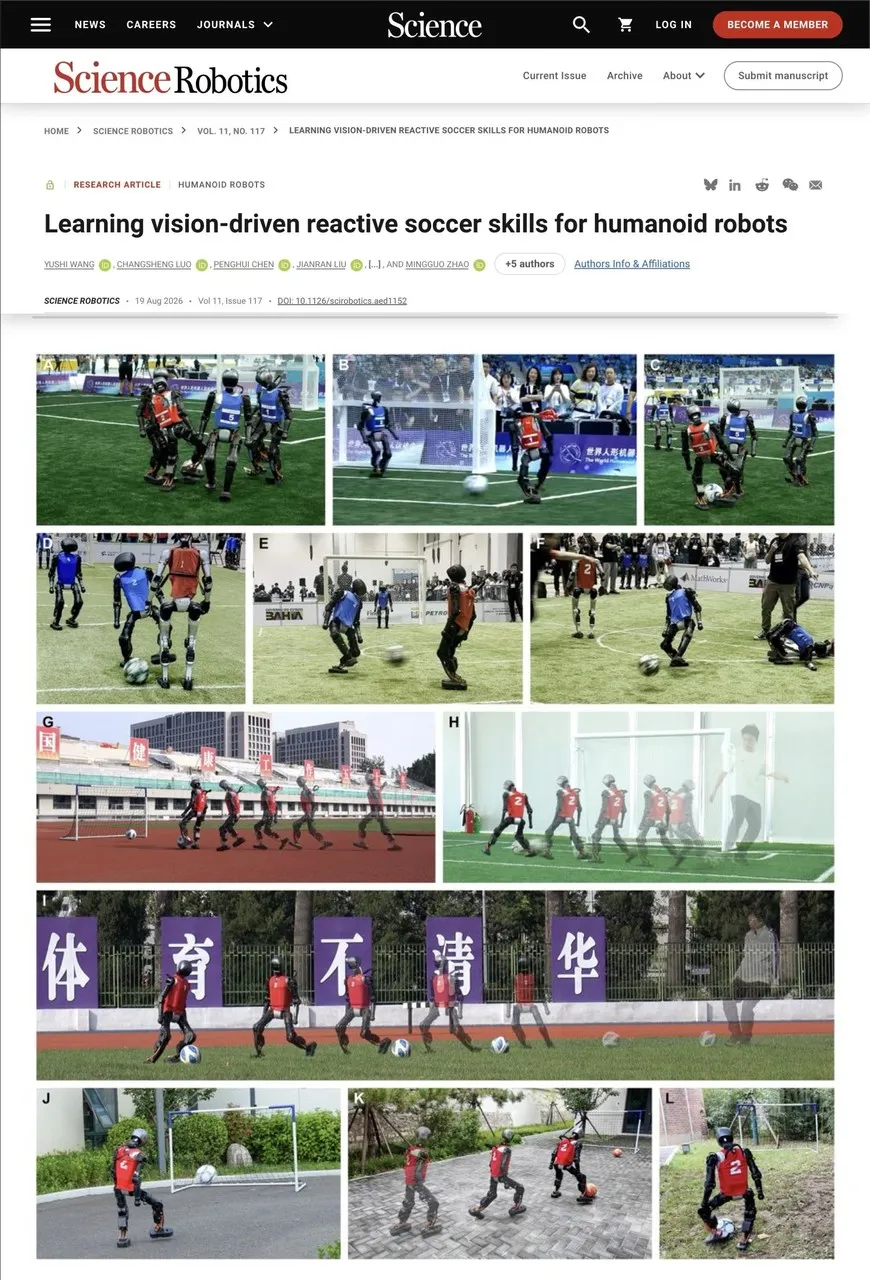
More impressive was the actual combat testing. The team from the University of Qinghai, Hephaestus, used the controller as an independent module for the RoboCup 2025 Adult Size Robot League and the 2025 World Championship of Human Robot, ultimately winning the doubles title with 76 goals and only 11 losses. In the competition, the robot must operate completely autonomously, relying solely on car-loaded computing and sensing systems, and strictly prohibiting the use of laser radars or multi-camera systems.
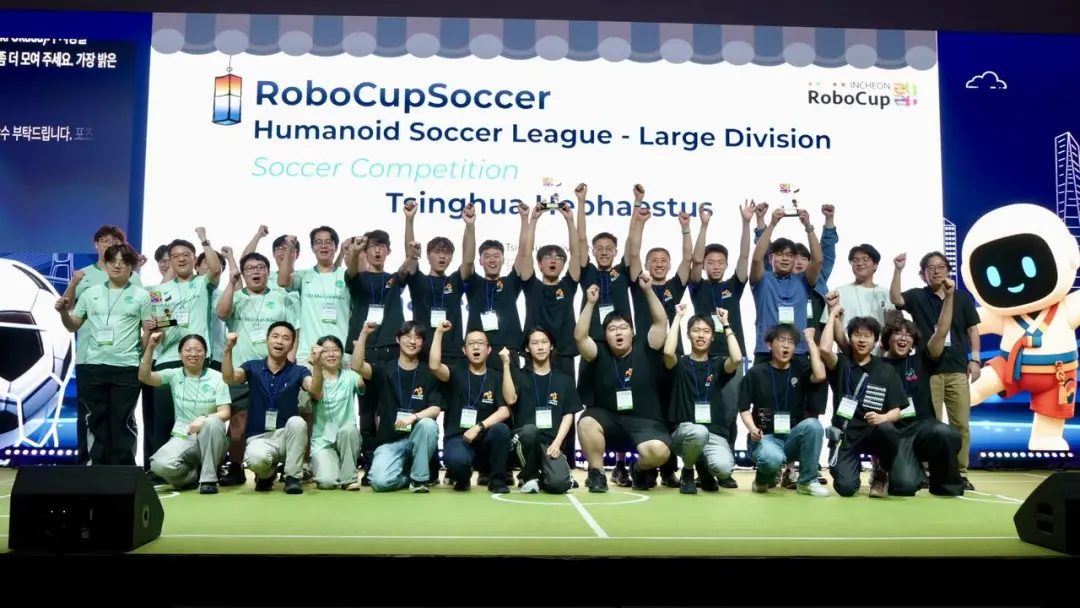
In July this year, the Qinghai Fireworks team successfully defended their title at the 2026 RoboCup in Incheon, South Korea, marking the most rigorous practical test of the technology in two consecutive world-leading events.
04.
Accelerated evolution: From academic breakthrough to industrial landfall
The research is supported by the accelerated evolution of the human-like robot hardware platform provided by Booster, and by the continuous simulation of the research to the real machine deployment tool chain.
Accelerated Evolution was founded in 2023 as a state-of-the-art enterprise specialising in the city of Beijing. The company builds on the vision of making humanoid robots as simple and reliable as computers.
At the most recent 2026 World Robotics Congress (WRC), its latest model of humanoid robot Booster T2 was unveiled. The T2 professional version featured the NVIDIA Thor flagship chip with an edge computing power of 2070 TFLOPS, 10 times that of the previous generation. The system delayed from 10 milliseconds to 4 milliseconds, providing a solid hardware base for complex real-time control and sensing tasks.
But the hardware is just the first step. Booster Studio, released at the same time, is a built-in integrated development environment with a built-in simulation toolchain that supports single-key deployments from virtual simulations to real robots, which means developers can skip the busy underlying adaptations, focusing directly on algorithm and application innovation.
As the CEO of Accelerated Evolution says: "Over the past two decades, the industry has been solving how to make robots better; today, the body is no longer the only problem". The value of a future robot depends on how many people are able to create new capabilities based on it.
05.
What is the meaning of this verse?
From the Robo Cup 2025 doubles championship to the 2026 Incheon championship, the results of two consecutive world championships at the soccer stadium confirmed the effectiveness and universality of this clay-sensitive clay-action clay mixing program. But more important than the trophy, the hardware platform that supports this research and accelerates the evolution of the Booster series is standardizing and producing championship-level algorithm capabilities.
With the launch of the Booster T2 and Booster Studio at the 2026 World Robotics Congress, developers and researchers now have a complete toolchain ranging from simulation to real-world key deployments that can quickly reproduce, modify and even exceed this milestone on the platform.
Carrying the ultimate vision of robotics winning the 2050 World Cup championship for humans in the RoboCup tournament, Prof. Kim Jong-un led the team to continue exploring the field of artificial intelligence. From the laboratory to the RoboCup championship podium, the football field has always been the most rigorous testing ground for artificial intelligence. But when top academic breakthroughs were encapsulated as replicable development platforms, the end of the competition extended to a broader industry scene.