A 10-millimeter-thick capsule flows into the stomach, pops out a needle, injects the drug into the tissue, and then takes the needle back.
The whole process was wireless, battery-powered, and a magnet stared at the outside, which was then heated with a loop of wire "next to the belly" and triggered.
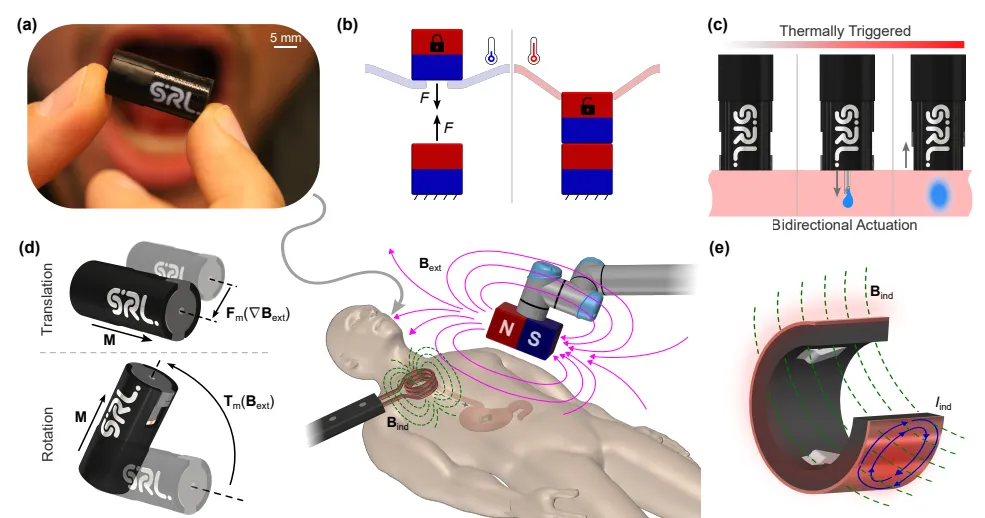
This is the latest paper from the University of Twente's Surgical Robotics Laboratory in the Netherlands, published in the collaborative journal Npj Robotics, a leading international journal, Nature.
The core of their new invention, the Thermally Triggered Magnetic Springs (TTMS), is a small device that produces newton-scale force on a millimeter scale and can be used to "burn to what degrees" to determine when to release force.
01.
In fact, most of the medications you take don't go into your body.
First, let's be clear about the problem.
Capsule robots, imaging, sensing, and magnetic-controlled navigation are not new, and magnetic-capsule lenses are even in clinical use.
The problem is that the vast majority of drugs given in capsules are simply poured into the gastrointestinal cavity, and then the drug is passed passively through the lipid layer, the upper layer of the skin, these physical barriers. These barriers work to block toxins and bacteria, which of course also block drugs. As a result, delivery efficiency is very low and the types of drugs that can be taken orally are strictly restricted.
Can you just stick a needle and send the medicine directly into the tissue?
Theoretically, of course, it's not easy, but it's not in engineering. Organizational penetration is typically measured at 1 Newton scale, with a mean of about 1.2 Newton, and the visual and tissue characteristics can be traced to several Newtons; the data cited in the paper is that it takes about 1 to 3 Newtons to penetrate soft tissue with an 18G needle.
In a millimetre-level, wireless capsule that can be pulled by a magnetic field, it produces so much force that it is almost impossible to solve it.
If the magnet is pulled directly by an external magnet, the magnetic field decreases at a distance of 1/L4 to produce several newtons tens of millimeters apart in the work space on a clinical scale, either the magnets are large and unrealistic, or the magnets are placed on the patient.

The other way is to use environmental changes (e.g. pH) to trigger pre-pressurized mechanical spring, which is powerful enough, but spatial control is almost zero, and there is a risk of premature mis-triggering. It is better to trigger with a magnetic field, but the reed switch can only be triggered by a weak field, which limits magnetic navigation.
One sentence: Power, controllability, navigation, the three have not been able to satisfy at the same time.
02.
A "hot" lock that locks force into capsules
The idea behind TTMS is straightforward: don't expect power from outside, it builds itself in the capsule.
A TTMS consists of two parts: one is a pre-pressurized magnetic spring with at least two permanent magnets, one of which can be freely displaced to store the magnetic momentum as the spring; and the other is a temperature-sensitive lock, the material is NOA63 ((Norland Products), a bio-compatible ultraviolet solidified polyamide-shaped memory polymer.
This material has a very useful dual characteristic: the higher the solidification temperature, the stiffness is permanently lifted; and the higher the ambient temperature, the stiffness temporarily softens.
This is where the game comes in. The lock can stay hard at normal temperatures and hold the magnetic spring's prepressure; once heated to a trigger temperature Tt, the lock softens, fails, and the stored energy is instantly released, turning into thrust or pull, specifically thrust or pull, depending on the direction of discharge of the internal magnet.
More importantly, this "trigger temperature can be programmed during manufacture".
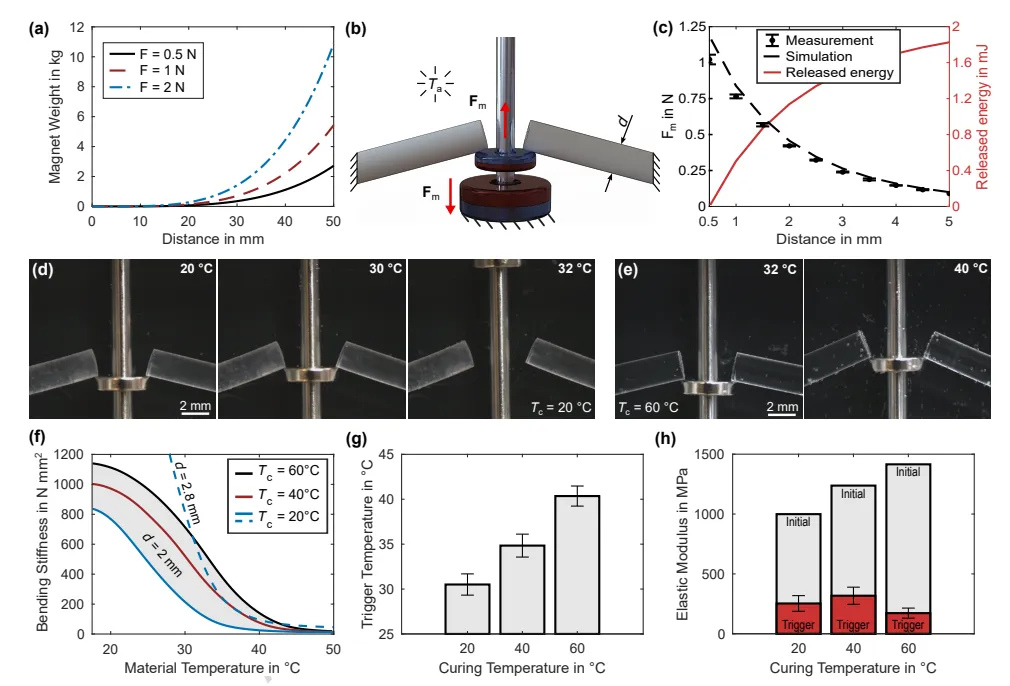
The authors verified it using the simplest version: two NOA63 beams (15 mm long, 2 mm in diameter) staring at two mutually exclusive ring magnets (0.8 Newton magnets per millimeter in spacing). The three beams were solidified at 20, 40, and 60 °C respectively, and then bubbled slowly in the bath to see when they "crashed".
The results are clear: beams that are 60°C solidified have a higher bending hardness at room temperature of 40% than those that are 20°C solidified and 300% higher at 30°C; while the solidification temperature rises from 20°C to 60°C, with the trigger temperature rising by about 10°C, while their elasticity patterns at their respective trigger temperatures are relatively close.
What does this mean? It means that geometrically exactly the same TTMS can have different trigger thresholds, and the output power is unaffected. Furthermore, the pump inserts several different TTMSs that trigger different temperatures into the same robot, requiring only a global "heating" signal to allow them to move in sequence without the need to address each executor separately.
Additionally, previous group work has shown that this type of NOA 63 mm-grade flexible structure decreases less than 2.5% in 50 recycled post-form variables and is still repeatable.
03.
A 40°C blast needle, a 45°C clamp, and a swine's stomach can be pierced.
Now put TTMS in the capsule.
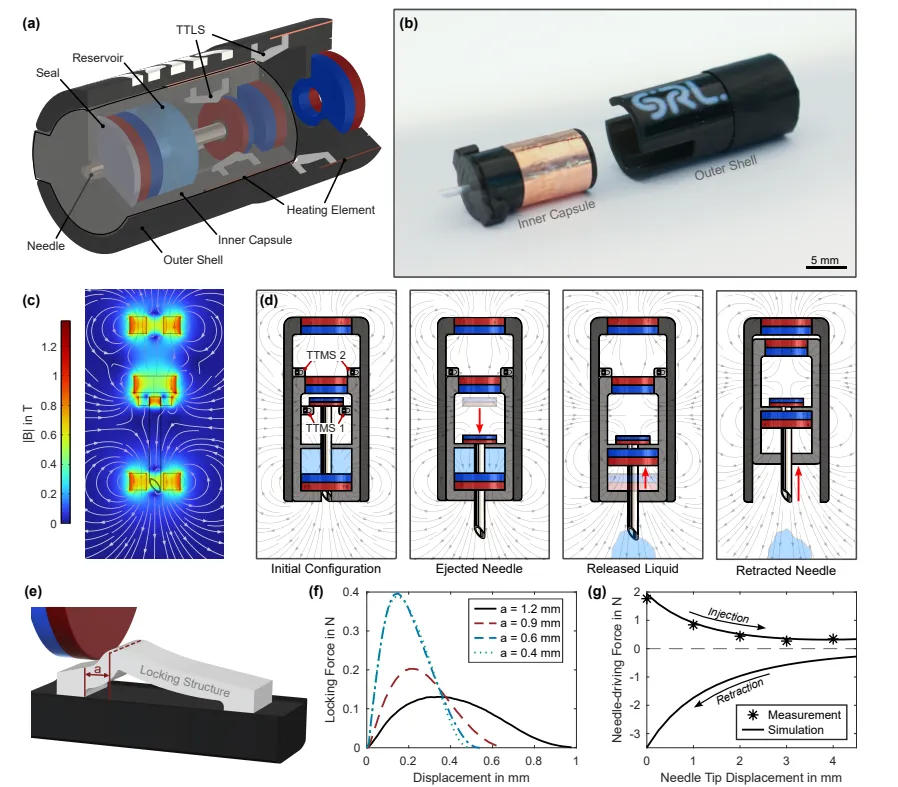
The capsule is cylindrical, 10 mm in diameter, 21 mm in length, divided into two parts of the inner capsule and the outer shell, with the subject 3D printed. The inner capsule is fitted with a needle for injection, three permanent magnets and the TTMS responsible for the "shooting needle"; the outer shell is a permanent magnet and the TTMS responsible for the "shooting needle".
Triggered by sensory heating: the capsule is outfitted with a 50 micron-thick copper band, the outer wire loop produces a switching magnetic field at 16 kHz, 400 W, and the magnetic navigation is used in a completely different frequency range between the two systems, so the capsule can be magnetically opened to the patient, and then re-heated after arrival, to avoid the needle being placed in advance.
The whole set of movements is quite well organized.
The first stage uses two mutually repulsive magnets, which are initially attached very close, triggering an instant peak output of about 2 newtons, with the needle stretching to decrease to about 0.5 newtons.
The third magnet is responsible for pressing the drug. It is magnetized with the magnet on the needle and is first fixed by friction; as the needle pops out, the magnetic force between the two increases, eventually overcoming the friction, compressing the inner capsule so that only the needle has come out, the drug will be squeezed out, plus a sealed capsule to prevent leakage, avoiding "the capsule on the tissue surface".
The second stage, in turn, uses two co-axis magnetization, an initial magnet at a distance of 5 mm, with an initial force of about 0.4 newtons, and a path to about 3.5 newtons during the action, pulling the needle back, shrinking the inner capsule into the outer membrane, to prevent the needle from continuing to stick to the tissue after the injection is completed.
Test results: The sensation is heated to the surface at about 40°C. The first stage is triggered, the needle pops out, blue dye is sprayed from the needle's mouth; the second stage is triggered, and the needle is recovered.
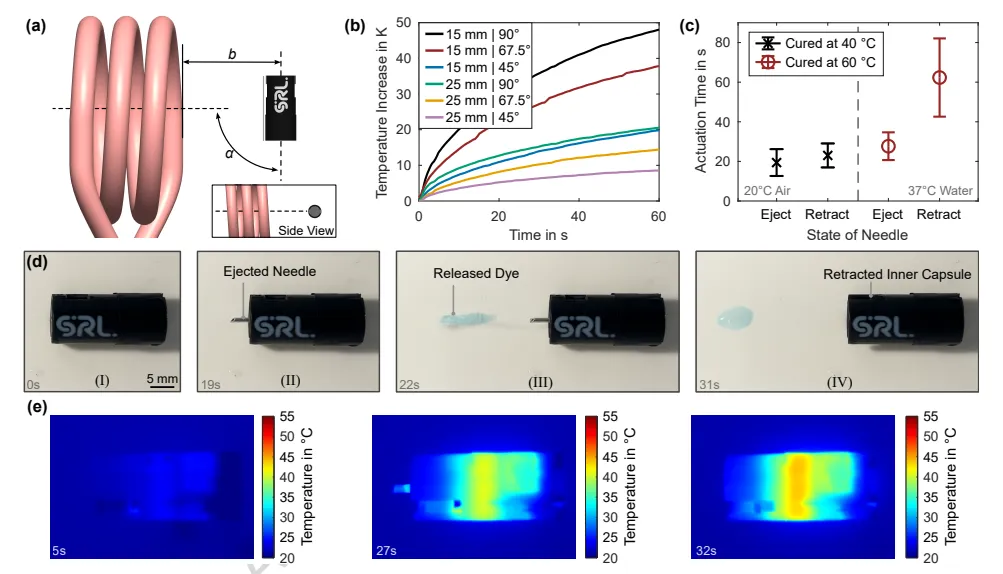
The heating capacity was also measured. When the wire-capsule is 25 mm away, the capsule axis is vertical to the wire axis, heating about 20°C for 60 seconds, which corresponds to a decrease in TTMS hardness of about 75-85%; even if the posture is 45°, the heating capacity can also be warmed by about 10°C, and the hardness decreases by up to 50%.
The "programmable" thing is most intuitive in environmental adaptation: 40°C solidified capsules in room temperature air, an average of 19±6.7 seconds of needles, 23±6.1 seconds of needles; and 60°C solidified capsules do not move how to bake at room temperature, but once placed in 37°C water it works perfectly normally, 30±7.0 seconds of needles, 60±19.8 seconds of needles.
In terms of mobility, the researchers used a handheld permanent magnet (diameter 30 mm, length 150 mm, N52) to rotate through gradient alignment and magnetic torque, completing bypassing, sliding and rolling over obstacles, respectively, in a labyrinth of three obstacles.
In the end, two scenes are closer to reality.
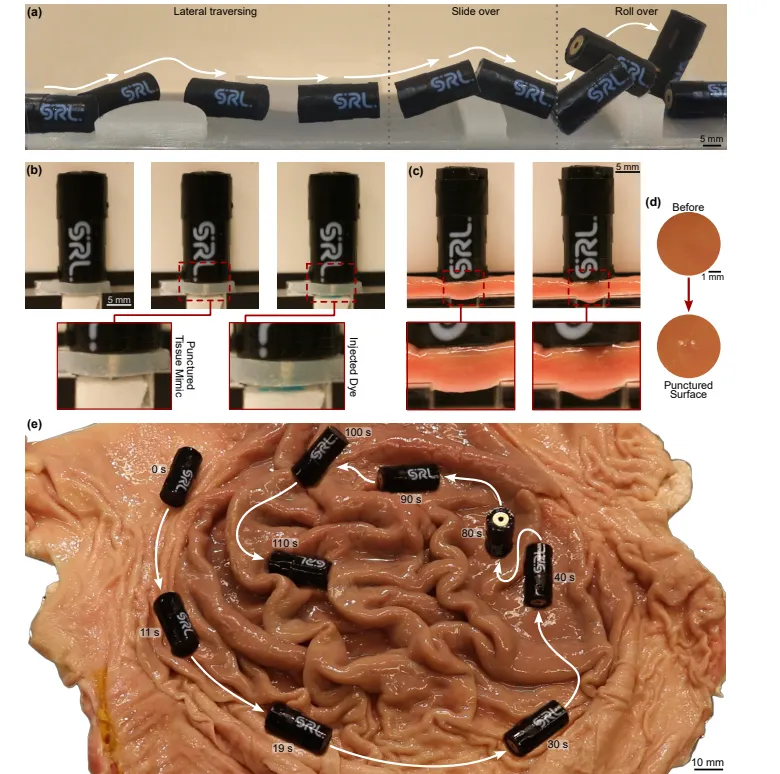
In the 1.5 wt% lipid soft tissue model, the needle was inserted 34 seconds later into the lipid slice, the dye was injected underneath the PVA sponge, and the needle was recovered for 6 seconds. In the stomach of the dissociated pig, the capsule was pulled by a magnet along a spiral trajectory to the center of the stomach, passing through the natural stomach lining; when switched to the piercing test, the needle popped out and penetrated the tissue clearly after 32 seconds after removing the capsule.
However, TTMS may be more than just a solution. After unraveling the concept of "force local drive" and "external magnetic field forces", it can in principle also be used to generate a global stimulus and a series of programmed sequential actions in Newton-level intervention scenarios such as live-testing and induction, which was difficult for millimeter-level robots in the past.
Address of the paper: