Recent text graphics models have evolved rapidly, but each work involves independently introducing an entire set of models, data and training designs, and then using private data to train a bright model.
Due to the lack of adequate dilution experiments, reproducible training formulas, and reproducible data formulas, researchers often find it difficult to determine where the best model performance comes from: better training data, or a specific model or training design.
If there is an excellent performance model that is fully reproducible from the training code to the training data, researchers can do more expansion and control of fusion experiments together to more accurately analyze and understand the real impact of different designs.
Recently, the i1 model released by a team at Princeton University responded to this need.
i1: A Simple and Fully Open Recipe for Strong Text-to-Image Models
Link to the paper:https://arxiv.org/abs/2606.11289
The main page of the project:https://zlab-princeton.github.io/i1/
The code is:https://github.com/zlab-princeton/i1
The data collection:https://huggingface.co/datasets/zlab-princeton/i1-captions
The team conducted more than 300 control experiments, using a total of more than 700,000 TPU v6e hours, and the system studied models and data design in the Transformers scattering model. Based on these experiments, they finally trained a Transformers model i1 with a parameter of 3B.
On the five benchmarks of GenEval, DPG-Bench, PRISM-Bench, CVTG-2K, and LongText-Bench, i1 averaged 29.5 percentage points ahead of the best open-source models before it. In these main focuses, the overall performance of i1 is also close to that of models with partially larger parameters and only open weights, such as the Qwen-Image of 20B.
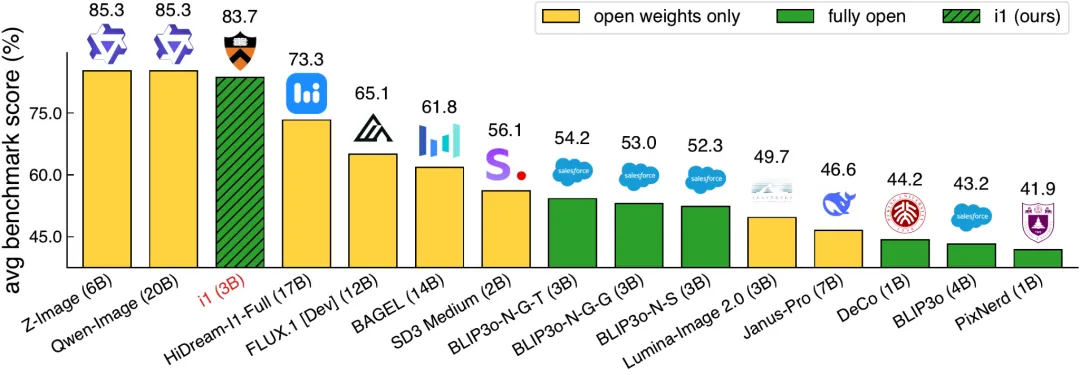
Average performance on the five text graph benchmark. i1 averaged 29.5 percentage points ahead of the previous best-performing open-source model, and close to several open-source-only leading models.

i1 Selected examples on general image generation tasks

i1 Selected examples of text rendering tasks
Control of experiments
The team's exploration was based on a simple and representative vernacular baseline: for the model, features were extracted from frozen text encoders in a shallow fusion manner and entered into a DiT network trained in flow matching from scratch; for the data, a combination of 12 open image datasets was combined, and VLM was used again to generate growth captioning.
All control experiments started from the same 256×256 resolution pre-training baseline, changing only one design each time to evaluate the impact of different models and data designs.
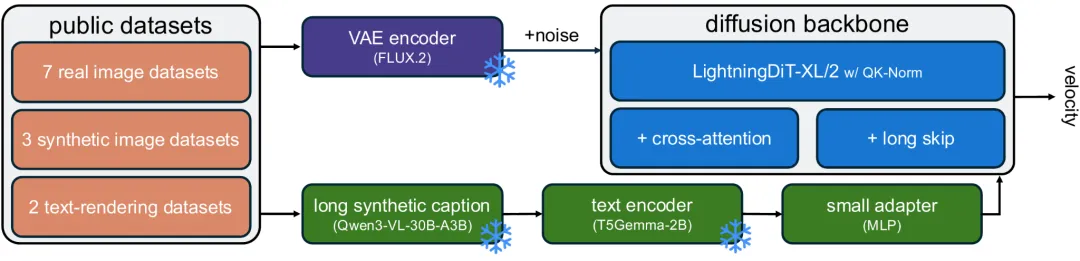
Starting from a single baseline, i1 conducts control experiments on a series of models and data designs
In terms of models, the team's findings include:
(1) Multiple text encoders can improve the performance of the model at the same time, but an adapter that increases the size of a single text encoder can also achieve similar results and lower computational costs.
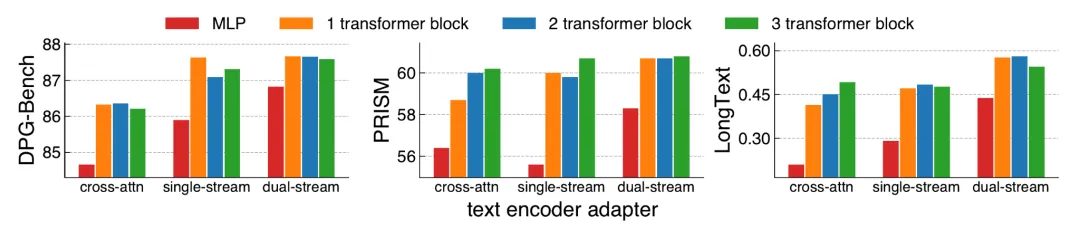
A slightly larger adapter of text encoder size is able to steadily improve performance on different backbones.
(2) AdaLN has a large number of parameters, but the additional benefits of AdaLN input timestep embedding and pooled text embedding are limited.
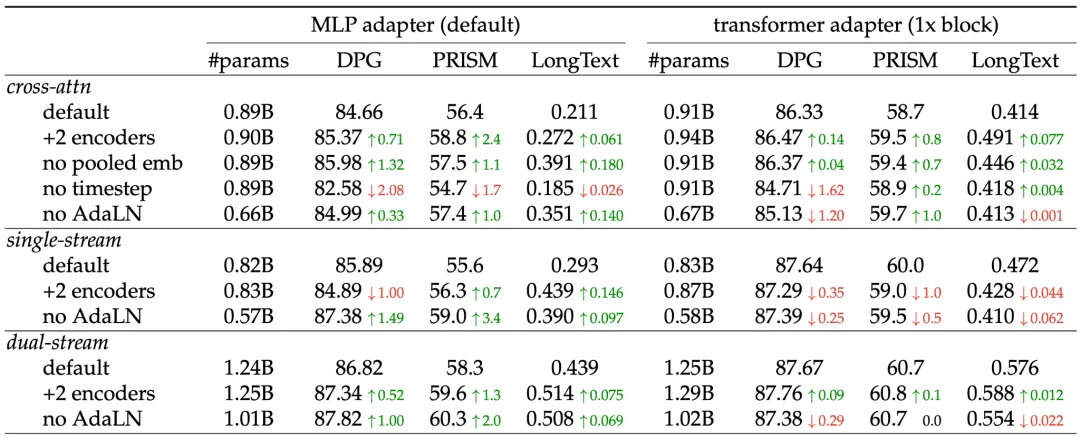
Additional benefits of timestep embedding and pooled text embedding with AdaLN are limited.
(3) In mainstream network design, under the same parameters, the dual-stream model is superior to the single-stream model and the single-stream model is superior to the cross-attention model. U-ViT-like long jump connections can steadily improve performance when controlling parameters or FLOPs.
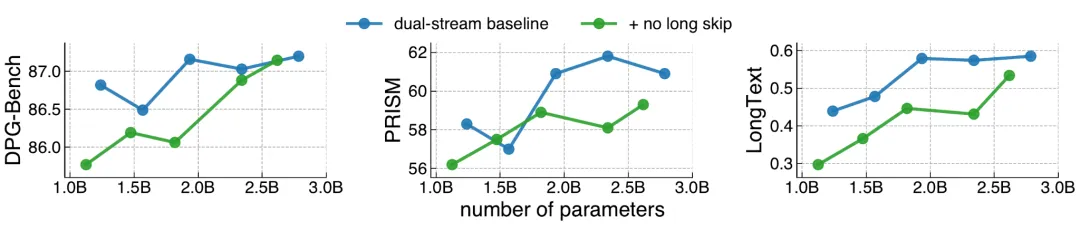
In the case of control parameters, adding a U-ViT-scale long jump connection can steadily improve performance.
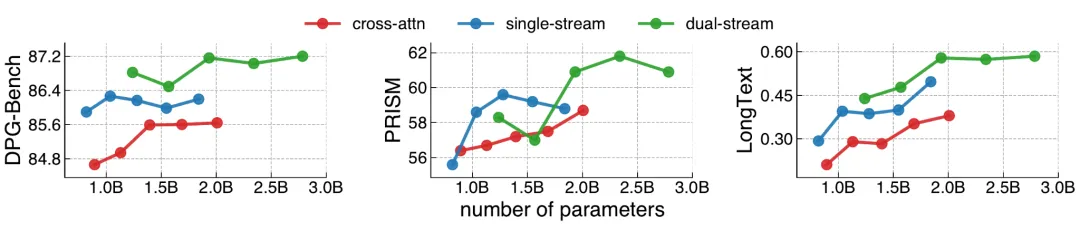
In the case of control parameters, dual-stream is better than single-stream than cross-attention.
In terms of data, the team's findings include:
(1) Training on short captions will undermine the overall performance of the model; while long captions can train stronger models, such models do poorly on short prompt.
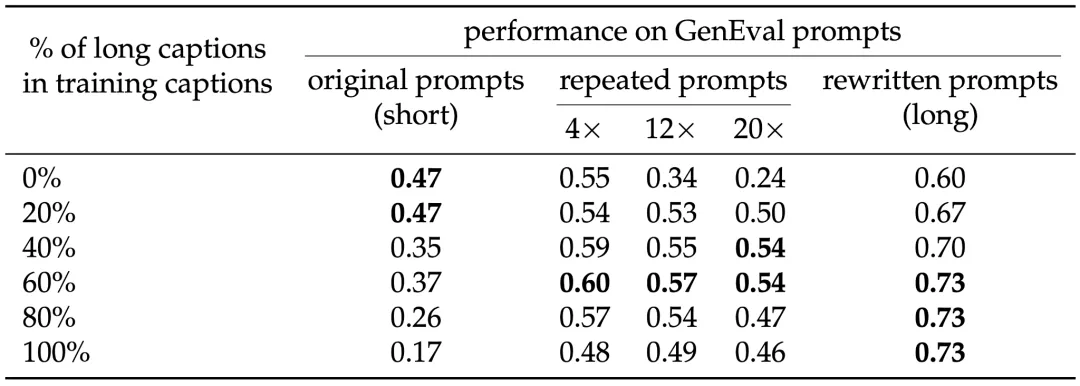
After training with different proportions of long and short captions, the model performs on different types of prompt.
(2) When the data set is diverse enough, repetitive training on smaller data sets will not significantly affect student graphics performance.

After the subsample of the data set to different sizes, the model's performance
(3) High-resolution training does not require extensive data coverage and can retain or even enhance the ability to learn at low-resolution training stages (e.g. text rendering).

Models that only retain specific datasets for 512×512 resolution training perform well. Even without the use of specialized text rendering data, the text rendering capability of the model can be significantly improved.
The ultimate i1 model
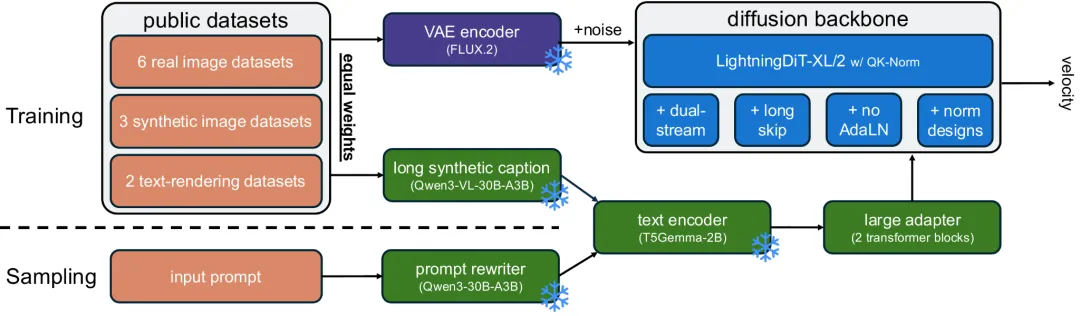
The overall model framework of i1 does not introduce complex new modules, but combines a simple design with multiple controlled experimental verification.
Based on the conclusions of the control experiments, the team combined several simple and effective designs to train the 3B parameter i1. It performed more closely to multiple parameters on the five mainstream text graph benchmarks, with only open-weighted models. i1 was also the first fully open model to achieve more accurate generation of text rendering, with scores of 0.8531 and 0.922 on CVTG-2K and LongText-Bench respectively.
i1 Performance in the evaluation of the text graph
Summary
i1 shows that training a competitive text graphics model does not necessarily depend on hard-to-access private data, opaque training formulas or complex model components: using only public datasets and building a concise formula based on systematically controlled experimental verification designs can also achieve a stronger level of ability in pronoun tracking and text rendering.
At the same time, the reproducible training formula i1 also provides a unified starting point for VBS studies, enabling researchers to evaluate new models or data designs under controlled conditions and to understand more accurately the real impact of different changes.
Introduction by the author
The first author was a first-year Ph.D. student at Princeton University and an undergraduate at the University of Pennsylvania, where his research focused on visual model generation.
The communications writer is an assistant professor at Princeton University. His research focuses on building AI systems that can better perceive and understand the world, analyzing how models work, and using AI to accelerate scientific research. He has won CVPR's best paper award for DenseNet, ConvNeXt, among others.