When the self-driving car races at almost 300 km/h on the F1 track with the car's offensive defense, interaction betting, the problem it faces has long been not only to improve lap speeds.
In extreme cases of high-speed speeds, the car must complete positioning and perception in a very short time, judge the position and intentions of the surrounding opponents, predict the interaction results after a few seconds, and decide whether to overtake, defend or slow down; at the same time, all decisions must be strictly bound by tyre attachment, vehicle dynamics, execution capabilities and stability boundaries.Once cognitive bias occurs, it can quickly evolve into real physical instability; changes in physical capacity boundaries, in turn, change the decision-making space that an intelligent body can choose.
That's right.Team of the AutoMan Lab at the South China University of Technology in SingaporeTrying to explore the question: What are the boundaries of a physically intelligent body's ability to integrate perception, positioning, prediction, decision-making, and control in extreme real-world conditions, and how will its cognitive limits and physical limits interact?
To address this issue, the team built an experimental platform for autonomous equation racing.Extreme physically intelligent body architecture centered on world modelsContrary to perceiving, predicting, planning, and controlling as separate modules, the system uses world models to predict opponents' interactions, automotive dynamics, and range of motion, and continually optimize intelligent agents through real racing data and internal simulation locks.

Title: Toward the Cognitive-Physical Limits of Embodied Intelligence through a World-Model-Centric Autonomous Racing Agent
Affiliation: 1) School of Mechanical and Aerospace Engineering, Nanyang Technological University, Singapore; K2 Holding, L.L.C, Abu Dhabi, United Arab Emirates
arXiv: arxiv.org/abs/2608.10618
It is a platform for self-driving cars.
Exploring the cognitive physical limits of a physically intelligent body
The core of physical intelligence is the ability of an intelligent organism to perceive, understand, make decisions, and act through continuous interaction with the real physical world. However, a large number of robotics and physical intelligence studies are still conducted in relatively conservative security environments or in environments of moderate complexity. This is important for validating algorithms that can't work well, but it's difficult to answer another more fundamental question:Smart bodies are deployed in the real worldWhat are the boundaries of security and reliability?
The research team broke down the problem into two interconnected aspects.
It's the first time I've ever been in a relationship with a person.It describes the ability of an intelligent organism to construct and update its understanding of the world in high-speed, dynamic and uncertain environments, and to make predictions and decisions accordingly. For self-driving cars, it includes high-speed positioning and perception, predicting the interaction of opponents, and choosing safe, viable and competitive decisions in a very short time.
The physical limit is the physical limit.It describes the range of motion that an intelligent body can actually perform. It is bounded by factors such as vehicle dynamics, tire rolling action on the ground, performance of the actuator, aerodynamics, road friction, tire temperature and stability.
The key is that these two types of boundaries are not independent of each other.
In the racing scene,Intelligent entities need to simultaneously face high-intensity antagonistic interactions and near-boundary dynamic controls.Vehicles need to complete positioning, perception and state estimates within a very short period of time; they need to constantly judge what other vehicles might do in the future; while their control movements are also tightly constrained by tyre attachment, actuator capabilities and vehicle stability. Any cognitive errors can quickly turn into physical risks when vehicles approach physical limits. Changes in physical performance boundaries also directly alter the decision-making space that intelligent agents can choose.
This is why we are here.Self-driving cars are not only an important platform to validate the performance of self-driving systems, but also provide a natural platform to explore the boundaries between cognitive and physical intelligence.。

A2RL: Putting physical intelligence into the real world of high-speed, interactive physics
The study is based on the world's largest F1 level autonomous driving equation racing league (A2RL). The A2RL uses a unified full-size Super Formula racing platform, placing autonomous driving systems directly in high-speed, near-limit and multi-vehicle interaction environments, and constructing a complete racing system ranging from high-fidelity simulations to full-size laboratory verification.
As the tournament continues to expand in size, the team has expanded from its original eight to 11 teams.Germany, Italy, the United States, Japan, France and ChinaOther countries, including top international tech companies, universities and research institutions in the fields of automotive engineering and artificial intelligence.
The Kinetiz team was formed jointly by the South Asian University of Technology, the UAE AI technology company K2, and ALP Autonomy.In the online simulation competition, Kinetiz later won titles at Autonodrome, Yas Marina North and other stations.SIM-Sprint champion of the year 2025In the online Abu Dhabi full-size live car race, the car achieved near 260 km/h of high-speed autonomous driving and successfully achieved its best result in the Grand Final at the Abu Dhabi Terminal F1 circuit in 2025, finishing fourth in the world (and first in Asia) in 2025.
More importantly, ongoing simulation and real-world car racing have accumulated a large amount of data for the team that is difficult to access in ordinary experimental environments, including successful cases of high-speed stable operation, supercar and defense, as well as extreme working conditions that are close to the risk of instability or even out of control. These data are an important basis for continuous learning of the world model.

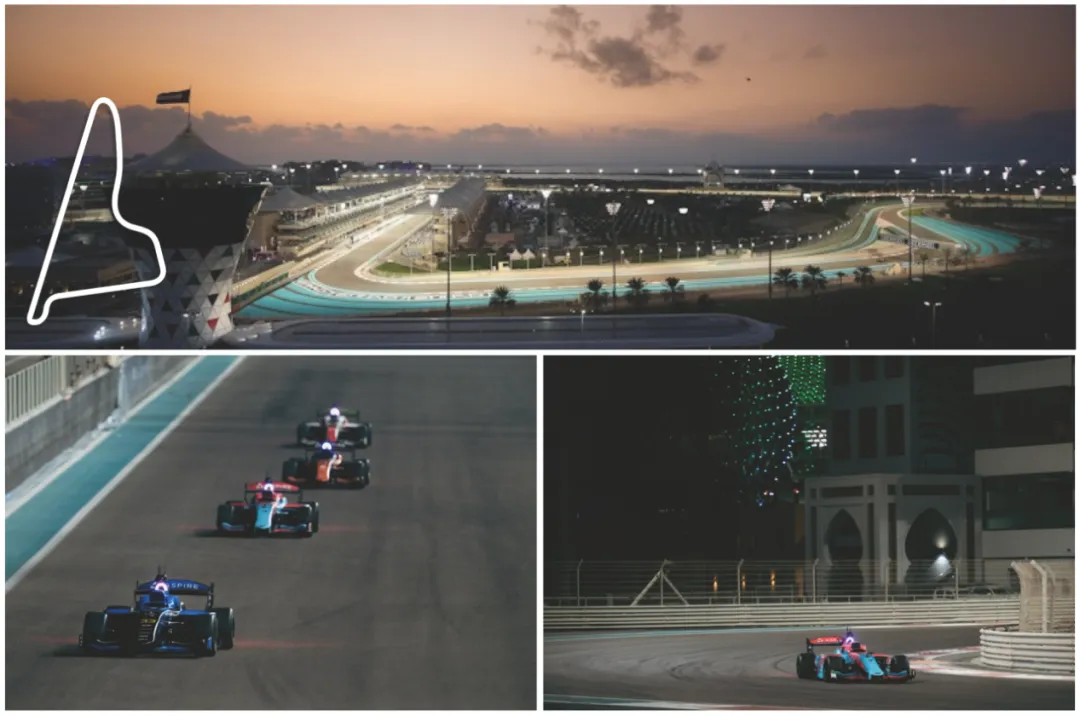
Self-driving race car smart body based on world models
Traditional self-driving systems typically work in stages along the chain of "perceived steam prediction steam planning steam control".
However, in near-extreme racing environments, small errors in a module can be quickly transmitted downstream.
A supercar move that seems reasonable from the current state may turn into a collision a few seconds later due to an opponent blocking the route; a trajectory that is geometrically feasible may not be actually executed because the tire is close to the attached limit.
So the team took theThe World Model is placed at the center of the entire intelligent body.This model of the world describes three things simultaneously:
One is.How external interactions will evolveFor example, an opponent can accelerate, defend, allow or maintain the current course.
The second one.How will the car respond?What changes in velocity, horizontal acceleration, horizontal and lateral oscillations will occur as a result of different oil doors, braking and turning inputs;
Three is.What else can we do now?The current speed, friction, tyre temperature and vehicle condition of the wheels, which movements are still within the range of practicality.
With such an internal prediction model, the intelligent body can no longer only make decisions based on "what it sees now", but can project multiple futures internally before actually executing it.
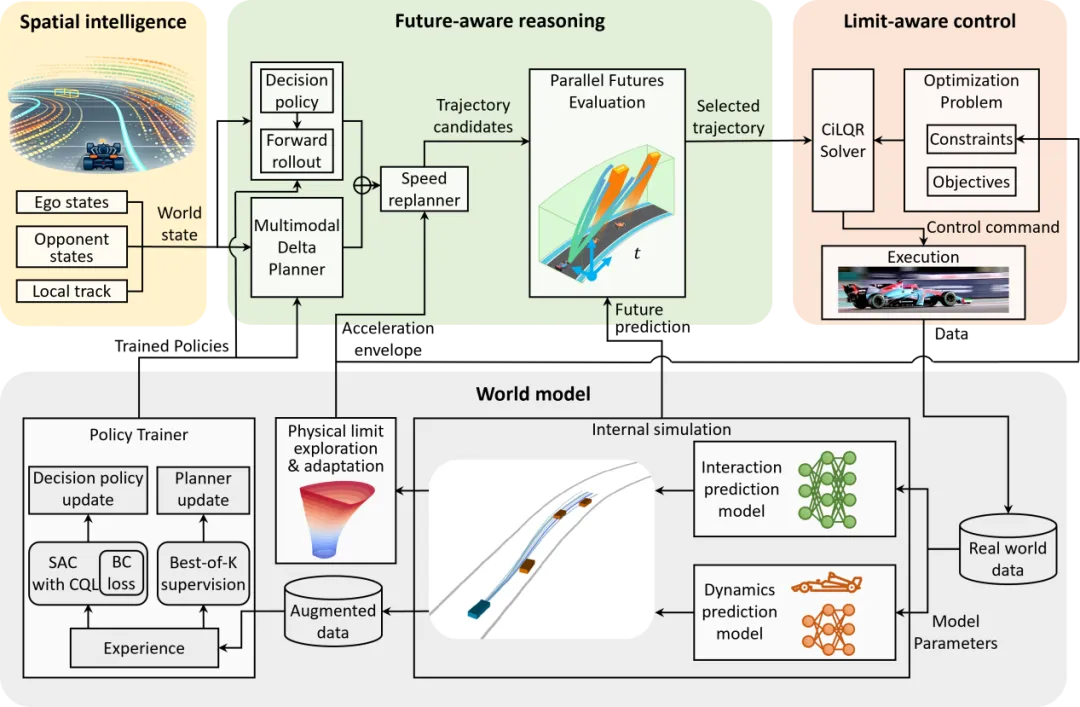
In a world model, "think again" and decide what to do.
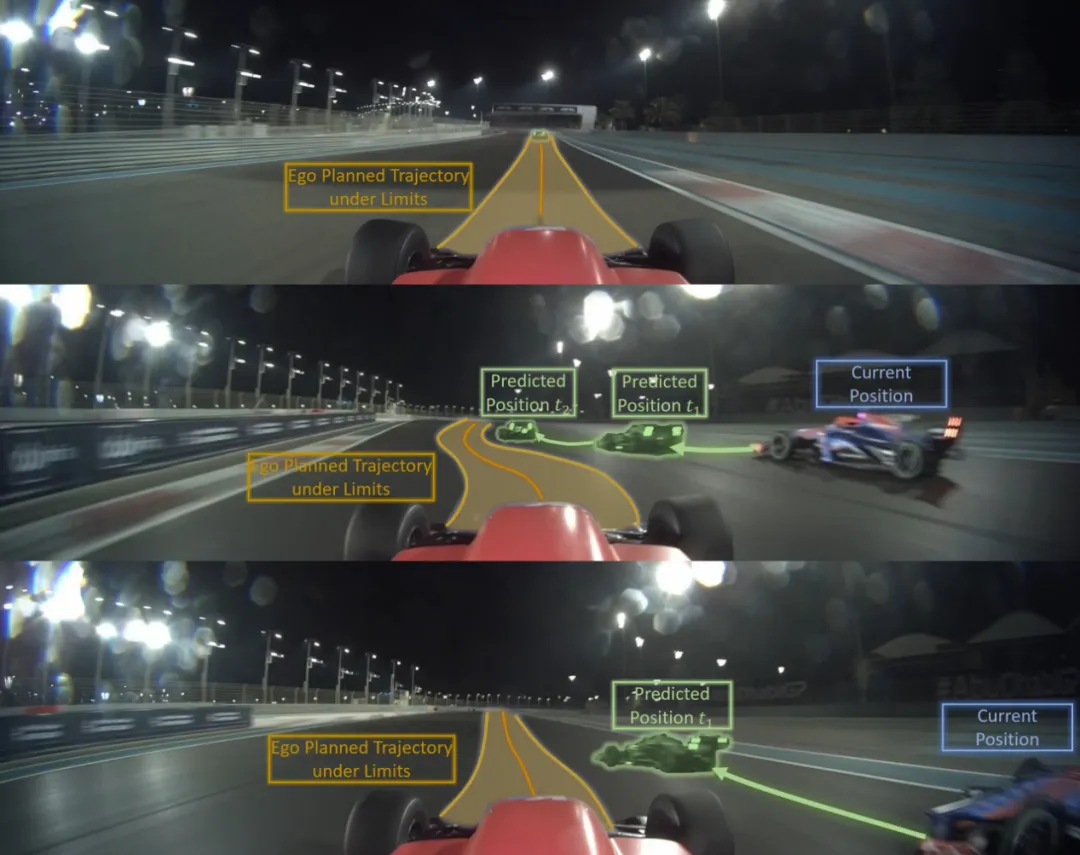
During the decision-making phase, Mr. Chief Systems forms a major decision-making trajectory and forms candidate trajectories around it with a number of different strategies. Subsequently, the world model propels these candidates forward and forward.
What would the opponents do if they chose a left-handed supercar?
If the acceleration continues, is the dynamic status of the vehicle still controllable after a few seconds?
While a route is faster, will it allow vehicles to enter inaccessible dynamic zones?
Integrated systemsInteraction security, physical feasibility and speed efficiencyAssessing future outcomes, filtering out high-risk actions before they are actually executed.
In real wheel-to-wheel supercar data, the world model's predicted opponent movements are more consistent with the actual interaction process. The dilution experiments show that in the same scenario, the intelligent body with the world model is able to identify the potential collision risk beforehand, while in the absence of future predictions, a seemingly reasonable action can eventually lead to a collision. This reflects the important role of the world model in extreme environments:It is important to include "what could happen in the future" in current decisions in advance.
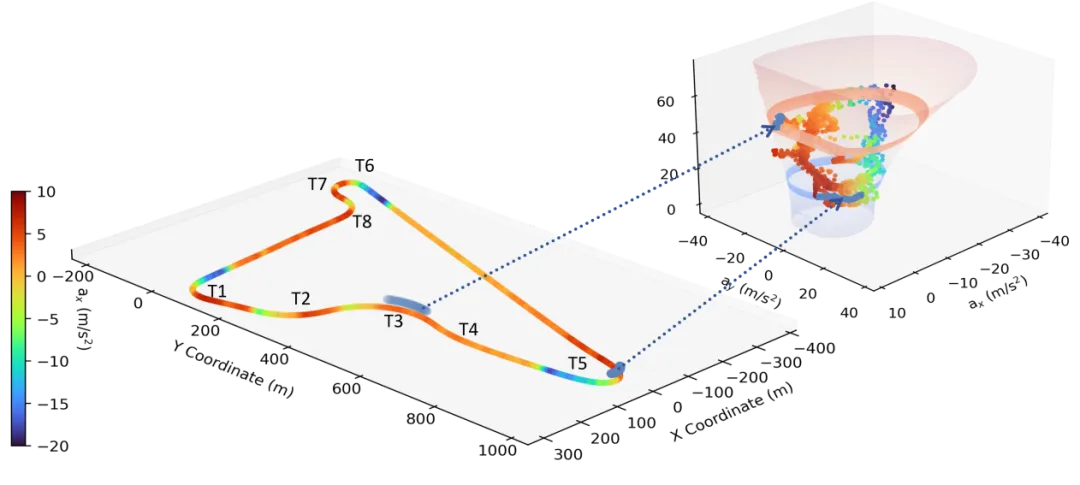
From the cognitive limit to the physical limit
It is not enough to predict a reasonable move, but ultimately to make it possible for a real vehicle to do so. To do so, the team further used world models to describe changes in vehicle speeds and operating conditions.Accelerated networking。
At the same time, tyre temperatures, road friction, and model prediction errors also change the physical limits of actual availability.
The controller uses the physical boundaries of these dynamic changes to restrict vehicle movement so that the planned trajectory can eventually be transformed into real executable direction, braking and acceleration instructions.
Real racing data shows that the highest256.3 km/hIn high-speed operation, the system is still able to maintain stable positioning and state estimates; peak horizontal acceleration is achieved.26.8 m/s²The study of near-extreme vehicle dynamics provides real physical data for world models.
The team also focused on a case of instability in a real race car.
In high-curvature tunnels, if the vehicle accelerates abruptly under a larger horizontal load and the tire temperature is not ideal, the vehicle may quickly lose attachment and rotate. The team reintroduced this true failure data into the world model and used the tire temperature and world model to predict the physical performance limits of the deflection dynamic contraction that can be used.Failure is no longer just an accidental data, but a learning signal for an intelligent organism to recognize its limits.
From real data to world models, back to stronger strategies.
The whole system is not fixed after training.
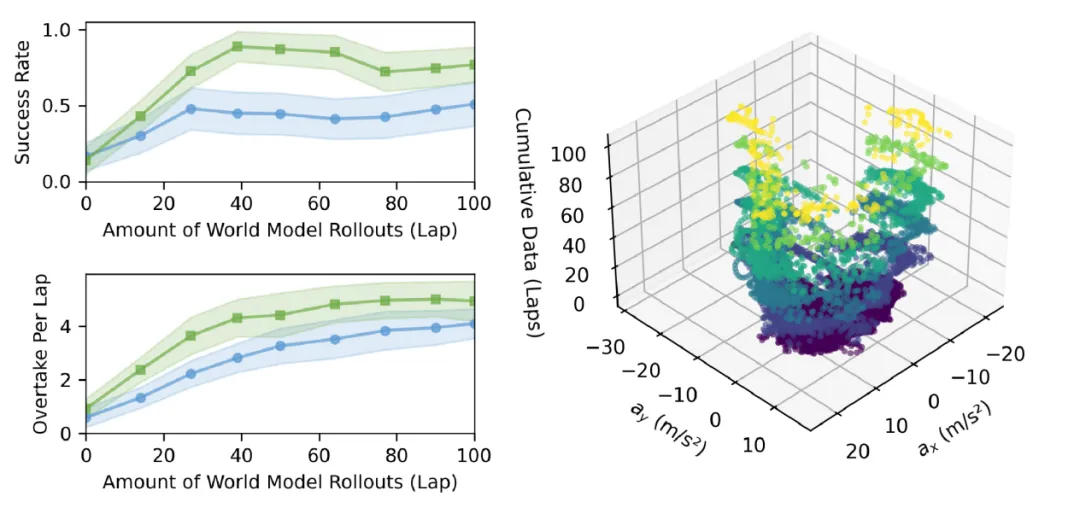
Real cars are constantly generating new dynamics, interaction and limit performance data, which are primarily used to update world models; updated world models are reproduced into more interactive scenarios and near-limits that are difficult to collect repeatedly on real racetracks to further optimize decision-making and planning strategies.
This has led to a continuous closure:
Real racing data → World model updates → Internal future rollout → Strategy optimization → Next round running.
As this process continues, the intelligent body not only runs faster but gradually learns to use its cognitive and physical abilities more effectively.
In a full-size self-driving racing simulation, the method was achieved in complex confrontation scenarios.88.3%The interaction success rate improved compared to BC and SAC respectively.40.8%and29.3%The average safe distance travelled is more than 50 kilometers.6.4 kmAs the world's models and strategies continue to evolve, the average cycle in simulation shrinks.17.9%The average speed increases.22.0%The average number of single-cylinder supercars is:2.78Increased to4.80The collision rate is.41.9%It's coming down.5.8%The system was also further tested on track layouts that did not participate in training. Different tracks have different curvature distributions, continuous tunnels, high-speed straightways and supercar opportunities to test whether the intelligent organism "remembers a track" or is able to migrate previously learned world-understanding and limited usability. The results showed that the intelligent organism still maintains close to a 90% success rate of interaction on multiple unseen tracks, demonstrating a certain zero-sample migration ability.
From understanding the world to understanding yourself.
This study is not just about how to build a faster self-driving car. For a physically intelligent body that is actually entering the physical world, it is not enough to understand "what is happening in the outside world".What is the next step to take when cognitive and physical conditions are bound together?
Self-driving cars offer an extreme but clear research scenario: where cognitive errors can quickly turn into real physical risks, and changes in physical limits can instantly change the decision-making space of an intelligent body.
By placing the world model between perception, prediction, decision-making and control, the team attempted to create a new closed loop that enabled the intelligent body to continuously update its understanding of the outside world and its capabilities from success and failure, and adjust its behavior accordingly.
This notion is not confined to racing cars. High-speed mobile robots, drones, foot robots, robotic collaboration systems, and robots with complex interactive dynamics all face similar problems: intelligent agents not only need to become smarter, but they also need to know what they can do and how much they can do in their current environment. In this sense, racetracks may not only be competing for speed, but are also becoming a laboratory for the study of extreme physical intelligence.
About the AutoMan Lab
The AutoMan Lab, an autonomous and man-made systems laboratory at the South China University of Technology in Singapore, is focusing on fundamental research and technological innovation at the forefront of human-centred multimodal robots, autonomous driving, physical intelligence, world models, and man-made hybrid intelligence.