On August 19, during the WRC 2026, the "Physical AI Leaders Forum" organized by Trans-Dimensional Intelligence was held in Beijing.
Prof. Jaquie, founder and CEO of Trans-Wise Intelligence, Chinese University of Hong Kong (Shenzhen), founder and CEO of Intelligent Future, Canadian Institute of Engineering Foreign Scholar Mei Min, chairman of the board of directors for robotics, co-founder of Shenzhen Technology, Wang Xiaogang, associate professor in the Department of Computer Science, Suzhou, Chinese University of Hong Kong (Shenzhen), associate assistant professor Shenzhen University of Science and Technology at Shenzhen University of Hong Kong, as well as the heads of algorithms and technology at companies such as guava robots, critical points, Intelligent Infinite, and others, gathered on the ground.
From generative world models, physical data and basic models, to cross-body learning, simulation training, and real-world deployments, the forum puts multiple technological routes in the field of physical AI on the same agenda. Although the routes are different, the focus is highly consistent: how physical AI moves from "understanding the world" to "doing tasks" and how it moves from a few successful demos to a sustainable scale-down.
At the forum, Jacqui delivered a talk on the topic of Physical Token Economics, cut from a "capacity cost account", in which the system explained the concept of Physical Token and how to measure the production cost of reliable physical intelligence.
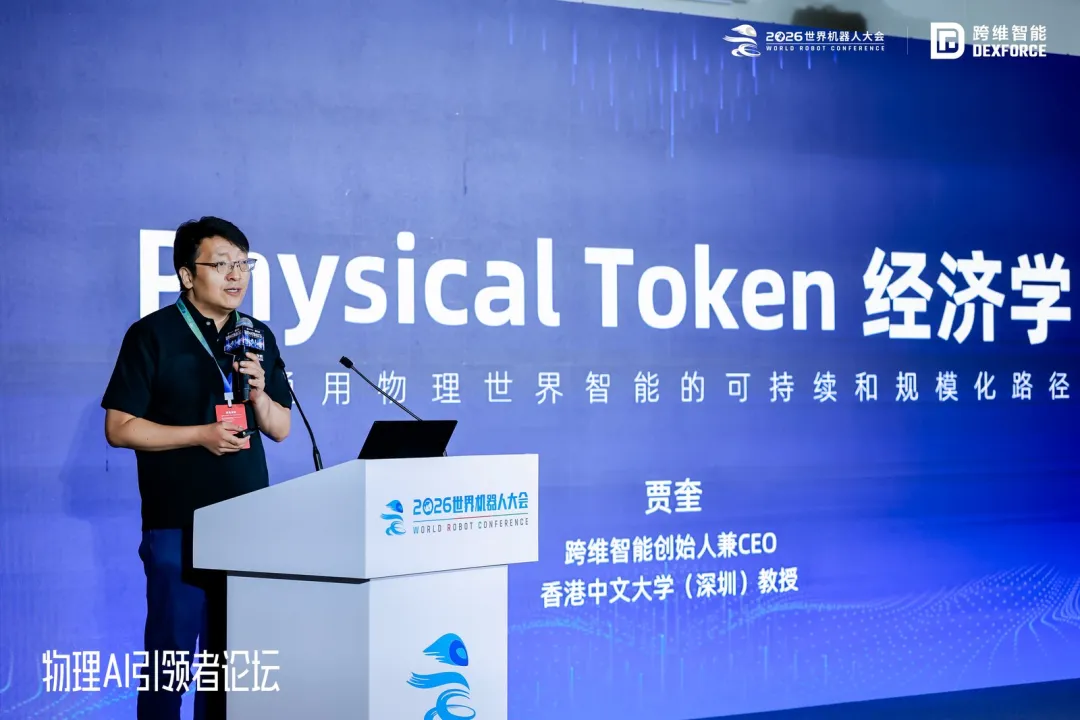
At the end of June, trans-dimensional intelligence announced the completion of a billion yuan B round of financing, with a post-investment valuation of more than 10 billion yuan, accelerating competition at the head of the physical AI track. Standing at a new industrial node, both the trans-dimensional and the entire physical intelligence industry must face a question: Will the path to universal physical intelligence be economically sustainable?
Moving towards universal physical intelligence without circumventing economies of scale
The ideal state of general-physical intelligence is for robots to enter unfamiliar scenarios and be able to replicate existing knowledge when faced with new objects and tasks, and to complete tasks with little adaptation or even without additional training. This is what the industry calls Generalist and Zero-shot.
The difficulty is not to draw the end, but how to get there.
Unlike the text, images, and videos that are available on the Internet, the actions, contacts, powers, and failures that robots require are largely acquired through interaction in the real world.
This puts physical intelligence in the face of a real contradiction: without sufficient physical experience, models are difficult to generalize; but if every new scenario is re-numbered, taught, trained, and modulated, robots will find it difficult to scale down.
If each new skill is learned at roughly the same cost, the robot will do more than just increase the number of projects. To get rid of project replication, existing data, models and deployment experience must be able to be continuously replicated: the data generated by one task serves more tasks, the failures encountered in deployment and the long-tail backflow models, and the data, training and manpower required in the next scenario decreases after the model is enhanced.
This is precisely the scale of the economy in which physical intelligence is needed, the boundaries of human capacity are expanding and the cost of obtaining the next capacity is falling.
From this point of view, scalability is not only the result of the maturation of general physical intelligence, but may also be a necessary pathway towards general availability. Robots first enter the real world, accumulate experience in continuous deployments, enhance models, and reduce deployment costs with stronger models.
The question has shifted from "what more can robots learn" to "how much human, data, and computing power will robots learn next?"
Physical Token Economics is trying to measure this bill.
From "How much can a model do?"
"How much will the next skill cost?"
Physical Token is not a simple action Token, nor does it mean that robots will have to be charged according to the Token in the future.
According to the trans-dimensional definition, Physical Token is "a unit of reliable physical intelligence capable of being produced by physical intelligences". This concept attempts to transform the intelligent production capacity of robots into an object that can be measured and calculated.
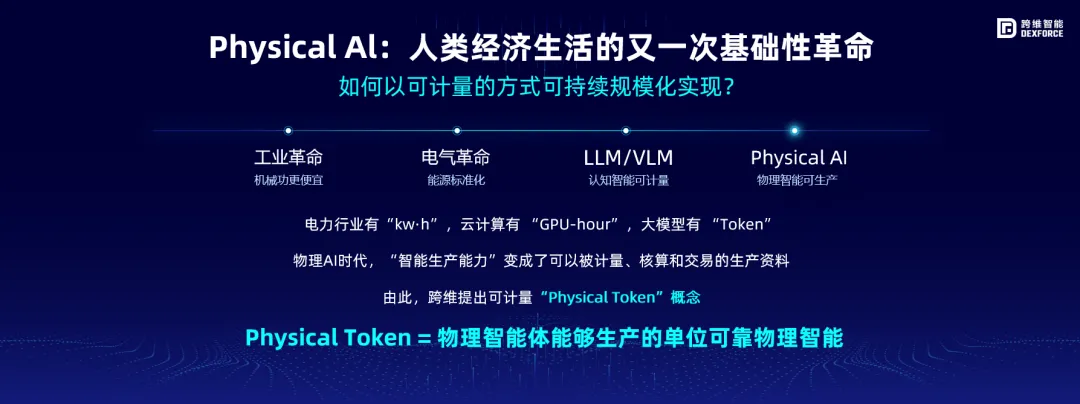
Therefore, Physical Token economics is concerned not with how one action counts, but with:
How much manpower, data and computing is required to produce units that are reliable for general physical intelligence?
It may take only a few seconds for a robot to complete a grab. But to make these seconds happen steadily in real-life scenarios, it is often followed by data collection, model training and engineering modeling. The movement itself is only a result, and the real cost is determined by a whole set of capability production processes before the action occurs.
According to the cross-dimensional breakdown, these costs depend mainly on three aspects: whether infrastructure can be absorbed from repetitive human resources into long-term tool assets; whether it can be used with as little expensive real data as possible to gain more effective training experience; whether data and models can be transnatural, cross-scenario, cross-task replication.
These inputs ultimately point to the same indicator:
Marginal Cost of New Capability The marginal cost of acquiring new capabilities.
If a robot expands from 1st to 50th and 100th capabilities, each requiring approximately the same amount of data, computational and engineering resources, the number of capabilities that increases is essentially project delivery.
Physical AI has only begun to have economies of scale when robots add a new skill, enter a scene or adapt to an entity, and the additional inputs required as accumulation continues to decrease.
Therefore, the measurement of whether or not general physical intelligence is established can not only look at the success rate of a single demo, but also at whether the limits of the model's capabilities can continue to expand, while keeping the cost curve of new capabilities downward.
It's the first time I've ever seen a robot.
It's essentially about reducing capacity production costs.
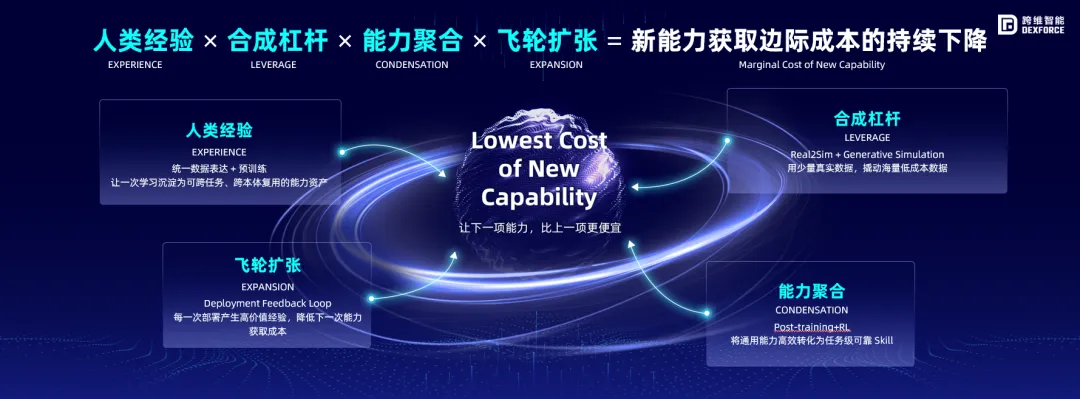
Starting from the marginal cost of acquiring new capabilities, re-examining the robotic technology lattice, we will find that data, pre-training, simulation, post-training and real deployment are not isolated from each other. Together, they solve one problem: how to get robots to use less data, computing and manpower when they acquire the next capability.
This pathway is broadly divided into four sections: human experience (Experience), synthetic leverage (Leverage), capacitance aggregation (Condensation), and aircraft expansion (Expansion).
Experience:
Making learning a reusable ability asset
There is no shortage of data in the robotics industry, and the problem is that it is difficult to directly replicate data from different sources.
Differences in body, camera, coordinate system, control frequency, and motion space divide data into one isolated island. If one data can only be used for one robot or one task, the cost of data is repaid every time a new skill is added.
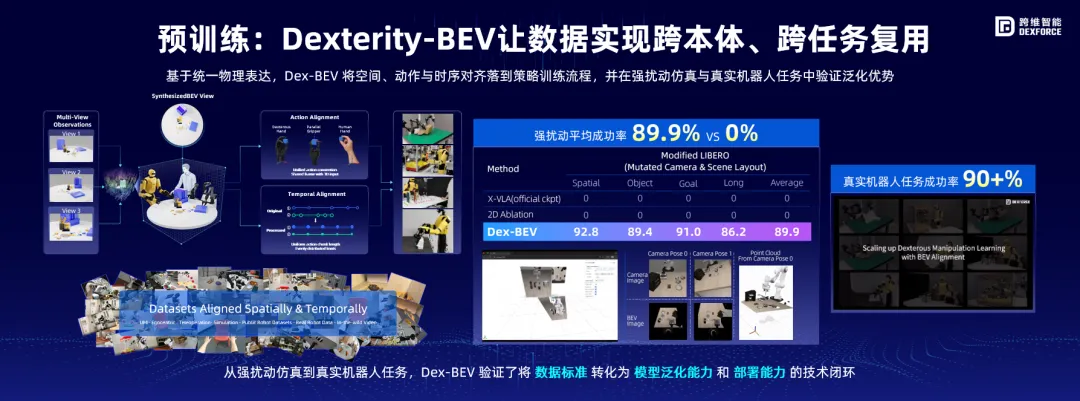
Therefore, the meaning of unified data expression and pre-training is not only to improve the model indicators of individual tasks, but also to allow the data already obtained to continue to serve new tasks and entities.
The interdimensional approach is to eliminate the inefficiencies caused by coordinates, formats, and labeling qualities by maintaining a unified coordinate system with effective differences in tasks, objects, and interactions. On this basis, Dexterity-BEV further completes the coordination of space, movement, and timing, enabling first-person, remote, simulation, and cross-body virtual machine data to enter a unified training system.
These data are then embedded into model capabilities through pre-training, allowing learning to form a trainable, transferable, and scalable asset.
Leverage:
Learn more about training with a little bit of real data
The cost of trial and error in the real world is high. Equipment needs to be occupied, people need to be involved, and failure can also lead to material loss and safety risks. If each new capability relies on a large number of real-world trial and error, it is difficult for robots to cover more scenarios.
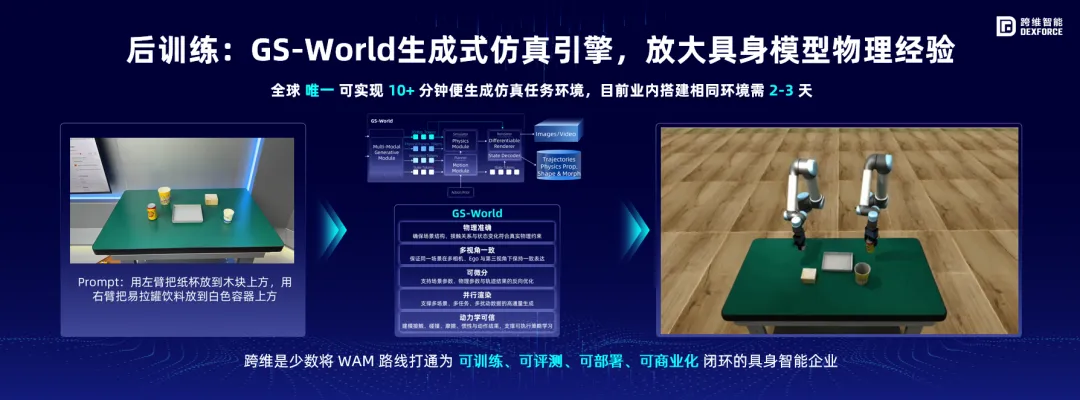
Real2Sim and the role of generative simulation are to move a large number of iterative trials and errors into a virtual environment that can run in parallel and automatically reset. A small amount of real data is a starting point for more low-cost training experiences.
The self-developed DexVerse intelligent engine is capable of generating high-performance simulation environments with physical properties such as rigidity, softness, sensation and touch, covering complex tasks such as flexible cables, fabrics, liquids, cutting and chain-like objects. GS-World's generated simulation engine further compresses the time it takes to build the simulation environment, which would normally take days to complete.
At the heart of this step is to use as little expensive real data as possible to harness as many effective training experiences as possible.
Condensation:
Transforming generic skills into reliable skills
The basic model is the accumulation of general knowledge, but after entering specific industrial, commercial and logistical scenarios, robots still need to translate this knowledge into task capabilities that can be stably executed.
If the model is retrained every time it enters a new scenario, it is still a project development; it is only on the basis of existing model bases that it is possible to build a production process capable of being replicated using simulation data, post-training and reinforcement learning to quickly complete task adaptations.
Therefore, the question of ability pooling is not "no further training" but how to efficiently convert general competencies into task-grade, reliable skills using fewer task-specific data, training resources and field engineering.
Expansion:
Reducing the cost of one capacity per deployment
After entering the real world, robots encounter endless failures in laboratory and simulation environments, border states, new objects and new tasks. These data often have a higher density of information.
If deployment of data remains in a single project, experience remains in an engineer's mind, and models remain in an expert's skill, then the next time you enter a new scene, you still need to start from scratch.
The key to the expansion of the aircraft was to establish a true feedback loop for deployment: the high-value data obtained in the deployment would be continuous backflow models, anti-breastfeeding pre-training and post-training.
In this way, a project is no longer just a one-time delivery, but a data input for the next round of capacity production.
WRC site
Three demos refer to the same set of capabilities to produce logic.
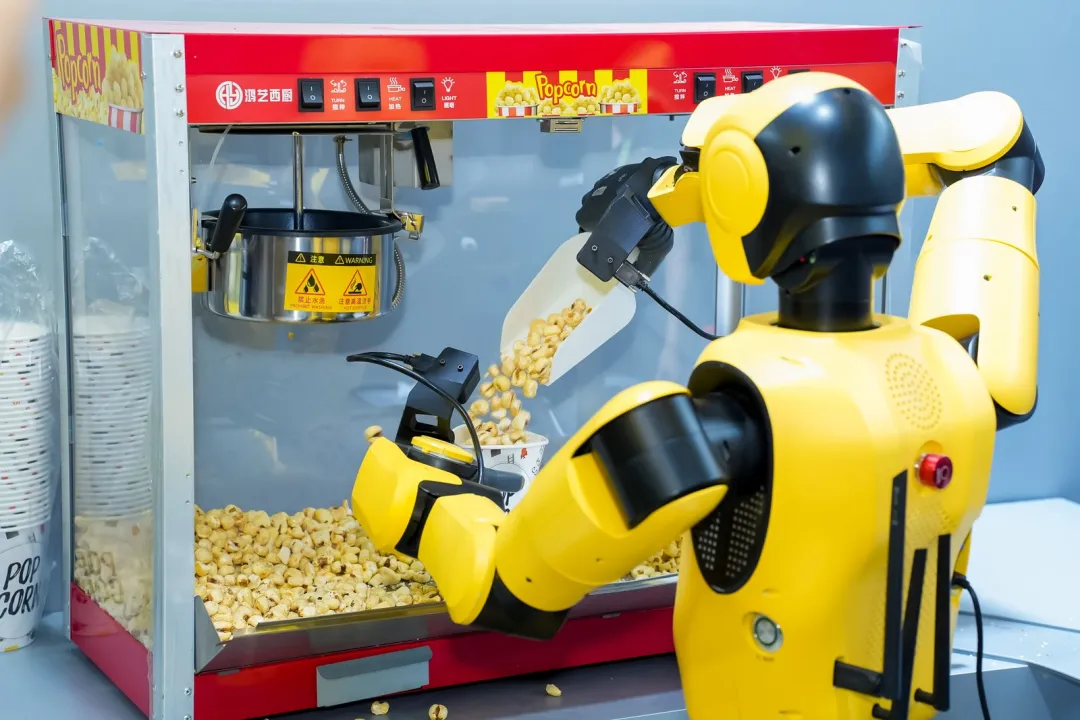
At the WRC 2026 site, cross-dimensional demonstrations of mobile device quality checks, business-super-autonomous scanning, and the continuous operation of ice cream and popcorn are presented.
These demos are from industrial manufacturing, retail and commercial services respectively. The tasks do not appear to be directly related, but from the point of view of Physical Token economics, they point to the same question: can a set of data, models and simulation systems enter different scenarios at a lower additional cost?
The mobile device's mass-detection line consists of two robots, closed-loop transmission bands, visual and detection equipment. The robot needs to complete dynamic tracking, fine-tuning boxes and disassembly boxes, waste detection and continuous collaboration. Its new task is to adapt a large amount of simulation training, prioritizing data production and training processes in a virtual environment, reducing repetitive collection and debugging on the real product line.
Commercial hyper-autonomous scanning faces a more open distribution of commodities. Bottled and packaged goods are changing in gesture and barcode locations are not fixed. Robots need to recognize the status of commodities and autonomously adjust crawling and scanning strategies. Multi-source heterogeneous data and world models are used to enhance their judgments about the status of commodities, spatial relationships and next steps.
The task of ice cream and popcorn demonstrates state-driven and abnormal handling capabilities. When tools change position, paper cups are missing or the feed is abnormal, robots need to adjust their behavior according to the new environmental state, rather than repeating fixed trajectories.
Of course, demo exhibitions are not directly equivalent to scale verification. In addition to adding several demonstration scenarios, it is more interesting to consider whether real data, training, trial and error, and additional input of on-site manpower actually decrease from one scene to the next.
These are the three demos that ultimately need to be answered.
Zero-shot might not be the starting point.
It's the results of economies of scale.
When it comes to general robots, the industry often expects a decisive model breakthrough: one day, when a strong enough underlying model emerges, robots will no longer need to be repeatedly numbered, trained and modulated for different tasks, directly entering the Zero-shot stage.
But from the data constraints of the physical world, another path may be more realistic.
Initially, a new task will still require a large amount of real data and field engineering. As experience enables cross-task replication, simulations to magnify the value of real data, post-training to improve the conversion efficiency of general capabilities to reliable skills, and real deployments to form feedback loops, the data, training, trial and manpower required for new tasks will gradually decrease.
Robots thus enter more scenarios and gain more real-world experience; model capabilities are enhanced and the additional adaptations required for new scenarios are further reduced.
In this sense, zero-shot is not necessarily a prerequisite for scalability, but may be a gradual outcome of a continuing scale economy. When the marginal cost of acquiring new capabilities is low enough, zero-shot moves from a model target to an industrial state.
This also explains why it is difficult for smart companies to separate commercialization from model research.
Commercialization not only generates revenue, but also provides models with rare tasks, failures, and long-term data in the real world. If deployment experiences fail to stream models, enterprises are still delivering repeat projects; if they only pursue the ultimate general model and fail to get robots into the real world, models lose important sources of physical experience.
Both need to form a closed loop: using existing capabilities to enter real scenarios, accumulating data and experience while creating business value; and reducing the cost of entering the next scenario once the model is strengthened.
This is another layer of the meaning of "eggs on the way down". Commercial scale is not only a measure of privilege before the maturation of general capabilities, but may also be a learning pathway to general physical intelligence.
As a result, the topic of discussion in the economics of physical tokens is not how general robots will later be priced, but rather a more fundamental question:
Are we going to be able to economically and sustainably go all the way to the universal?
If the answer is right, the end of Physical AI may not be the sudden appearance of a helpless robot, but a set of intelligent systems that can continuously access real-world scenarios, absorb new experiences, and produce reliable new capabilities at increasingly low marginal costs.
The next capability is cheaper than the previous one.
Perhaps this is just the beginning of a truly smart economy of scale.