It's the first time in the history of the world.
In complex visual scenarios, infrared target detection is essential. Traditional methods rely on the fusion of RGB and infrared, but RGB can deteriorate in low light or bad weather, affecting the detection effect.
In complex visual scenarios such as night sensing, security monitoring, drone patrols and autonomous driving, infrared target detection has important application value.
Traditional RGB-IR multi-mode detection methods typically complement RGB with infrared information by default and merge the two modules simultaneously during the training and reasoning stages. However, in real-world scenarios such as low light, fog, and strong retrograde light, RGB images can deteriorate significantly, not only making it difficult to provide an effective complement, but also introducing noise into infrared representations, causing a decrease in detection performance.
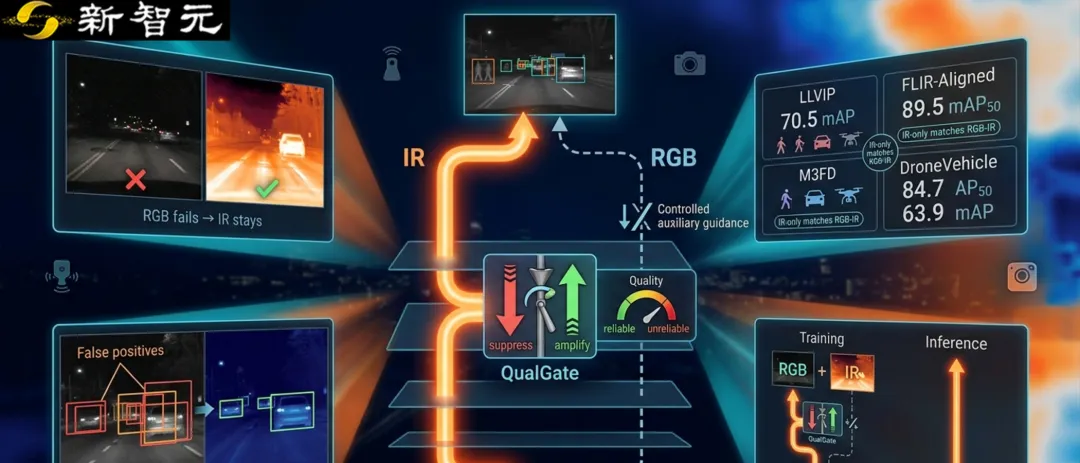
To address this issue, institutions such as Beihang University have proposed a framework for quality perception RGB guidance aimed at detecting efficient infrared targets.InfraNet。
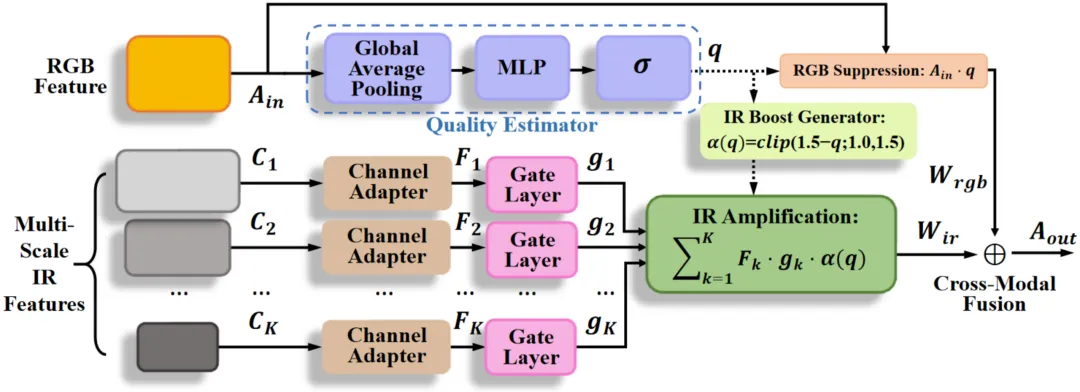
InfraNet uses an IR-centric design that uses infrared branches as the main path, RGB branches as the reliability controlled auxiliary signal for the training phase, and proposes a QualGate module that adapts to suppress unreliable RGB guidance, compensating for infrared characteristics.
Link to the paper:https://arxiv.org/abs/2607.03795
Based on this framework, InfrNet supports both RGB-IR dual-mode reasoning and IR-only single-mode deployments.
On the four RGB-IR detection benchmarks of LLVIP, FLIR-Aligned, M3FD and DroneVehicle, InfraNet achieved strong competitive results, with YOLOv8 reaching RGB-IR on LLVIP.70.5mAPIR-only reach68.8 mAPFLIR-Aligned on the YOLOv5 RGB-IR reaches89.5 mAP50IR-only reach88.1 mAP50DroneVehicle YOLOv12-IR has reached84.7 AP50and63.9mAP。
The work suggests that in complex environmental perceptions, multi-modal learning should not merely unconditionally integrate more information, but more importantly, allow the model to judge when to believe in RGB, when to return to a more stable infrared model.
Does RGB really help?
The intuition of RGB-IR multi-module target detection is natural: RGB images provide color, texture, and spatial detail, and infrared images provide thermal radiation information, which combined should be more robust than a single model.
However, this assumption is not always true in a truly complex environment. RGB images rely heavily on ambient light. At night, in foggy days, in bright light, in low light or in rainy snow, RGB can cause severe noise, over-darkness, over-exposure and structural deficiencies. At the same time, if the model continues to integrate RGB with IR as the same reliable input, degraded RGB characteristics may contaminate the red light, resulting in mischecks and leaks.
In other words, RGB is not always "enhancing information" and can sometimes be a source of noise.
InfraNet is dominated by infrared
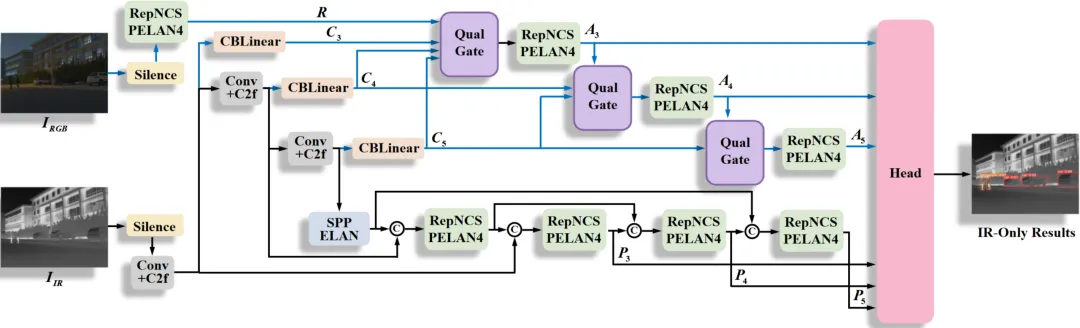
InfraNet's core idea is to:IR-centricThe RGB branch is used as an auxiliary path during the training phase to provide reliability-controlled cross-modal guidance for infrared representation learning.
This differs from traditional RGB-IR symmetry integration. Traditional methods typically require both training and reasoning stages to input RGB and IR at the same time, while InfrNet does not view RGB as a relying reasoning model, but uses it as an auxiliary to training period information. Thus, models can learn structural clues that have value in RGB during training, but are not necessarily bound by RGB when deployed.
Based on this idea, the InfrNet has two forms:
InfraNet-IRRGB assisted infrared branches in training, RGB branches removed and fusion modules in reasoning, and only infrared images were used to complete the detection.
InfraNet-RGB-IRRGB and IR are used in both the training and reasoning stages to stabilize the scenarios available for dual-mode sensors.
 QualGateWhen to believe/suppress RGB
The key modules of InfraNet are:QualGate,Instead of simply combining RGB and IR characteristics, we learn a reliability control signal associated with detection tasks to regulate the effects of RGB on infrared branches.
When the RGB characteristic is reliable, QualGate allows it to provide more cross-mode guidance; when the RGB characteristic is degraded, QualGate reduces the RGB contribution to prevent noise from spreading to infrared representations. At the same time, QualGate enhances IR characteristics, making models more reliant on stable infrared information when RGB is unreliable.
Specifically, QualGate includes two complementary directions:
RGB suppression: suppress unreliable RGB routing and reduce the negative migration of low-quality RGB.
IR amplification: Compensation and enhancement of infrared characteristics, keeping the infrared main pathway stable in complex environments.
This makes InfrNet's focus not on whether RGB images are "good looking" visually, but whether RGB features are actually helpful for current detection tasks.
The results of the experiment
The paper conducted system experiments on four sets of RGB-IR detection data from LLVIP, FLIR-Aligned, M3FD and DroneVehicle, covering tasks such as pedestrian detection, on-board thermal imaging, multi-scene detection and unmanned vehicle detection.
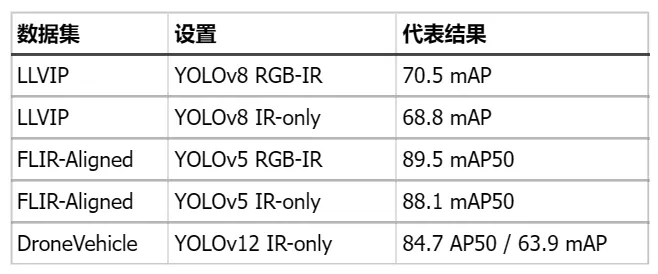
These results show that the InfrNet has not only built a more complex two-mode fusion model, but also validated the effectiveness of "training using RGB, reasoning using infrared only". This is crucial for real deployment scenarios: infrared sensors are usually more stable at night and in bad weather, while the RGB image quality fluctuates significantly with lighting conditions.
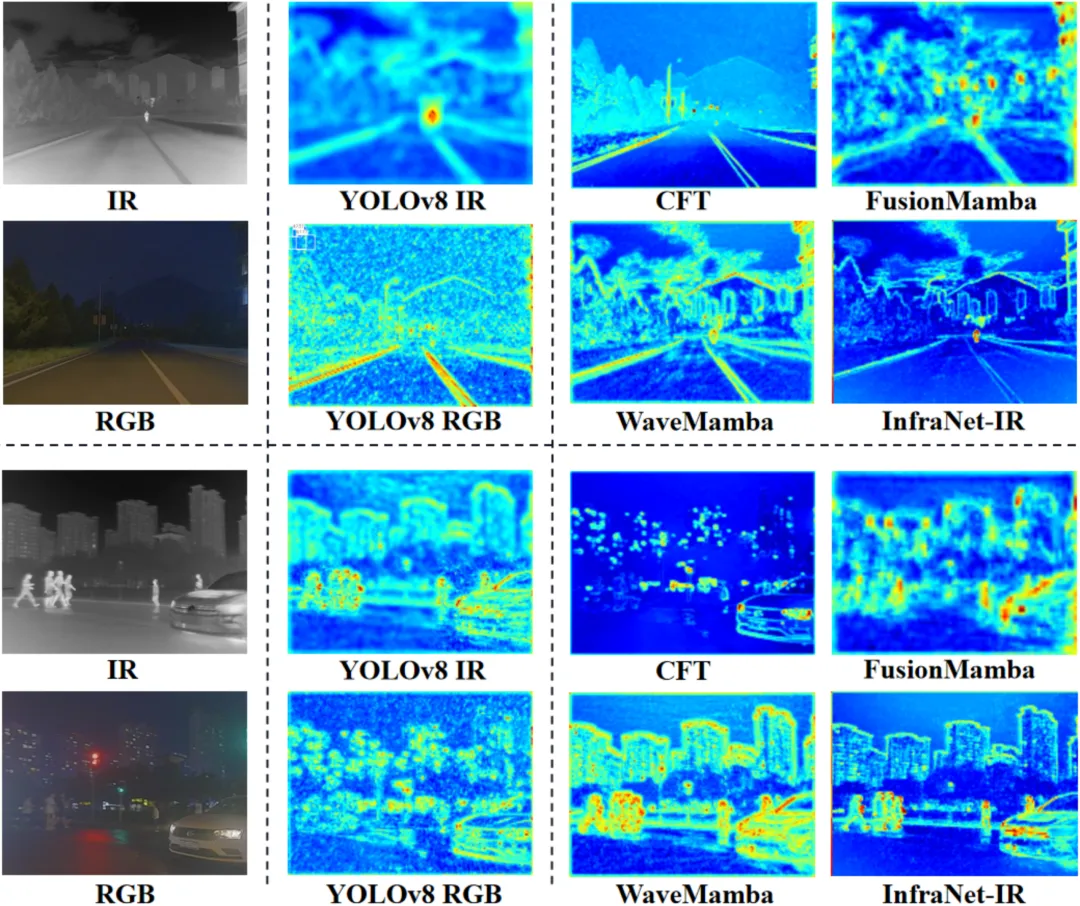
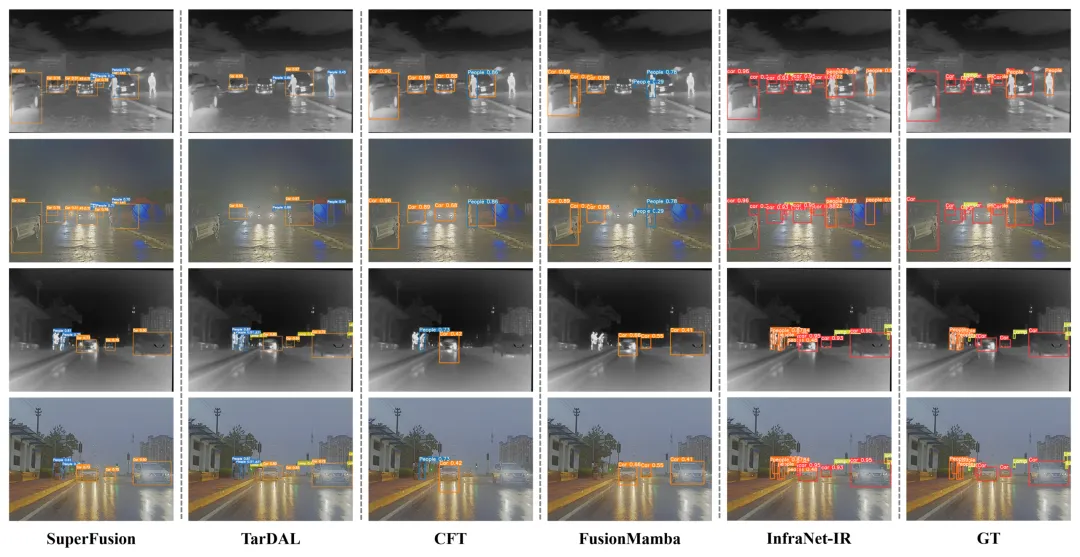
In M3FD visualization results, the InfrNet-IR can produce more compact detection frames and less error detection under different lighting conditions. Compared to some traditional fusion methods, the InfrNet-IR can still maintain a more stable positioning capability in RGB degradation scenarios.
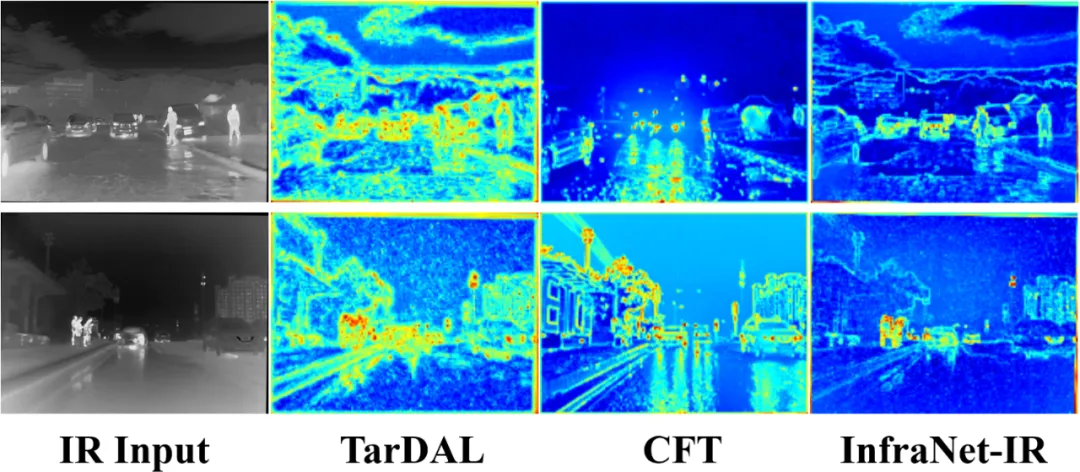
Further feature visualization suggests that InfrNet-IR can generate more targeted aligned responses and reduce background region activation. This demonstrates that quality perception RGB guidance at training stages can help infrared branches learn more robust representations while maintaining IR-only reasoning at deployment stages.
Multimodal learning is more than just "incorporating more information".
InfraNet is not just about improving infrared target detection metrics, it's about reviewing pattern relationships in multi-modal learning.
Traditional multimodal methods often emphasize how to integrate more information, but sensors in the real world are not always reliable.
RGB may deteriorate due to night, light, fog, or equipment problems; different models may also be missing, inconsistent, or inconsistent in quality. Therefore, a robust multi-mode sensing system not only learns to use multi-mode information but also learns to reject unreliable models.
This is exactly how InfraNet works: when RGB is reliable, it helps to represent infrared learning; when RGB is unreliable, it suppresses interference with the detection process; and when deployment environments are more suitable for infrared, it allows models to make inferences using only infrared images.
For scenarios such as autonomous driving, drone patrols, night security and intelligent traffic, this design of "quality perception, infrared dominance, flexible deployment" provides an infrared target detection program closer to a truly complex environment.