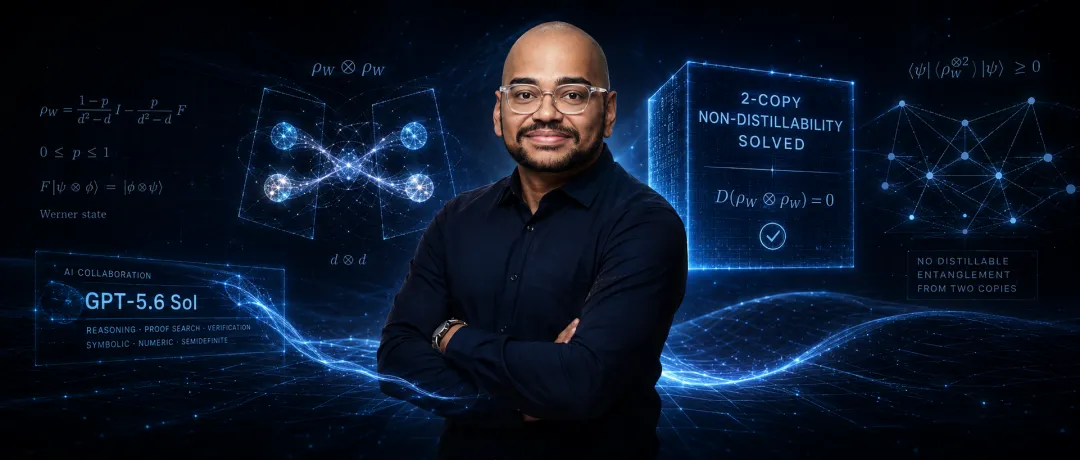
It's the first time in the history of the world.
On July 23, a 25-year-long puzzle in the field of quantum information was solved, and two independent proofs appeared on the same day!
One is generated by GPT-5.6 Sol, and the time signature is set at UTC 11:23;
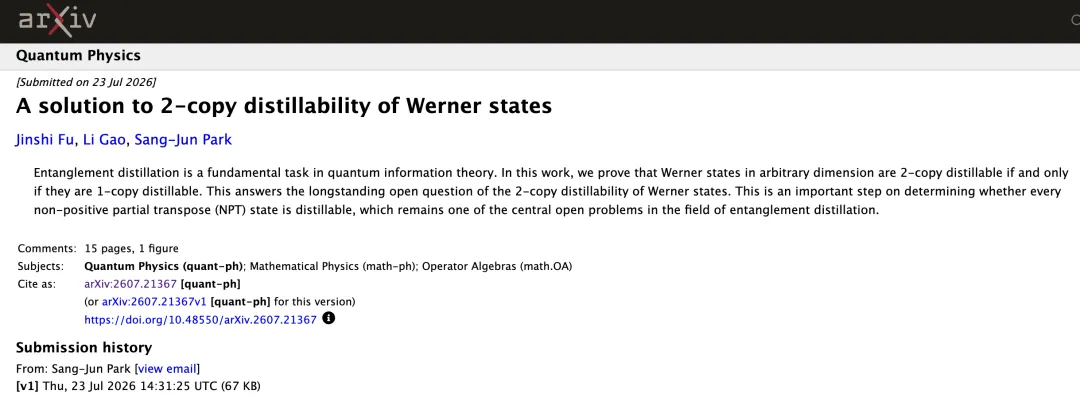
The other was submitted directly to arXiv at UTC 14:31.
It's about three hours in front of and behind.
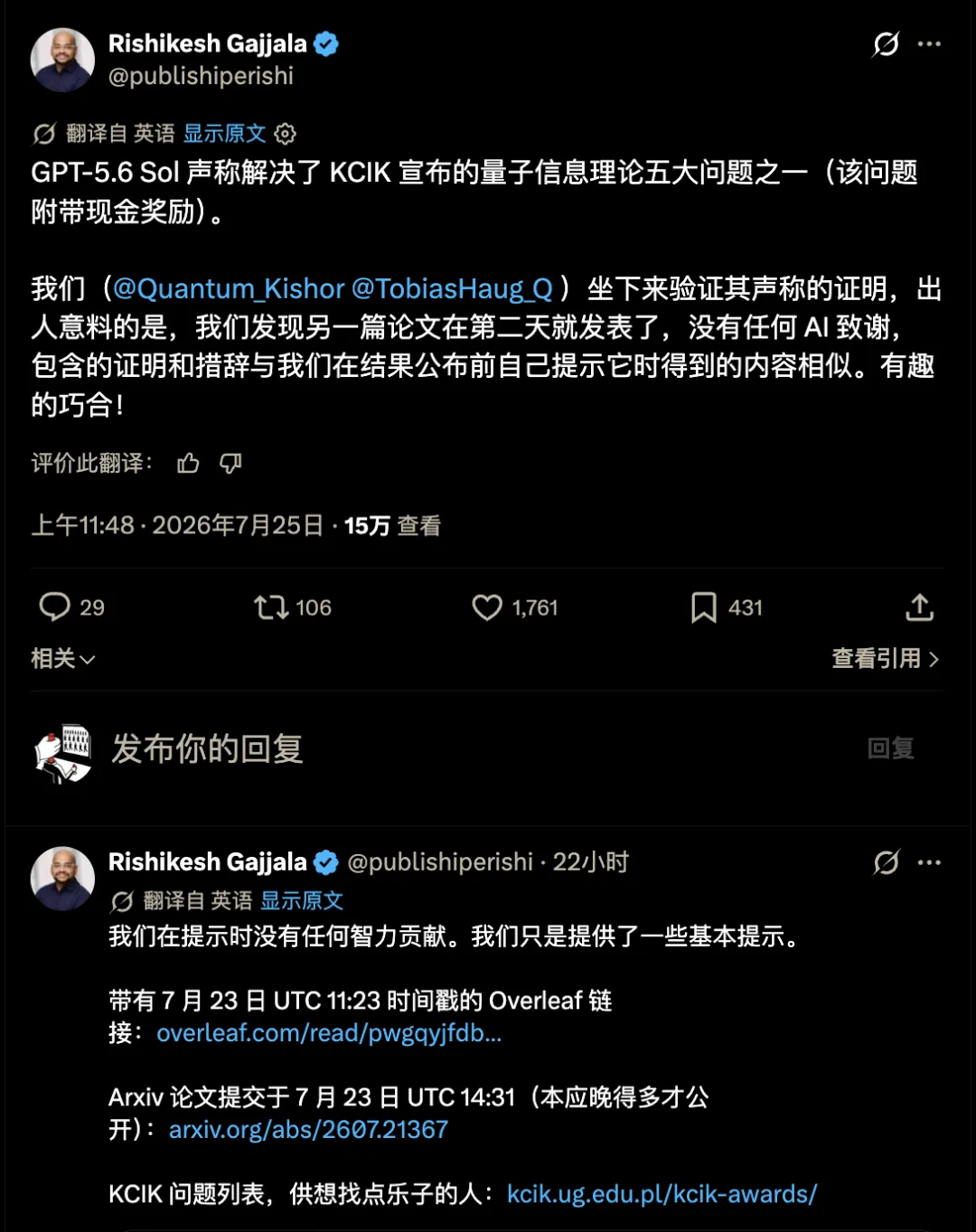
Two days later, Rishikesh Gajjala, a postdoctoral fellow at New York University in Abu Dhabi, publicly questioned the human-signed paper on X: "The human-signed paper has a similarity to the proof he and his colleagues obtained from the basic prompt GPT-5.6 Sol, and there is no AI use statement in the entire paper".
Two proofs, three hours difference
This is the question of Werner's 2-copy non-distillable problem.
The International Center for Quantum Information (KCIK) at the University of Gdańsk, Poland, ranked it as the fifth of the five Grand Prize puzzles for quantum information in 2022, along with a cash prize of EUR 2021.
The question, which dates back to 2000, is whether the Werner model of the parameter α = −1/2 can be solved by distilling two copies.
For more than twenty years, some special cases have been gradually breached, but the full dimension has nothing to do with the constant absence.
Gajjala tweeted that he and two colleagues @Quantum_Kishor, @TobiasHaug_Q tested the model's ability to solve the problem with GPT-5.6 Sol.
According to him, the process is extremely simple:
We had no intellectual contributions while prompting. We just gave some basic prompts.
We don't have any intellectual input when we're giving tips. We're just giving some basic tips.
Without any professional guidance, only the most basic prompts were given, the model directly produced a complete set of proofs and was written into the Overleaf document, clocking in at 11:23 UTC on 23 July.
On the same day UTC 14:31, arXiv published the paper A solution to 2-copy distillability of Werner states.
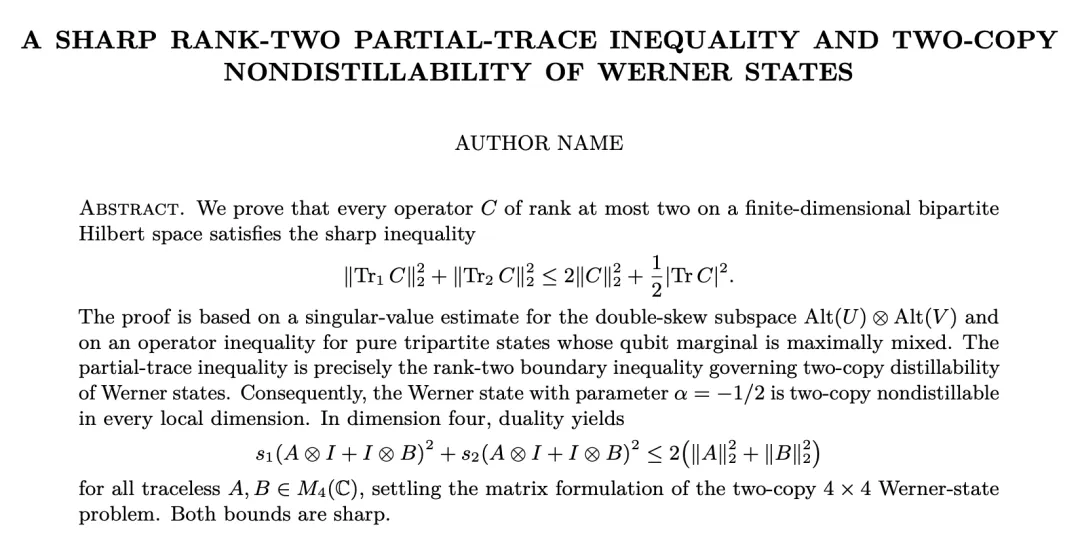
The core conclusion is consistent with the output of GPT-5.6 Sol: for all dimensions d ≥ 2, the Werner state ρ ((−1/2) is 2-copy undisturbed.
Gajjala wrote in a tweet:
We found another paper published the very next day, with NO AI acknowledgment, containing a proof and phrasing similar to what we got when we prompted it ourselves before the result was announced. An interesting coincidence!
We found another paper published the next day, without any thanks to AI, that contained proofs and phrases similar to what we got when we suggested it to ourselves before publishing the results.
A comparison of the two papers shows that the paths differ markedly.
Gajjala's version follows the path of partial-trace inequality: first, an odd-valued estimate is made on a double-opposite quantum space called Alt (U) + Alt (V), and then an odd-valued derivative is derived through a three-dimensional integer inequality.
Fu and others went the other way, translating the problem into block-operator inequality, in symmetrical sub-spaces, to the Hilbert-Schmidt paradigm that opposes projection into zero-level, first-level, and second-level variables, using the Cauchy-Schwarz unequal locked Schur condition.
Both papers used Takagi breakdowns and received a critical estimate of 1/2 dimensionless, but the overall structure was different.
When AI solves problems independentlyDo the existing academic signature rules hold up?
According to Werner, this is of particular interest because it is not the only example.
GPT-5.6 Sol was released on July 9, and within half a month, mathematical proofs that can be independently verified in three different disciplines had been produced.
It's a good idea.
On July 10, OpenAI released proof of the Cycle Double Cover conjecture generated by the GPT-5.6 Sol Ultra model.
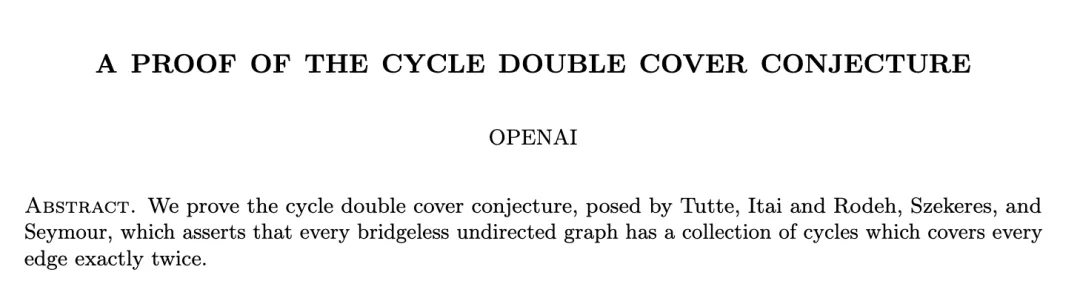
This graphing problem has been around for nearly 50 years, proving that the entire text is only three pages long and was completed in less than an hour by 64 parallel sub-intelligent entities.
Statistics:
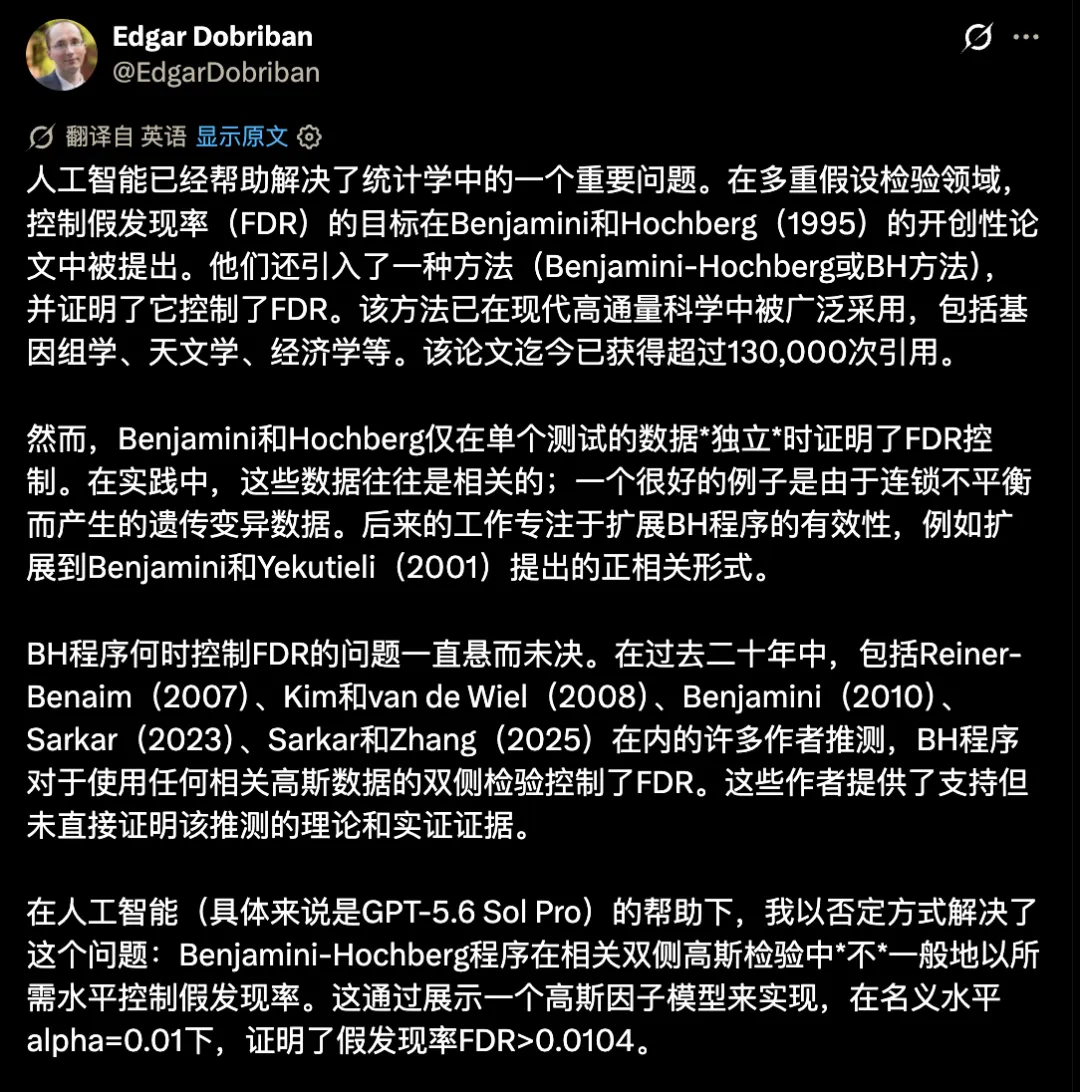
Four days later, Edgar Dobriban, a professor of statistics at the University of Pennsylvania, used GPT-5.6 Sol Pro to refute a 20-year-old conjecture about the Benjamini-Hochberg process in 90 minutes.
Algebraic geometry:
Fable 5 also directly falsified the three-dimensional and higher-dimensional form of the famous Jacobite conjecture on July 19.
In just six months, the flagship AI's Nobel Prize-winning scientific achievements have surfaced in the rain after spring.
The mathematical reasoning ability of big language models is crossing a critical line from "assisting human researchers" to "complete proof of independently generated verifiability".
As soon as this line was crossed, the gray areas of academic signature were immediately exposed.
Dobriban's practice provides a reference: as a single author, he uploaded the counter-examples to arXiv, but the word-for-word proof in the paper was clearly done by GPT-5.6 Pro.
The academic community has reacted differently to this, but at least information transparency has been made.
The focus of Werner's controversy is precisely this: If AI is indeed used, zero declarations make it impossible for readers to distinguish between human origin and machine output.
Currently, arXiv does not require authors to disclose the use of AI tools, and most journals' policies remain at the "recommendation statement" level.
When the GPT-5.6-level model becomes widely available, the gray area "with AI in the dark, signature hanging only on humans" will expand rapidly.
The next observation node is the attitude of the KCIK Prize Committee: the question now has two claims of complete proof, one from AI and one from humans (and is questionable about AI), to whom does the prize go?
The more fundamental problem is that when machines begin to participate in solving award-winning research pendings, academic priorities and signature rules require a systematic update of the code, which has not yet begun.
Should AI have the right to sign?
After paying for AI, is it possible to buy its intellectual output together?