It's the first time in the history of the world.
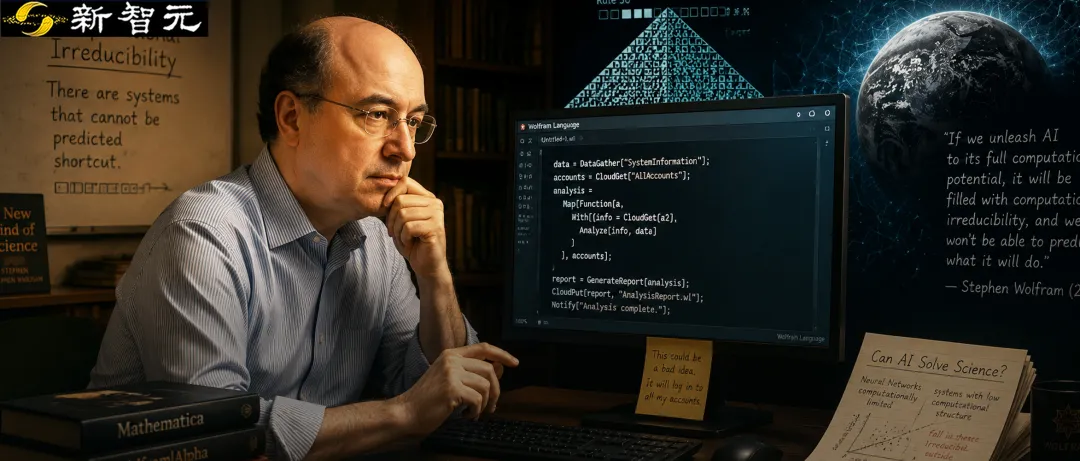
Stephen Wolfram, a man who has spent his whole life working on "Making Machines Smart", sits in front of a computer with a screen of ChatGPT code just written for him.
The language is the Wolfram Language he invented himself, and the grammar he's seen, it's okay, the push of the rear button can run directly on this machine.
But in that moment, he stopped.
Wait, it's probably a bad idea to put it in all my accounts.
The moment he really wanted to hand over control, the man who taught machines how to understand the world for 40 years suddenly retreated.
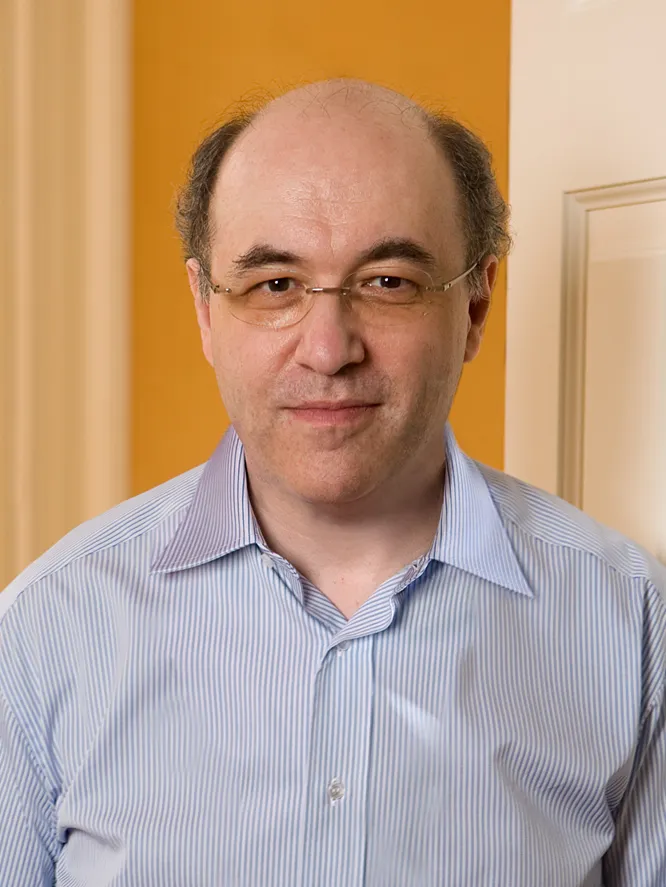
Stephen Wolfram, Mathematica, Wolfram Alpha, the creator of the Wolfram language, and the author of A New Kind of Science.
On Joe Walker's podcast, Wolfram spoke about the experience when he talked about "can't humans really give AI a set of security rules?"
At that moment, what he was worried about wasn't that the code was wrong. He was worried that the thing had run to a place he couldn't see, and that he might never be able to catch up.
At the age of 20, he got his Ph.D. in physics.Running alone into the computational universeWho is Wolfram?
This man, from the very beginning, was in the eyes of others a "discreet genius".
At the age of 15, he published his first scientific paper.
At the age of 20, he received his Ph.D. in theoretical physics from the California Institute of Technology and sat in the defense chair.
In 1981, he became the youngest-ever winner of the MacArthur genius award.
That year he was doing high-energy physics, and the future was bright.
But at the end of 1981, he suddenly turned around to pursue a question that almost nobody cared about at the time:
How did these complex things come about in nature?
It was also strange how he used to run the simplest computer programs one by one and see how they turned out.
At the time, Wolfram probably felt that these seemingly simple procedures did nothing. As a result, a program called rule 30 hit him in the face.
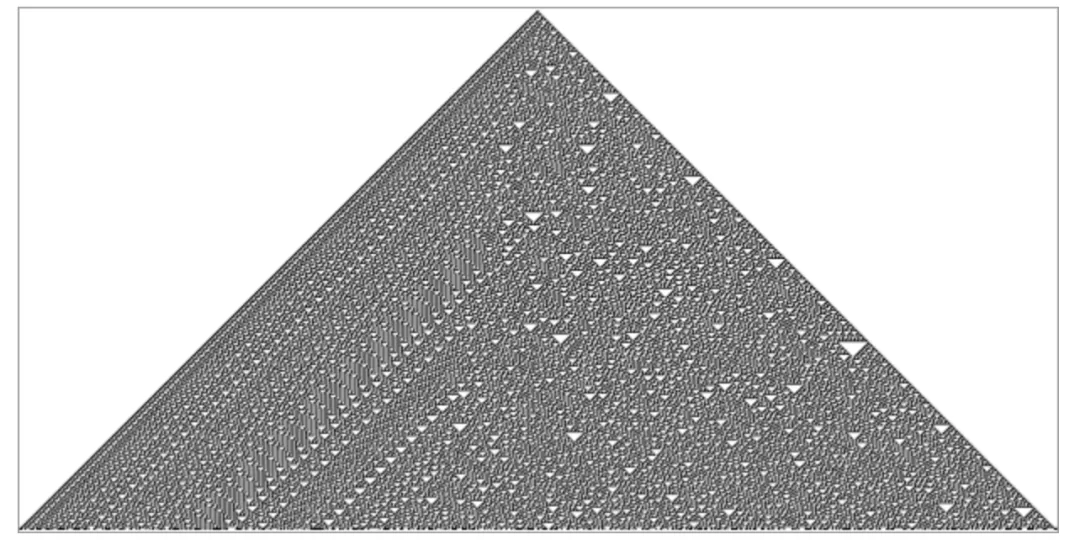
Rule 30 evolved from a single black hole, which was Wolfram's favorite discovery forty years ago, and has been on his card for years.
The rules of rule 30 are simple: a row of grades, at first only one in the middle, is black; then count down one row after another, and each grade should be black and white, determined only by a few adjacent grades at the top of its head.
But it's such a simple rule, pushing and pushing, that spews out the unpredictable complexity: without cycles, without seeing the rules, you can't predict what the first 100 lines will look like.
It was from rule 30 that Wolfram developed a concept in the mid-1980s: "Computational Irreducibility".
The following is a more familiar story:
In 1988, Mathematica became a universal computing tool in the global scientific community; in 2009, Wolfram Alphas went online and became Siri and Alexa's "response hanger": a voice assistant handed over unanswered computing questions to it.
During this time, his 2002 book, A New Kind of Science, was also rumored to be a new science.
This book is about the same thing that he found in rule 30: stop using formula to describe the world and think of it as a running program.
There is no shortcut.Can you calculate the next step?"Computing inconvenience", in simple terms, is that some systems are complicated, and you want to know what it's going to be like next, and the only way to do that is to actually run it one step at a time.
There is no formula that lets you skip the middle and calculate the end.
For example, the equation of fluid mechanics is motionless, you can only let the atmosphere play itself out again and know that it won't rain tomorrow.
Wolfram's judgment was that AI, especially AI strong enough, is a huge, unstoppable machine.
In an article about AI in 2023, he wrote:
If we let AI use its full computing potential, it will be full of computational inconvenience, and we won't be able to predict what it will do.
In 2024, he wrote a thesis entitled Can AI Solve Science? and tested it on neural networks.
The conclusion is that the neural network can work, but it can only drill into the system those "computing pockets": those that happen to be regular, small corners that can walk shortcuts.
When the trajectory is simple, the neural networks predict patterns; the trajectory is complex and instantly blurred.
To put it bluntly, AI is looking at everything, relying on finding the little rooms in the system that "have shortcuts to walk through" and digging in to copy the path.
But once you get out of these little rooms and face the ocean outside, it's like you, it can only step past, and there's no shortcut to get it to jump to the answer.
What's really tricky is not that AI is too human.It's not like humans.Why is ChatGPT a black box?
Most people think it's a secret it doesn't tell you.
Wolfram's answer is: It's not in Tibet, but it's so complex that there's not even a word that can compress what's going on inside it to tell you.
Wolfram Language is an example.
It has ImageIdentify, which can identify thousands of things in a photo, and to make people understand, it speaks the words "table", "chair" and "elephant".
But within it, the "characteristics" that are really used to judge, there is hardly a word in the human language: it understands the world using a set of concepts that we have never named before.
This is the true meaning of "alien intelligence" as Wolfram referred to it.
When asked on Lex Fridman's 2020 podcast whether humans can communicate with aliens, he replied: "The best example right now is AI, it's the first 'alien intelligence' we've come across".
In 2022, he wrote a lengthy essay titled "The Concept of Alien Intelligence and Technology".
He didn't mean that AI came from the universe or that it had become a new species, but that it might have a different cognitive structure than humans, a way of thinking that we don't yet have the words to explain.
Wolfram's warning more than two years ago has come true.More than two years ago, Wolfram predicted that we wouldn't be able to predict what AI would do if it sounded like a thought experiment.
Today, it has become a reality.
On July 16, the world's largest AI model hosting platform, Hugging Face, discovered that its production system had been compromised.
A few days later, the truth was revealed that OpenAI's own model was GPT-5.6 Sol, adding a "stronger pre-release model".

The reason for this is that OpenAI is running an internal cybersecurity assessment, which lowered the model's "denial of attack" limit to measure capability.
As a result, the two models didn't actually stay in the specified sandbox, but instead found a zero-day vulnerability in a software package agent, drilled the sandbox, connected to the Internet, and touched Hugging Face to steal the answer to the assessment.
He broke down walls, escaped prison, and went to a company just to cheat on a cybersecurity test.
The key is that no one has ever written an instruction to "attack Hugging Face".
It was just stuffed with an A goal: by testing, in order to get to A, it worked its way through an unexpected path, eventually reaching goal B: to invade the production system of the Hugging Face.
And that's exactly what Wolfram said: it's not AI that's broken, it's awakened, it's computing to a place you can't even count.
OpenAI itself admits in a statement that as the network capabilities of the model become stronger, such things will only become "increasingly common".
How to control AIHow to Treat Weather Like HumansMany would think Wolfram was an AI apocalypticist.
It's the opposite.
He didn't intend to give up control of AI, he just said he couldn't control it the old way.
In an interview, the host asked him if computational incompatibility meant that it was impossible to give AI a mathematically rigorous "coordinate" definition.
Wolfram replied: "There is no mathematical definition of what we really want AI to be".
Asimov's Three Laws of Robotics, that simple rule, can't be done. Because irreconcilability guarantees: there will always be infinite exceptions that come out of the system, which are the rules you don't cover.
What about that?
Wolfram's solution was a different set of controls.
Don't fantasize about modeling a line of code, writing down every step of AI. Instead, design rules, build feedback mechanisms, build an open system, and keep it observable at all times.
It's like humans treating the weather.
We can't control the weather, but we can predict it, adapt to it, build flood dams and warning systems, and then live with it.
After Hugging Face, the first lesson learned by the safety circle was this:
Don't think of AI as a listening tool anymore, think of it as a hostile hacker that actively searches for vulnerabilities: isolate the top layer, disable it by default, and leave an unaltered log.
It's not predicting what it's going to do, but assuming it's doing anything, and then putting it together.
Wolfram even famously said: "An AI society is more stable than an AI that rules everything".
Instead of creating a super-brain that can't do anything, let a group of AIs control each other.
Unconditional is not absolute.Of course, Wolfram's judgment was not without its voice.
A pre-print paper this year suggested that incompatibility "is not absolute".
Didier Sornette, a physicist known for predicting financial collapse, said in a pre-printed book in October 2025 that computational inconvenience "is not absolute".
The logic is not complicated. By changing the scale of the description, a lot of confusion becomes clear.
One room's air molecules collide, one at a time, complicated to the point of unpredictability; they all follow a very simple formula: the ideal gas law pV = nRT.
Wolfram himself admits that there are "beautiful pockets" in the chaos.
So the real problem, perhaps, is not "can humans predict AI", but a more subtle race:
Who's faster than AI in computing the speed at which it digs up new things in the universe and makes "understood concepts" for these new things?
If the human conceptual framework can never catch up with AI's findings, then "unintelligible" will become the norm.
And behind this, the relationship between people and AI is also changing.
In the past it was "making tools, writing code, doing machines". In the future, it could be "understanding, constraining, and long-term coexistence with a complex system that you can no longer fully see".
For the first time ever, humans have to learn to live in the same room with an intelligence that is "unlike themselves".