In action chunking, which has become the VLA label today, "how many steps to perform one time" is considered a fixed superparameter for almost all work. A new paper by Beijing University and Microsoft Asia Research Institute notes that this default setting itself is an important cause of failure.
The research team proposed the Bernoulli-Continuation Policy (BCP): Freeze-base VLA, which trains only a lightweight head of 16.4M parameters, breaks down "how long to execute" into a series of "continue to execute or reprogram" Bernoulli decisions, and optimizes them from the trajectory level through GRPO. On all 50 RoboTwin 2.0 missions, the average success rate of the LingBot-VLA rose from 89.88% to 93.94%, achieving SOTA in the VLA method; the success rate of the real-machine Mark Cup mission increased from 44% to 84%.
Continue or Replan? Bernoulli-Continuation Policy Learning for Adaptive Horizon Execution
arXiv:2608.03483
The main page of the project:https://fleetfootwork.github.io/BCP/
A. Background: the decision-making dimension of engineering details
Action chunking allows VLAs to predict a sequence of movements in the future, rather than predicting individual movements gradually, both reducing the frequency of model reasoning and improving the sequence consistency of movements. In chunk-based VLAs, there are two horizons: the prediction horizon determines how many movements the model generates at a time, and the execution horizon determines how many of those movements will actually be executed, and robots then re-observe and plan.
Mainstream work such as OpenVLA,π_0.5,LingBot-VLA uses a fixed execution horizon. This is often more smooth and stable in the roughness movement phase in free space; but in the touch, alignment, and clavicle closure phases such as those sensitive to precision, small position errors can accumulate rapidly and robots must reobserve before entering these phases.
In order to quantify this phenomenon, the team designed a phase-shift experiment: all variants used the exact same 50-step horizon, the only difference being that the first chunk reprogrammed only φ steps and then reprogrammed every 50 steps.

The difference between the highest and lowest is 11.3 percentage points, and it's worth noting that the Upper/Lower Bound is a hindsight oracle, and it's impossible to know in advance when it's actually deployed.
In the Placing Dual Shoes task, this difference is very intuitive: when φ=32, the robot performs an outdated claw-closing operation that ultimately causes the task to fail; and when φ=23, it happens that a reprogramming occurs before the critical operating phase, and the robot obtains new observations so that it can accurately complete the grabbing operation and successfully execute the task. On the same task, the best phase success rate is 92%, while the worst phase is only 80%.[3]
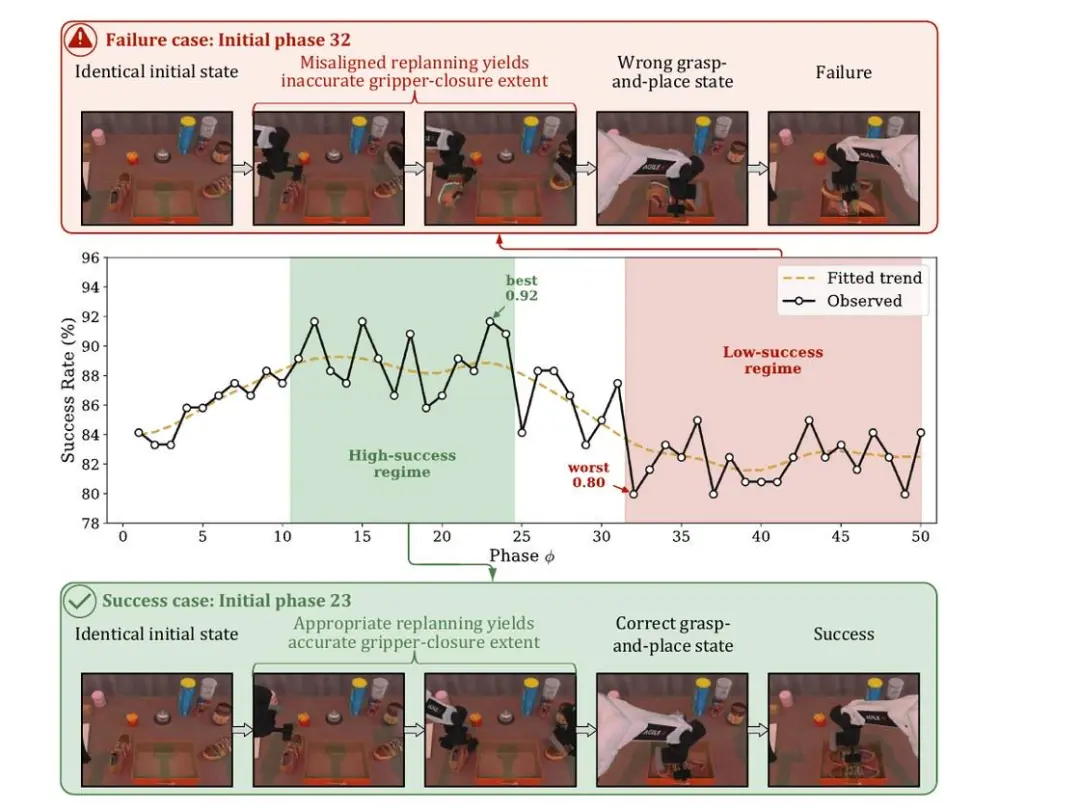
Figure 1 The same model, the same 50-step horizon, only changes the landing point of the re-planning boundary:φ=32 when the claw closure of the width leads to failure,φ=23 when the boundary falls before the operating stage.
More importantly, there is no replicable law of optimum phase. The paper statistics the best φ of each of the 50 tasks and performs a card-based optimization test: x2 = 5.00, p = 0.287, the original assumption of uniform distribution cannot be rejected.
The paper raises a central question: given a predicted action chunk, how long should the robot stop and reprogram?
Method 2: Three challenges and three designs
It is not easy to learn such a strategy, but the civilization lists three challenges and provides a corresponding design.
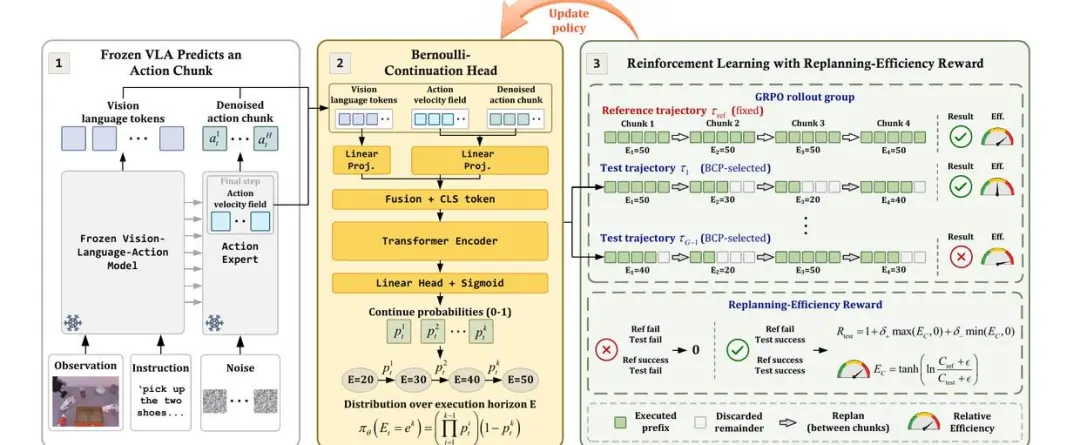
Figure 2 BCP framework. The frozen VLA predicts the long action chunk, and the Bernoulli-Continuation Head duplicates its characteristic to produce a series of "continuing probabilities", according to which the execution horizon is selected; the overall optimization using GRPO + Replanning-Efficiency Reward.
2.1 Candidate horizon with a forward-sharing structure
When performing 40 steps and performing 50 steps, the first 40 moves are exactly the same, the only difference between the two being whether they continue to be performed after the 40th step. The standard softmax classifier sees different candidate horizons as separate, disordered categories from each other, thus completely ignoring this natural forward-sharing structure.
The Bernoulli-Continuation Head method is to output a logit of M−1 and get a "continuation probability" through the sigmoid.
In this case, the probability of continuing from the horizon to execution. Selecting the k-horizon is equivalent to continuing through the previous k−1 "continue" decision and stopping at the k-position:
This factor decomposition is highly consistent with the nested structure that the chunk performs naturally: only the current chunk is consistently judged to be credible, and the strategy gradually moves to a longer horizon; at the same time, the adjacent horizon also naturally has a closer probability cube, which is exactly what is missing from traditional classification strategies.
Specifically, the head does not require an additional VLA forward-thinking. It duplicates the three types of representations that VLA has generated during the prediction of the action chunk: the VLM token, the corresponding de-noise movement of each action step, and the characteristic speed of its last step. The three types of representations are spelled and projected, with a learning [CLS] token added at the front, followed by a two-layer Transformer encoder, and finally mapped to M−1 logit.
2.2 per-chunk Supervision unrecognizable
Each horizon decision correlates with the subsequent chunk and subsequent decisions. The same end result may be generated by multiple different horizon sequences, so there is no single ground-truth stop label. Based on this, the research team abandoned supervised learning and used GRPO to optimize results from trajectory levels.
For each instance of a mission, the sample G−1 adapts the trajectory, while the additional rollout uses a reference trajectory using a fixed horizon to determine the advantage:
It does not contain any BCP decisions, does not participate in parameter updates, and provides only a stable reference to a relatively fixed strategy. Throughout the training process, the base VLA is constantly frozen.
2.3 Purely successful rewards will cause the horizon to collapse
Short horizons are naturally more conservative. If only two-value success rates are used as a reward, the strategy can easily degenerate into frequent heavy planning, thus wasting expensive VLA calls.
First define the relative efficiency term, where C represents the number of calls of the VLA, and tanh is used to limit the range of numerical values:
The ultimate prize is:
The failure trajectory reward is zero and has nothing to do with efficiency, so the strategy cannot always dominate the success of the task through the "short and failed" suites.
In other words, strategies are encouraged to plan decisively when new observations are really needed, allowing for certain additional call expenses as long as they can ensure the success of the task;
Group-based optimization has been improved. Only when two-value success rewards are available, an effective gradient cannot be generated if the trajectory in a group is completely successful or completely unsuccessful; after adding efficiency items, success trajectories can be further differentiated based on VLA calls, so that the entire successful group can still generate non-zero advantage. Reference trajectory determination also ensures that a clear negative learning signal can still be obtained when "fixed strategy succeeds, adaptive strategy fails". Only when the reference trajectory and all adaptive trajectories fail, the group will be discarded, significantly mitigating the gradient scarcity problem brought about by rare task rewards.
Three, the results of the experiment
3.1 RoboTwin 2.0: SOTA in the VLA method
Based on the LingBot-VLA, 13 low-success missions with an initial success rate of less than 90%:
Clean:75.15% → 86.23%(+11.08%)
Randomized:73.54% → 83.46%(+9.92%)
All 50 missions:
Clean:89.88% → 93.94%(+4.06%)
Randomized:88.78% → 92.84%(+4.06%)
This result achieved SOTA in all contrasting VLA methods and was also close to the best WAM results. The most significant improvement on a single task was Hanging Mug: 41% → 87% ((Randomized below 36% → 62%); the rest, such as Blocks Ranking Size: 70% → 88%); Turn Switch: 60% → 72%); Click Alarm Clock: 80% → 91%); Place Object Scale: 80% → 91%) for tasks that contain precision-sensitive crawling, placement, or interaction phases.
Particularly noteworthy is that BCP is trained only in the Clean setting and directly migrates to the Randomized setting with a consistent increase of +4.06%, indicating that what is learned is not over-fitting under specific visual conditions, but closer to "when to continue trusting the current chunk, when to re-planning" such as knowledge related to the task phase.
This improvement was the same for different base models: on ABot-M0, 13 tasks improved by +10.69% (Clean) and +11.77% (Randomized); on ACT, it improved by +5.38%.
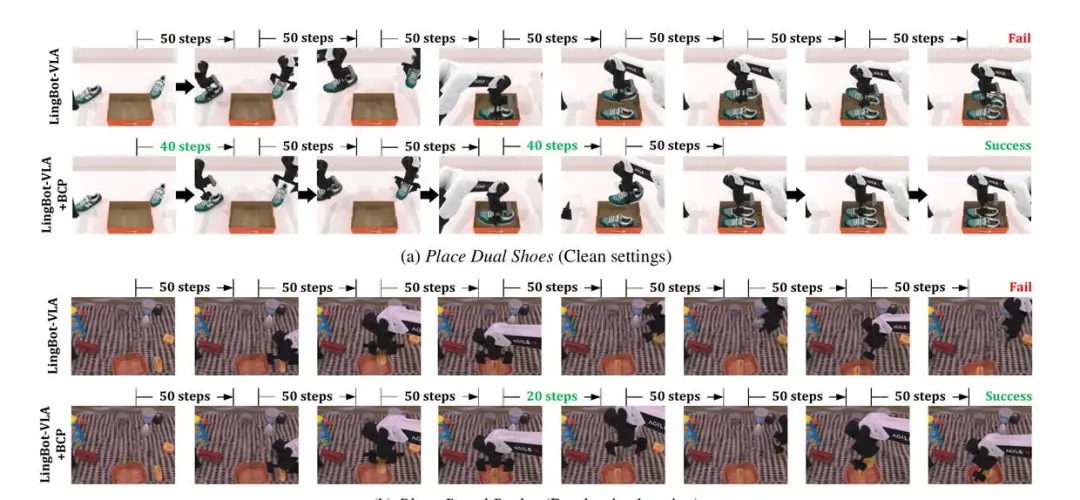
Figure 3 RoboTwin 2.0 qualitative contrast. BCP actively shortened the horizon before the critical operating phase (Figure 3).
3.2 LIBERO / LIBERO-PRO: The harder the task, the greater the advantage
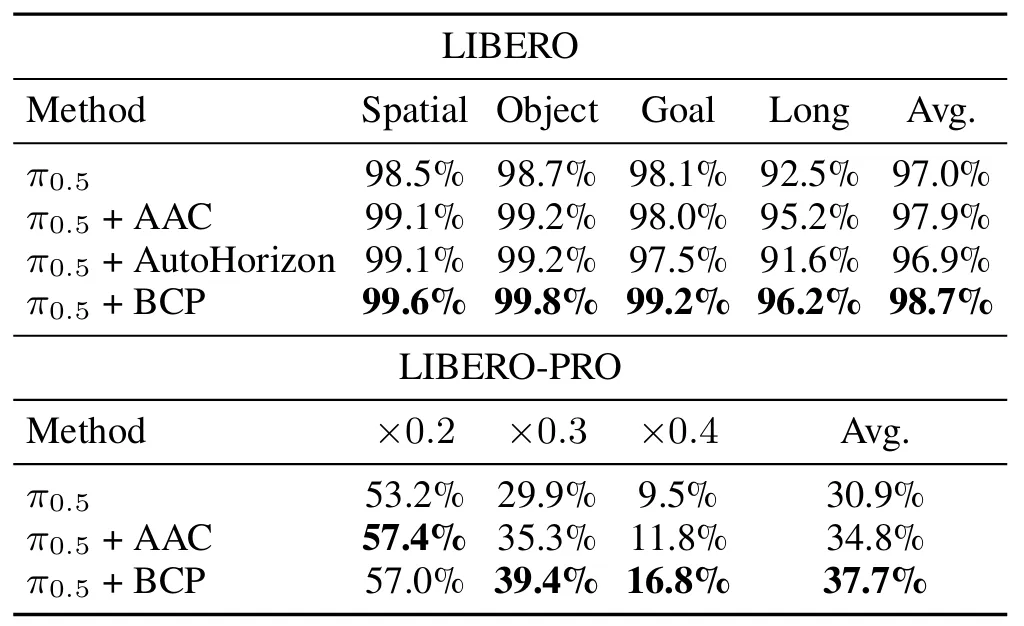
On LIBERO-PRO, which emphasizes more generalization capabilities, BCP brought an improvement of +6.8%, up 2.9 percentage points from AAC, and set the most obvious advantage at the greatest disruptive magnitude ×0.4 (16.8% vs. 11.8%).
3.3 More re-planning, but less overall running time
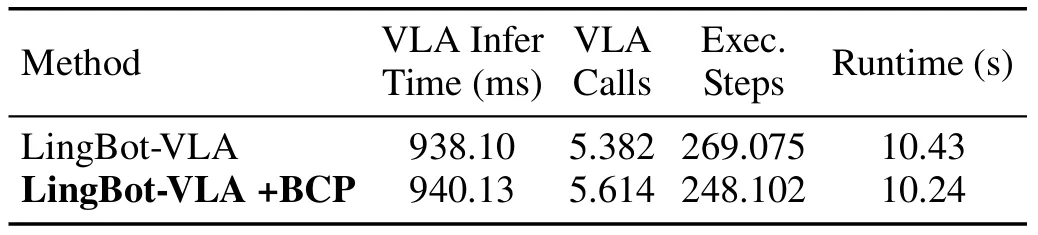
Continuation head leads to an additional cost of only 2.03 ms per reasoning. Although the call frequency of the VLA has increased slightly, the total execution time has decreased from 269 steps to 248 steps due to more accurate and less inefficient movements.
In contrast to the eight execution strategies (Random, Fixed 20/30/40; Action Trigger, Uncertainty Proxy, AAC, AutoHorizon), the BCP has the highest success rate and lowest runtime at the same time. Fixed 20 does not even exceed the full-chunk baseline, indicating that shorter horizons are not naturally superior; while Uncertainty Proxy and AAC have significantly higher runtime because they require multiple chunk to estimate uncertainty or latency.
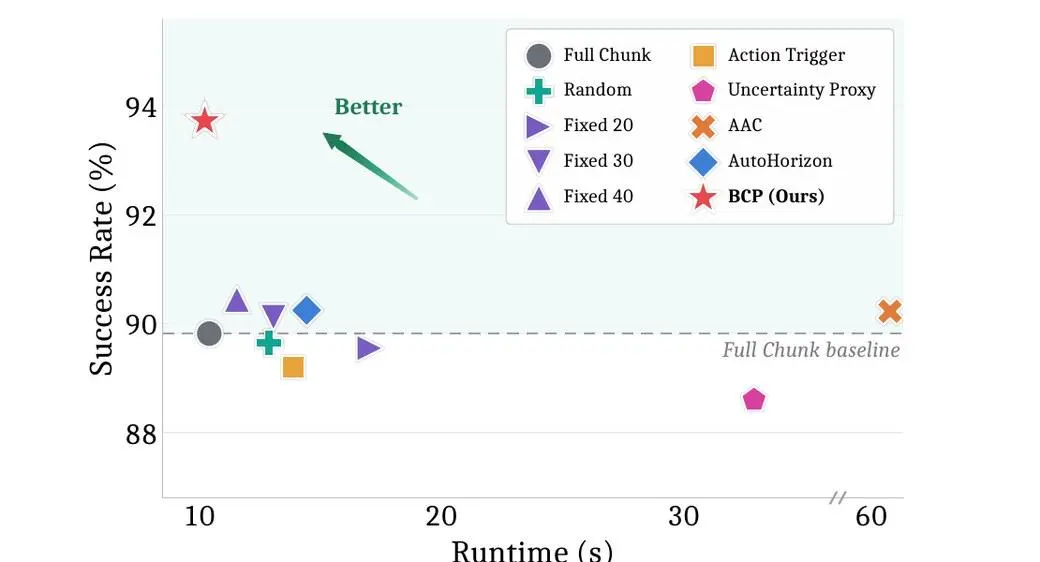
Figure 4 Success rates on 50 missions: BCP (Red Star) at the same time as the highest success rates and lowest run times; Uncertainty Proxy and AAC have significantly higher run times due to multiple chunk sampling.
3.4 Dissolution: Three components verified one by one
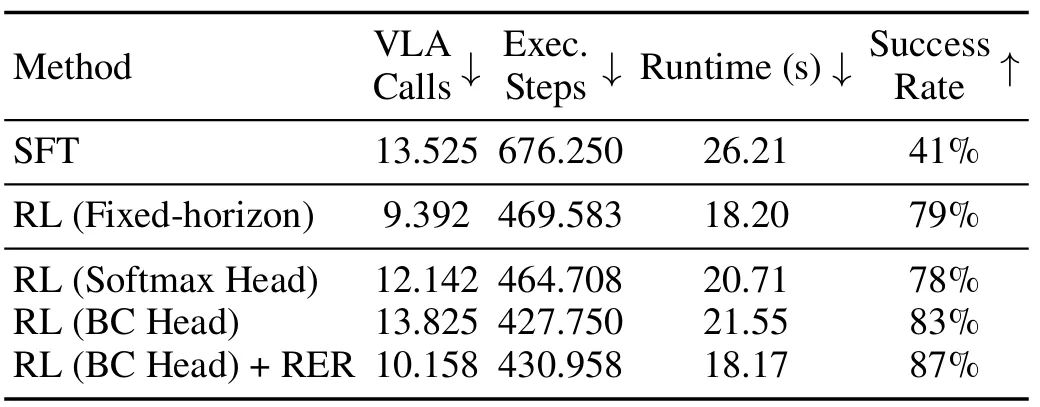
There are three very clear conclusions to be drawn from melting experiments:
Second, training a lightweight head with a 16.4M parameter can essentially match the effects of a 442.8M parameter action expert (78% vs. 79%), with the two parameters about 27 times the difference. This directly supports the paper's core judgment that this type of failure is largely due to a mismatch of replanning time, and not necessarily due to a lack of capacity to generate base VLA movements.
Second, after replacing softmax with Bernoulli-Continuation Head, the success rate improved further by +5% (78% → 83%), validating the sequential relationships of the explicit modeling horizon and the value of the forward-sharing structure.
Third, the addition of the RER resulted in an increase of +4% ((83% → 87%) while lowering the number of VLA calls from 13.825 to 10.158 and running time from 21.55 s to 18.17 s. It can be seen that without the RER, BC Head does indeed have a conservative tendency to collapse towards the short horizon, with the corresponding VLA call times being the highest.
Hyperparametric experiments also show that the granularity of the candidate horizon is equally important: changing the candidate set from {15, 20, 25,..., 50} to a more gross granularity {20, 30, 40, 50}, reducing the success rate from 87% to 78% for a candidate set that is too rough would force the strategy to stop too early or too late at the critical stage.
3.5 Real machine: AGIBOT G1
On the AGIBOT G1 kernel, the research team used the LingBot-VLA as the base, collecting 250 mission-specific remote control trajectories for each mission, and training SFT strategies with the 2000 General Trajectory Tracking Strategy; the base VLA remained frozen with only 128 BCP trajectories.
Grasping Bottle: 74% → 92%
Hanging Mug: The error in the position of the cup handle relative to the hanger is < 2 cm) 44 per cent → 84 per cent and the AAC is 48 per cent.
As can be seen from the execution sequence, BCP actively shrinks the horizon in close proximity to the operating phase, refreshing the observations before crawling and hanging, thus generating more precise movements.
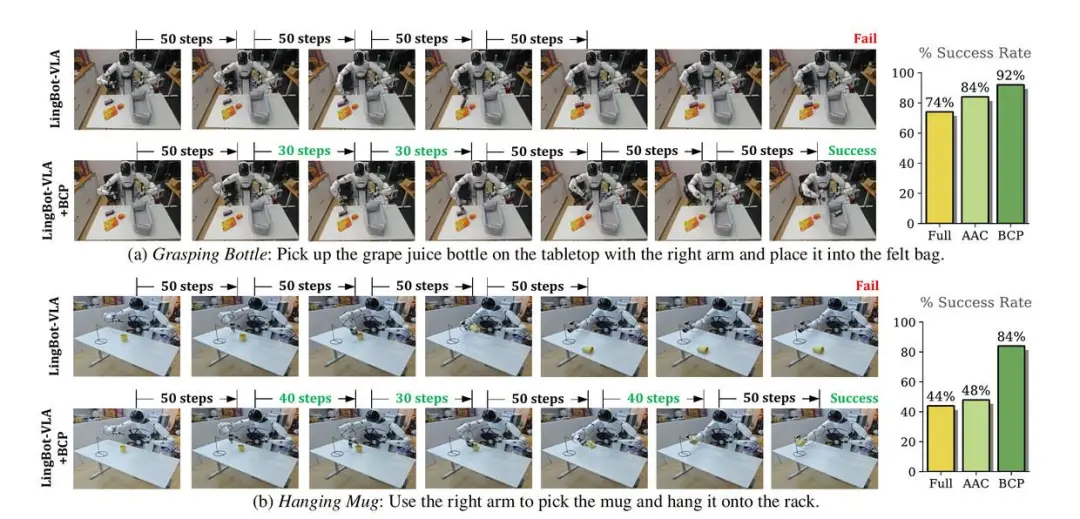
Figure 5 Real machine AGIBOT G1 Grab the bottle 74% → 92%, hang the Mark Cup 44% → 84%
Four, Summary and Limitations
The value of this work is not only a few percentage points higher in success rates, but more importantly, it points to a problem that has long been considered an engineering detail: the execution horizon itself is an important decision dimension that can be optimized at very low cost.
While much of the work has focused on "how to generate movements more accurately", the paper suggests that a significant portion of the failure actually comes from "robots continuing to execute with their eyes closed at the wrong time", requiring only a lightweight head of 16.4M parameters. Because the base VLA is fully frozen, i.e. plugged in, and results can be obtained one-time forward, BCP has a very direct migration value to the already deployed chunk-based VLA system.
The paper also makes clear the boundaries of the method: BCP is solely responsible for deciding when to stop executing the current chunk and reprogramming, and does not modify the VLA itself. Its effectiveness depends on the baseline VLA being able to generate a fundamentally reasonable, executable action chunk; if the predicted action itself is wrong, adjusting the execution horizon or reprogramming the timing is still not enough to correct the trajectory.
Author's note
The team of authors comes from Beijing University and Microsoft Asia Research Institute, together with Weichen Xu, a PhD student at Beijing University, currently an MSRA intern, Zhenhua Liu, a senior researcher at MSRA, and communications author Jiaolong Yang, a senior researcher at MSRA, whose research focuses on 3D vision and artificial intelligence.