There are a lot of robots that can swim and fly, but robots that can both swim and fly locally, and look at the world can be counted. Because it has to be crossed, it is an almost impassable physical chasm between a waterfall and a skyscraper.
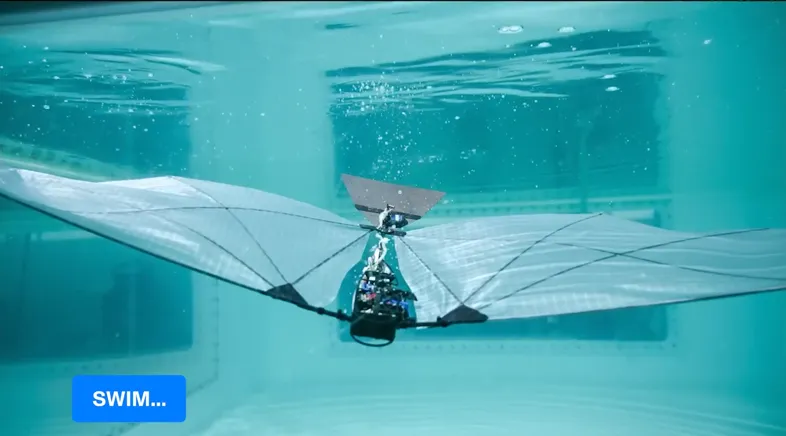
Recently, a joint team from MIT and EPFL at Lausanne Federal Institute of Technology has trampled the chasm underfoot. They've created a biomechanical bird that weighs about 250 grams and can swim under the water with its wings and fly freely between three states, and the results have been published in the top journal Science.
01.
Why are two robots so difficult?
An uncommon physical fact is that the density of water is about 800 times that of air.
This means that the same structure can fly in the air with air power and with hundreds of times the resistance and buoyancy to reach underwater. In the past, robots that tried to pump water through and eat chickpeas had to rely almost exclusively on the complexity of rigid folding wings, propellers, and leg pushing mechanisms. The bigger the robot, the heavier it was, and the more functionally it looked like chickpeas could get underwater, the less refined the chickpeas were.
The great thing about this machine bird is that it does exactly the same thing: it has no propellers, no leg support, no complex folding structures, only a pair of wings.
02.
And the first two, most of them, were made out of paper.
In fact, it is not the first time that robots that can both float in water and climb the sky have appeared, but previous designs have largely been made of rubber.
For example, MIT's Medusa and Gibbs Humdinga cross-medium platforms are typical pieces of machinery that are either heavily switched between different shapes, or that rely on wheels, two sets of propulsion devices like two vans, which are large in size and always without extra power structures.
That's why it's been picked up by the Journal of Robotics: it's not about adding a functional chip to an existing robot, but it's about rethinking the concept of robotics from a biology perspective.
03.
A pair of wings, how can you do two things at once?

The biggest technical challenge is how can the same pair of wings both adapt to the resistance of water and raise the lift of the air?
The answer given by the MIT team is flexible wings + precise control of stroke frequency.
• Underwater: the wings are passively bent to 90 degrees, like birds lifting their wings attached, significantly reducing the load of the motor; shortening the effective course of a single stroke, while the stroke frequency is maintained at 0.1 to 6 times per second, accompanied by a neutral float design, the machine bird does not float in the water, stably while saving money and energy.
• In the air: Machine birds rely on the same wing structure to beat fast at a rate of 11 times per second, and rely on high-speed vibration to obtain enough lift to maintain flight.
One set of structures, in two working conditions, relies on transferring the design power of a tensile shaft from the muscle (the motor) to the tensile shaft. The tensile wings in different media will turn the tensile shaft into the shape it needs.
This is the essence of imitation.
04.
The most frightening moment: from the surface.
The most stunning link in the switch between the two machines was undoubtedly the moment when they jumped out of the water.
After all, at this moment, the machine bird will be at the top of a huge water resistance, pulling its entire claw out of the water in an instant, and will be struggling for seconds to catch the air force.

The team reveals that the entire vacuuming process takes less than a second to complete 8 to 10 wings and jumps out of the water.
Moreover, this rising and jumping angle pump is extremely focused on the angle of drainage that must be controlled at around 70 degrees:
• The angle is calm, the tail pulls resistance over the water and does not fly;
• The angle is too vertical, and the machine bird can lose its balance and fall back into the water.
This 70-degree grit of gold, which has been refined repeatedly in data experiments, is the most powerful and the most easily overlooked technical detail of any machine bird.
05.
What about a breakthrough in engineering that unleashed a biological cage?
This machine bird is not only an engineering breakthrough, it also gives biologists a measuring stick.
In the natural world, about 100 species of birds are capable of switching their diving prey between water and land and then flying directly from the surface. In the past, it has been widely speculated that birds shrink their wings underwater in order to save energy, but with this experiment, the team proposed a new possibility: that birds shrink their wings underwater, perhaps in order to swim faster rather than simply save energy.
More interestingly, the energy-consuming data: when a single flight is more than 15.5 meters away, flying saves more energy than swimming, which fits well with the logic that birds prefer to fly or not to swim when moving long distances.
A machine bird, in turn, proves the evolutionary wisdom of nature.
06.
$300 for an unmanned aerial vehicle that can float
Unfortunately, the results of this laboratory-level research are far from perfect.
According to the team, the machine bird cost about $300 to build, and CAD design documents are available. Project manager, MIT Assistant Professor of Mechanical Engineering, Raphael Zufferey, gave a realistic vision: allowing marine scientists, marine biologists, and even coastal communities to use this low-cost shuttle to complete environmental monitoring, sampling, and observation of marine life.
You can even imagine a scene like this: Before the typhoon, a 250-gram machine bird takes off from a research vessel, plunges underwater across the sea, looks at the health of the reef, and then floats back to shore.
Of course, it is still in the laboratory testing phase, with a long way to go for autonomous navigation, seawater adaptability and durability. But the direction is clear: allowing robots like birds to roam freely in the water and in the sky, is becoming a reality that can be bought for 300 dollars.