Today, a tweet from two days ago started circulating with only five words: Scott Gray has left OpenAI.
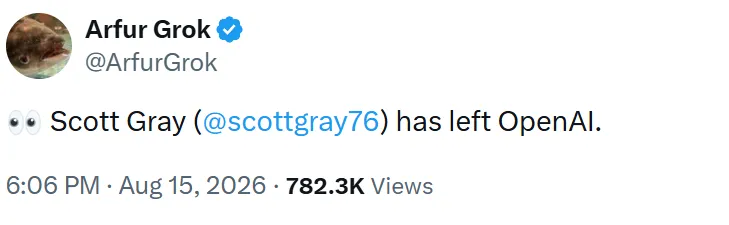
The renowned engineer, nicknamed "the god of the CUDA kernel, the world's strongest GPU programmer", has become one of OpenAI's biggest losers this year. Although he hasn't released a confirmation yet, his profile on X and Bluesky has changed from "GPU Geek at @OpenAI to "Former GPU geek at @OpenAI, and added the phrase "currently independent, exploring some neuroscience-inspired AI methods".
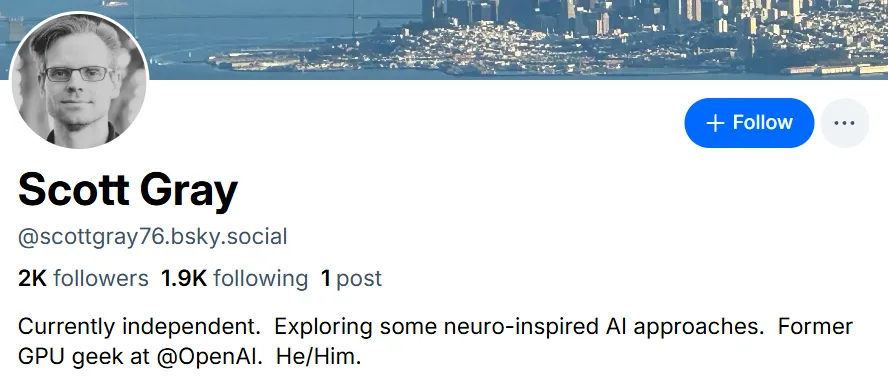
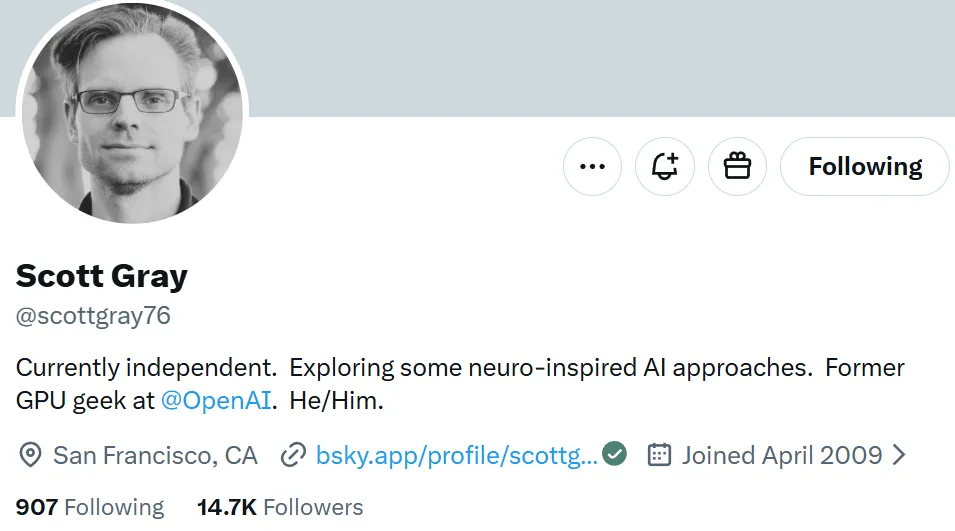
An engineer who worked at OpenAI for a decade announced his departure with a briefing.
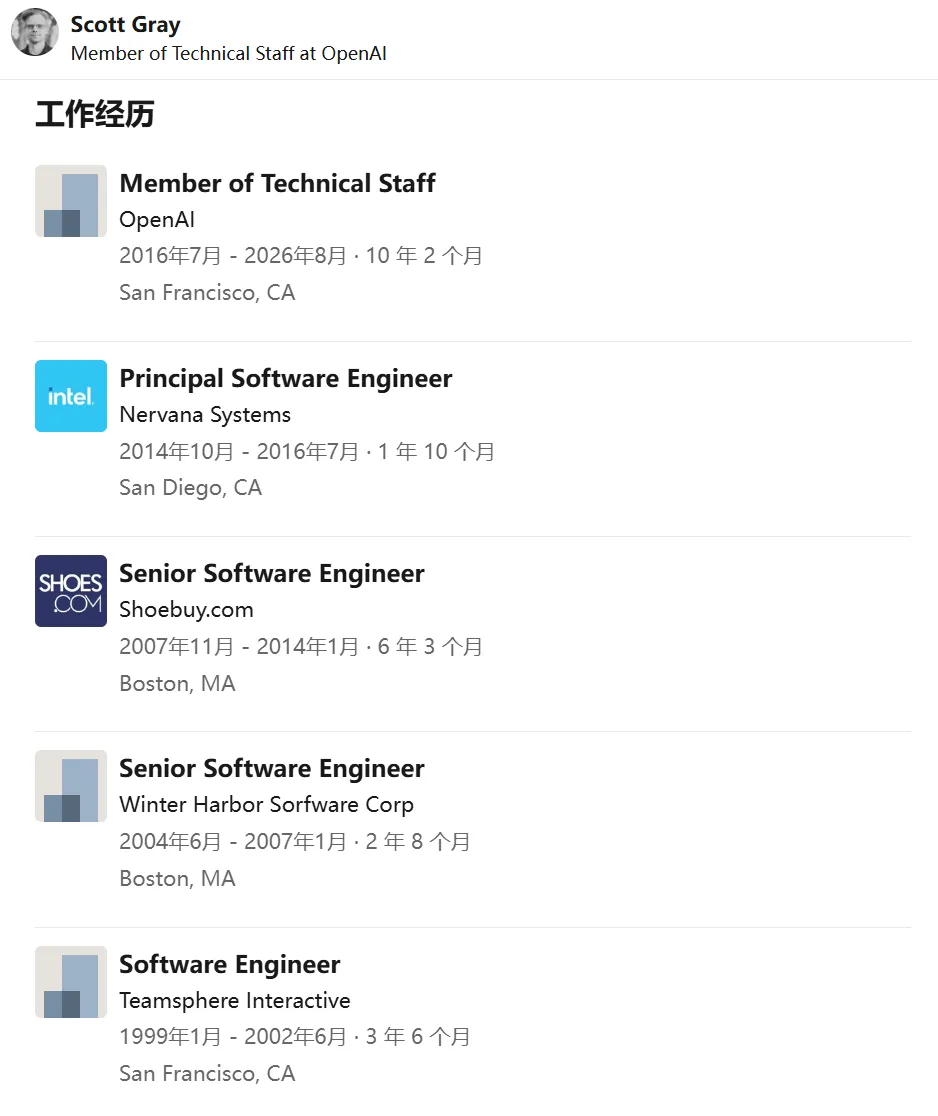
It's no coincidence. Just a decade ago, on August 16, OpenAI published a blog entitled "Team updates" about five full-time members who joined the team that month: Dario Amodei, Philip Wolski, Jack Clark, Scott Gray and Zain Shah.
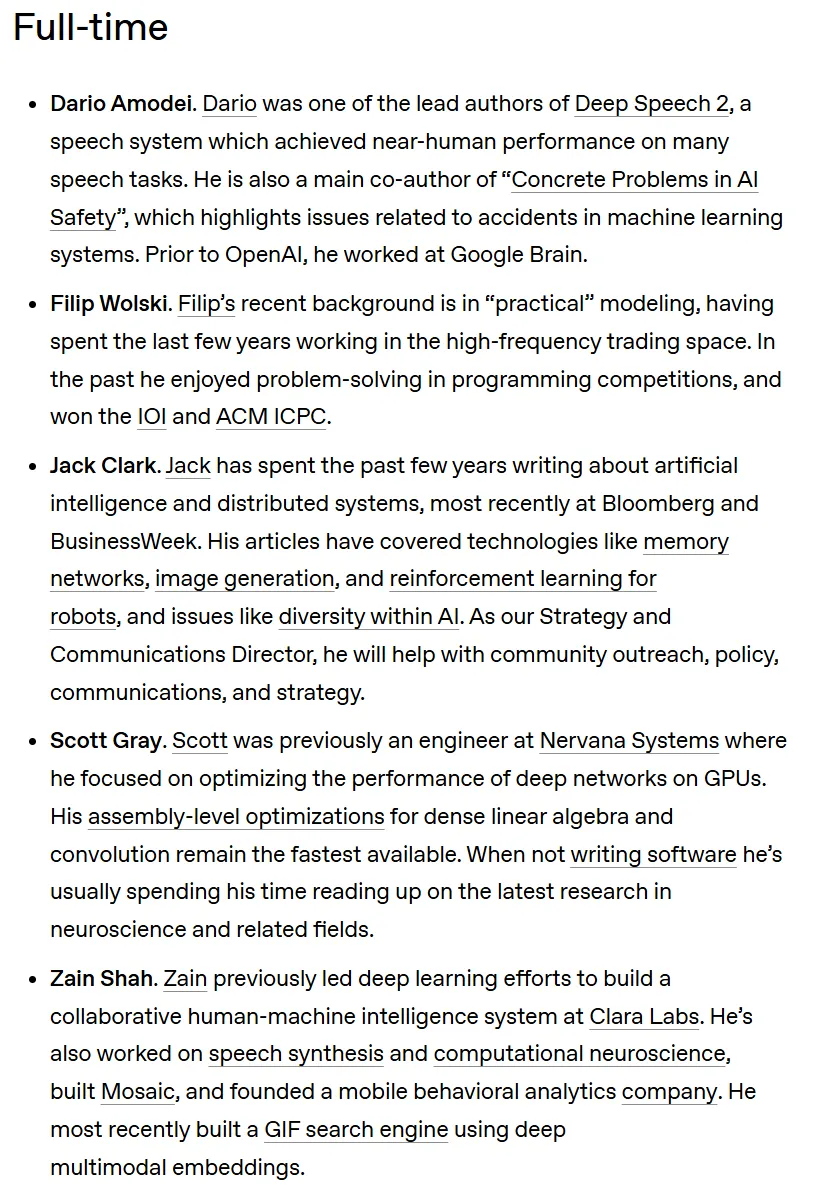
A decade later, today, Dario is the CEO of Anthropic, Jack Clark is in charge of policy at Anthropic, and Scott Gray labels OpenAI a "former".
As of now, OpenAI has not released any statements about Scott Gray's departure, and Gray himself has not made any specific statements. The common source of all the reports is a change to his social account profile, and a post that was subsequently circulated on X. The exact departure date, where to go, or whether a new company has been found, are not disclosed.
Another detail on his account is worth mentioning. Gray's last original X tweet was suspended on November 20, 2023, with a line: "OpenAI is nothing without its people". That was the third day after Sam Altman was fired from his board of directors, and more than seven hundred employees asked the board to resign.

Scott Gray's short story
In an earlier article about Scott Gray, we looked at the god of the CUDA kernel, the world's most powerful GPU programmer, and the god behind OpenAI.
His reputation dates back to the Nervana Systems era. At a time when the vast majority of developers relied on NVIDIA's official libraries such as CUDA C/C++ and cuBLAS, cuDNN, multi-layered software abstractions that shielded hardware details, also constituted performance ceilings. Gray's judgment was that these abstractions had to be bypassed, so he wrote maxas, a compiler for the Maxwell architecture that allowed developers to directly write SASS machine codes, manually allocate repositories, manage memory delays, and control instruction flows.
On the GM204 GPU, the kernel reached the peak of hardware theory at 98%, and was 4.8% faster than the official shutdown of NVIDIA, as well as the cuBLAS handwritten by the expert. MaxDNN subsequently promoted the same methodology to convolution: stable computing efficiency of 93% to 95% across all the convolution layers of AlexNet, while the efficiency of the cuDNN of the same period fluctuated significantly between 32% and 57%.
This is the essence of all his later work: not accepting the performance limits given by the abstract layer.
In the OpenAI team's August 2016 update, only two technical reviews were made about him, mainly because he focused on optimizing the performance of deep networking on GPUs at Nervana, while he optimized the compilation level of linear algebra and convolution "to date is still the fastest". The same paragraph also mentions that he usually read the latest research in neuroscience and related fields when not writing code.
It seems that a decade later, his new direction, "Neuroscience-inspired AI approaches", is actually a return to that unchanging interest.
After joining OpenAI, his role changed from "optimizer" to "enabler". In 2017, he and Alec Radford, Durk Kingma, released the Block Smaller GPU kernel. In contrast to removing the unstructured Smaller of a single weight, the Block Smaller cuts the weight matrix into fixed-sized blocks and sets the whole block to zero.
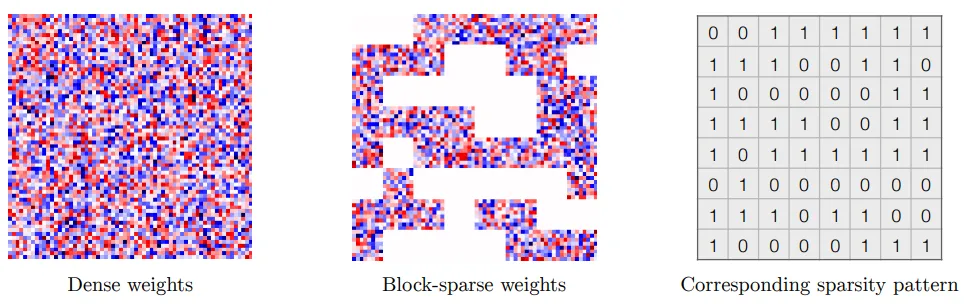
OpenAI has a rare-earth core plot.
Following this line down, Rewon Child, Scott Gray, Alec Radford, and Ilya Sutskever, authors of the 2019 thriller Generating Long Sequences with Sparse Transformers, reduced the time spent on attention and memory from O (n2) to O (n√n), and cited civilization as one of three contributions to the "rapid attention training core".
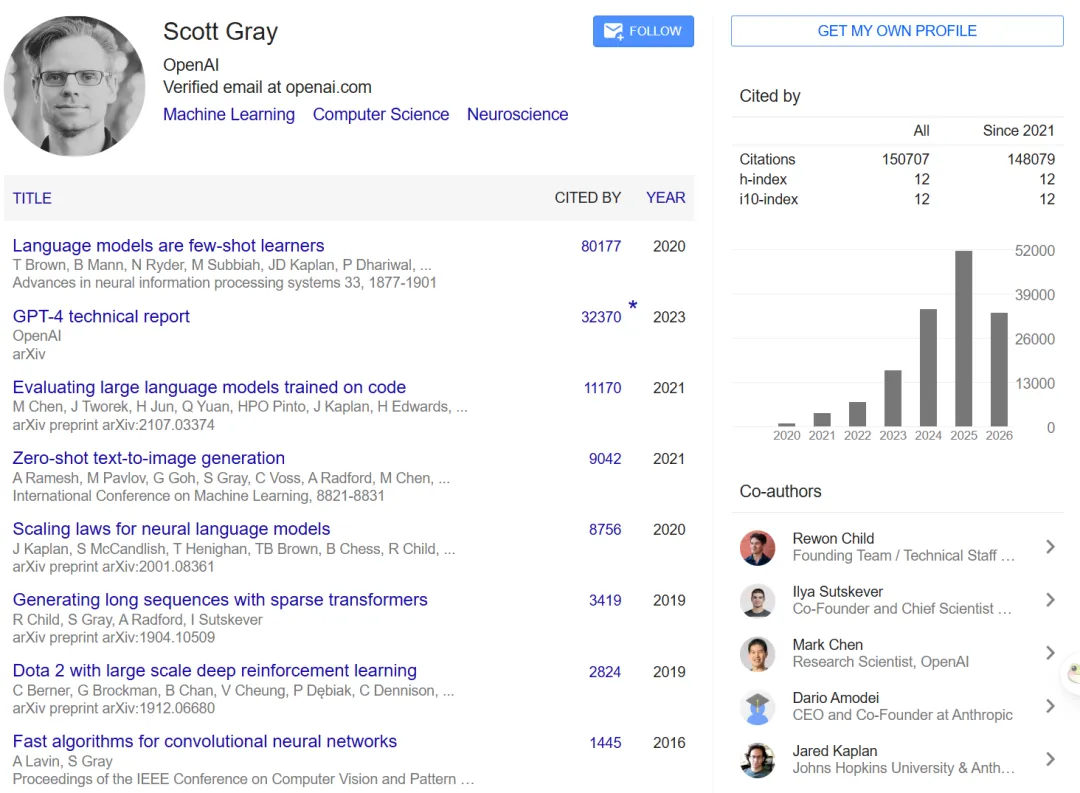
Later, his name appeared in the authors' list of GPT-3, the authors' list of Scaling Laws for Neural Language Models, the authors' list of DALL E, and the technical reports of OpenAI Five.
In September 2025, Rohan Pandey, a former OpenAI employee, posted on X that there was only about one person in the company responsible for the reasoning side of the CUDA kernel, and his colleagues wrote a notebook kernel called "the Bob kernel", which runs trillions of times a day on tens of thousands of GPUs.
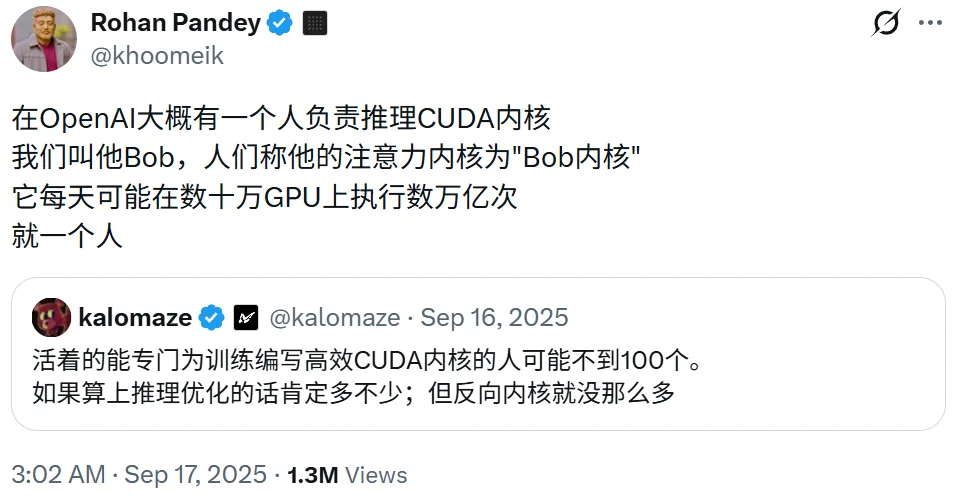
There may be fewer than a hundred people around the world who can write a high-performance CUDA kernel for the training process (especially reverse propagation) as this skill requires a mastery of parallel computing theory, GPU hardware architecture and deep learning algorithms, while most practitioners stay on the application or logical optimization layer.
And now Scott Gray is gone.
OpenAI has lost many people by 2026
According to X-blogger Chubby, OpenAI has 12 senior leaders this year, covering operations, business, products, research, security, ethics, and hardware.
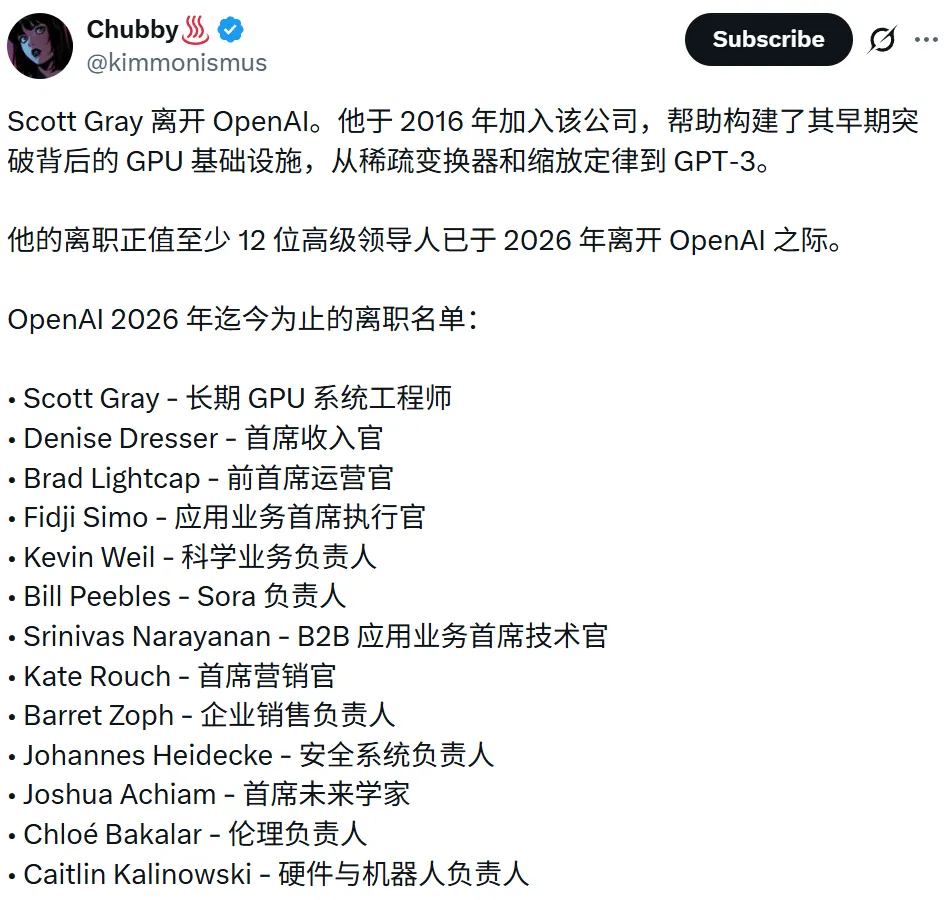
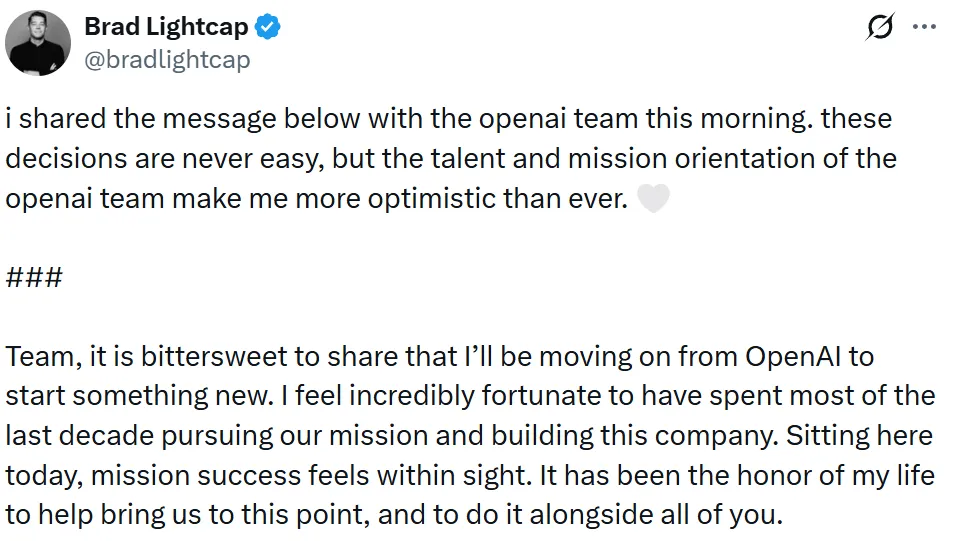
Eight years ago, Brad Lightcap, formerly CFO and COO at OpenAI, announced his resignation on X, calling it "start something new"; two days later, Chief Revenue Officer Denise Dresser, who took over in December, announced his resignation and was succeeded by former Wiz president and COO Dali Rajic.
On the commercial and product lines, application business CEO Fidji Simo took a leave of absence for health reasons in April; retired full-time in July to become a part-time consultant; former CMO Kate Rouch resigned in April due to treatment needs; CTO of enterprise business Srinivas Narayanan announced his departure in April. On the research and product side, Kevin Weil, head of OpenAI for Science, Bill Peebles announced his resignation in April; Weil is currently working as an AI science startup; Barret Zoph returned from Thinking Machines Lab in January this year to lead the enterprise AI sales of AI in June, and the company did not explain why.
Three members of the Safety and Ethics Line were concentrated in July: Security Systems Head Johannes Heidecke left the reorganization of the security team to join the research department headed by Mia Glaese; Chief Futurist Joshua Achiam left almost nine years later, and his previous mission coordination team was disbanded in February; Ethics Head Chloé Bakalar joined less than a year later. Earlier in March, Caitlin Kalinowski, head of robotics and consumer hardware, resigned because of her disagreement with the company's collaboration with the Pentagon.
The list also lacks one: In January this year, research vice president Jerry Tworek, who was responsible for reasoning models, left the startup nearly seven years later, citing a desire to do some research that was "difficult to do within OpenAI".
What is the meaning of this verse?
Scott Gray's departure may not immediately change the pace of OpenAI's model release. A decade of accumulated engineering systems won't come to a standstill because of one person's departure. But for a company increasingly dependent on scale, efficiency and cost control, losing an engineer who can push hardware performance to the limit and who has been deeply involved in multiple generations of core models is still not a change that can be understated.
The timing of this departure is also noteworthy: OpenAI is preparing to go public, become a revenue-seeking giant and participate in a global infrastructure competition.
Scott Gray's choice was not to join another cutting-edge lab or announce a startup, only to say in his personal profile that he was independently exploring "a neuroscience-inspired AI approach". From an engineer who spent his spare time reading a neuroscience paper in his official introduction in 2016 to re-writing neuroscience into his personal profile a decade later, it was more like a long-awaited return: after crushing existing computational paradigms to the extreme, he began looking for another possibility.
In 2023, Gray wrote, "OpenAI is nothing without its people". Looking back today, the phrase is both an expression of the company's crisis and a late note. OpenAI will not lose everything because someone leaves, but the direction of a company will ultimately be shaped by the people who leave, the people who leave, and the issues they choose to explore.