Today, Symbiosis Robotics has released a new demo.
In the image, the robot first presses down the body and moves its legs into the car's narrow driving seat. After driving to the track, it moves in the direction of the tunnel in front of it, stepping on the fuel door with the right foot, controlling the brakes with the left foot.
In some of the racetrack footage, the robot adjusted the direction according to the channel; the camera came to the end, and the car immediately drifted behind it.
Don't tell me this is a bit of a "robot driver" action.
However, the heat wave is not just drifting.
What this video really wants to answer is a more basic question: robots already understand the channels, so how do we turn this judgment into a full-body joint action in time?
The team introduced Direct Perception Control (DPC) which eliminated the intermediate motion representation that required independent Whole-Body Tracker tracking, allowing the model to combine images, tasks and body feedback to directly calculate joints and hand targets.
To train the system, the team also compiled 15,010 hours of physical data.
What's the problem with a robot driving a card?
Take a look at the car.
The cartridges were short and narrow, with the robot pressing down the steering wheel, rearranging the legs, knees and legs, and giving both hands space to hold the steering wheel.
After opening, there's more to it.
On the one hand, the robot must judge the tunnels according to the track image, on the other hand, it must continuously coordinate the direction of the hands and feet: the hands adjust the direction, the right foot controls the oil gate, the left foot controls the brakes.
In other words, the difficulty is not simply "turning the steering wheel" or "stepping on the oil door", but getting the perception, decision-making and control of the whole body in a continuous movement.
This exposes a longstanding problem in the human-robot system: how far apart are the models that understand tasks and the models that actually control the body?
What is the limitation of a Motion Interface?
Common human-like robot controls are divided into "know what to do" and "let the body do it".
Figure Helix uses a set of systems to handle low-frequency semantic reasoning and a set of systems responsible for high-frequency control. Gemini Robotics 2 also uses embodied reasoning models to complete task reasoning and full-body movement execution with VLA respectively. This type of sub-layer design has become very mature, and DPC further explores whether to allow models responsible for cognitive understanding to be combined with motion experts who directly generate joint movement in a unified training, so that task understanding and full-body control are mutually compatible and mutually enhanced.
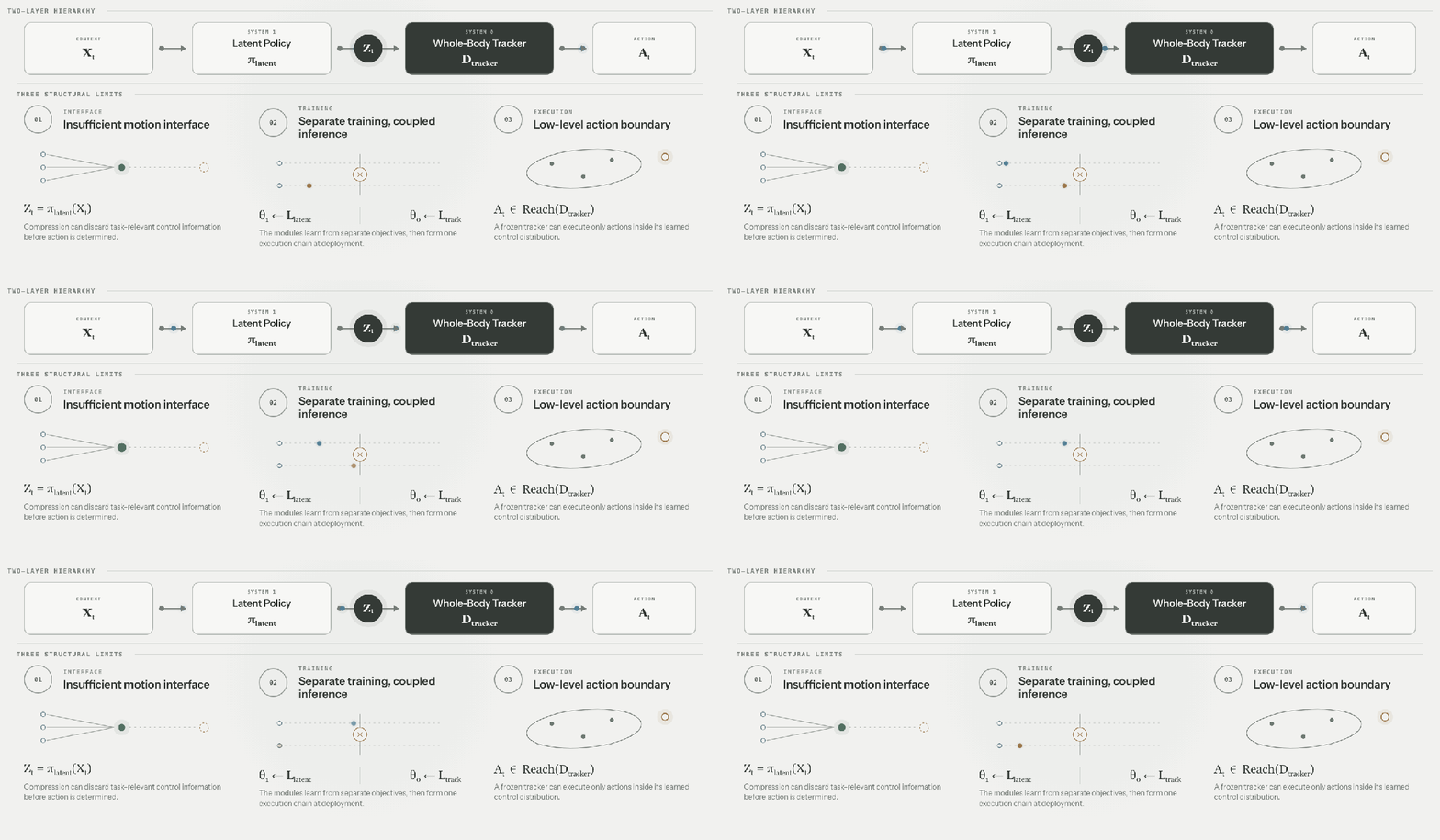
DPC examines whether the interface retains enough information, as well as how to train the connection and what movements the lower-level controller will do.
What's missing from the Motion Goal posture?
Motion goal describes what the body is supposed to do, and when it is actually executed, the tracker must also be combined with the current state of the body to calculate the Joint Target. Even if the upper model understands the task better, the tracker will not automatically master the movements learned under different contact and balance conditions.

Similar motion intentions in subterranean space may correspond to markedly different joint movements after mapping the conditions of the body's state.
Is it possible to continuously execute and train together in the laboratory?
Latent Policy and System 0 work in sequence when the system is running. In training, the former learns to generate movements, while the latter learns tracking and stability separately. The two models are not connected through interfaces until deployment, and the errors and image changes produced by the lower-level movements cannot be used to adjust the upper-level strategy simultaneously.
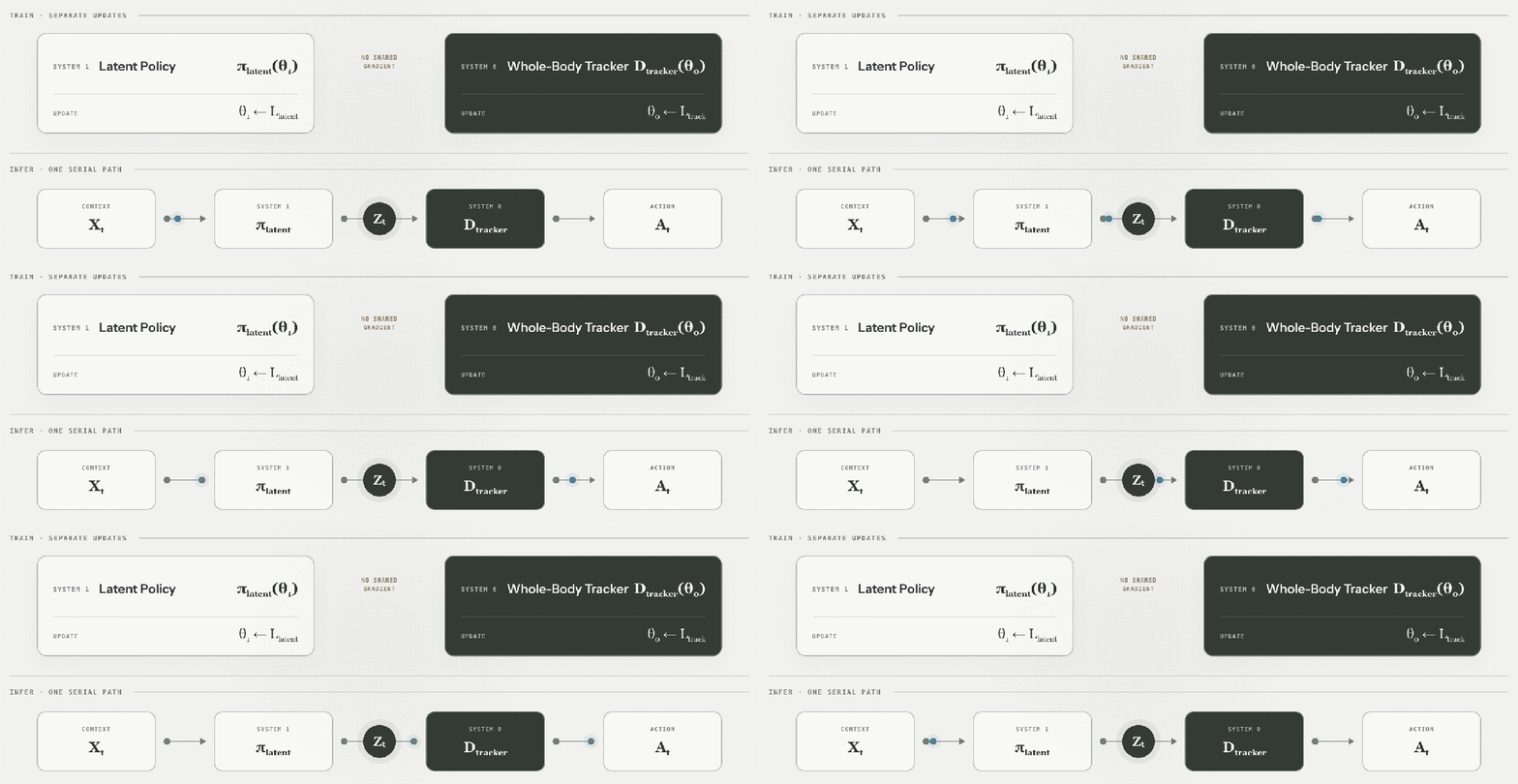
Latent Policy is trained and deployed separately with the Whole-Body Tracker via the Motion Interface.
When the low-level controller is frozen, can the robot's ability to move expand?
What movements the robot will ultimately perform will also depend on what training data System 0 has seen. Low-level pioneers, if mainly learning to walk, will continue to perform the newly added mobile operation tasks of the pioneers. Sitting in a car requires rearranging full body posture in a narrow space, and driving requires continuous upper- and lower-legged cooperation, all of which extend the original walking range.
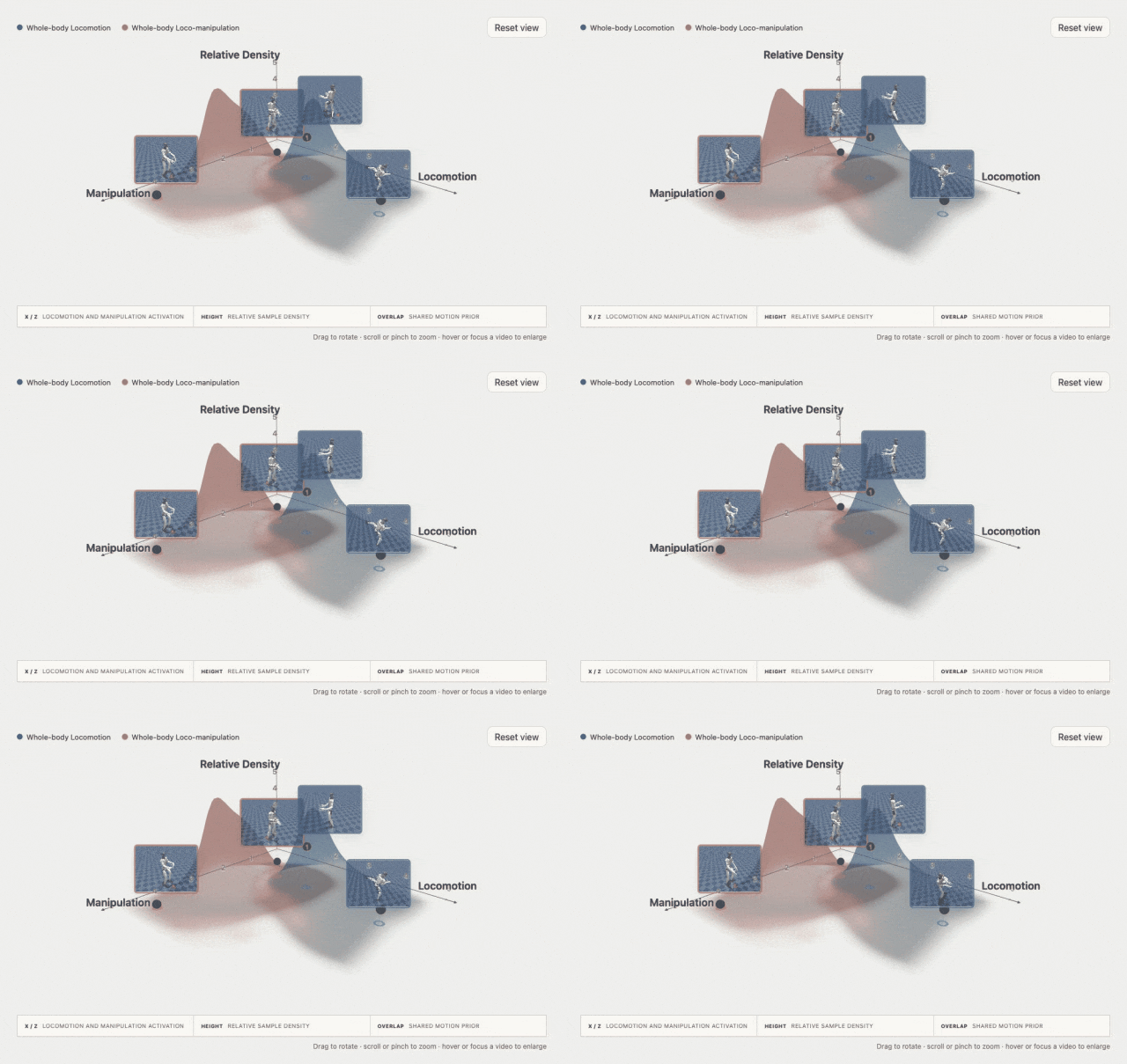
Mobile operations enter areas less covered by walking data, and the range of movements learned by low-level controllers will affect the final execution.
This is not a problem faced by the DPC alone. O-0, MotionWAM and Ψ0 both use visual information and body state to generate movement, but still use layered controls: the first two predict the latent movement of the whole body and are then executed by the bottom controller; Ψ0 dislocates the lower extremities, respectively generating lower extremity movement instructions and upper extremity joint commands.
DPC, how do you turn a picture directly into a joint action?
If restricted from the intermediate interface, the DPC's choice is not to continue to extend the display layer, but to bypass it. According to the official statement, the DPC eliminates the intermediate motion display that requires independent Whole-Body Tracker tracking. The DPC reads images and task language while receiving body state; previous motion recording and feedback execution are also incorporated into the calculation, ultimately directly outputting joints and hand targets.[1]
The direct output of the joint target in the DPC is the direct output of the joint target. The motor is still powered by the PD control and hardware execution layers, and security measures such as joint restrictions have been fully maintained.
Within the DPC, Perception Expert and Motion Expert are retained, the former understanding scenarios and tasks, and the latter handling high-frequency body feedback. Symbiotic Attention allows the two sides to exchange information and train under the same action objective.
The camera image does not need to be computed repeatedly, but the state of the body is constantly changing. DPC updates visual results asynchronously, while continuously reading the body's feedback.
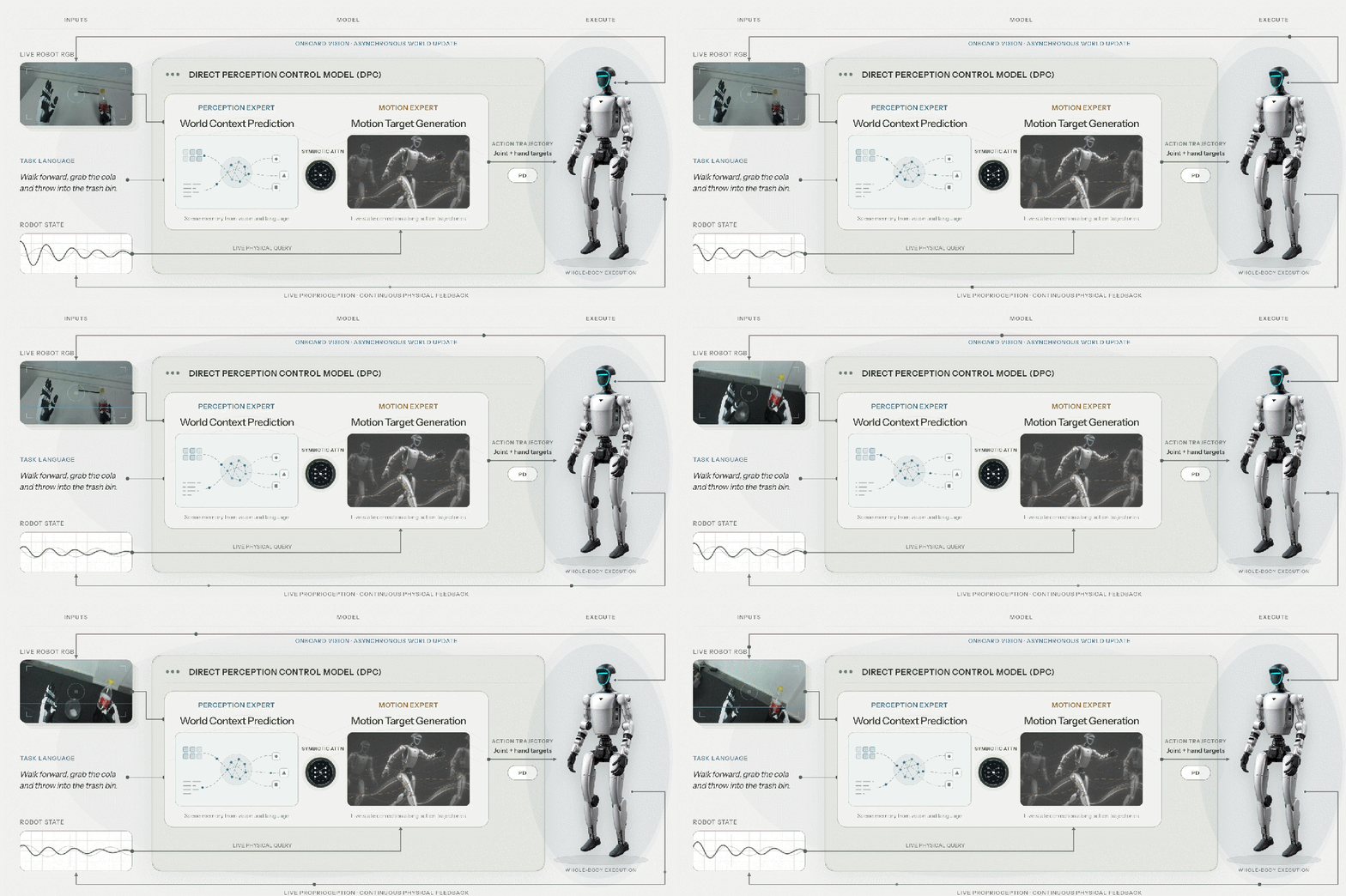
DPC canceled the motion reference waiting for Tracker to track, directly combining images and body feedback to calculate the joints and hand targets.
Direct output joint action opens the training link, but also requires the strategy to deal positively with the accumulated deviations in virtual execution. After the interface is canceled, the DPC strategy also learns to deal with the deviations in virtual operations, so it first completes the initialization through Offline BC and then enters the second phase of DriftDistill training. The student encounters a state of easy deviation in the online rollout, for which the Frozen Teacher gives a recovery motion; during training, the online rollout and offline demonstrations are used to update the Student.
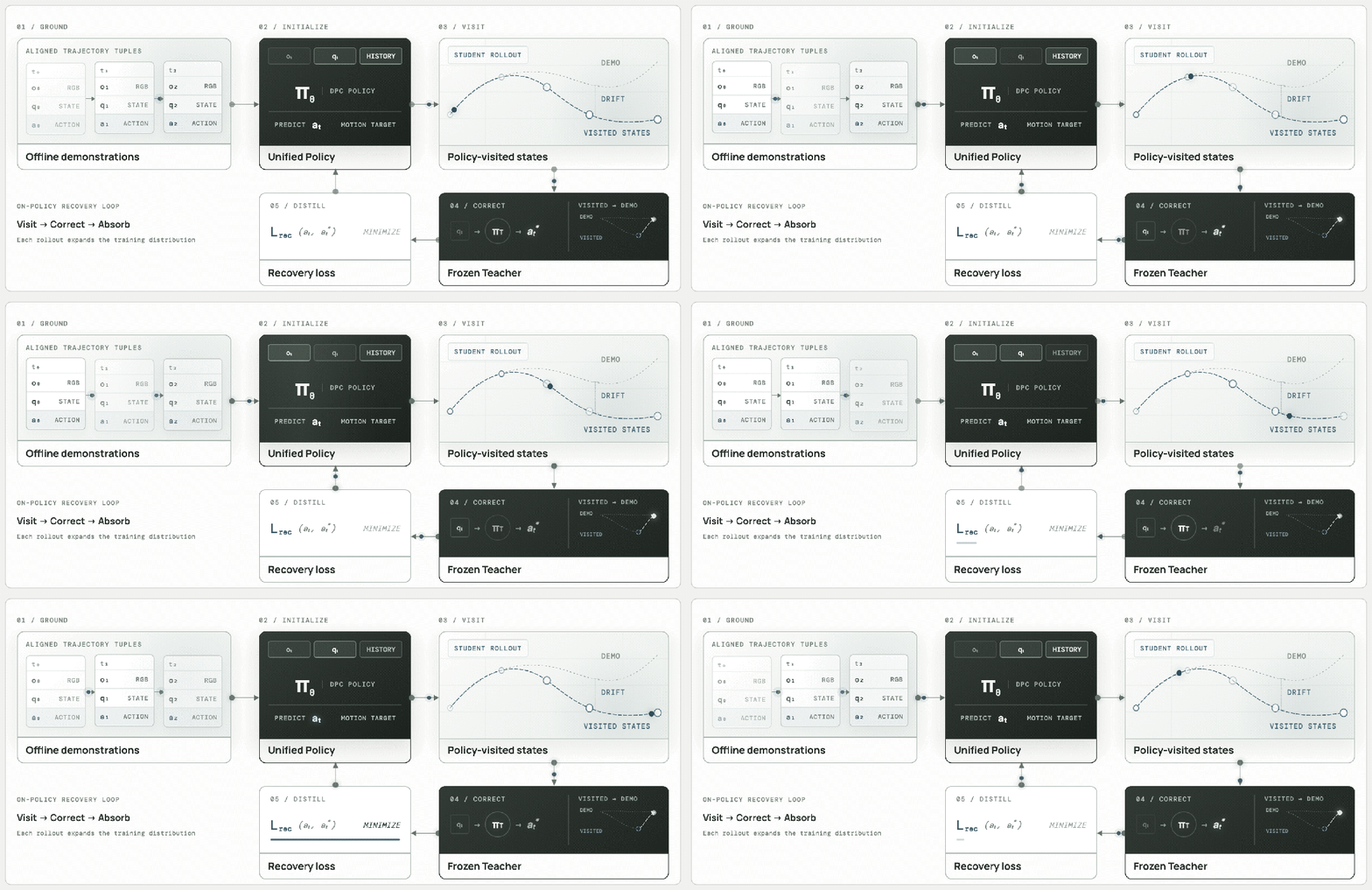
DriftDistill uses offline demonstrations to build the base of the action, and then adds the deviation states that the Student actually encountered and the recovery actions given by the Teacher to the training.
After repeated rollouts, the Student will gradually learn the status and recovery paths they encountered in the deployment. The updated Student strategy can handle more virtual states and can continue to complete tasks after deviations occur.
How do you put 15,010 hours of data into the same robot body?
Direct output of Joint Target also pushes the data problem to the forefront: records from different sources must first be converted into the same syntax language. Human video and different robot data use their own physical structure and control methods, and cannot be directly mixed for training; DPC therefore converts each data class into G1 executable, time-aligned joint action, and then unified for training.[1]
The data set was updated to include 15,010 hours:
6,781 hours of Human Ego data;
4,024 hours of Armed Robot data;
3,660 hours of Wheeled Humanoid data;
545 hours of bipedal humanoid data.
Data from different sources are converted to correspond to the same set of G1 joint movements.
Once the conversion is complete, images, task language, body status, action history, and subsequent linkage actions are placed on the same time axis. All data eventually fall into the same execution space, providing a unified Joint Target oversight for the DPC model.
In addition to driving, what else did DPC do?
Driving is one of the most eye-catching episodes, but not the entire DPC presentation.
The official page also shows mobile grabbing and placement, as well as full-body operation under restricted gestures.[1]
In the mobile operation segment, the robot goes to the front of the barrel, bends down the barrel and picks up the target alone, then moves back to the designated position and puts it down.
The robot walks in front of the barrel, bends over and picks up the target, and then moves back to its position.
Grabbing will change the negative weight, turning will change the supporting relationship. Robots need to complete tasks at the same time, while adjusting their entire body movements according to their new physical state.
The robot squeezed down the trunk and adjusted its limbs to sit in the low cardboard seats.
Sitting in a cardboard car pushes this capability into a more restricted space; after driving to the track, the change screen enters the control loop further.
These demos are linked to the same thing: the robot sees the changes in the environment and no longer serves as a motion reference, waiting for an independent Tracker translation, but instead combines the physical state of the moment to directly calculate the next joint action.
Of course, a drift video is not the same as a robot learning general driving. The focus of the DPC demonstration is not how mature the driving skills are, but whether the task understanding and full-body control can really connect under the same training goal.
Back to the beginning.
The robot sees the tunnel, immediately adjusting the direction and the oil gate; the body state changes, and the next joint movements also change.
From "understand" to "move on", there's more than one interface missing in the middle.
It also provides opportunities for perception and control to learn how to accomplish tasks together in the same system.
Sources of information
[1] Symbiosis-Robotics. Direct Perception Control Model, 2026.
[2] Figure. Helix: A Vision-Language-Action Model for Generalist Humanoid Control, 2025.
[3] Google DeepMind. Gemini Robotics 2 brings whole body intelligence to robots, 2026.
[4] Li Z, Zhang Z, Wei Y, et al. $\omega $-0: A Latent Predictive World Action Model for Concurrent Humanoid Loco-Manipulation, 2026. ttps://arxiv.org/pdf/2608.06375
[5] Zheng J, Ma T, Fan Y, et al. MotionWAM: Towards Foundation World Action Models for Real-Time Humanoid Loco-Manipulation, 2026.
[6] PSI Lab. {$\Psi_0$}: An Open Foundation Model Towards Universal Humanoid Loco-Manipulation,2026.