The Robotics Conference learned that China's Chipotle Intelligent Technology Limited (Shanghai) had completed a nearly billion yuan angel round of financing, which was followed up by China's Heifeng Capital Group, Jiangsu Capital Group, Pudong Capital Group, Lilia Group and two publicly traded companies. The company rebuilt six-dimensional sensors using optical pathways, bringing the price of its original thousand-dollar product to the thousand-dollar level.
It is worth noting that the angel wheel's investment squares: marketed VCs, Shanghai state-owned enterprises, assembly plants, and publicly traded companies are rare. At a time when smart parts finance is generally at a tight production pace and repurchase rates, this lineup is not common in angel wheels. It releases a pricing signal: the six-dimensional sensor, which was once classified as a "precision instrument", is being redefined by the market as a standard for physical intelligence.
01.
The problem with stress film schemes is not accuracy, but that accuracy is difficult to maintain in mass production.
The bottleneck of the stress film scheme is not laboratory accuracy, but consistency in mass production.
Six-dimensional sensors simultaneously calculate three-dimensional forces (Fx/Fy/Fz) and three-dimensional rectangles (Mx/My/Mz), which are the robot's smooth control, collision prevention and fine-grabbing core perception inputs. The typical layout of a humanoid robot is a pair of wrists + pair of elbows, each for a total of four; if the fingertips of each hand are embedded in a micro six-dimensional, the unit capacity can be 9 to 14.
Over the past decade, the industry has been dominated by resistance stress film schemes: metallic foam or aluminum stress film is attached to the surface of the elastic body, the force is changed→ resistance value changes→ Whiston bridge calculation value. The technology is mature, the noise is high, but there are several physical problems that are difficult to overcome: elastic body and foam layer with temperature, aging over time, temperature drift and fluctuation are inevitable; robots once entering dynamic motion, the static signal matrix is very vulnerable to structural vibration, the axis is significantly distorted; while the pointed finger space is usually less than φ20mm, the placement process becomes smaller, the more difficult it is to ensure that foam is miniaturized and consistent with natural contradictions.
These problems are directly reflected in the price: high-end scenarios depend on ATI, SCHUNK, a single 4 to 80,000 yuan; domestic variation film flow schemes about 1.5 to 30,000 yuan. According to the single four dynamic configurations, only sensor costs are 6 to 120,000 yuan.
02.
Curiously controlled route: jump off stickers, switch to light paths
Instead of continuing to evolve along the path of the stress film, the sensor selects a non-contact optical program to measure the decomposition value of the light signal. Sensing elements do not need to be frozen, which fundamentally avoids the aging of the light layer and heat drift; light signals are naturally resistant to electromagnetic interference, and axis chaining no longer relies on the algorithm of "hard decomposition", but instead relies on the light path structure itself to separate the different directional signals physically.
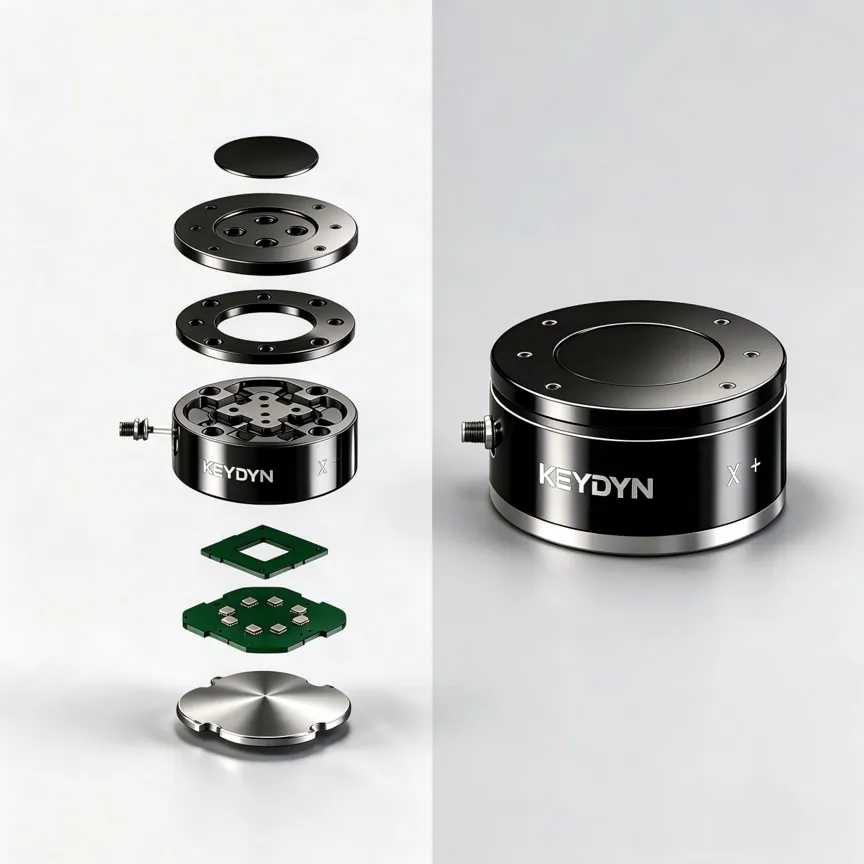
Program landing requires two things to be done at the same time: structural, flat, wireless non-contact design that can fit into the flexible finger knot cavity, moving the position of the six-dimensional sensor deployment from the "wrist" to the "finger knot"; in the process, self-developed high-precision automated labeling and testing equipment, coupled with self-developed soldering algorithms, solidify the entire production line with past artificial adhesives and manually labeled links.
Millenium pricing is the natural outcome of this combination: optical devices themselves are inexpensive, and the real cost is consumed by the fact that once the artificial labeling and labeling equipment is self-developed and mass-produced, the marginal costs are drastically compressed. Judging whether an optical power company has actually gone mass-produced, rather than looking at the precision indicators it claims, it is better to look at two things: dare not to press the single price to millenium, dare not to promise the free exchange of labels between different batches.
Currently, CGI smart control products have passed industry authority standards testing and have entered the supply chain of many of the leading AI hardware enterprises.
03.
It's time for the "standard piece" of sensors?
Consolidator HIPP Capital said: "With its underlying physical innovations, Fuji Point Intelligent Control has broken the overseas technology monopoly, and its optical six-dimensional sensors are not only superior in performance, but also have stronger volume and cost advantages, and are perfectly suited to the core demands of the scale-up of the smart industry.
As an important part of the robotics industry chain, high-precision, low-cost, and quantum-production power sensors are a prerequisite for human-machine safety co-operation and fine-tuning operations. We look forward to deeper ecological cooperation in the future.
We will continue to pursue our ambition to use extreme technology to empower smart cars, accelerate the large-scale application of domestic high-end motion sensors, and install a more agile, reliable steering wheel for the global robotics industry.
04.
What would change if there is a six-dimensional optical power of the thousand-millionth order?
In the robotics classroom, if a humanoid robot integrates four wrist straps in a single machine, the total cost of a variation program can range from 6 to 120,000 yuan, and the 1000-mode optical program can be pressed to 4,000 to 8,000 yuan. After the cost crosses this line, the decision logic of the integrated machine factory will shift from "don't wear a mask" to "pack some redundancies", and the mask will open from the high-end selection window to the model of the entire machine.
This is also the first time that optical routes have actually received a "candidate for mass production" ticket. In the last decade, optical programs have remained long-term in costless scenarios such as surgical robots, space, etc. The label has always been "good but expensive".
If this were to happen, the narrative of domestic alternatives would also change: the logic of the variants is "precision tracking ATI, cutting in half the price", and the essence is substituted in the framework of precision instruments; the odd thing is to reconstruct the "thousand-millionth precision instrument" as "thousand-millionth interchangeable standard parts".