Today, crawling is no longer the most surprising thing with physical intelligence. It is not difficult to get a robot to complete a crawling action, it is difficult to get it to do it without being told the answer in advance. For example, without a predetermined coordinate, can a robot grab a cup that has been moved?
The question that really deserves to be discussed is: Will robots still reach out directly after the cup moves? and continue to execute the entire process perfectly. Behind this simple scenario, the increasingly realistic question of being physically intelligent is that when robots enter factories, warehouses, shops, and even homes from laboratories, the world won't wait for it the way it does in data sets.
There will be several millimeters of height and depth, objects will be touched, lighting will change, sensors will be delayed, the motor will not be 100 percent accurate, the last second is still in place, the next second may be moving.
Recently, this problem seems to have been solved in a new way, using both mathematical and non-traditional AI methodologies.
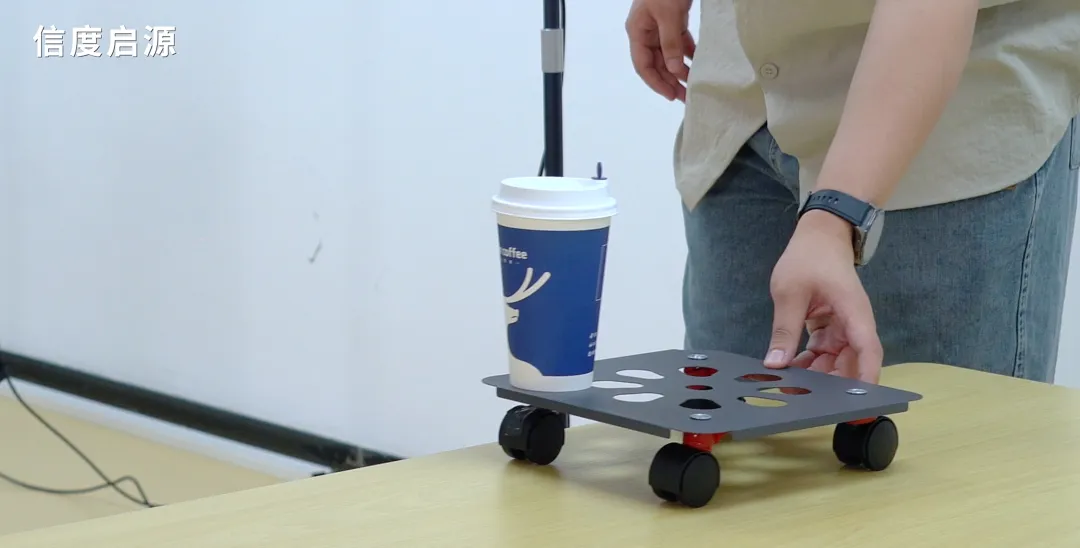
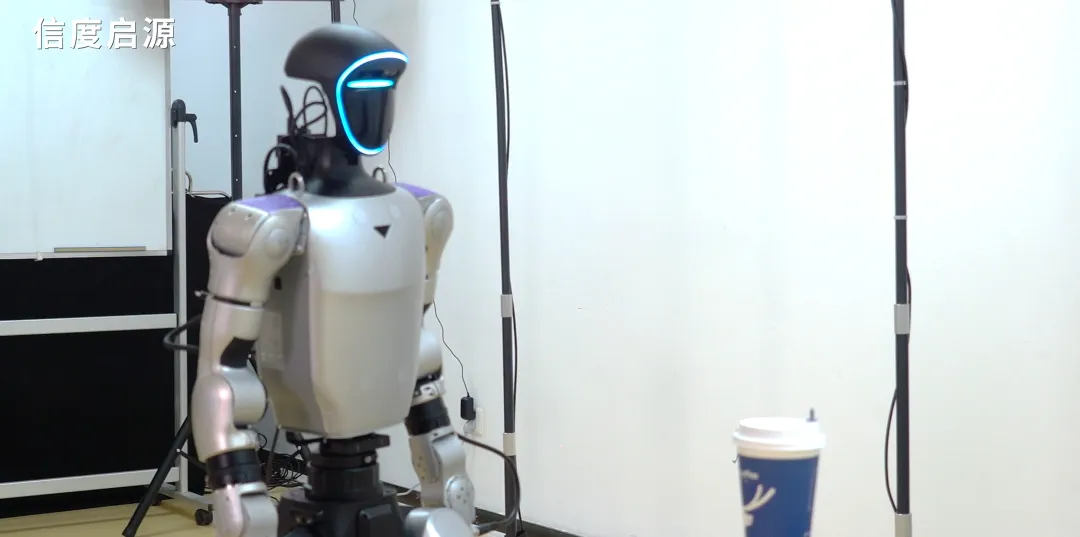
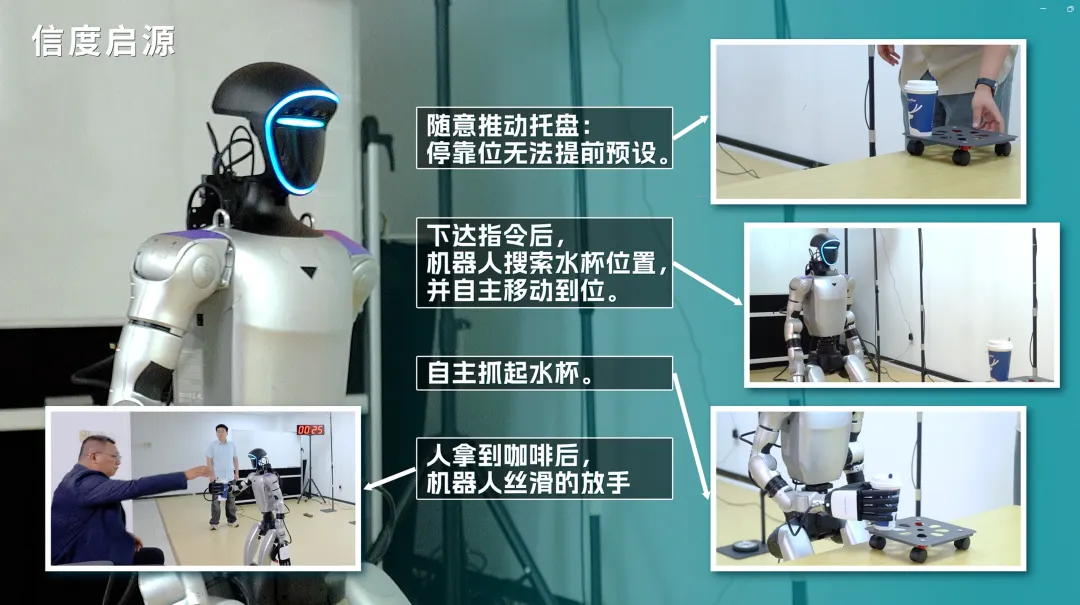
In one of the offices in the video, a humanoid robot stands at a table and puts a cup of coffee on the table, below which is a tray with wheels. Someone pushes a tray in advance. The cup moves with the tray and stops in an unmarked position. A few seconds later, a voice command is sent: take a cup of water. The robot does not re-scan the scene, nor does it stop to wait for artificial calibration.
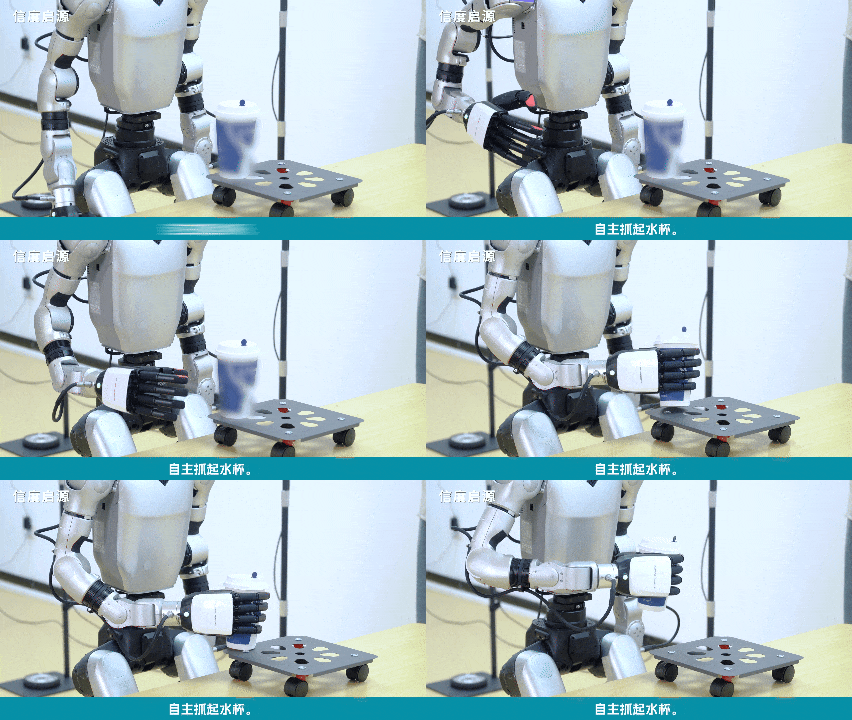
In the end, the robot delivers the coffee to the person, the person gets the coffee cup, the robot automatically loosens, the task silk has no cardboard, there are no awkward scenes where the player takes away the cup, the robot loosens without trials and hesitations, like one who has practiced a thousand moves, and is close to the normal speed and response of the person.
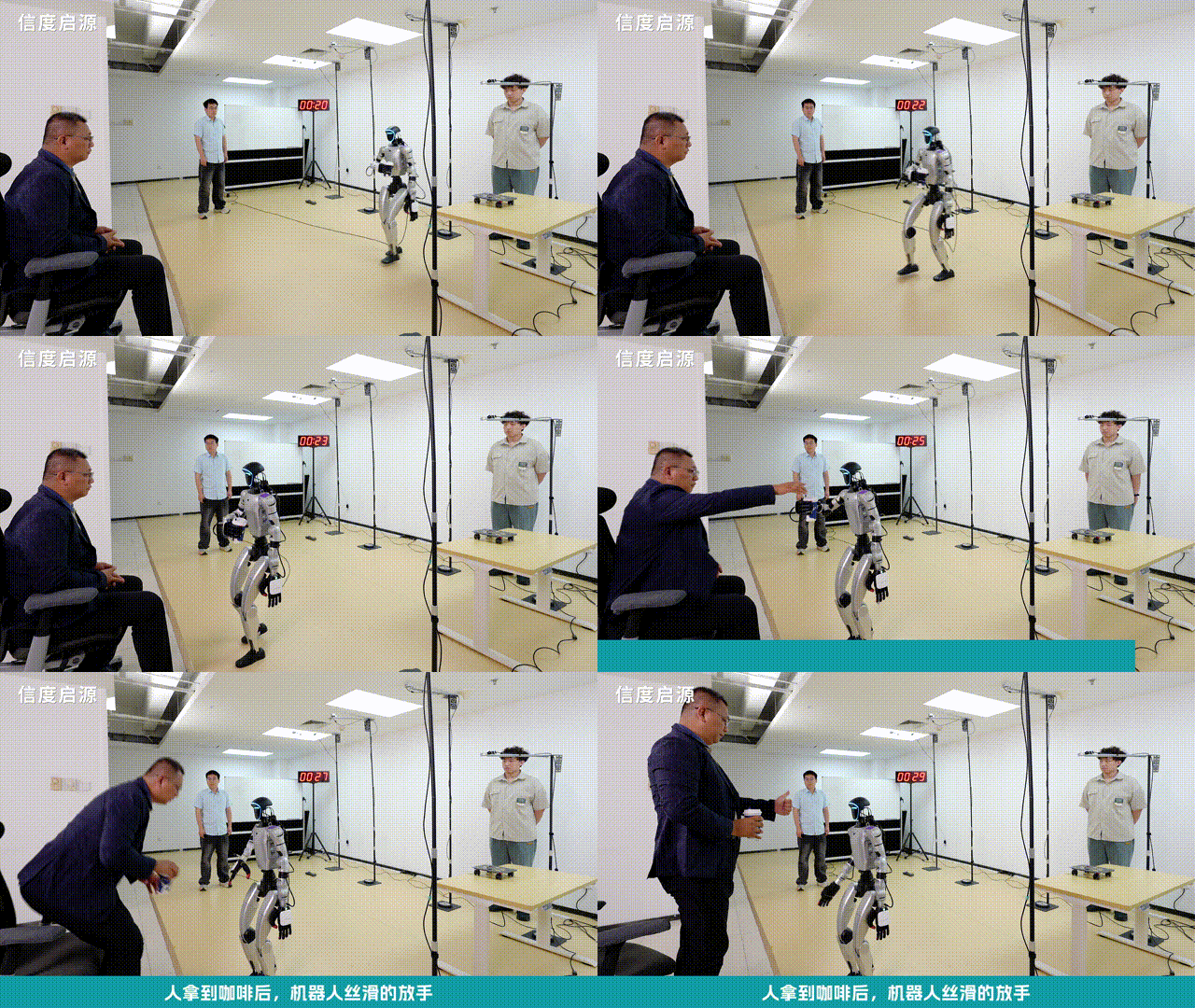
Capturing the dynamic position of the test algorithm, delivering the algorithm's momentum, time, and space at the same time, is the hardest part of the chain. An untrained robot quickly determines the physical safety of its movements within the boundaries, so it's easy to get caught up in a ten-second video that's the best way to make decisions like a human, fast, and explainable.
The newly-founded company, which is moving a theoretical system from the field of mathematics into robots, is trying to build a new paradigm of uncertainty-based theoretical puzzles, combining uncertain statistics, uncertain differential equations, and uncertain controls to create a new model of puzzles called the Puzzles of the World Model Puzzles.
It's not about making the model bigger, it's about trying to use mathematical methods to make robots less speculative, less calculative, and less step-by-step to find out exactly how the action should happen.
If this path could eventually be established in more real-world scenarios, it might change not just a robot model, but the understanding of AI itself as it moves from laboratory to industry.
01.
There is a gap between hot money and landing.
93.5 billion yuan. This is the total amount of financing for the domestic body-smart racetrack in the first half of 2026, which is five times that of the same period last year. 322 financing events, a growth of 137%, the market size is expected to break trillions of dollars in the year.
The other side of hot money is the delay in landing. An in-depth report by the Securities and Exchange Commission in April 2026 highlights the problem that robot hardware is mature enough, and the real bottlenecks are in large models.
Data collection, model training, scenario labeling, all of which are burning money, deploying a robot input line, often taking months of custom development. The industry is not lacking in enthusiasm, what is lacking is a way to really get robots into the real world.
This is a new possibility, as shown in the credentials initiation video.
02.
The two main channels are facing similar challenges
There are currently two "mainstream channels" in the industry around what to do with the brains of robots.
The first is the end-to-end model route. The vision, the language, the action are all embedded in the same neural network, the data drive, the black box runs, the generalization depends on the stack. Its difficulty comes from this, the data is never enough, the distribution is always incomplete, it encounters unseen combinations, the model can only guess. The second is the traditional hybrid route controlled by AI.
The two paths coincide, both using data to approach the physical world. The real world frequency is very unstable, the ground will not be flat, the light will not be constant, the motor will not be absolutely accurate, the scene will never be repeated.
When the data-driven boundaries emerged, the industry turned its attention to world models. Instead of letting robots remember every scene, it was better to let them understand the laws of physics and then play the game. Turing Prize winner Yann LeCun has repeatedly publicly stated that big language models are not the path to true intelligence, but that intelligent agents need models that can predict the world. Stanford University professor Lee Ffeifei sees space intelligence as the next direction of AI. At WAIC 2026, world models are defined as AI's real-world cognitive brain.
However, the direction is new, and the method is continuing. The mainstream world model is still based on data adaptation as a core, with big models processing bulk data, and the idea is consistent with the first two routes.
In addition to data-driven and rule-driven, it opts for theoretical drives, starting with mathematical axioms, where every step of the calculation is in a white box.
03.
Making robot control a mathematical problem
To understand the third path, we have to go back to the secondary school of geometry. Where the robot is, where the cup is, and from which angle the hand is grasped, are the questions of position and gesture in space, which is the first level.
Disruption in the real world is inevitable. The ground will not be absolutely flat, the engine will always have a bias, and sensors will always be separated from noise, models and reality. Statistical relevance is good at describing trends, but it is difficult to give a causal boundary. How to handle this distance is a question to be answered at the third level.
It is calculated not as a speculative move, but as a credible boundary. Just as an old driver would not go to calculate the probability distribution of a vehicle's sidewalk, he would only instinctively maintain a safe distance. Within this geometry, the move is physically safe.
The mathematical system is a set of credible intelligence algorithms that calculate the real-time credible boundaries of future states, allowing robots to make optimal decisions within the boundaries without requiring mass sampling, predetermined distribution, or even re-training for new scenarios.
04.
Seven modules that recreate the information processing of the human brain
On top of this mathematical system, the belief system is powered by a seven-channel framework consisting of seven modules of hearing, touch, vision, testing, prediction, decision making, and control.
The first three are responsible for perception. The auditory, tactile, visual modules extract the geometric characteristics of the environment from sensor data, convert it into credentials, and transmit it to the downstream modules.
What really determines how the robot moves, how fast it moves, is the rear wheels.
The test module is similar to the frontal system of the human brain. The millisecond level determines whether the current state is beyond the physical credible boundaries, discovers a dangerous immediate interruption of action, regardless of higher decision-making.
Predicting the module against the top of the human brain, doing an anti-intuitive thing, predicting now. All sensors have delays, and robots always see the world tens of milliseconds ago, based on data with delays and noise, it reverses the real state of the moment and then proceeds to the next step.
The decision-making module corresponds to the forefront, and is based on the principle of maximization of trust to solve the optimal control laws directly, rather than taking probability sampling in tens of thousands of candidate moves.
The control module interacts with the brain and the base, converting decision-making instructions into precise control signals for the motor.
The key here, too, is to test, predict, make decisions, and control the quadrilateral completely without using the big model. Every step of the calculation has clear mathematical support, decision traceability, explainability, and black box guesses with no neural networks in the middle.
05.
Where did it come from?
This is the reason why we believe the world model is fast and economical.
The mainstream big model route is reverse-training. Data flows in and out, and the algorithm burns out, and in a different scenario, often with a round of collection and calibration. The model of the belief world is directed toward design. Algorithms are introduced directly from mathematical aesthetics, bypassing big models, saving a lot of thought.
In the team's words, the big model is to match the world with data, and the belief source is to understand the world with mathematics. These are two worldviews. For investors, everything saved is a number on the account.
Anti-disturbance capability also embodies the commercial value of the third path. In traditional schemes, markup, data collection, training models, a customized development of a production line for several months. Belief world models do not need to be retrained for new scenarios. Centimeter-level position bias, lighting changes, and micro disturbances can all be handled by themselves.
This means that the economic threshold for scale deployment is lowered. The same model can be adapted to different robot bodies, different operating scenarios, and bulk landing space is opened up. The list of industrial installations, commercial services, household services, landing scenarios is also growing.
06.
Twenty years of theory, a self-contained chain
The third way is not by chance.
Its theoretical basis is uncertainty theory, founded in 2007 by Professor Liu Bei, of the Department of Mathematical Sciences at Tsinghua University, which is the formal mathematical branch of the study of non-decisive phenomena. Two sets of formal systems deal with different phenomena: probability theory, research frequency, and uncertain theoretical research beliefs, each with its own applicable boundaries.
Within twenty years, this set of theories derived from the fields of statistical uncertainty, planning uncertainty, logic uncertainty, process uncertainty, analysis uncertainty, differential equations uncertainty, and finance. It was translated into Russian, Japanese, and Persian as the Uncertainty Theory, published by German publisher Springer.
This is the first start-up in the field of physical intelligence in the Chinese Mathematics Department.
From the most basic theory of uncertainty, to the construction of seven modular architectures, to the deployment of hardware platforms, to the modulation of deployments, to the completion of the entire chain of trust-based technologies. This is a completely autonomous, non-dependent route to the mainstream Western AI paradigm, from basic science to application, the whole chain of origin.
07.
From the blackboard to the production line
Currently, a new round of financing has been launched, the next step being to adapt the model of the world of trust to more industrial robots, humanoid robot platforms, and promote industrial and commercial scenarios.
While the industry is still arguing about insufficient data and poor computing power, the company chooses to start with logic. It gives robots a set of mathematical frameworks that are synonymous with human intuition to make decisions using explainable physical laws.
The glass in the video is just beginning.