Over the past two years, the human-robot industry has solved many problems that can't be solved.
Robots are starting to be able to walk, grab, sort, move, big models, VLAs and world models are pushing the boundaries of intelligence. But as more and more robots start to leave the lab, a more realistic problem emerges:
That is to say, making a robot and making 10,000 robots are two completely different industries.
The former relies on technological breakthroughs and the latter relies on manufacturing systems.
When industrial hardware intelligence begins to enter the real production line, the problems facing the industry change as well. Not only do robots need to have stronger intelligence, but they also need to address a range of engineering issues such as core component costs, supply chain stability, mass assembly efficiency, product consistency and fast delivery.
This means that human robots are undergoing an important competitive shift in focus, from the original laboratory that determines what robots can do to the current manufacturing system that determines how far robots can go.
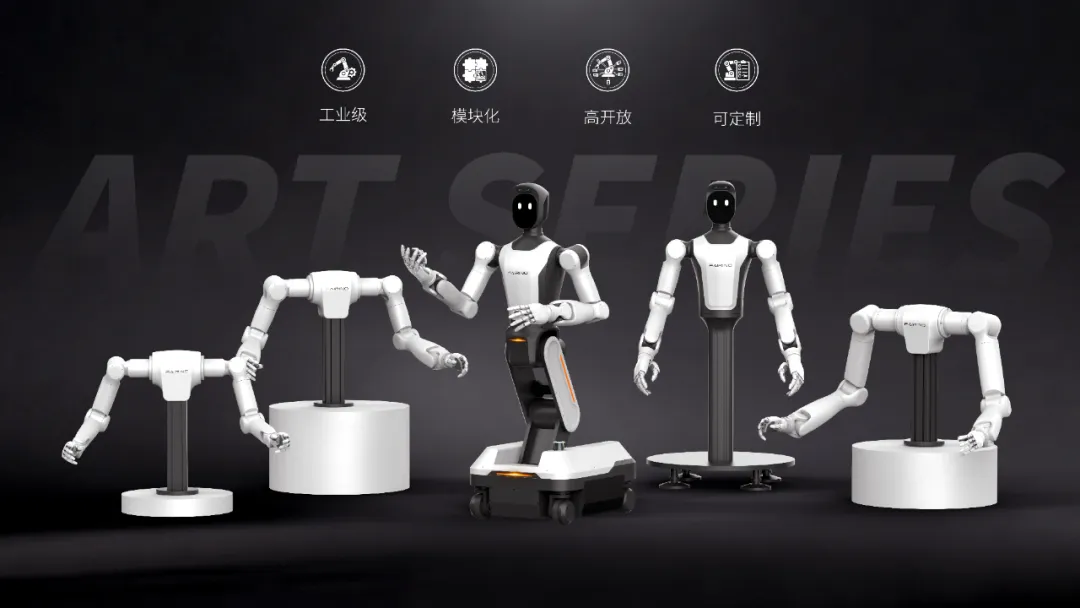
Recently, with the introduction of the ART series of industrial manpower control arms. From standardized man-made joint modules, man-made mechanical arms, to arms, upper-body R&D platforms, and integrated reference designs, Fao will systematically replicate core components, joints, controls, and scale manufacturing capabilities that have accumulated in the past in the field of collaborative robotics to the field of industrial physical intelligence.
The Robotics Workshop learned that from 2024, FAO has been providing in-depth, customised human-powered arm control services to the industry, continuing to explore the applications of industrial AI in real-world scenarios.
Prior to this, facing the apparel flexible manufacturing scene, the global leader in intelligent silicon manufacturing, Jack Tech, which relies on a complete globalized layout and mass process scene experience accumulated in the deep-growth industry, combined its self-developed VLA vertical-domain-sized model based on the FARO industrial-grade humanoid control arm to build silicon robot system solutions, combining its own process accumulation and scenario experience in the field of intelligent silicon manufacturing, to accelerate the application of humanoid robots in the silicon industry.
Based on Bosch's industrial resources and the underlying strengths of Galaxy's general robotics technology, the company, using its own robotic body, vertical model and software platforms, builds artificial intelligence applications based on human-powered control arms at an industrial level through deep industrial know-how and engineering capabilities, driving the integration of robots from intelligent decision-making to physical execution capabilities.
So, on the surface, it's an expansion of a line of products from Fao. But if you put it at the point where industrial AI is starting to scale, there's something more to be concerned about: while the industry is still looking for limits on the capabilities of robots, Fao is starting to link more intelligent agents to the physical world, and is trying to redefine the way an industrial robot body is made, so that more embodied intelligent enterprises can actually do product cases.
01.
The next threshold for industrial intelligence is manufacturing.
In the past few years, the main competition in the human-robot industry has been in terms of technology. Higher freedom, stronger mobility, more complex operational tasks, and more generalized body models have led to the rapid transition of robots from non-combustible to non-combustible.
But industrialization doesn't happen naturally. When robots move from a few samples in the lab to hundreds, thousands or even more in the factory, the changes in the rate of industrialization will change rapidly.
Can core parts stabilize supply? Can different batches of products be consistent? How many parts do a set of robots need? Can a production line complete assembly quickly? Will a robot be re-developed or adjusted on an existing platform when new scenario demands arise?
These problems are rarely seen in robot demonstration videos, but determine whether a robot will actually enter the manufacturing industry.
In the past, the industry has discussed reducing the cost of robots, used to dismantle BOMs and judge how much more motors, decelerators and sensors can be reduced. However, the biggest cost of robots after they have actually entered mass production is not limited to the purchase price of parts.
The huge inventory pressure of SKUs, the engineering costs of repeated R&D and development of different models, the complexity of assembly caused by non-standard designs, and the inability of small batch manufacturing to produce a large-scale effect eventually lead to the cost of a robot.
As a result, the real issue that needs to be addressed is not just the lowering of parts, but the lowering of manufacturing systems. The core logic behind the ART series is also here.

02.
Reduce costs by reducing manufacturing complexity first
According to the latest disclosures by Fau, which are based on practical applications and industry practices, the company is attempting to establish a fully self-developed and highly standardized integrated manufacturing system for silicon.
Currently, Fao has developed and self-produced the six core components of the pump, controller, encoder, servo drive, servo motor, and brake, delivering a cumulative total of 250,000 joint modules and generating an annual capacity of 300,000 joint modules.
A deeper change comes from standardization. For example, in the case of a pulse reducer, the company combined its core components with the overall machine architecture to bring the entire range of pulse reducers down to 10 standardised generic models.
After SKU reduction, changes occur along the entire manufacturing chain. The production scale of a single model increases, core component manufacturing costs decrease; supply chain management difficulties decrease, and inventory pressures decrease; more parts can be shared between different products, and R&D input can also be thinned by larger-scale products.
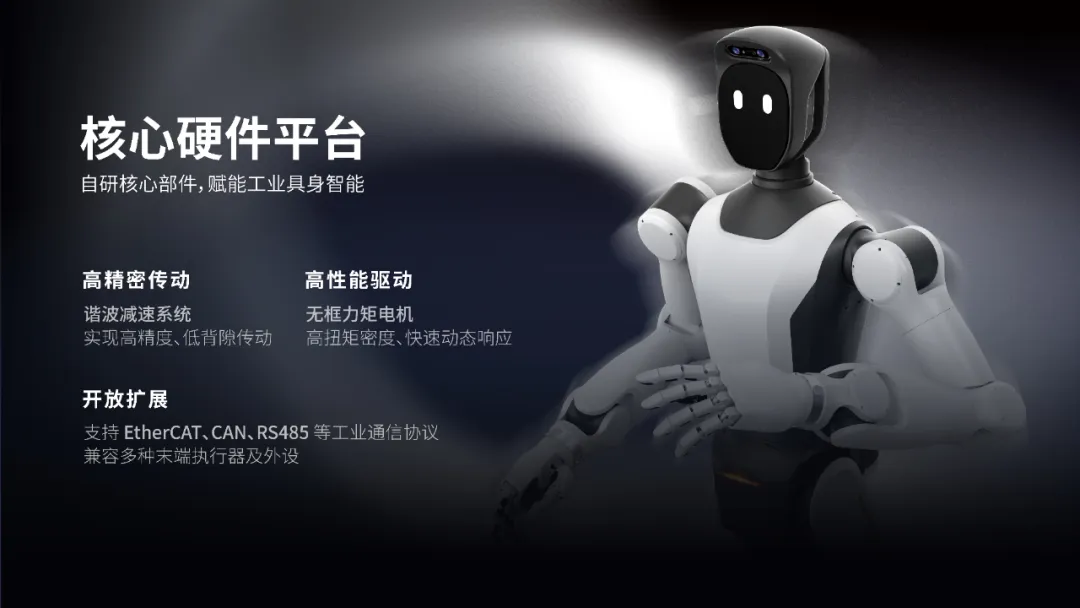
At the overall level, standardized interfaces and modular architectures further reduce the complexity of assembly. A truly mature manufacturing system is not a way to make ten thousand parts cheaper, but to reduce the complexity that needs to be manufactured from the start.
This is also an important capability of Fao to move from collaborative robots to industrial hardware intelligence. In 2025, Fao's year-round orders topped 13,000 units and shipped more than 11,000. These figures are really valuable, not just in scale. It means that Fao has gone through the entire process of robot development from product development to mass production.
This is exactly what is needed for industrial and physical intelligence to truly scale.
03.
Industrial intentions behind a set of key parameters
In terms of industrial hardware intelligence, there is also an important technological base: humanoid robots with upper limbs and collaborative robots have a higher reusable space in underlying technical systems.
Integration of joints, pulse wavelength reducers, servo systems, encoders, motion control and power control, which form the core capabilities of upper limbs of industrial robots, are also central to the long-term engineering of collaborative robots. Of course, the two are not exactly the same, as well as the need for greater freedom, more complex arm synchronization, and more real-time interaction with visual models, or VLAs.
With the introduction of the ART series, Fau was essentially reassembling the underlying hardware capabilities that had already been verified in scale manufacturing and reassembling a product platform that was geared towards physical intelligence. This migration is particularly evident in the actual parameters.
The first is about the combination of precision and speed. ART7 repeat positioning accuracy is ±0.03mm, end TCP speeds are up to 1.2m/s, while maintaining a 1:2 high load-to-weight ratio. This set of data, taken together, releases a clear industry signal that the ability of physically intelligent people to move from hydrogen to high-speed high-precision fuels is likely to begin to evolve.
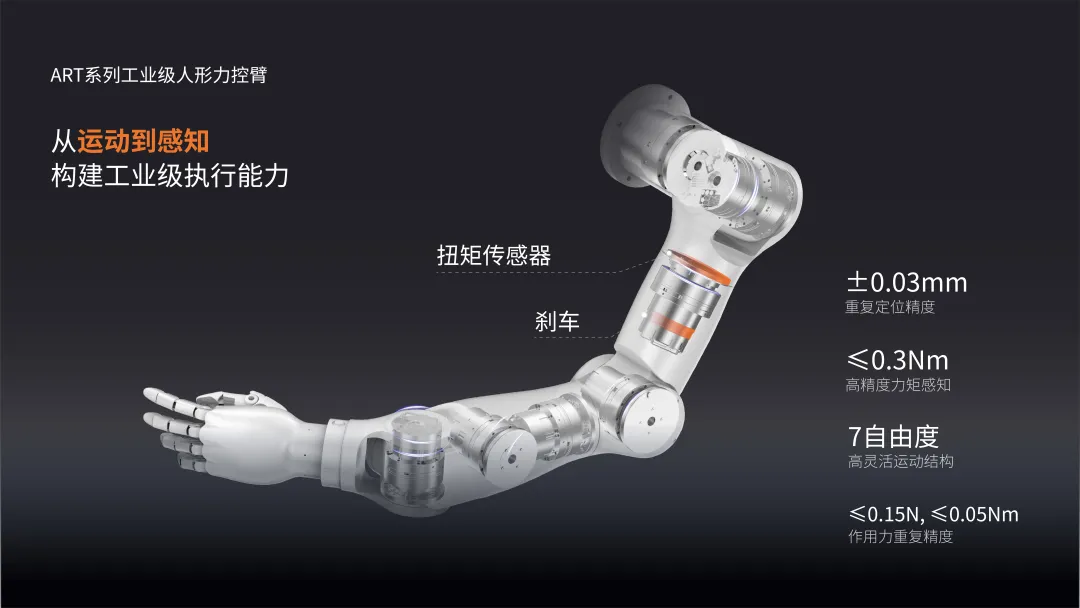
In the past, industry custom has held that high precision must sacrifice speed and high load must increase self-weight, which is the design logic of the traditional industrial arm. But when robots need to get into 3C assembly lines with upstream pulses, or to complete micro-level insertions in precision structural components, the speed and precision of decomposition are the real hard indicators of the industrial landscape. Fayoon can achieve both at the same time at a 1:2 load-to-weight ratio, indicating that its engine, decelerator and control design has completed an intergenerational iteration, also allowing the ART7 to ultimately have a maximum instant load of 10 kg and a maximum instant load of 14 kg.
In the context of physical intelligence, the sensitivity of force control determines the extent to which robots can fully understand the physical world. Traditional industrial robots rely on position control to complete repetitive movements, but physical intelligence enters the field of grinding, precision assembly, flexibility insertion, etc. This means that the sensitivity of the sensitivity of touch changes and adjustments are made in real time. In the context of physical intelligence, the sensitivity of force control determines the extent to which robots can fully understand the physical world.
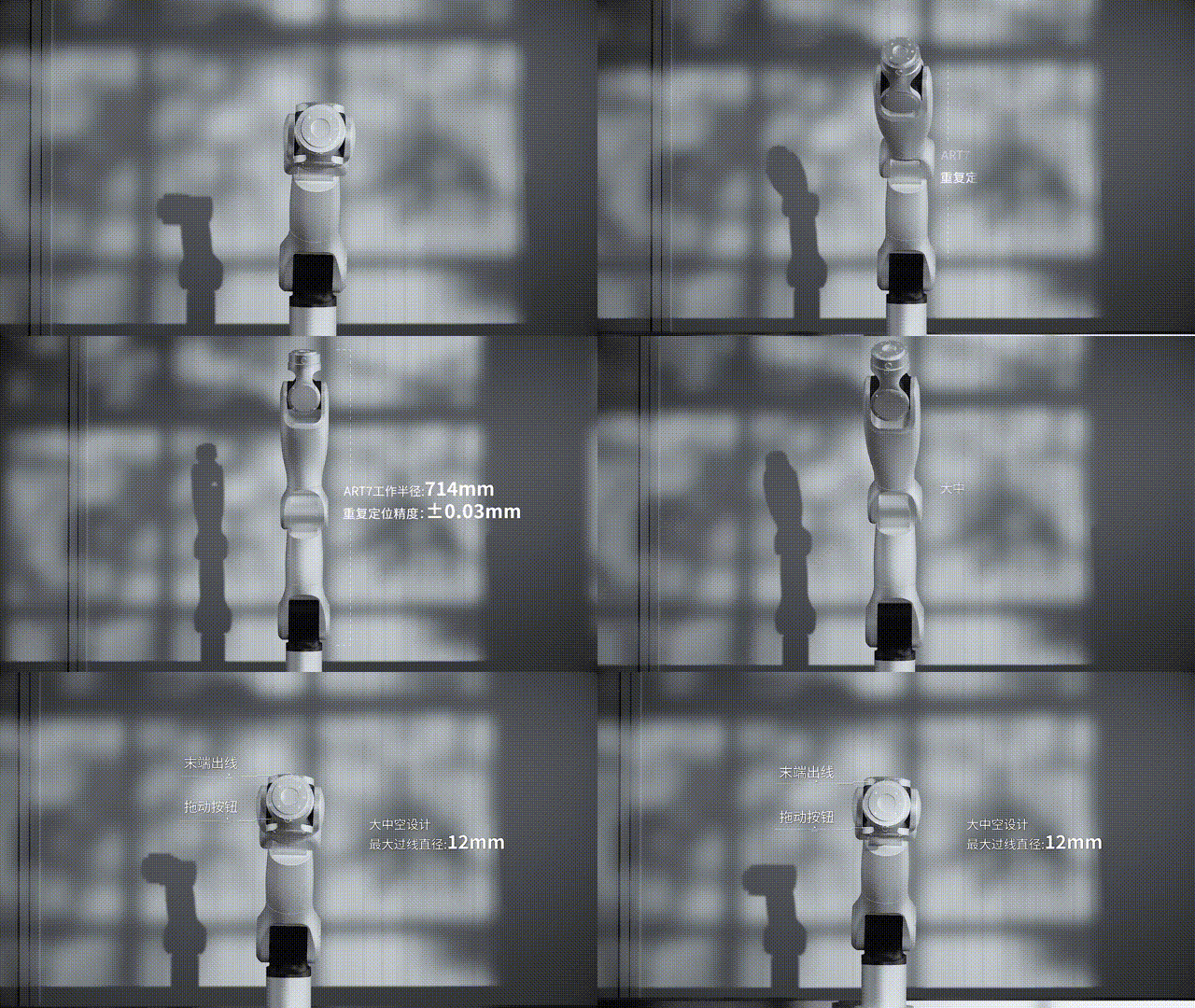
In addition, the performance of the joints integration of the FAOART series is also stunning. The ART series uses 7 degrees of freedom + cross-wrist structure, high-integrated joints built-in with the maximum wiring diameter of 12 mm. The cross-wrist structure is not common in the industrial scene, but it greatly improves the ability to adjust the posture of the end in a narrow space, leaving the need for position modulation operations, such as installation, displacement, and more. The 12 mm wide cross-wrist structure, as seen in the main hall, is not just for aesthetic purposes. In the real production line, the deployment of visual sensors, transmission lines and end-user beam management directly determines the failure rate and maintenance cycle of the equipment.

04.
Communication architecture: Invisible skeletons of silicon with intelligent production lines
Compared to frequency and load, the layout of the FAROART series in the communication architecture is equally worthy of attention.
ART series-supported high-integrated control boxes support 2×gigabyte Ethernet networks (including 1×TSN networks) and EtherCAT high-speed communications, with a single set of systems supporting up to 5 mechanical arm synchronous controls through a combination of controllers and branches.
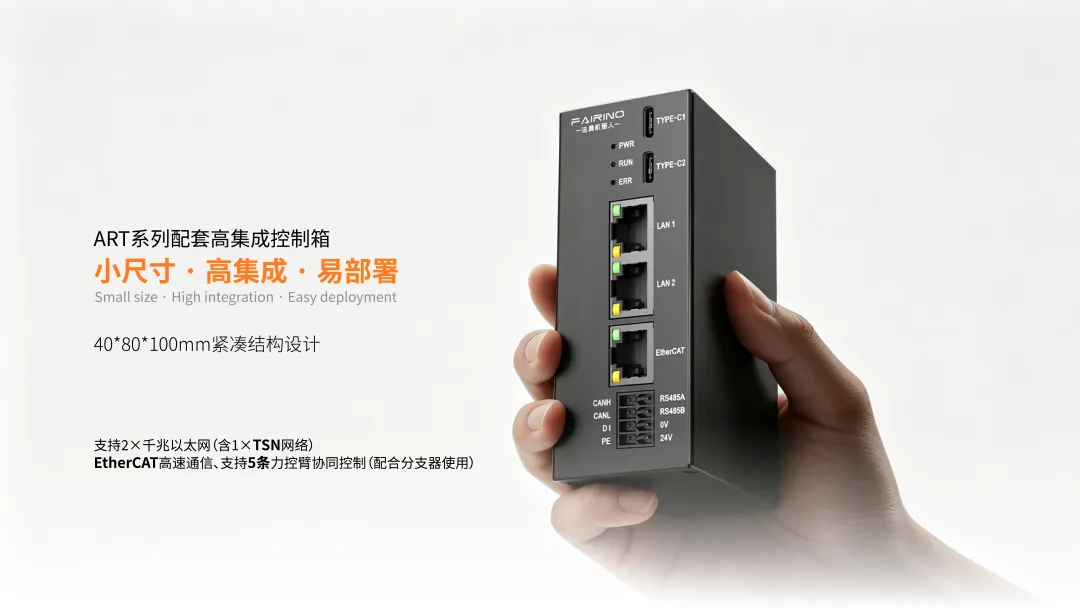
The introduction of TSN (time-sensitive network) is a technological option that deserves industry attention. Traditional industrial baseline is difficult to guarantee certainty over time when dealing with multi-arm synchronization, visual closure and real-time decision-making simultaneously.
Communication bandwidth and synchronous accuracy will be more decisive than peak loads for single-arms when deployed from a single-arms verification to a production line with physical intelligence. In the ART series, Fao pre-embedded TSN capabilities, essentially in preparation for a longer-term goal, so that robots are no longer an isolated strand on the production line, but can be grouped into networks, synchronizable distributed execution units.
05.
Open software: Let the brain and the body work together
If the communication architecture is solved by collaboration between multiple machines, the degree to which the software is open determines the ability of a single device to carry top-notch brain waves.
The ART series opens up mainstream industrial communication protocols such as EtherCAT, CAN, RS485 at the hardware level, and features such as compatible vision, smart hands, etc. It is really worth the industry's attention because of its open-source strategy, advanced open-source dynamics and kinetic computing, flexible resistance control, power point hybrid control, high-power control algorithm SDK, which supports the ROS2 development environment, and is capable of transmitting full-joint control feedback and complete motion status data in real time.
This means that the competitive landscape for physically intelligent people is moving towards division. The algorithm team is better at model training and data-closing than underlying hardware drive and motion control engineering. If every physically intelligent company were to start from scratch by routing underlying communication and power control algorithms to the mechanical arm, the misallocation of resources across the industry would be extremely serious.
This is why open-source computing is more important than traditional industrial robots, and the future of artificial intelligence differentiation is not in hardware properties, but in data and models at the top. Whoever can enable algorithm teams to call on hardware capabilities at the lowest cost is more likely to become the leading provider of artificial intelligence in the age of artificial intelligence.
06.
Summary: Price is the result of the manufacturing system
Here's a look back at the price of this announcement: the ART series industrial-grade human-powered control arm from 23800 yuan (single arm), whose industrial significance is really clear.
The significance of this figure is not to produce a mere price shock. An industrial-grade human-powered control arm with ±0.03mm accuracy, a 1kHz power control refresh rate, TSN network support and a full-fledgedROS2 ecosystem is almost impossible to achieve at this price under past cost structures.
Fau was able to do this through a three-tiered superimposition: full-frame self-development determines the upper limit of cost controls; the extreme standardization of the shock absorber SKU to 10 units, which greatly compresses supply chain and inventory costs; and the scale effect of the annual production of 300,000 sets of joint modules, further diluting unit R&D and manufacturing costs.
Thus, price is more like a water-to-ripened outcome, with core components self-developing to determine cost space, standardization to reduce supply chain complexity, modularity to reduce iterative development, and large-scale manufacturing to mitigate spending. When these capabilities are ultimately superimposed on the product, price is only one response given by the manufacturing system.
What Fau is really answering is a bigger question than a single product: how did industrial intelligence go from an expensive technical verification product to a scale-up and widespread industrial base?
In the past, the industry competed over who could lead the way in building a robot with more capabilities. The future would require answering another question, the same set of industry-level capabilities, who could build it ten thousand times more stably with fewer parts, shorter assembly times and more mature supply chains?
The real scale of humanoid robots will come not only from technological breakthroughs, but ultimately from manufacturing systems.
The real value of the FAROART series may not lie in how well it performs today, but in what path it paves tomorrow for 10,000 units.