Self-developed nickel is becoming the most frequently used word in the robotics industry and one of the most easily diluted.
The robots themselves, the smart hands, the sensors, the data and the models, as long as they cover a few of these links, a company seems to be able to fit itself into a full-blown narrative.
Pasini chooses a route that few people follow.
In the full-frame technology closure, Pasini continued to deepen the chip's self-development capabilities, evolving from the GEN4 touch sensing chip, fully empowering high-precision sensors and execution terminals. Performing end-to-end biological contacts, sensor capture contacts, and achieving ultra-high frequency capture and hardware-grade coding at the source of the signal.
On August 13, 2026, PaXini officially released the fourth-generation GEN4 FUSE sensing unit.
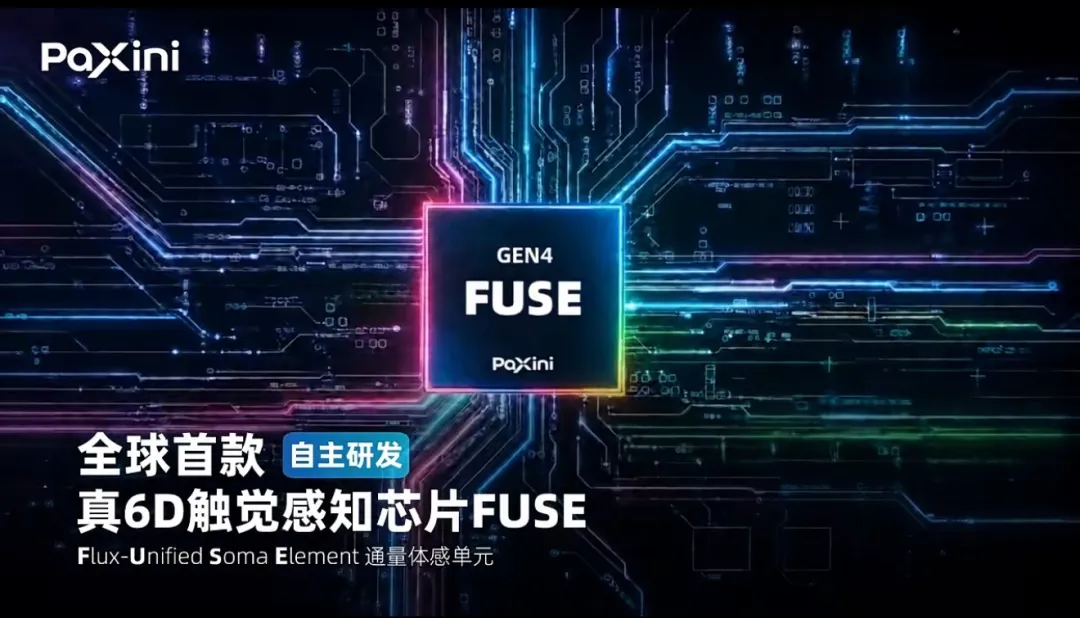
The fourth generation of fox is the most likely to be underestimated in this release.
From its first prototype to Gen4, Pasini has completed four rounds of technological leaps; in the past year, its self-developed touch sensing chips have surpassed 1 million cumulative shipments. In other words, Gen4 FUSE is not a concept chip that has just come out of the lab, but is based on the latest results of four generations of architectural evolution, a million-particle production experience and a large number of real robot missions.
Generations of products can come from inspiration, while generations of products can only come from continuous accumulation.
GEN4 FUSE is the culmination of Pasini's four-generation technological leaps. Real-life 6D full-directional measurement, micro-second ultra-high dynamic continuous sampling, ultra-high bandwidth, large synchronization, unique type of brain synthesis coding, the only dual-contract, the five main technological focal points together declare: Physical AI's touch base is built, fully ready.
At a time when secondary adaptations are still common in the industry around general-purpose chips, Pasini has incorporated the robot's inherent need for touch into the fourth generation of proprietary chips. This leadership is reflected not only in a particular parameter, but also in the technological depths created by the joint generation of chips, sensors, robot bodies and real data.
01.
From the core to the chip, it penetrates the three layers of the technical lattice downwards.
To understand the value of GEN4 FUSE, one must first understand the unique technical architecture of Pasini. Pasini's technical layout spans three levels: the uppermost is the flexible hand and robot body, the middle layer is the high-precision multi-dimensional touch sensor (the company's core product) and the bottom layer is the core device sensing chip inside the sensor.
The vast majority of robot manufacturers have stopped buying in-house sensors for touch sensors; a handful of sensor companies are capable of self-development, but very few are willing to continue downstream penetration into chip design.
Based not only on the research and development needs of their own agile hands and robotic bodies, but also on the downward trend of the entire body-intelligent industry, Pasini has chosen this long-term path for more and more customers to buy touch sensors and touch data services.
It is these customer demands that come from real industrial scenarios that drive Pasini to penetrate the technological capabilities of the chip design layer.
Pasini's accumulation in the field of chips is strong and deep. From its first prototype to today's fourth generation of products, the company has undergone four technological leaps, and in the past year, the cumulative shipments of self-developed touch sensing chips have surpassed 1 million, proving that its chips have been verified by mass production.
The fourth-generation Gen4 FUSE product, which was released this year, is a performance leap over a million-level mass production experience rather than a concept product in the lab. It is both the most basic technological foundation of the three-tier architecture and the latest answer to Pasini's demands for the development of the body-intelligent landing and body-touch industry.
As early as 2025, the company pioneered the industry's only full-body touch suite product line, integrating multi-dimensional touch sensors, electronic skin, six-dimensional power sensors, joint torque sensors, and footprint sensors into a single platform for the first time.
The performance limits of each sensor are directly dependent on the capabilities of its internal core chips, which are previously equipped with the first-generation chips, which have been supported by the industry status of the suite with their leading performance.
Today, GEN4 FUSE has been upgraded as a sensor core device with native 6D full-directional measurement, micro-second ultra-high dynamic continuous sampling, ultra-high bandwidth synchronization, unique type of brain synthesis coding, unique dual-resistance, five major technology focus points, pushing the overall sensing capabilities of the sensor from multi-node splicing to a full-scale intelligent synchronous array, providing a solid touch infrastructure for scalable landing with body intelligence.
02.
Pain points: Why are touch signals always around the roadblocks?
The industry has long had a hidden bottleneck: the vast majority of touch sensors output only primitive analogue-mechanical signals, and robots require additional computational links to translate them into understandable motion information.

The root of the problem is that the core chips inside the sensors do not have native computing and coding capabilities. As physical intelligence moves from the lab to the production line, customers have raised higher demands on touch sensing timeliness, data quality and system integration efficiency, and general chip solutions are no longer able to meet industry demands.
The Pasini 2025 full-body touchset has greatly mitigated this problem through multi-node deployments, but the performance limits at the sensor level are always limited to the chip layer.
GEN4 FUSE comes straight out of the core device layer of the sensor to rewrite the rules of Native Reality 6D so that every touch sensor on the chip becomes the touch neuron that the sensor thinks about.
Real-life 6D: Don't turn around, go straight out
GEN4 FUSE relies on a 6D touch-sensing array of longitudinal flow engines and horizontal flow grids to simultaneously capture the full time-space trajectory of sub-micrometer depth shifts, contact surfaces and sliding.
This capability directly empowers touch sensors: six-dimensional information that used to be measured separately at each node, then integrated into the computation, is now native to one-time output by the chip inside the sensor, increasing data consistency and significantly reducing latency.
Millions of Hz x microseconds: revolution in the perception of flash time resolution
GEN4 FUSE receives primordial biomechanical signals at 1,000,000 Hz at an ultra-high frequency, with zero-cattle sensitivity to detect momentary fluctuations in the magnetic field.
The chip is equipped with a touch sensor capable of capturing sub-micrometer-level depth changes, contact surfaces and sliding full time and space trajectory sensors, and is upgraded to a dynamic event perception sensor.
Synaptic encoding: 100 times compression, tokenized output
The built-in time-quantitative unit and synaptic encoder compile dynamic contact, physical properties directly into standardized touch tokens.
100 times data compression not only saves bandwidth, but more importantly, it establishes a generalized sense of touch.
The only double-resistant: 0 noise silicon electromagnetic immunosorbent
In complex industrial environments, external strong magnetic and diffuse charges are the two greatest enemies of touch measurement.
GEN4 FUSE is the only underlying technology in the industry that can simultaneously immunise both types of interference, which ensures that the chip's touch sensors remain zero-noise even in poor working conditions.
From the fingertips to the toes: a chip that activates a network of sensors
The full-body touch suite for 2025 will cover the main robotic thrust nodes, while GEN4 FUSE will be upgraded as a sensor core device, giving each sensor a native Intelligent Touch.
03.
Four generations of technology, millions of tons of production and a complete shutdown
While the large-scale visual model allows robots to see the dark world, GEN4 FUSE is making Pasini's touch sensors truly feel the dark world.
Individual parameters can be tracked, and generations of products can be replicated, but the time it takes for four generations of products to accumulate, the process experience of millions of chips being formed, and the actual robotic task of constantly feedback to the R&D closure of the underlying devices, can be difficult to replicate simultaneously.
While technological breakthroughs can occur at any given moment, technological leadership can only be formed by continuous engineering practices.
The release of GEN4 FUSE is therefore not just an update of the Pasini product line. It is more like a technological node: robotic touch starts from the peripheral sensing capabilities and enters a new phase driven by native chips, full-body sensing networks, and standardized touch Token.