While humanoid robots can walk, run, and recognize everything, it's still difficult to operate precisely in the face of bottle caps, pinching thin films, and precision screws. The industry is increasingly realizing that beyond vision, touch is becoming the next core bottleneck for physically intelligent landing.
In the capital markets, the touch-perception track is also warming up at a surprising rate.
It is predicted that in 2026, the size of the domestic humanoid robot special touch sensors market will exceed USD 320 million, with a growth rate of over 160%, the fastest segment racing of all parts of the humanoid robot. As of July this year, the new funding in the field of touch sensing has exceeded USD 7 billion, and at least two companies are struggling with new innovations.
In the runway on the eve of the outbreak, modular technology in Shenzhen is showing acceleration.
Recently, Module Technology Limited in Shenzhen (ModuTech) announced the completion of the tens of millions of yuan Pre-A round of financing invested by Falun Gong Capital, and Point Stone Capital as its financial advisor.
01.
Full circle of self-development: from perception to decision-making
Modular technology is characterized by its attempt to unlock the entire technological chain of touch perception.
There are not a few companies in the industry that make touch sensors, but most of them stayed at the stage of making a touch sensor. Modular technology is different in that it builds three large plates of touch sensors - data collection - touch models - from hardware to algorithms, from physical signals to intelligent decision-making.
1. Sensors: Optical touch + pressure block complex solution
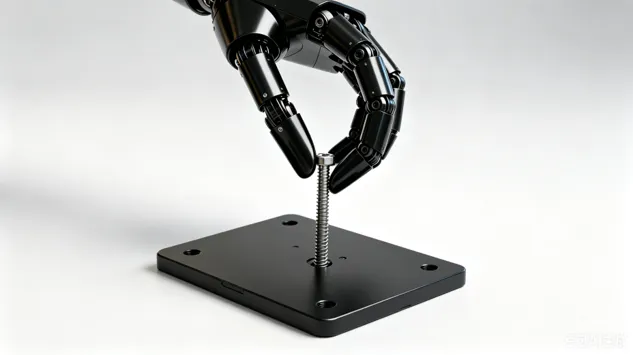
The difficulty of robotic touch not only lies in the perception of whether or not the claw touches the claw, but also in where the claw contact occurs, with what posture, how much force, how the surface texture fits. Different parts of a mechanical hand differ in the sensitivity to the above problem, the tip area needs to complete precise operations such as grabbing, sliding detection, shape recognition, and the pressure areas such as the thumb and wrist are higher in terms of space and structural design. Modular technology is based on this reality, not on a single technical path, but on the integration of depth of touch with each other, so that they can be extended and complemented.
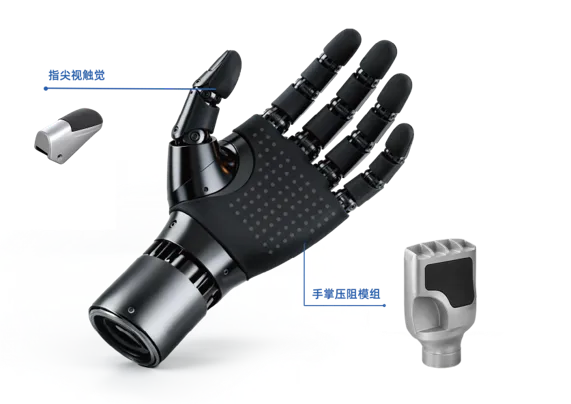
Concentrating touch + pressure block complex solutions
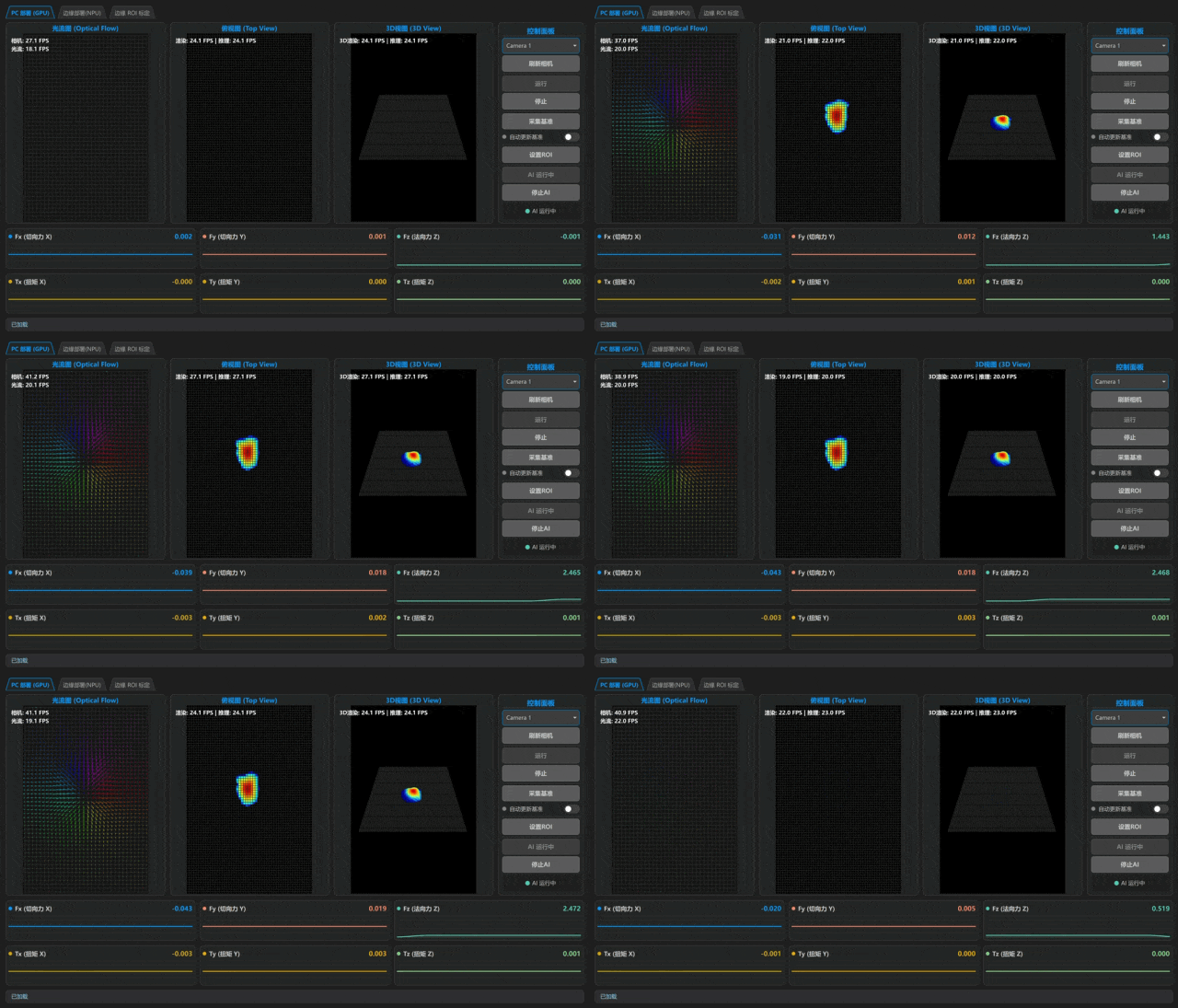
The effects of visual touch on positioning machines
In areas requiring high-precision spatial resolution, visual touch schemes are based on the principle of optical imaging, light field changes caused by contact elasticity, counter-introducing three-dimensional shapes, sliding trends, and complete six-dimensional information. These schemes are particularly good at handling the position of small parts in precise assemblies.
In large area areas such as the thumb and palm, limited to installation space and flexibility, modeling technology uses pressure-resistant flexible electronic skin. This type of module is lightweight and flexible, can be attached to curved surfaces, by means of microscopic sensing structures and three-dimensional force algorithms, real-time feedback to grab strength, contact posture and surface texture. It does not pursue extreme resolution, but it is well suited for wide-ranging coverage, quick response, and durability, suitable for wire mesh grab and collision detection.
In real-world control, visual touch provides high-precision characteristic point information for the lens locally, and pressure resistance to the skin provides a continuous pressure distribution of the lens globally, both of which, after the data layer is merged, the robot can both perceive the tiny bumps on the edge of the object and determine whether the overall grip is stable. Currently, the industry is able to master both visual touch and compressive sensing technology at the same time, and few enterprises are able to integrate the two into delicate hands. This focus point combines with the sensing ability of lens, which is one of the core differences between modular technology and most touch sensor suppliers.
2. Tactile data collection: turning every operation into a data asset
Data collection systems are the neural hubs of hardware and algorithms, and are a common weak link in the industry.
In today's industry, the fragmentation of touch data is a common pain point: the data formats produced by different sensors are not uniform, multi-modal data such as touch, vision, robot state are difficult to achieve accurate timing, raw data is noisy, there is no task-level markup, and it cannot be used directly for model training.
Modular technology has built a multi-modal high-frequency synchronous, task-level aligned data system to address this industry pain point: integrating multi-source data such as touch, pressure, three-dimensional power, micro-vibration, temperature, vision, robotic state and control instructions, coordinating time and event levels, mapping heterogeneous data accurately to the same timeline, and then working through professional task labeling and high-speed cleaning, ultimately producing traceable, traceable, standardized data assets.
At the core of the system is the transformation of each robot's physical interaction into high-quality, mission-level data fuel, allowing sensors to shift from one-time hardware to continuous value-added data inputs.
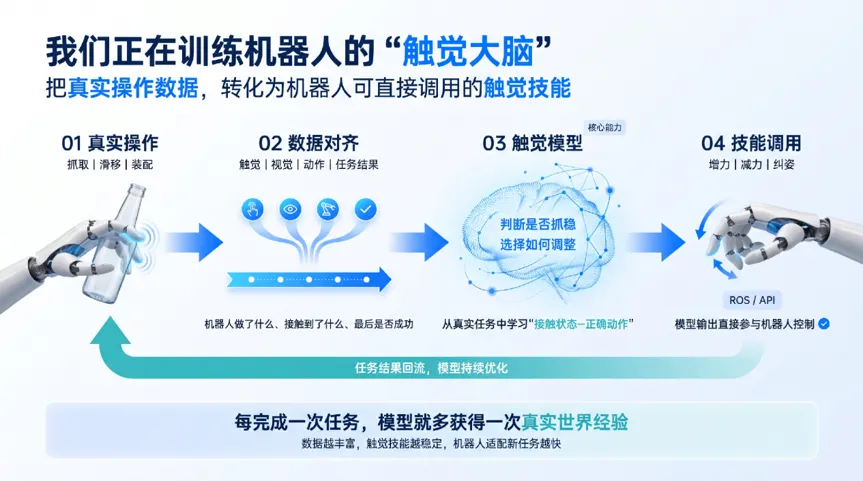
3. Tactile model: allowing sensors to perceive silicon from silicon to evolve into a decision-making silicon
Based on hardware and data, modular technology has expanded further, creating touch modeling capabilities that have allowed sensors to truly evolve from sensors of silicon to silicon-based decision makers.
Unlike the industry-common low-level status recognition, modular technology uses a two-tiered architecture called the General Touch Base + Task Skills Model: the bottom is the General Touch Base, which is trained to master general touch cognition through bulk data pre-training; the top is a task skill model for different scenarios that can be quickly adapted to specific task needs such as sorting, assembly, and agile handling.
In training mode, the model unifies multi-modal information, such as self-monitoring pre-training, task demonstration learning, real-time feedback optimization, integration of tactile, visual, joint state and task ID, and the final output is not an abstract perceptual result, but a control signal that can be directly executed by robots, such as sliding pre-warnings, force-control suggestions, and trajectory corrections.
The core advantage of this model is that it forms a closed loop of continuous evolution: with each completed operation, the results of the task flow back into the data system, which in turn optimizes the accuracy of the model. The same general underpinning can be rapidly expanded to more scenarios, allowing the original one-time hardware input to become a continuous evolutionary asset that is used the smarter and more valuable.
02.
Two-engine drive: left-handed humanoid robot, right-handed industrial manufacturing
Now that the technology loop is closed, the next question is: who needs this technology and is willing to pay for it?
The answer to modular technology is to get a handle on two key areas: human robots and industrial intelligence manufacturing.
In the field of humanoid robots, they have established deep collaborations with more than a dozen of the world's leading companies. One customer placed millions of orders on a scale that is about to be delivered; another customer's products have been imported into the supply chain and are in the crawling stage from small to large batches.
It is worth noting that this is not just a laboratory verification, but a large-scale commercial delivery. For start-up sensor companies, obtaining repeat orders from key customers is the best proof of product stability and consistency.
On the industrial manufacturing side, the application scenario is equally clear. Modular technology's touch sensors have been cut into the high demands of new energy battery detection, 3C manufacturing, automotive parts, and other industrial scenarios. One real data from customer lines is that after installing modular optical touch sensors, the incidence decreases by at least 30%.
It is estimated that a 30% decrease in the unfavorable rate could be a cost saving of tens of millions for a production line of one million products a year. This can be directly reflected in the economic benefits on the financial statements, which is the fundamental reason why industrial customers are willing to pay.
The two racetracks also have a synergistic effect: the cutting edge demand for humanoid robots will drive ever-changing technology, pushing product performance upwards; while large-scale deliveries of industrial scenarios will continue to grind the maturity and reliability of products.
03.
Product matrix formatting, six-dimensional sensors turned on and delivered
At the product level, Modular Technology has formed four major product lines: MoVi visual touch sensors, MoFi touch modules, MoGlo touch gloves and touch models, covering the entire chain from core devices to algorithms.
Among them, the recently released MoVi visual touch six-dimensional sensors are gaining market attention.
Traditional six-dimensional sensors are expensive, tens of thousands of yuan in power, and are large in volume and complex in structure. Modular technology combines visual touch technology with six-dimensional sensing, achieving 150,000 effective sensing points, a sensitivity of 0.1N, and significant advantages in volume and cost.
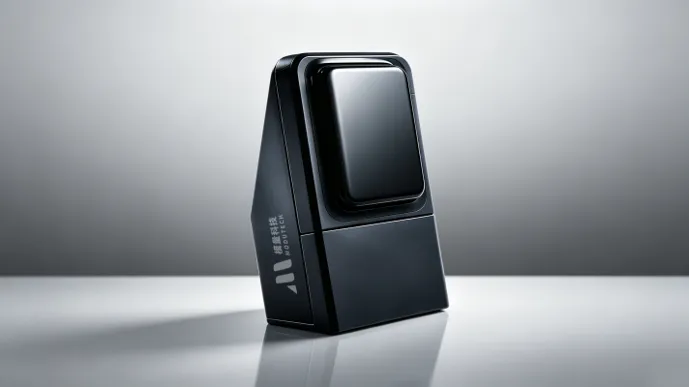
It is understood that the product received a large number of active consultations within two months of its launch and has completed the delivery of small batch orders, and the pace of commercialization in the field of hardware is accelerating.
Another product line of note is the MoGlo touch glove. Modular technology also has two product lines of textile touch gloves and touch and posture sensing gloves. The former can capture changes in pressure when the hand touches an object in real time, generating high-resolution hand pressure distribution maps; the latter further integrates the gesture capture function, which can fully record the gesture information of the hand during human hand operation.
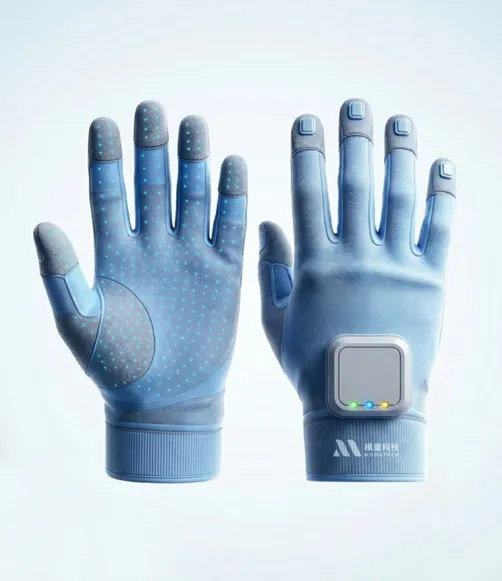
MoGlo data collection gloves
The strategic significance of this type of product lies in the collection of data. Hands-on operation is one of the ultimate challenges of physical intelligence, and training hands-on operation requires a huge amount of human data.
04.
The touch of the data plane is just beginning to turn.
From the technical roadmap of modular technology, it constructs the closed-loop logic of a silicon-perceived silicon data silicon model.
Sensors collect high-dimensional tactile data such as force, shape change, temperature, material in real-world application scenarios; high-precision signal collection systems align and mark these raw data to task-level tasks; high-quality datasets continuously train anti-feeding algorithm models to improve recognition accuracy and generalization capabilities; models drive the upgrading of intrinsic capabilities to form industry-standardised knowledge systems; capacity-enhanced robots enter more application scenarios, drive more sensor deployments, and produce richer data.
The more customers, the richer the scene, the more data, the more accurate the algorithms, the more competitive the products, and the more difficult it is for the latter to catch up.
This is why Module Technology co-founder Zhou Jiangling would say: "The competition in the touch sensing industry is ultimately the competition of data. Whoever turns the wheel of data first will establish a lasting advantage".
From this point of view, the completion of three rounds of financing in a year may be taking over this time window.
2026-2027 will be a critical period in the nation's large-scale deployment of touch sensors.