On August 12, 2026, a live broadcast without a script, a fully open logistics classification, dropped a heavy bomb on the smart circle.
Autonomous variable robots challenge the fastest live stream of global machine personality sorting, launching a continuous one-hour public test. The final data is classified at 1,816 pieces/hour. This figure is about 45% higher than the industry benchmark of 1,248 pieces/hour previously created by the US-headquartered Intelligent Design firm Figure AI.
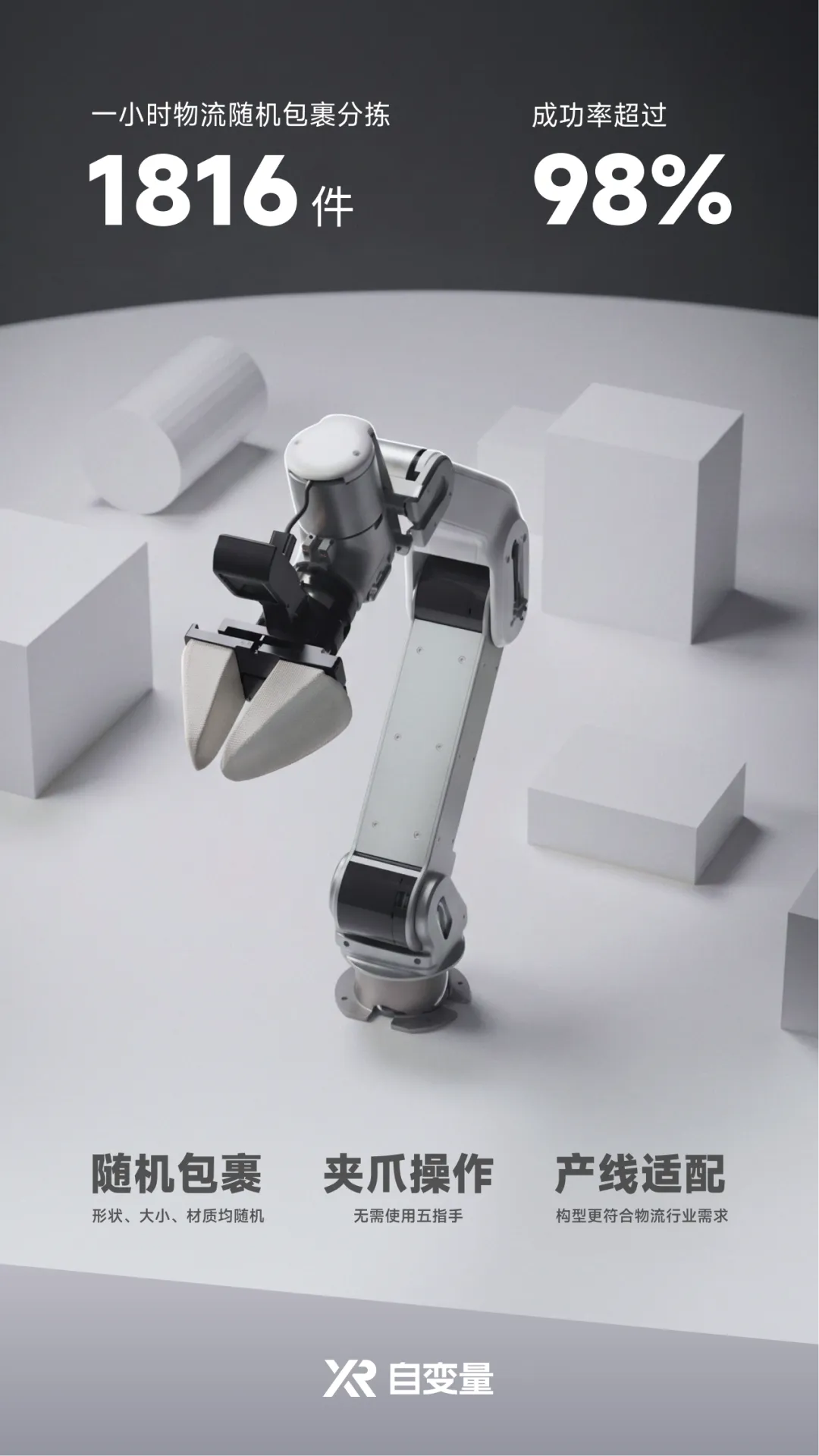
It's also worth noting that the hardware used by the variable itself has only two mechanical arms + claws, a slightly reduced cost of about 70% compared to the US Figure AI humanoid robot + five-fingered clutch system. Not only that, it handles real packages on the logistics product line, complex randomized packages far exceeding the standardized ones of Figure AI, and achieves more than 98% sorting accuracy.
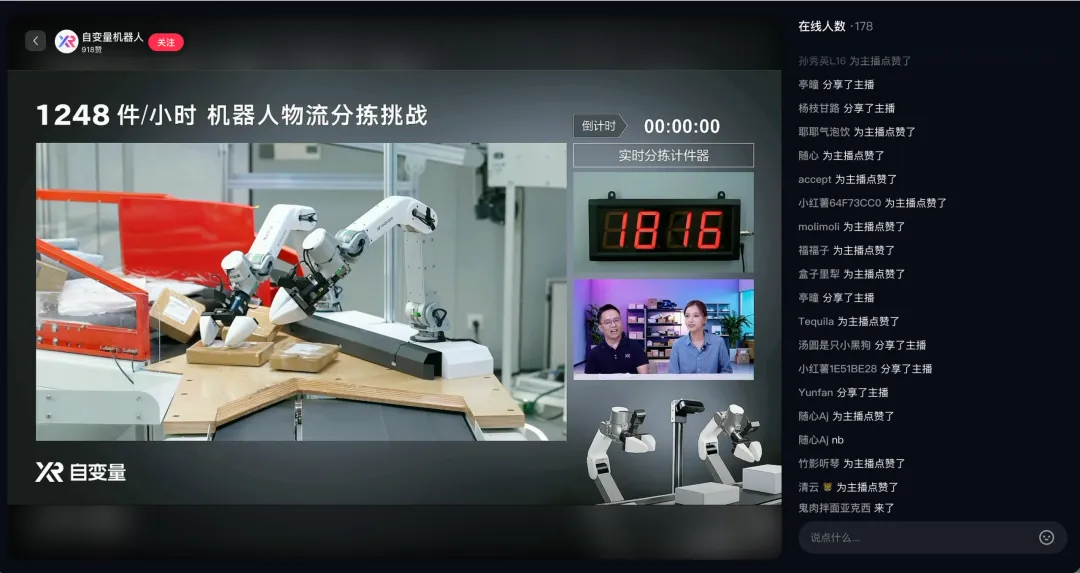
Aside from the intuitive impact of the live broadcast itself, it is even more noteworthy that the technical route is different this time. When overseas leading companies have been betting on the hardware stacking route of the human body + five-finger sleek handles, the self-variable plain hardware configuration with only two mechanical arms standardized claw claw, achieves the double transcendence of efficiency and the difficulty of operation.
01.
A non-symmetrical and anti-hypertensive
Before discussing efficiency, we must first clarify a key premise: the efficiency of sorting under different working conditions is not directly comparable.
In May 2026, Figure AI launched a hundreds of hours of logistics sorting live broadcast at its San Jose headquarters, which resulted in Figure 03 robots cumulatively processing 249558 packages over 200 hours of continuous operation, with an average efficiency of 1248 parts per hour. The live broadcast caused a worldwide sensation and is considered a milestone in the introduction of humanoid robots into the industrial scene.
After 10 hours of manned combat, Figure AI won 12,924 against 12,732 by a margin of weak advantage, with a time difference of 0.04 seconds, further confirming that the efficiency of human robot sorting has approached human limits.
But one detail that is often overlooked is that in Figure AI's test scenes, packaging is mainly standardised delivery packaging with relatively high consistency. This is similar to measuring 100 meters on a standard track, where the results are excellent, but there is still a gap with the complex environment of the real racecourse.
In this live test, the variable itself was chosen to completely restore the real warehouse to a chaotic state.
According to the public broadcast, the types of packages in this test were very diverse: both conventional e-commerce cartons, courier soft bags, and unconventional deformities such as cylinder-shaped accelerators, bubble-encapsulated green pieces.

This variation in working conditions poses substantially different requirements for intelligent systems. In a standardized packaging scenario, the system only needs to master a limited grappling strategy; whereas a completely random, heterogeneous packaging scenario requires models to have real physical understanding and dynamic decision-making capabilities.
In the face of packages of different properties, the self-variable WALL-B model demonstrates a differentiated operating strategy based on physical cognition:
Layered transportation strategies: lightweight packaging directly catches the packaging, maximizing throughput efficiency; larger and heavier boxes use two-arms transportation, lateral movement, to avoid forcibly grabbing causing packaging loss.
Flat packaging adapts: small lightweight pieces use the fast rotation of the inertia; heavy ones use the gradual gradual rotation; soft packaging for clothing is first flattened by digging, stalling, and then calibrated in a single direction.
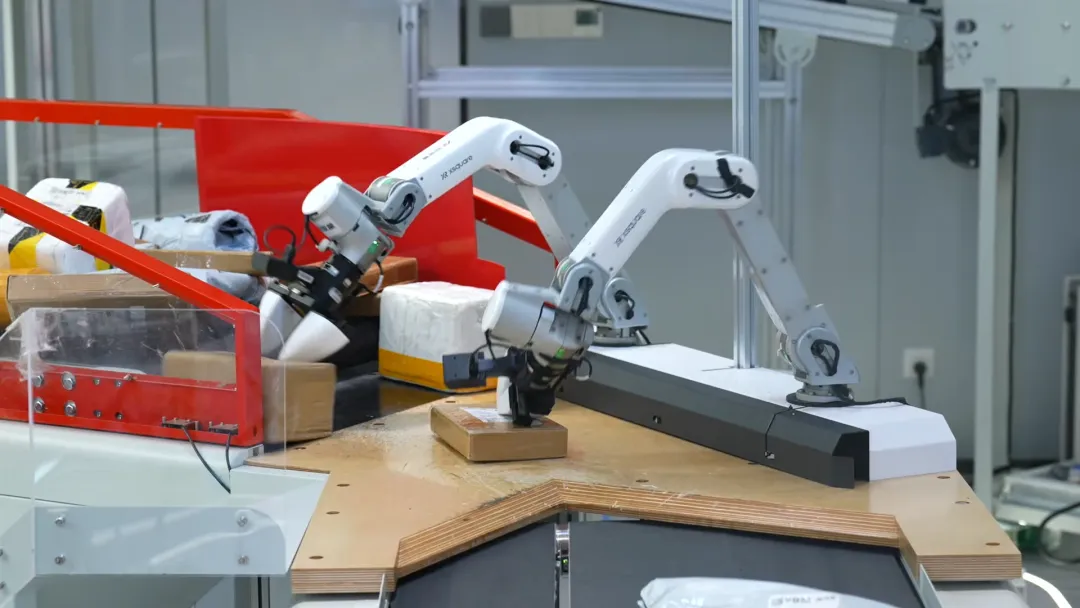
This dynamic decision-making capability based on the recognition of physical laws is not possible with pre-programmed special sorting devices and simple vision programs, and is the core value of a general-purpose intelligent large model.
The more difficult working conditions, the more efficient, that's where the true gold content of this self-variable test is.
02.
Hardware stacking or model preference?
Efficiency figures are the result of a collision between two very different technological routes.
The path commonly chosen by overseas corporations can be summarized as a hardware priority path. Based on the human body, coupled with a high-freedom five-fingered hand, by stacking the hardware freedoms to raise the capacity limit. The underlying logic of this path is that the hardware complexity supplements the model's capability boundaries, when the model is not smart enough to make the hands more flexible and the body more like a human.
Figure 03 is a typical representation of this route. The full-body humanoid structure, fitted with flexible five-fingered hands, hand-held built-in cameras and touch sensors, and single-piece hardware costs are extremely high. The advantages of this scheme are that it is formally human-compatible and theoretically seamlessly enters the human workspace; but the disadvantages are equally obvious: structural complexity, high failure rates, expensive operating costs, and long deployment cycles.
The self-selecting variable is an autonomous path that prioritizes the hardware model and makes the hardware practical.
In the technological philosophy of self-variability, hardware should serve the scene rather than the unnecessary cost of the shape symbol. Since the core needs for logistics sorting are efficiency, stability, and low-cost processing of packages, the most reasonable hardware configuration should be an arm-machine arm-standard claw.
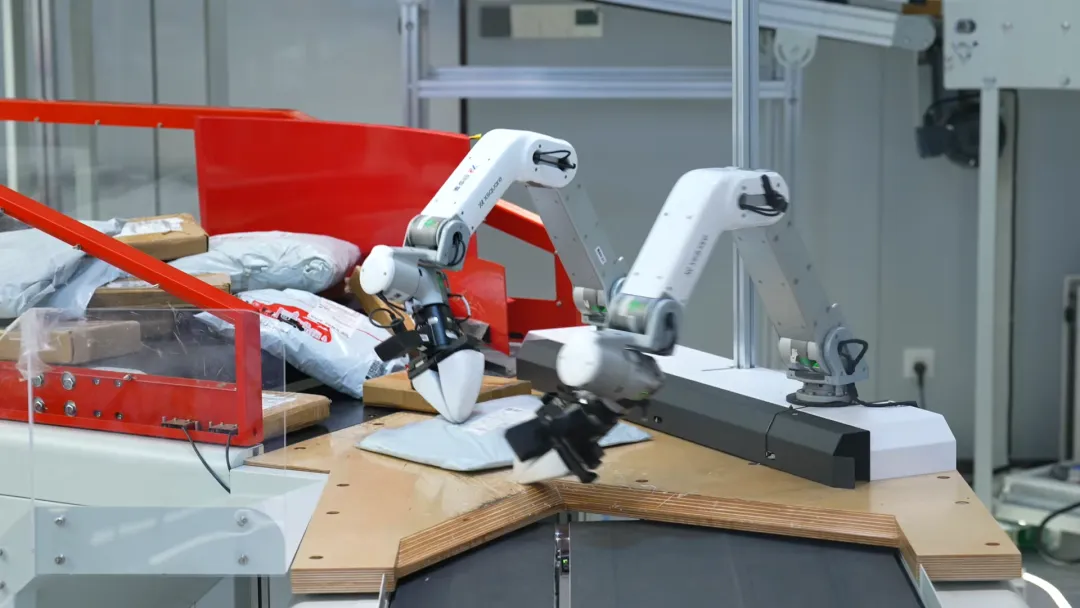
This divergence of routes has resulted in a comprehensive three-dimensional reconstruction:
1. Quantitative differences in deployment costs
The elimination of man-made redundant structures, the adoption of industry-wide standard claws, makes the overall deployment cost of autonomous variable schemes significantly lower than overseas equivalent schemes.
According to the team's calculations, under the current equivalent allocation capacity, the overall hardware deployment cost of the two-arm claw program (including body, claw, machine control and basic adaptation) is only 30% of the FIGURE AI humanoid robot program.
2. Essential differences in operational efficiency
The standard claw structure is simple, few parts, and continuous operation failure rates are much lower than the five-fingered hand of high freedoms. The core demand of the storage scenario is 7×24 hours of continuous operation, and any outage means a loss of capacity.
While the five-fingered hand is more flexible, precise alignment calibration, maintenance, and replacement requires professional technicians and longer downtime. The standard claw is almost one of the most mature parts in the industry, with plenty of spare parts, convenient replacement, and very low maintenance costs.
3. Differences in landing cycles
The two-arm mechanical arm configuration can be directly embedded in existing warehouse sorting workshops, without the need for large-scale transformation of the production line and man-made workspaces. While the humanoid robot program needs to be adapted to the humanoid workspaces, production line transformation is highly demanding.
This means that autonomous variable schemes can be rapidly replicated into multiple storage scenarios, significantly improving the efficiency of industrial landing. This engineering advantage is particularly crucial in the context of the current logistics enterprise's widespread pursuit of rapid verification and rapid landing.
When the model is strong enough to understand and control the physical world, the industry no longer needs to expand the boundaries of capability by stacking up expensive precision hardware.
03.
WALL-B: The underlying revolution in the unified model architecture of the world
The answer lies not in the hardware, but in the brains of the models.
In April 2026, Autonomous Variables released the world's first WUM-based Unified World Model (WALL-B). The key breakthrough in this architecture is that it combines all the capabilities of vision, language, motion, and physical prediction to train and integrate from scratch in the same network, eliminating the boundaries between modules and data transfer losses.
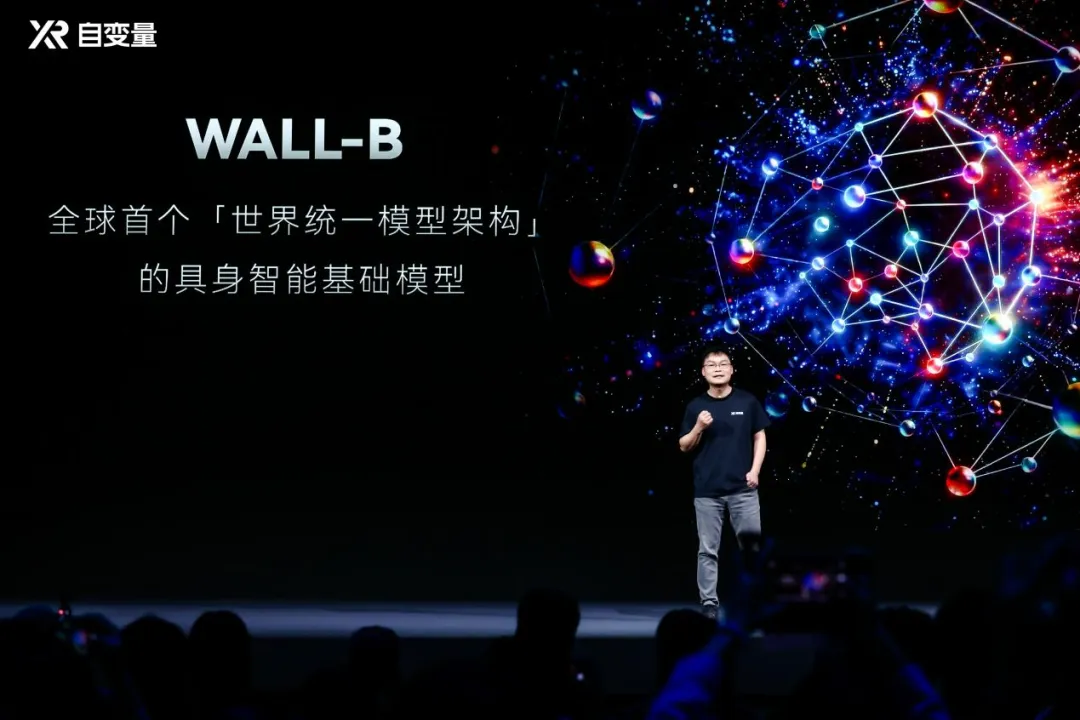
Prior to WALL-B, the VLA model was the mainstream technology framework of today's smart industry, and its core idea was to combine three modules of vision, language, and action: visual modules responsible for perception, language modules responsible for understanding instructions, and action modules responsible for the output of control signals. Representative models such as Google's RT-2, and Physical Intelligence's π* are all part of this technology route.
However, there is an inherent flaw in VLA architecture: module splicing inevitably leads to information loss and delay. Visual characteristics are transferred to language modules after extraction, language modules are transferred to action modules after decision making, and each time data is transferred across modules, information is lost, thus increasing latency, efficiency and accuracy are naturally discounted.
The more fundamental problem is that splicing architectures cannot truly understand physical laws.
It can simulate trajectories of action that have been observed, but it is difficult to reason with unseen scenarios that are consistent with physical common sense. This is why many VLA models perform surprisingly in demonstration scenarios, often overtaking real complex environments.
WALL-B's WUM architecture, which incorporates all the capabilities of vision, language, motion, and physical prediction into the same network, combines training and integration from scratch, and builds on this architecture, WALL-B achieves three core technical features:
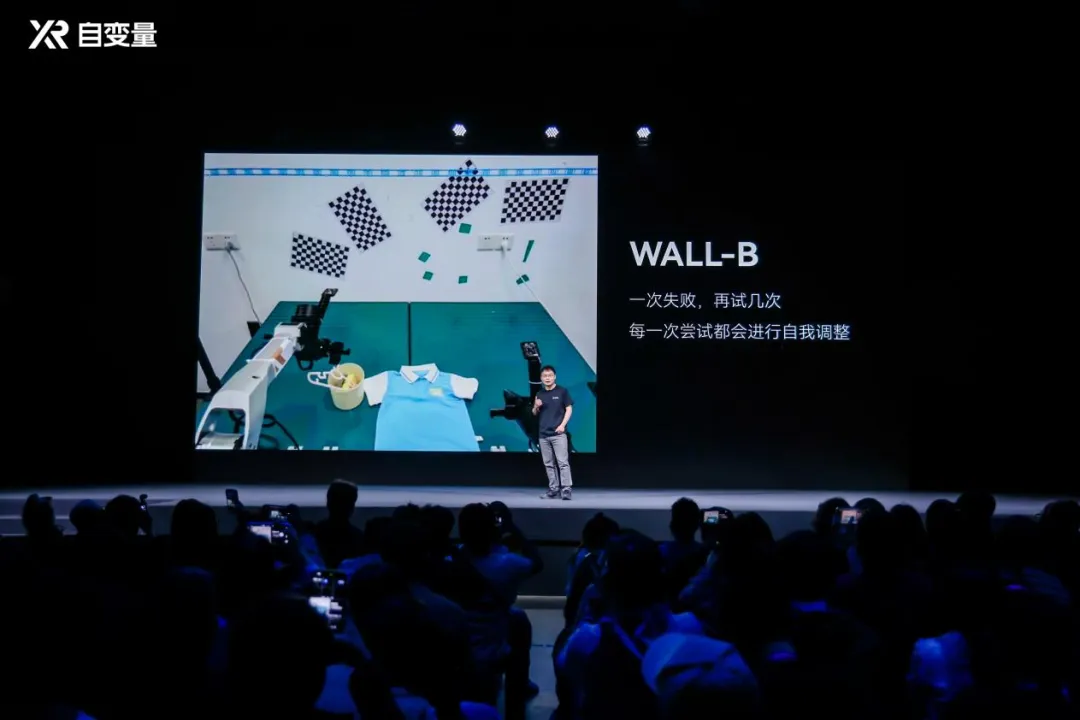
First, a stronger capacity for spatial reasoning. Because perception and decision-making are done in the same network, spatial geometric information is not lost in the module transmission, and the model has a more accurate understanding of object positions and spatial relationships.
Second, the ability to understand the true laws of physics. WALL-B is able to understand the mechanical laws of the physical world, the properties of materials, the inertia of motion, and predict the evolution of environments and events. That's why it can automatically select different grabbing and rolling strategies for different packages.
Third, memory and the ability to self-evolve. Models can accumulate experience and self-optimization in interaction with the environment. This means that the longer the deployment, the more data, the better the model will perform and form a vertical loop.
Another thing to note is that the Wall-OSS-0.5 model was open source in May of this year, and for the first time in the world, it is possible to complete multiple operational tasks without having to do post-training for downstream tasks, with pre-trained models deployed directly to the robot.
From the spliced VLA to the native unified WUM, the physically intelligent large model is undergoing a paradigm shift in its underlying architecture.
04.
The same model, from the living room to the warehouse
As you can see here, a natural question is: is the self-variable a model specifically tailored for logistics?
Readers familiar with the company know that the answer is quite the opposite. It was one of the first companies in the country to adopt a full end-to-end pathway to implement a general-purpose smart model and pioneered the scale-up of home appliance robots globally.
In the first half of this year, Autonomous Variable 58 was the first company in Shenzhen to introduce robotic door-to-door housekeeping services, followed by professional housekeepers, and coordinated cleaning and collection tasks. Currently, the service has expanded from Shenzhen to Beijing. In July, Autonomous Variable also collaborated with the Shenzhen Social Welfare Services Guidance Center to put humanoid robots in nursing homes for the elderly, carrying out daily patrols, delivery of items, voice escorting and other care work.
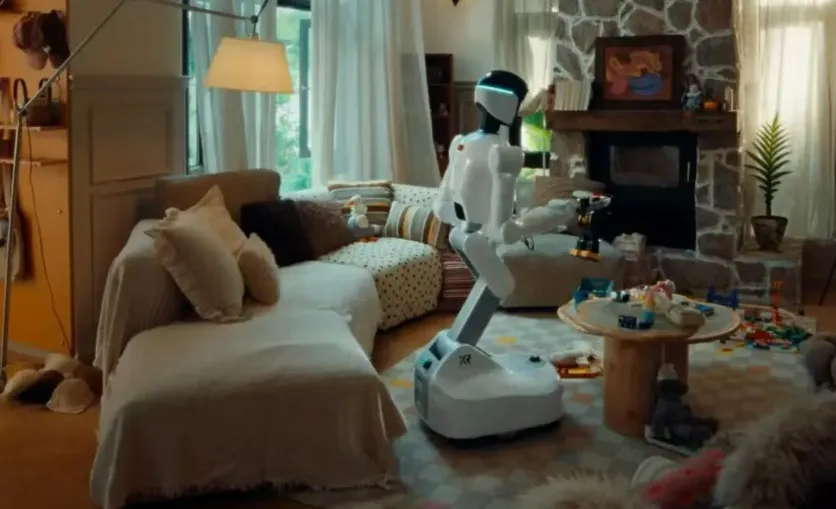
This is the true meaning of the six words used by General Motors.
In the past, the common practice in the field of industrial robots was to build a single-scenes model array, sort robots specially sorted models, and coding robots specially trained models. Each new scenario required data collection from scratch, training models, high marginal costs, and long landing cycles.
The core value of general physical intelligence is that when models have a general understanding of the physical world, scenario expansion is no longer a zero-to-one iterative development, but a natural outflow of underlying capabilities.
Household scenes and industrial sorting, seemingly very different, a chaotic environment, a variety of tasks, a relatively high error rate; a process specification, a single goal, demands for efficiency and stability are harsh. But at the level of the underlying laws of the physical world, the two are common, requiring identification of objects, understanding space, planning operations, control strength, and predictions.
The physical cognitive abilities of the WALL-B model, learned in the home scene, and adapted to the industrial scene, require only a small amount of scenographic data to release a powerful operational capability. This ability to generalize across scenarios has led to a sharp decrease in marginal costs and an increase in the expansion rate.
This means that once a large model of general-purpose smartphones is mature, it can quickly penetrate thousands of industries, today it can do logistics sorting, tomorrow it can do 3C assembly, without having to re-engineer the wheels every time, only having to do a lightweight adaptation on the unified base.
05.
What is the meaning of this verse?
Looking back at this reversal, it really answers the question: what is the best path to becoming physically intelligent industrialised?
On this core value trajectory of industrial landing, Chinese companies have already given an answer with the facts: not blindly following overseas technological routes, but with more pragmatic engineering thinking, deeper modeling capabilities, and a dual lead in efficiency and cost in more random and complex real-world conditions.
The 1816 units/hour of self-variability achieved in this logistics sorting live broadcast is no more than an efficiency figure. It means that when the plane of physical AI starts to spin, whoever can run the real-machine data pump model in front of the positive feedback loop on the landing of the pump scene, whoever can win the initiative at the next stage.
China's physically intelligent industry is using its claws to declare to the world that true technological leadership lies in a deeper understanding of the physical world and a more pragmatic respect for industrial values.