Meta is back up!
On Monday, the company, which has a market capitalization of about $1.5 trillion, released the underlying parameters for its new open AI model, Muse Glimmer, which developers can download and modify directly.
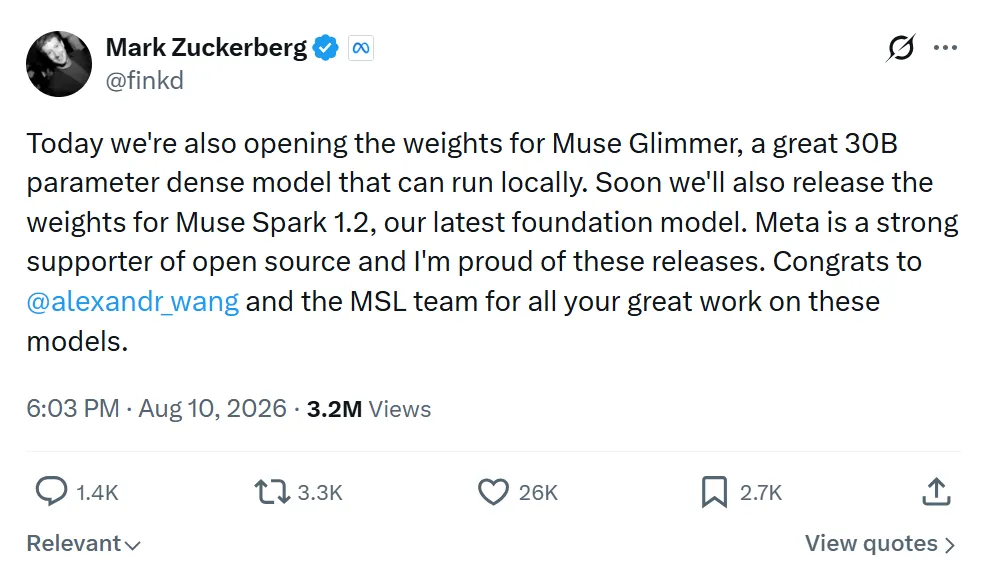
In the coming weeks, Meta will also unlock the model weight of its more powerful Muse Spark 1.2, Meta's newest base model.
In response, Zuckerberg said: "Meta has always been a strong supporter of open source and he is very proud of these releases.
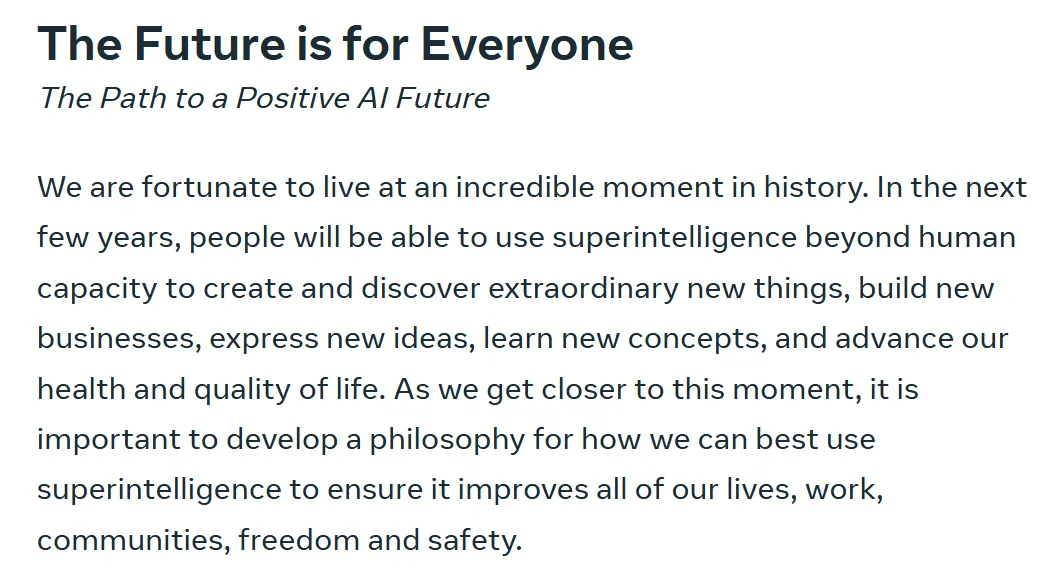
Zuckerberg also published an article on Meta's official website proposing to provide free and powerful AI to billions of people, hoping to empower individuals and balance the power of large organizations.
Address of the article:
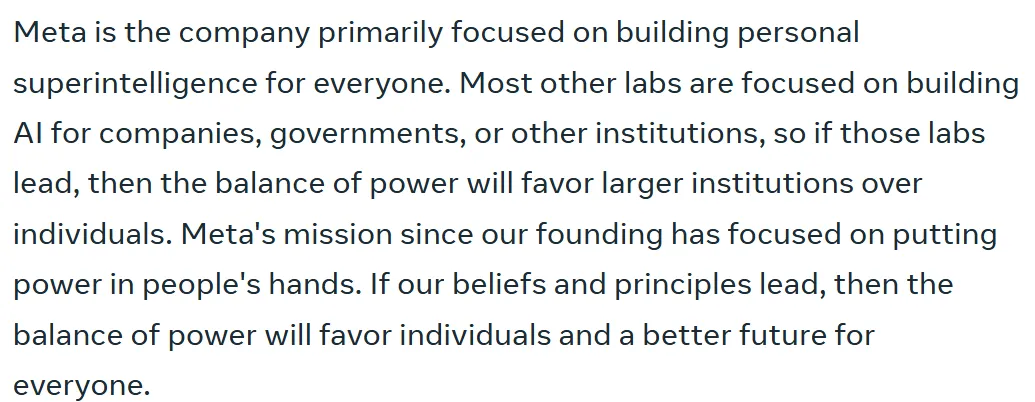
In an apparent statement directed at companies such as Google, Anthropic and OpenAI, he wrote: "Most other labs are focused on building AI for companies, governments or other agencies. If these labs end up at the forefront, the balance of power will be more geared toward large organizations than individuals".
These commitments mean that Meta is returning to the open AI path it previously used to differentiate itself from its competitors.
Earlier this year, Meta did not open the underlying authority of Muse Spark due to security concerns. As the competition between the leading AI companies escalated, a growing core issue became: how much of the most powerful AI technology should be open.
But anyway, Zuckerberg's re-embracing of the open path is almost a good thing.
Yann LeCun seldom applauds an old host.

Another user commented, "This wave tastes so bad! Zuckerberg really killed back".

"We love open AI (dog heads)".

Meta re-tweeted "open source"
Muse Glimmer is Meta's first open-weight model since Llama 4, and Meta's first model released under the Apache 2.0 license.
The previous Llama series used custom licenses that were restricted to some commercial scenarios. Apache 2.0 is much more relaxed, allowing companies to directly deploy or continue to fine-tune, develop derivative models and integrate them into their own products.
Muse Glimmer was distilled by Muse Spark, with a total parameter volume of about 29.6 billion, including about 1.8 billion parameters of visual encoders. The model supports text and image input, has a 128-K context, focuses on enhanced multi-step reasoning, tool calling and fault recovery, and is positioned as the base of Agent on personal devices.
Traditional cloud agents require continuous uploading of files, messages, and work contexts, and the longer the tasks, the more calls, and the higher the Token bills. Once deployed, the data can remain on-premises, and delay and reasoning costs can be more easily controlled.
The hardware barrier still exists. The BF16 of the Muse Glimmer weighs close to 60GB, making it difficult for ordinary computers to carry directly. The 4-bit quantified version of Meta compresses the language model to 20GB and can run in either 24GB or 32GB storage environments.
The so-called "personal computer can run", more accurately, is a PC with a high-end Mac or RTX 5090 graphics card that can run.
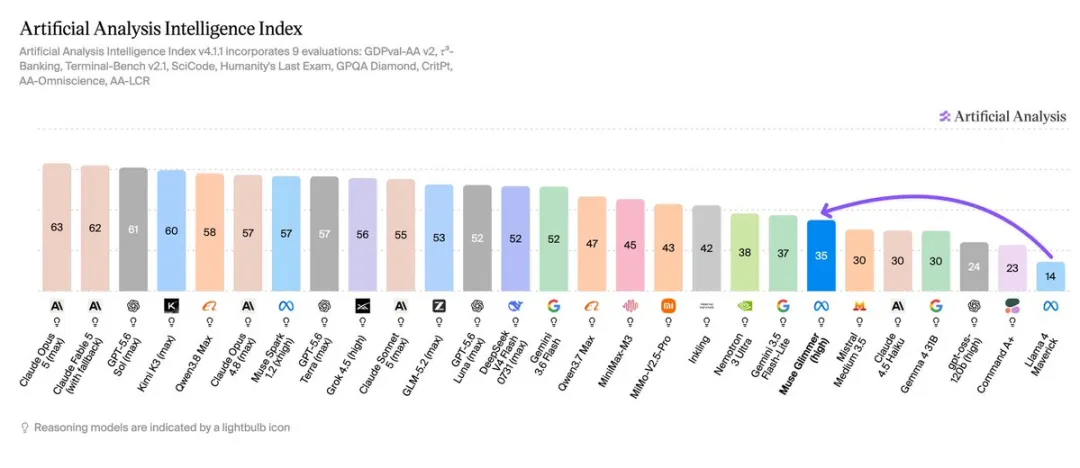
In terms of parametric efficiency, Muse Glimmer has delivered a good performance list.
Artificial Analysis gives an IQ of 35 points, 21 points higher than the Llama 4 Maverick. It is close to the 36 points Kimi K2.5, slightly lower than the equivalent Qwen3.6 27B and Ling 3.0 Flash, both of which are 38 points.
In Meta-published Agent ratings, Muse Glimmer scored 75.5 on the MCP Atlas, up from 62.5 on Qwen 3.6 27B; DeepSearch QA was 74.6 and slightly above the latter's 71.1.1.
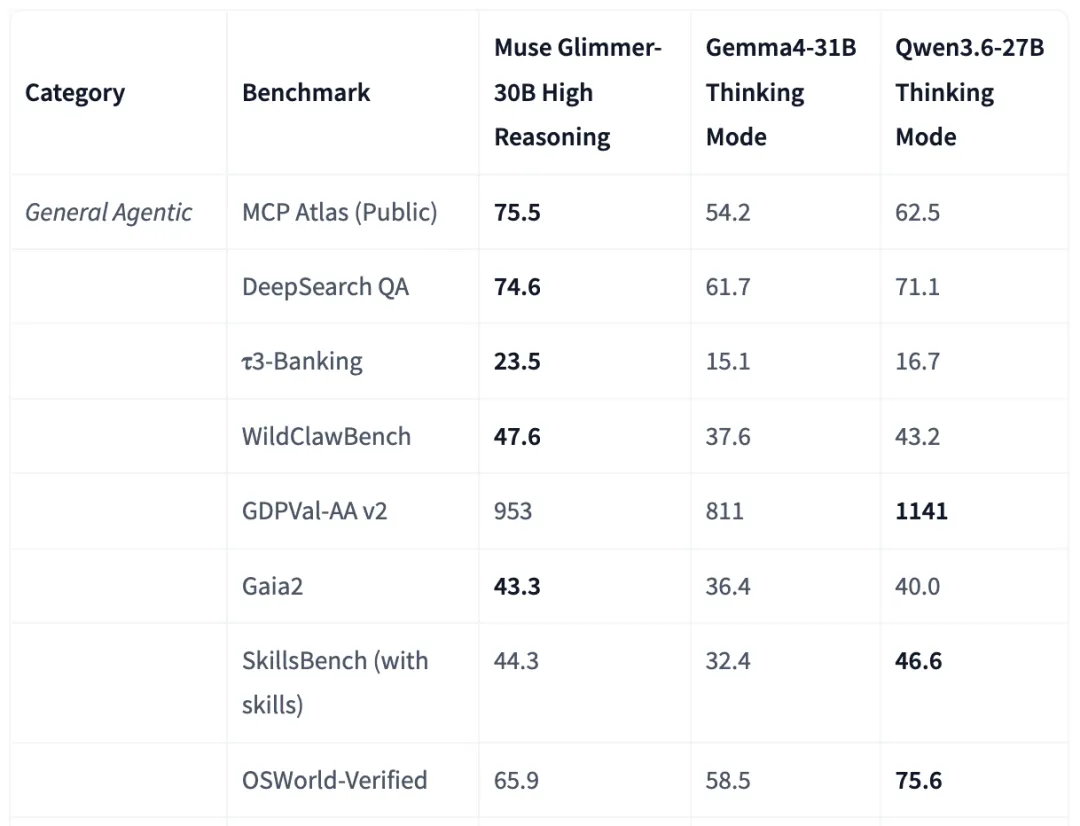
Independent ratings also expose the shortboard. Muse Glimmer's score on GDPval-AA v2 is 953 Elo, below the human baseline of 1000 points, and it also lags behind Qwen3.6 27B's 1141 points. It has a hallucination rate of 82%, Qwen3.6 27B's 49% in AA-Omniscience ratings. On Terminal-Bench 2.1, Muse Glimmer scores 52%, as well as 61% for Qwen3.6 27B.
As a result, Muse Glimmer is well suited for local tool calls and process execution, and still needs to be accompanied by retrieval and artificial replication in the face of high-precision knowledge tasks.
Zuckerberg's fight for the power of AI narrative
According to Zuckerberg, the core of AI competition can be summed up in two questions: who gets superintelligence and what people do with it.
He wants to give "personal super-intelligence" to billions of users so that AI can participate in everyday affairs such as health, career, finance, interests and relationships.
This set of proposals would tie open models to individual autonomy and directly challenge the closed-source routes of companies such as OpenAI, Anthropic and others.
Zuckerberg opposes the use of security risk as a competence-focused defense.
He believes that handing over the most powerful AI to a handful of institutions creates new power risks in itself. Open models allow for more developer checks, vulnerabilities are more easily exposed and fixed, and individuals can customize AI as needed.
He also defended the model's distillation.
OpenAI and Anthropic have repeatedly accused Chinese companies of using U.S. closed source models to train their own models. Zuckerberg stressed that people should retain the principle of "learning from observable information". He also opposed restricting overseas open models, advocating that U.S. open models rely on competition to become the best in the world.
However, Meta didn't avoid all the security issues.
Zuckerberg suggested that Meta's independent directors would be responsible for approving the security standards required to open the model; the company could also provide intermediate training checkpoints to the government to detect risks earlier.
Beyond open source, there is the ecological and computational business.
Meta is now back to open weights, with real-world pressure.
China's open-source model is rapidly narrowing the gap with the US closed-source flagship. DeepSeek, Kimi and Qwen continue to improve performance, and rely on low pricing, customizability and local deployment to expand their reach. If US model companies continue to tighten their leverage, the global developer ecosystem could accelerate their migration to other suppliers.
Meta needs to take back these developers. Muse Glimmer lowered the local deployment threshold, Muse Spark 1.2 is responsible for raising capacity limits, and both models can cover personal devices, enterprise privatization deployments and cloud services.
This year, Meta plans to invest up to $145 billion to build AI infrastructure while preparing for cloud computing operations. Model weighting can be free, reasoning, management and development tools can still generate revenue.
The $1 billion data center community fund announced on the same day also serves this framework. Meta needs to build more data centers and alleviate local communities' concerns about electricity, water and land use.
Muse Glimmer was not enough to rewrite the model layout. Its importance lies in the fact that Meta re-established the open-heavyweight camp and gave a product available for local agents.
If Meta were to launch Muse Spark 1.2 as planned, the competition between open and closed sources would escalate further.
Next, the industry will have to answer three questions: which capabilities can be opened up, who will bear the costs, and who will make the rules.
The link is as follows: