It's the first time in the history of the world.
Carbon-based speed has been hit again by hydrogen-based intelligence!
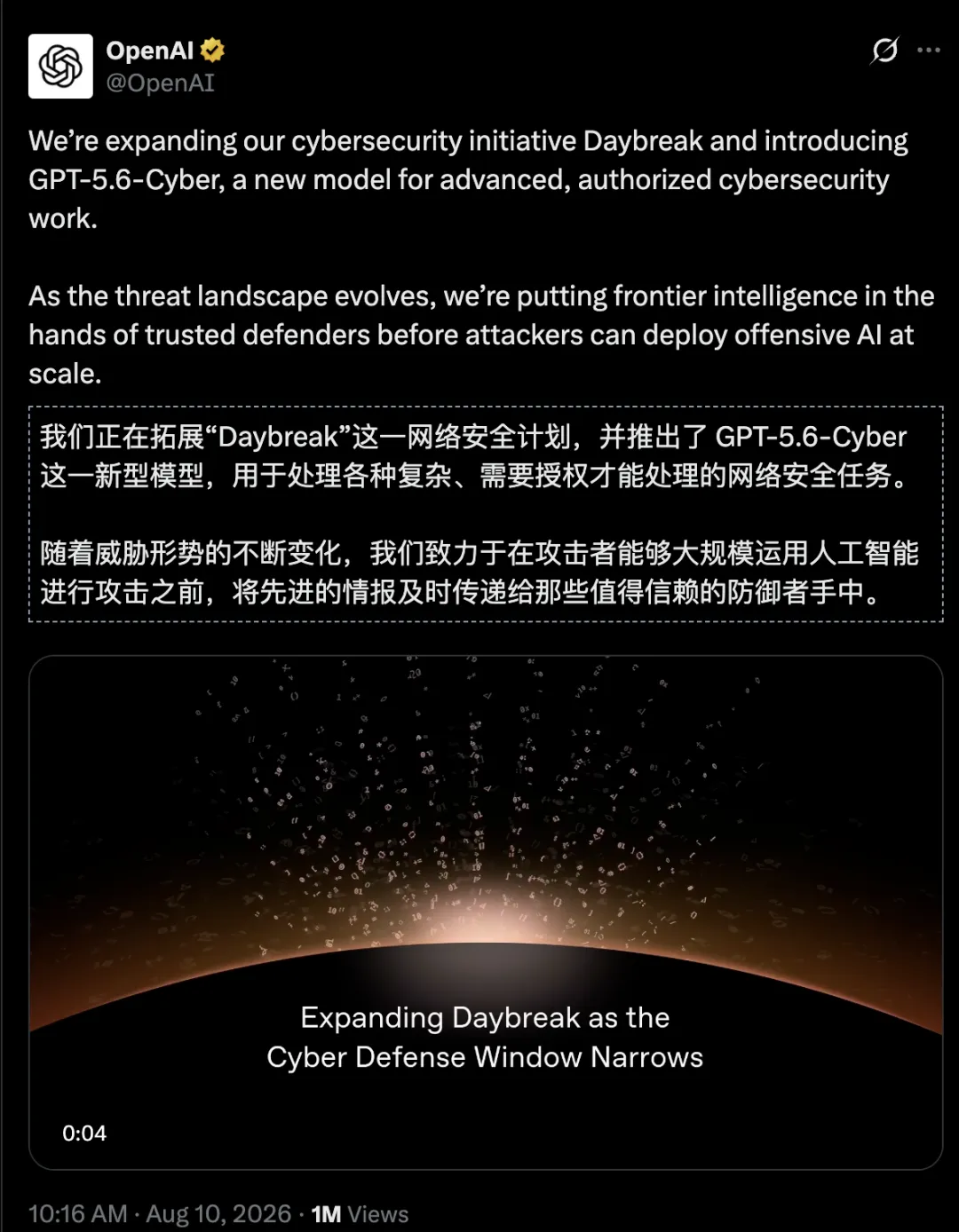
To avoid the end of cyberspace, OpenAI is expanding its "breakthrough program".
OpenAI has introduced the GPT-5.6-Cyber security-specific model, which is specifically designed to handle information security tasks and completely disrupts the cybersecurity paradigm.
Now, OpenAI has released the results of GPT-5.6-Cyber: the new model uncovered 400+ core vulnerabilities, including:
- A high-risk vulnerability in the V8 of a Chrome JavaScript engine;
- One mainstream mobile operating system: at least 5 vulnerabilities, including a complete chain from non-mail applications to local claims;
- A mainstream database: 3 major vulnerabilities that contain remote code execution paths;
- The core of a mainstream operating system: over 400 vulnerabilities that can lead to leverage.
Currently, GPT-5.6-Cyber is only available as part of the "Daybreak" (break) program after reviews such as identity verification.
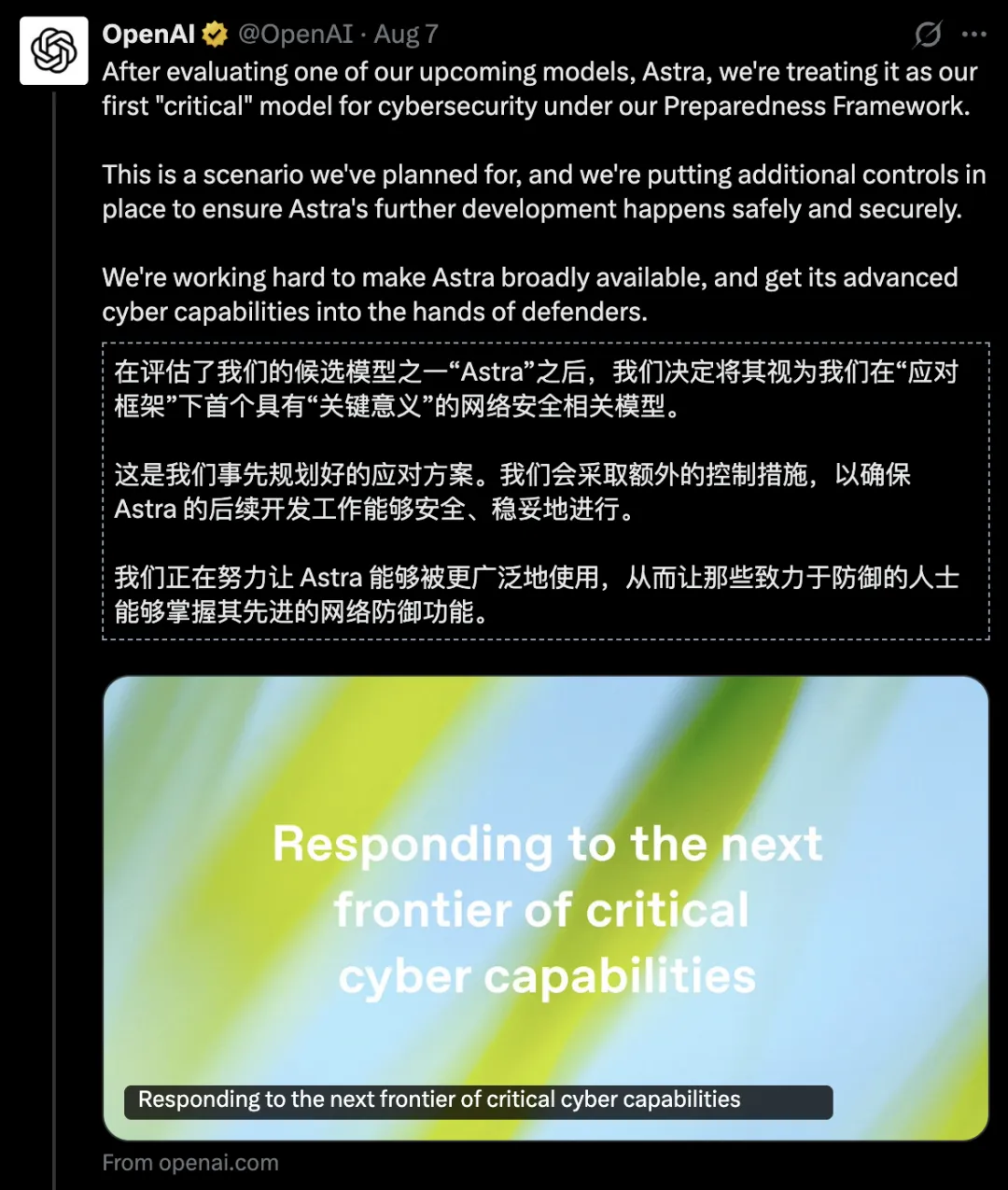
OpenAI: AI will cross "crisis points"A few days ago, OpenAI just stepped on a brake.
The next generation of Astra performed so strongly in internal assessments that "it cannot be ruled out" that it has reached a "critical" level of cybersecurity capability, deciding to suspend all Astra-related activities that do not meet enhanced security requirements.
There is no doubt that if a computer vulnerability is deliberately exploited, the consequences can be devastating: your personal information, your credit card passwords, or even the entire Internet!
What's even more embarrassing is that Claude Fable 5, Chat GPT 5.6 Sol, and others are the best models.
When security defenders want to use AI to simulate an attack to verify a zero-day vulnerability, big models often say, "Sorry, I can't help you".
After the internal AI of OpenAI invaded the HuggingFace, the country's open-source model was picked up.
The emergence of the Daybreak plan has disrupted all of this.
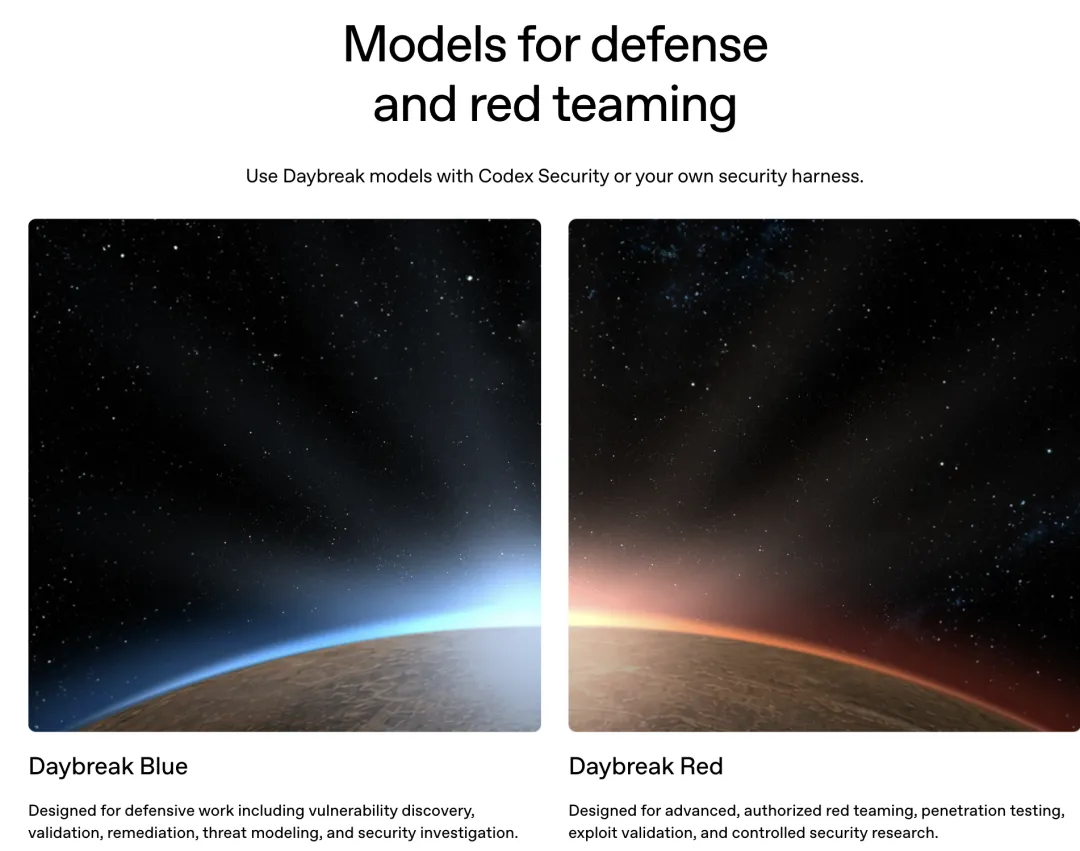
OpenAI divides the program into two different channels, giving information security researchers the most powerful spears and shields:
- Daybreak Blue (Blue Channel): provides a common GPT-5.6 Sol model for defenders, but removes system-level shielding that prevents legitimate defense work. It is used for routine vulnerability detection, security code auditing, malware analysis, and patch verification.
- Daybreak Red (Red channel): A core channel for authorizing vulnerability research, exploit validation, and Red Team test design, supported by specially trained GPT-5.6-Cyber.
OpenAI has tested new models in vulnerability-based chain development, authentication bypassing, authorization enhancements, and other high-level cybersecurity scenarios.
GPT‐5.6‐Cyber completed 95.0% of such requests, while GPT‐5.6 Sol completed only 1.5% and 2.0% when using Daybreak Blue access permissions.
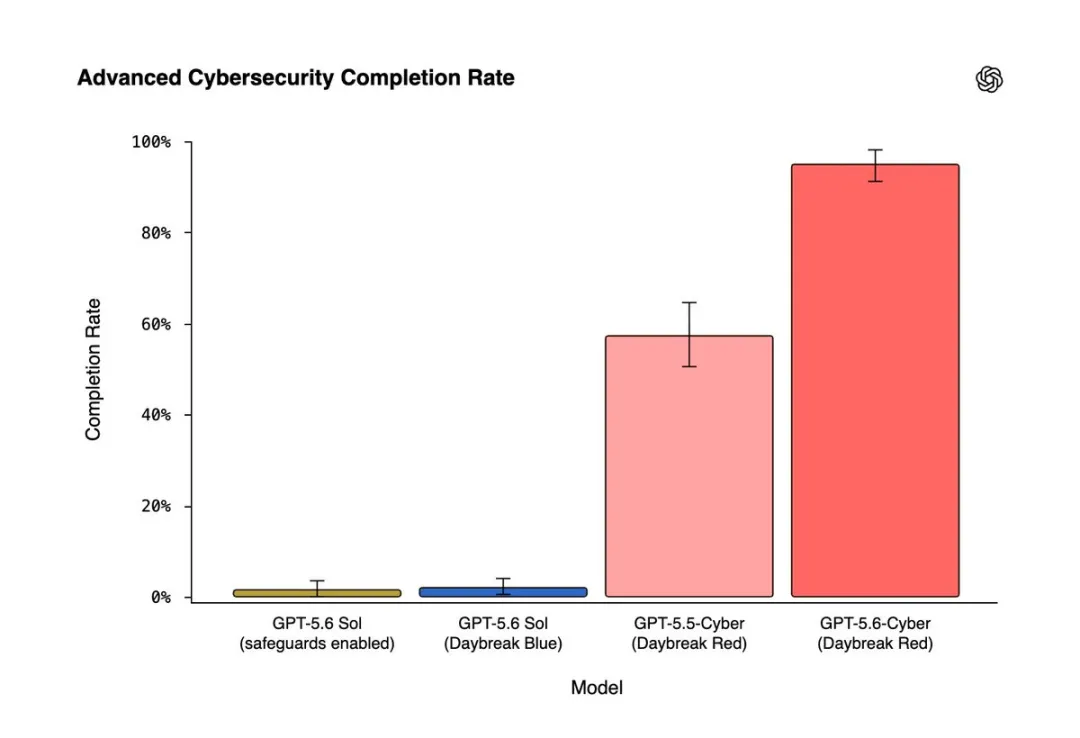
In other words, security researchers no longer need to be discriminated against. Since then, the strongest cyberattacks against AI have emerged.
As Jared Atkinson, chief technology officer at security firm SpecterOps, said:
Reducing unnecessary "rejection responses" in a regulated trust environment enables security researchers to stay focused, spend time verifying vulnerabilities and transforming them into defensive values, rather than battling models.
GPT-5.6-CyberChatGPT's most powerful information security modelBased on the GPT-5.6 Sol, GPT-5.6-Cyber, which is targeted for security training and refreshed by multiple benchmarks, is the strongest security model in ChatGPT.
GPT-5.6-Cyber is far ahead of GPT-5.6-Sol in exploiting, detecting and evaluating vulnerabilities.
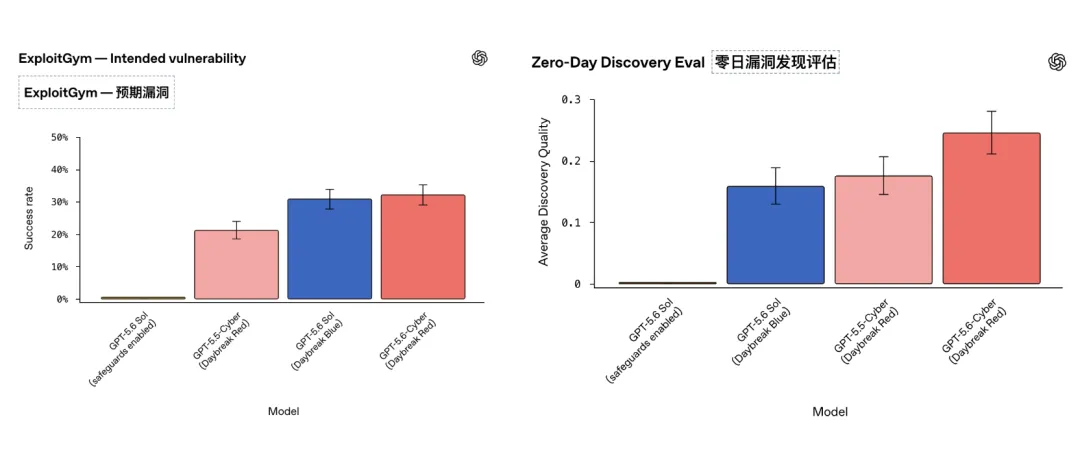
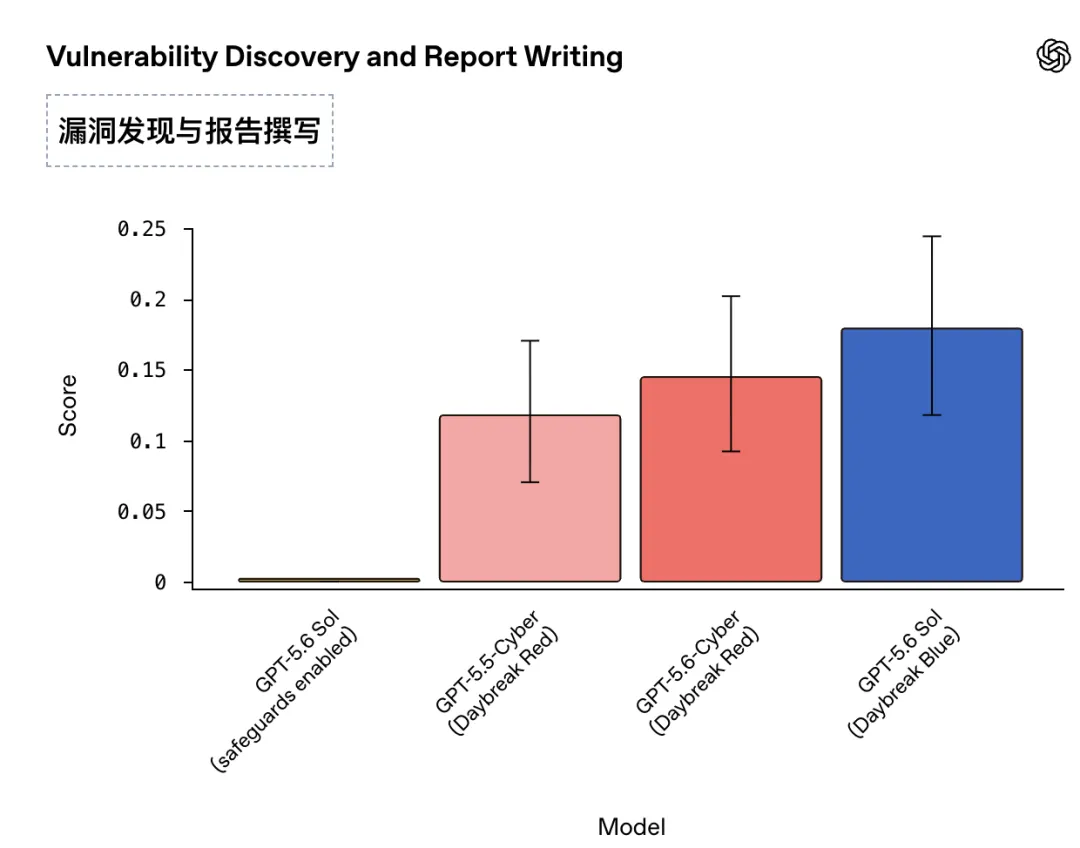
The only unexpected occurrence was in the detection of vulnerabilities and the writing of reports.The final score for GPT-5.6-Cyber was lost to GPT-5.6 Sol.。
This may be due to GPT-5.6-Cyber's deep reinforcement learning and alignment mitigation in cyber defense missions.
When it discovers a vulnerability, it only wants to prove its existence with the simplest code and the fastest time possible, and it is impatient with how to explain its cause in detail in human language and write a long-running security report.
If the metrics and parameters are too boring to dig for, then digging a hole in a large real-world codebase is to test whether the GPT-5.6-Cyber really has the ultimate "network detective" intuition.
In the face of the complexity of millions of lines of code, in order to find a valuable vulnerability, AI, like human hackers, must continually go through several difficult paths: build the hypothesis that the system is running, simulate the abnormal interaction of multiple components, capture the instantaneous memory damage, and ultimately prove that the gap can be exploited.
After completing the GPT-5.6-Cyber training, OpenAI's security research team had it turn its attention to the huge, complex JavaScript engine of the V8 series of Google Chrome browsers, made up of a stack of countless C++ code.
Then AI discovered a high-risk vulnerability.
When the engine attempts to convert certain values to integers, the compiler mistakenly skips the security check.
If an undefined value is entered, the system does not report the error as expected, but instead produces an extremely large odd integer. If this number is subsequently used as an index for the array, disaster strikes: the JIT compiler mistakenly believes that the index is still within the safe range of the array, thus omitting boundary checks when running Bounds Check.
At this point, AI has completed the first step: escape from prison.An attacker can read or rewrite memory data of other objects in the V8 sandbox.
But if you really want to execute the malicious code, you have to find the second key to make the sandbox escape.
Surprisingly, the thinking of GPT-5.6-Cyber has not stopped.The second vulnerability was found and exploited on its own: the Stack Escape flaw in JSPI (JavaScript Promise Integration).。
By cleverly "chaining" the two vulnerabilities together, AI successfully opened a dark path to the bottom of the system, enabling arbitrary code to be executed outside the Chrome sandbox.
The OpenAI team quickly submitted the findings to the Google Security Team, and the vulnerability was corrected in a timely manner.
This is a milestone in the history of AI development:AI already has a "creative logic" for building loopholes across components.
And the Chrome V8 is just a prey on its hunting list.
GPT-5.6-Cyber has demonstrated terrifying "killer power" in several core digital infrastructures:
Attack on Smartphone OS
In a mobile operating system with hundreds of millions of users, AI independently discoveredFive high-risk loopholesIt has successfully built a complete chain of attacks from "general unauthorized apps" to "acquisition of system to high privileges" (local privileges).
Breaking into the Pop Database
In a large open-source database, AI is continuously miningThree deadly flawsIt contains a remote code that can execute the RCE path to launch an attack directly from the external network.
Nuclear disaster
In the core of a mainstream operating system, the GPT-5.6-Cyber is like a fully automatic harvesting machine.More than 400The potential loopholes that can be used to leverage rights.
AI doesn't create danger, it exposes dangerThe emergence of GPT-5.6-Cyber has been interpreted by many as "AI making cyberspace more dangerous".
More accurately, however, it exposes the dangers that existed but were disguised by human expertise, in advance, concentrated, and on a large scale.
There's always been a zero-day loophole.
There have always been potential routes of uplift in the core. Only in the past they have been found to be extremely expensive, extremely slow. Now the cost is falling, the speed is increasing.
OpenAI's choice is essentially a gamble rather than allowing attack capabilities to be scaled up in the dark, rather than handing over the same profitable capabilities to a screened defender, even if that means taking the risk of "the sword being misused".
The window of cyber defense is shrinking at the speed of AI. The time left for human hesitation has been calculated by the hour.