Recently, the head of technology at Ali Qishan, Lin Jun Jun, announced a new trend: the founding of a new AI company Pragmatik Labs in Shanghai, also known as p7k. The direction was officially announced for the first time: the next generation of Agent to explore the digital world and the physical world.
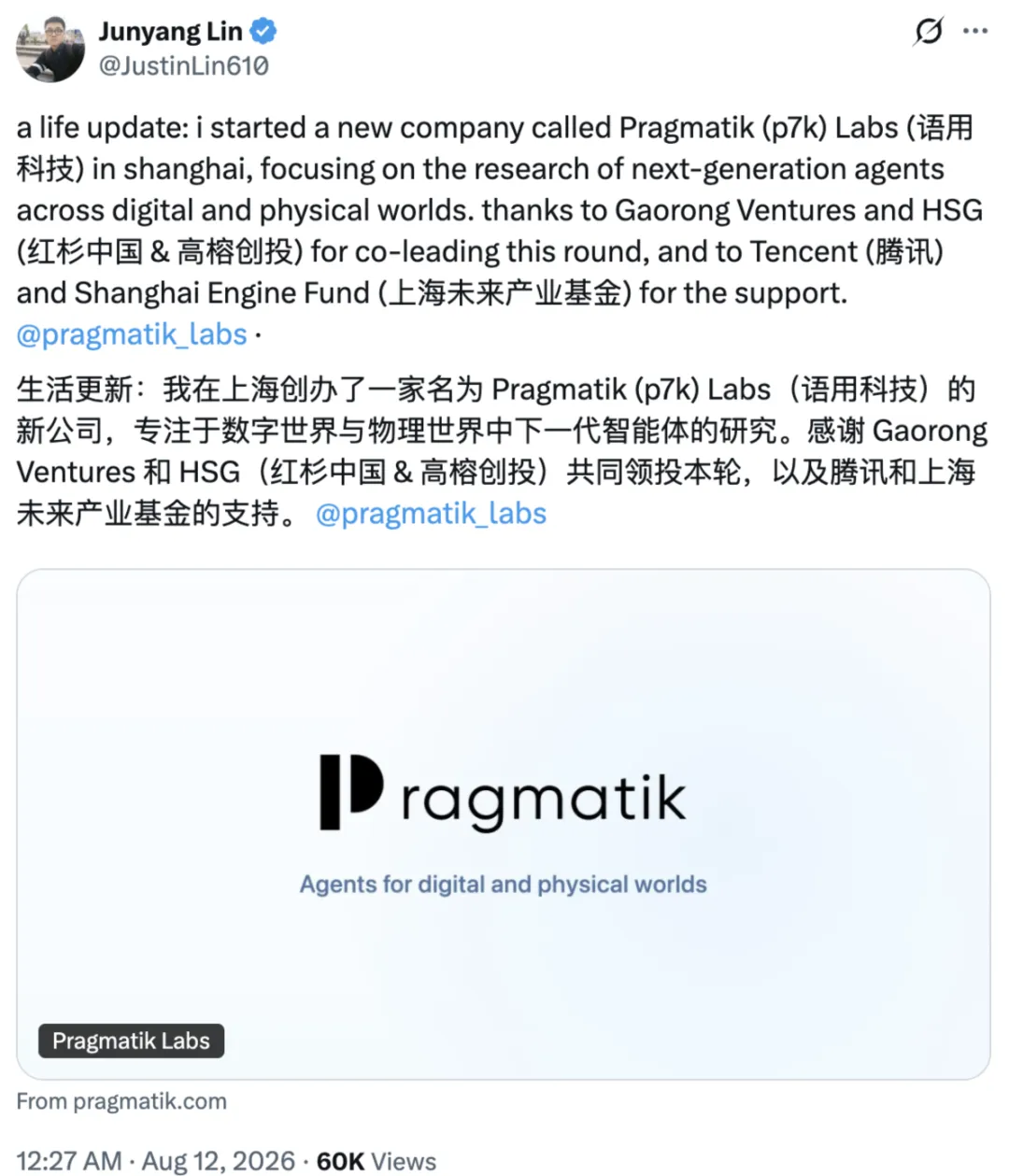
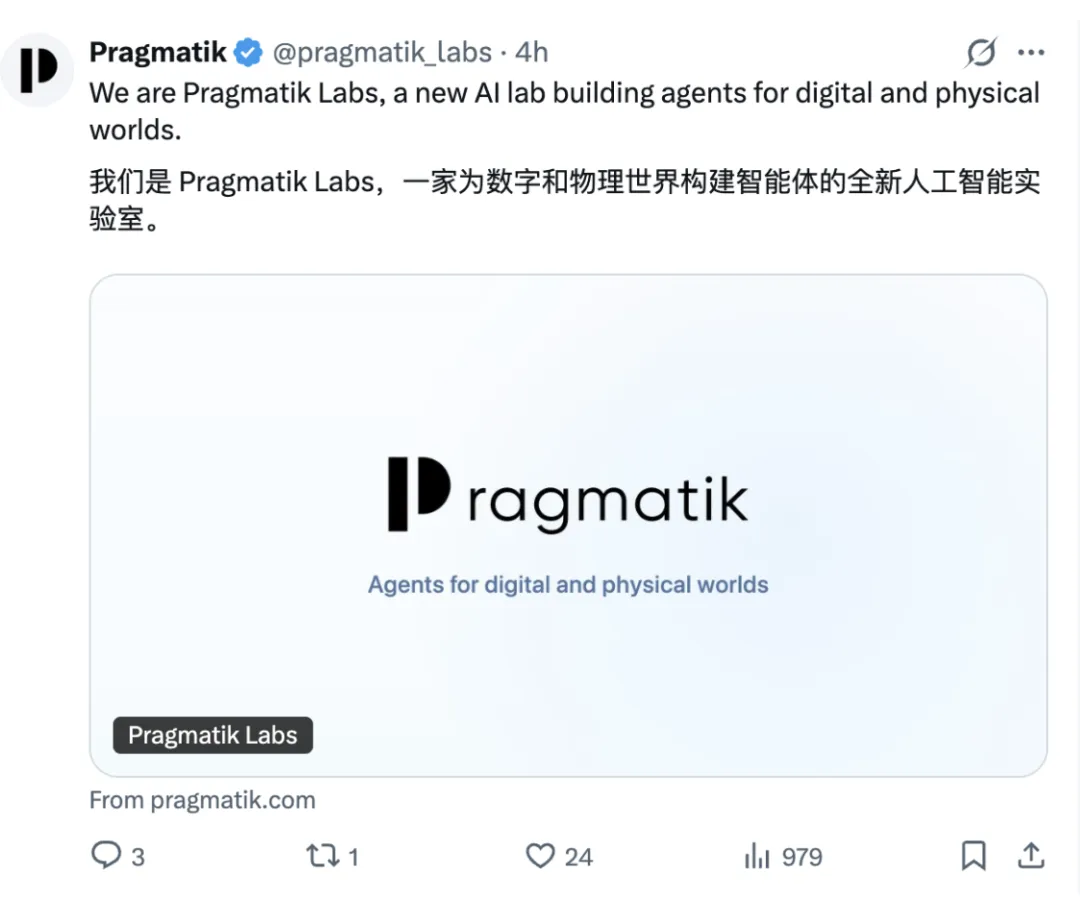
At the same time, the investment lineup of Pragmatik Labs also surfaced. Lin Jun Jun revealed that Kaohsiung Investments and HSG Redwoods China jointly took over the round of financing, supporting Tencent and the Shanghai Future Industry Fund.
Earlier, it was reported that Pragmatik Labs had invested hundreds of millions of dollars in this round of financing, with Qualcomm and HSG investing about 100 million dollars, Tencent investing about 20 million dollars, and the company being valued at about 2 billion dollars.
This also means that by the time of its official debut, Pragmatik Labs has been valued at RMB 10 billion.
In the meantime, from March of this year, when he left the question, to May, when he was exposed to start-ups, to June, when he was exposed to the progress of financing, the speculation surrounding Lin Jun Jun Jun Jun Jun has finally been answered after almost half a year.
The tech executive who led Qwen to break into the top tier of global big models did not stay at the big factory, nor did he limit the new company's goals to the basic model.
He left the next stop for Agent.
At the moment, the new company's official website has also emerged, but the information disclosed is very limited, no model parameters have been published, and no specific products have been released. However, the company's technical layout is already quite clear.
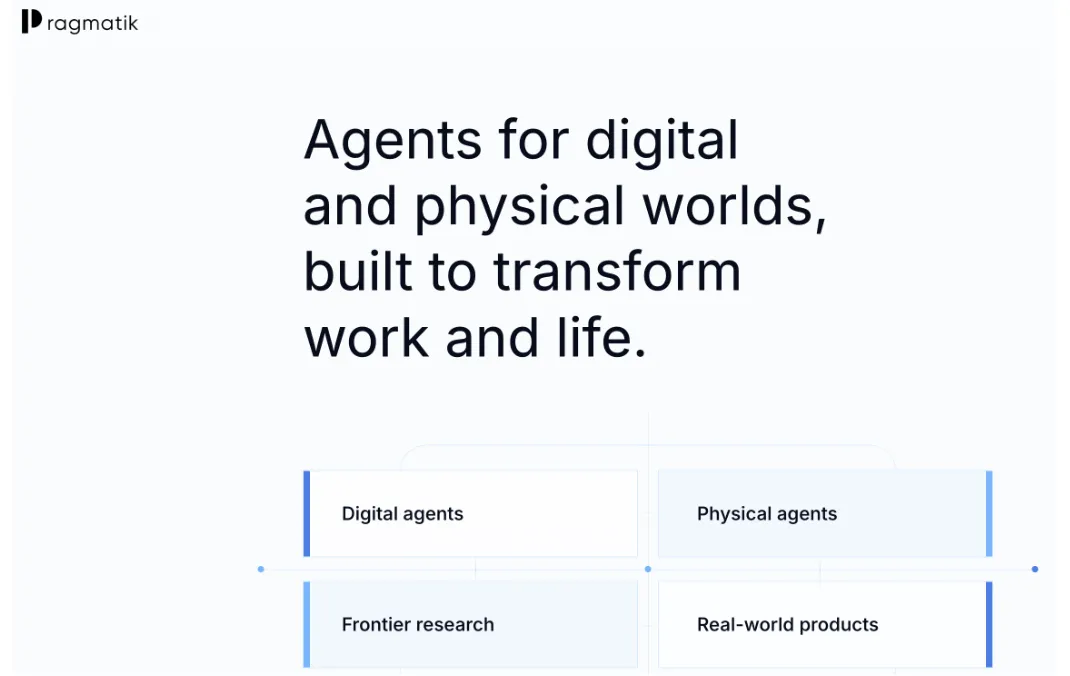
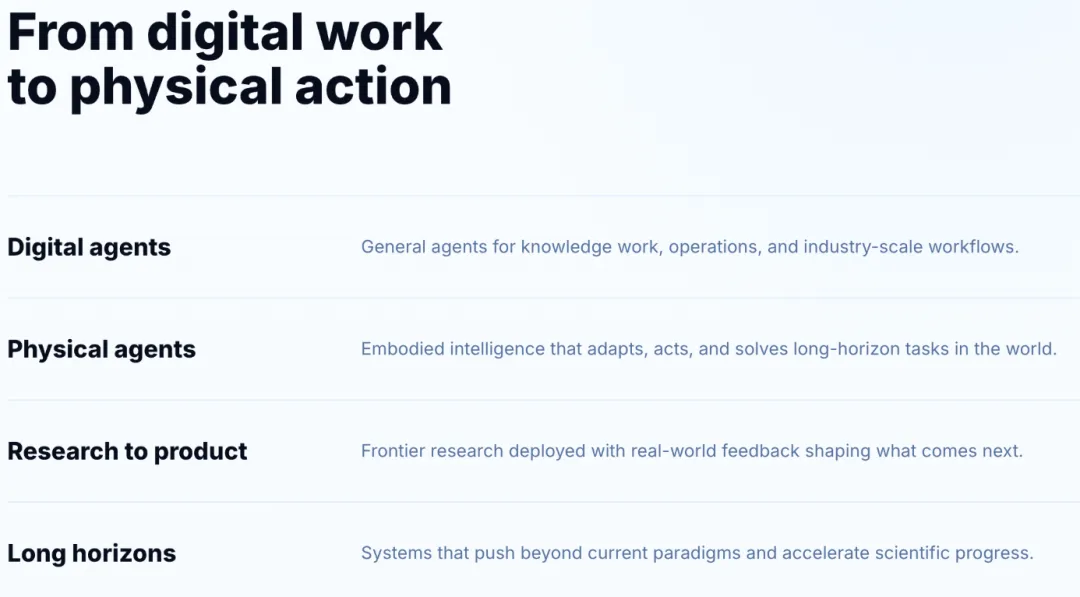
Pragmatik clearly divides the research direction into two: Digital Agents (digital agent) + Physical Agents (physical agent) based on this, and divides it into four parts:
Digital Agent: A general intelligence body focused on knowledge work, business operations and industrial workflows.
Physical Agent: Physical intelligence capable of adapting to the environment, acting and completing long-range tasks in the real world.
From research to product: transforming cutting-edge research into a real product and continuing to shape the next step in research direction through real-world feedback.
Long-range exploration: building systems that break existing paradigms and accelerate scientific progress.
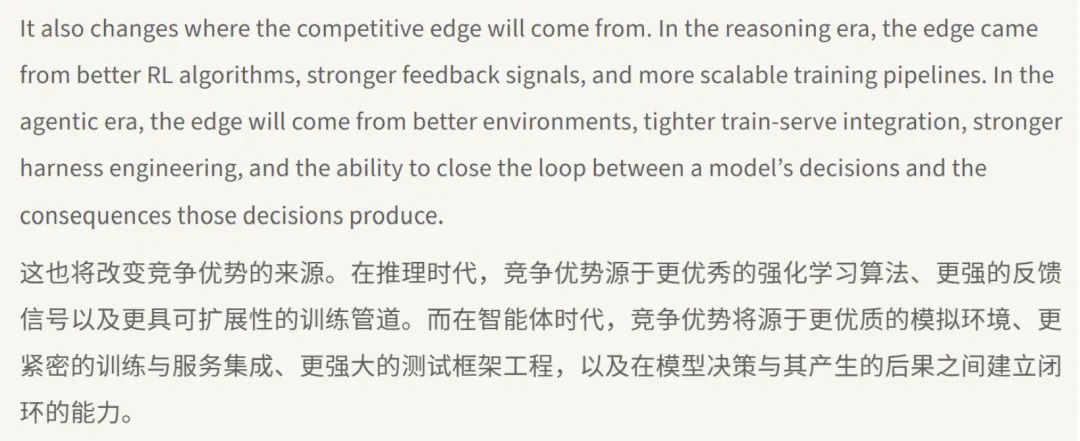
In fact, the choice of this technological route is not without precedent, and as early as March this year, Lin Jun Jun published an article titled From 'Reasoning' Thinking to 'Agentic' Thinking, suggesting that the next phase of AI focus will shift further from "training models" to "training intelligent agents, even training systems composed of multiple intelligent agents".
The following is a link to the article:
Lin Jun Jun-ho further defined the term "Agent".
In his conception, the real object of training in the Age of Agents was the complete system of "Model+Environment", including Harness, training environments, evaluators, and even collaborations between multiple Agents.
This is probably what Pragmatik Labs calls "the next generation of agents".
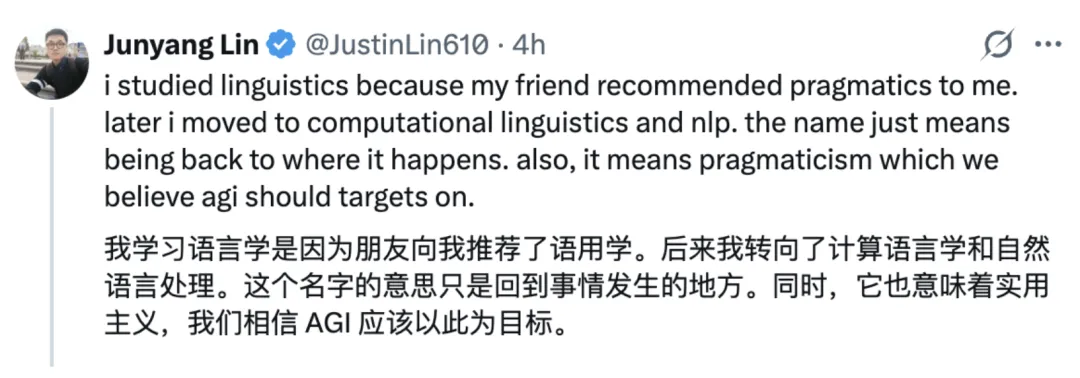
Speaking about the name of the new company, Lin Jun Jun explained: "I first studied linguistics because a friend recommended pragmatics to me, and then I turned to computational linguistics and natural language processing (NLP).
The name, on the one hand, means to go back to where everything really happened; on the other hand, it also refers to pragmatism.
And speaking of this, we will no longer have to re-evaluate the bright lifestyles of Lin Jun-yeon.
Born in 1993, Lin Yun-hwan attended the English Department of the Faculty of International Relations and studied Japanese, Russian, German and French at the same time; and a master's degree in foreign linguistics and applied linguistics at Peking University, where his deep linguistic background laid the foundation for his subsequent understanding of the underlying logic of the big language model, enabling him to gain a deeper understanding and accumulation of machine language and human intentions.
According to sources, while at university, Lin Jun-hoon tested the English dictionary with more than 3 million samples and found that the accuracy of normal machine translation was only about 23%, compared to an earlier version of Transformer of 27%. This seemingly inconspicuous data contrast gave him a keen grasp of the potential for the big model to explode in the future.
After completing his master's degree in 2019, Lin joined the Intelligent Computing Laboratory at Alibaba University as a senior algorithm engineer, researching natural language processing and formally entering the AI front-end field.
After that, in just over six years, the path to promotion was paved with a strange upgrade...
At the end of 2022, Alibaba merged the language, visual and AI teams of the Dhamma School into the Ali Cloud to form the Semantic Laboratory, which officially takes over the large model of the Semantic Q series, raising the flag of the technology leader.
Under his leadership, Ali introduced the Qwen series of open-source models involving all kinds of parametric scales, and really introduced Ali's AI technology more widely into the industry ecosystem.
In August 2024, after the departure of Zhou, the former head of GMQ, who joined the byte, Ali made a recall of the core department's employees, thus elevating Lin Jun to P9.
In May 2025, Lin Jun Junjun, who led the team to the top of the P10 rankings, became Alibaba's youngest P10 level technical manager.
In October 2025, Lin Jun-hoon personally formed a team of robots and physically intelligent people inside Qwen, which is considered by the outside world to be one of Ali's clearest physical AI system exploration strategies. At the time, he tweeted in X that he was trying to get the model out of the virtual screen to truly understand space and learn how to operate manually, pushing intelligence into the real physical world.
In early March of this year, Lin Jun-ho tweeted announcing his departure from the Qwen team.
Recently, Lin Jun Jun-ho officially announced the launch of a new direction, Pragmatik Labs, which opts to bet "the next generation of agents across the digital world and the physical world".
Lin Jun Jun, who was involved in building one of China's most globally influential large model systems, chose to write the company's research goals into the digital and physical world for the first time when he officially announced the new company's name, which is itself a worthy industry signal.
The basic model's "war" is far from over, but more and more top researchers are starting to ask the next question: how does the model think about how to actually get things done?
Perhaps that is the question Pragmatik Labs has to answer.
So, what do you think of Lin Jun's new company and new direction?
The link is as follows: