It's the first time in the history of the world.
When encryption, compression, indexing, memory and context services approach the medium, the value boundaries of SSD, DRAM, HBM and HBF will be redistributed.
AI Agent is transforming the computer from "a model call after a problem is received" into an operating system that continues to observe, reason, call tools, modify environments and maintain state.
A task may continuously access models, memory, vector indexes, business databases, object storage, and network services, and may continuously rewrite tool results, execution trajectories, user preferences, and temporary context and audit records. The longer the agent runs, the more the value depends on whether the data can be securely stored, retrieved correctly, updated in a timely manner, and replicated at low cost.[1]
This means that storage is no longer just a drop-off terminal after the agent has finished work, but will gradually enter the agent's perception, memory, and decision-making cycle. AI SSDs have shown the first directions: save the model with the adapter, accept the removable KV Cache, shorten the cold start, and expand the deployable model capacity. Step by step, SSDs can also perform encryption, compression, decryption, re-marking, indexing, version maintenance and lifecycle governance, and provide lifecycle capacity for Agent Memory.
This change did not come about by accident. The self-encrypted disk can now transparently complete data decryption within the controller; computational storage standards list compression, encryption, regular filtering and decryption as functions that can be executed by the storage side; products such as Samsung SmartSSD have also brought database scanning and video processing down to the disk side.[4][5][7] The novelty of the Agent era is that these capabilities no longer serve general data processing, but begin to reassemble around the identity of the intelligent body, context, memory, tool trajectory, and token costs.
Different names such as "security SSDs", "compressed SSDs", "recovery SSDs", "memory SSDs" or "SSDs in the above context" may emerge in the future market, and may not form separate hardware categories, but instead merge programmable functional SSDs: the underlying formats are still compatible with standard storage, with upper-level software that discovers and calls device functions depending on the situation.
NVMe has formed a set of commands such as Computational Programs and Subsystem Local Memory that provide standardized pathways for device-side program detection, configuration and execution.[6] The real industry problem is not just whether a processor can be placed on the board, but who defines data semantics, functional boundaries, and end-to-end results.
Agent is not a one-time call.It's a continuously written data chain.The main permanent objects of traditional chatbots are the conversation logs, while the Agent produces more complex data charts. It needs to store observations, tool output, plans and reflections, task intermediate status, user images, environmental snapshots, retrieval evidence and execution logs; the model side also produces the KV Cache, Prefix Cache, Adapter, Expert Weight and Checkpoint.
Agent Memory is not the same as embedding all historical conversations in a vector database. Recent research into the system of Agent Memory from a data management perspective, breaking it down into four modules representing storage, information extraction, retrieval and routing, maintenance, and pointing out that no single architecture is superior to all workloads.[9]
Systems such as Mem0 also emphasize converting the original conversation into a more compact, repeatable long-term memory to reduce the input and retrieval burden of tokens in long sessions.[10] This means that the storage layer will both preserve the content in the future and preserve how the content is organized, updated and forgotten.
A memory object should have a user or Agent identity, tenant, source, time, version, authorization, credibility, retention period, and deletability; the context of the model also requires binding the model version, Tokenizer, location code, and Adapter. Only the naming space and lifecycle are specified, and subsequent compression, indexing, caching, and sharing will not disrupt the semantic boundaries.
A functional SSD plays a reasonable role in this data chain not in judging whether an experience is worth remembering on its own, but in getting closer to executing the data certainty work after Runtime has given the object and strategy. For example, by selecting the renter's key, placing the data by lifecycle, compressing and decompressing the object, maintaining index pages and metadata, prioritizing the upcoming re-loading that will be logically used, and putting the tail delay, write enlargement and media health feedback to the upper layer.
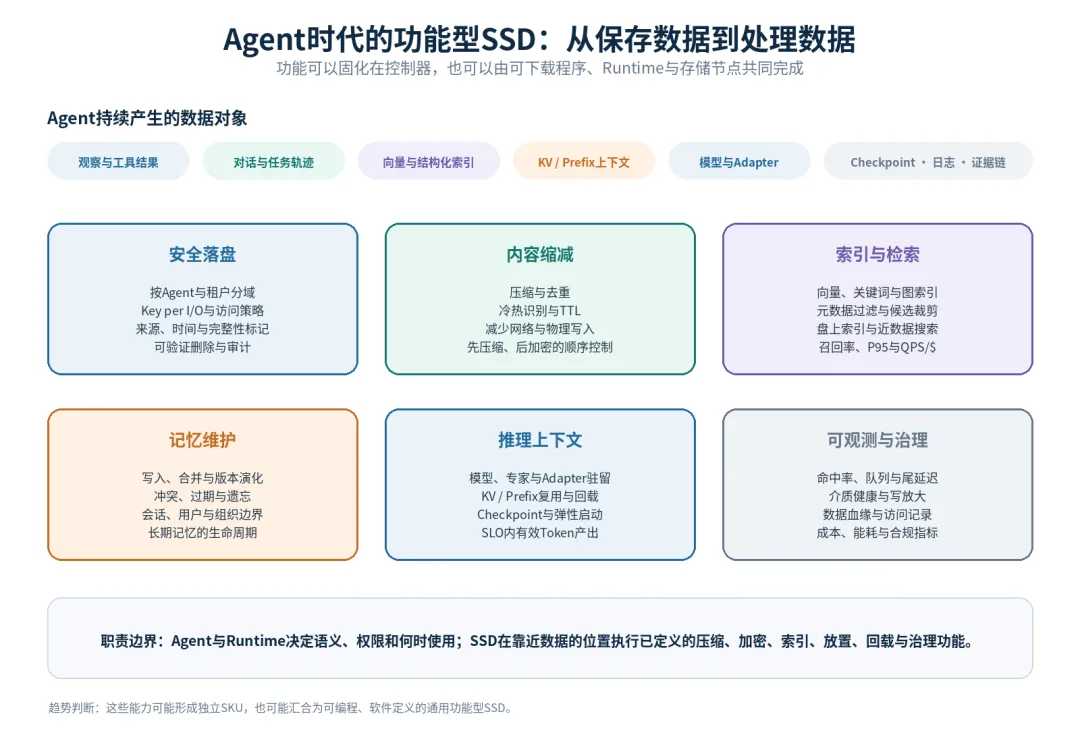
Figure 1 Agent-time functional SSD capability spectrum. Security, content reduction, indexing, memory, reasoning context and governance capabilities can be consolidated on the device, or can be completed with downloadable programs, runtime and storage nodes. Figure 1 depicts industrial mechanisms, computing storage and security capability boundaries referring to SNIA and NVMe specifications.[4][5][6]
The core judgmentsAgent-era SSD upgrades do not simply increase disk computing power, but combine standard block devices, detectable near-data functionality, object semantics and lifecycle governance. The closer the functionality to the medium, the more identifiable, auditable, and separable it should be; the closer the decision-making to the model, the more it needs to be kept in Runtime.
Automated encryption already exists, and the change is that the strategy starts to follow Agent."Data drop-down automatic encryption" is not a concept of the future. Self-encrypted disks will be used by dedicated hardware in controllers to write data encrypted, read data decrypted, and achieve transparent data static protection through key management and strategic control.[5]
For the Agent system, the new requirement is that the cryptographic graph be further refined from a complete or single naming space to users, agents, tasks, and objects: personal memory and application caches on the same terminal device cannot override each other, and the context of the shared multi-tenant Cloud Agent must also specify which can be duplicated and which can only be read within a domain.
The NVMe specification has been introduced with finer granularity capabilities such as host key management and Key Per I/O,[6] providing the basis for different security contexts each time I/O carries. Future secure SSDs may also combine data sources, timelines, access records, integrity verification and credible deletion, allowing Agents to not only answer "I remember what", but also "Where this memory came from, was it modified, who read it, when it had to be deleted". For financial, medical, enterprise knowledge libraries, and personal AI, evidence chains may be as important as the speed of retrieval.
Encryption also alters the sequence of other nearby data functions. After encryption, byte flows are often difficult to compress and decrypt effectively, so content shrinkage should generally be preceded by encryption[5]; indexes need to distinguish between description characteristics, protected metadata and the boundaries of searchable passwords.
Compression, indexing and memory maintenance could be the next batch of SSD featuresCompression is one of the easiest features to form a commercial closed loop. The agent repeatedly writes text, JSON, logs, vectors, checkpoints, and multimedia intermediate results, a substantial portion of which are structured duplicates. Compression can reduce transmission, physical write and capacity occupancy, and indirectly reduce energy consumption and media wear. However, compression ratio, extra time delay, CPU savings, and write magnification must be measured together; continuous compression may benefit from the weight of already quantified or highly compressed models.
The relationship between index function and Agent is more direct, since memory is only valuable when recalled correctly. KIOXIA AiSAQ places vectors and index structures on SSDs to reduce DRAM occupancy with SSD-friendly clustering and graphing searches, and has demonstrated single-server billion-scale vector retrieval.[8] A strict distinction needs to be made between AiSAQ first and foremost being a set of software technologies with SSD as the main index carrier, which does not mean that ordinary SSDs automatically generate embedding or understand semantics.
Memory maintenance is more complicated than indexing. Long-term Agent Memory can result in new additions, mergers, conflicts, revisions, deletions, expirations, and forgetting; the same facts may also exist at the same time as original records, abstracts, vectors, and knowledge graphs.[9] Future "memory SSDs" can provide atomic updates, logs, TTLs, cold placement, and secure deletions for these versions, but they cannot determine what is real memory based solely on similarity.
From a product perspective, these features do not necessarily require complex models to run on every disk. Compression, encryption, hashing, filtering, indexing page maintenance and object lifecycle are all suitable for specific circuits or lightweight procedures; embedding, rearrangement, abstraction and memory integration can be done by a host or independent accelerator.
The key to a functional SSD is to combine the two types of work with a unified object ID and an observable interface, thus transporting less data, rather than plugging all AI calculations into the disk.
Edge: SSDs may become the long-term status layer of Personal AgentsThe end-side Agent will continue to access personal documents, photos, emails, calendars, application status, browsing records, and device sensing data. Unified memory is only suitable for storing current workstations, while SSDs can store larger local model libraries, adapters, vector indexes, personal memory, and tool tracks. As long as the standard NVMe format is maintained, functional SSDs can be installed first as a regular system disk directly by AI PCs and workstations, and then through drive, runtime and solid-state security, indexing and context.
Its value to consumers is not "hard drive thinking", but the ability of a local AI to remember longer, to continue working on a weak network, and to reduce the raw data and input tokens that are uploaded to the cloud for each task. The meeting agent can preserve audio, summaries and task status, the programming agent can maintain warehouse indexes and modify history, the home agent can share authorized photos, documents and device status across devices. SSDs keep these states near the device, and the router decides whether to process locally or call the cloud based on quality, privacy, power consumption, and networking.
The edge market may also expand from a single disk to small storage nodes. AI PCs, home servers, or store edge boxes can provide local model lenses, personal memory, vector libraries, and encrypted archives for mobile phones, tablets, robots, and cameras, avoiding that each device keeps the same set of data repeatedly. The business model extends from capacity upgrades to AI PC premiums, local Agent subscriptions, model and skill package management, and private nodes for homes and small businesses.
Local storage is not automatically equivalent to privacy. If an application can arbitrarily read memory, indexes can't delete the old version, and the more features are detached from the device, the greater the attack. End-to-end SSDs must isolate applications, allow users to consent, retain time, validate removal, and cancel keys after the device is lost as a product capability, rather than merely using privacy as a marketing slogan.
Cloud side: SSDs move from device to agent storage nodeCloud-side agents are larger in size and require more sharing. A complex request links multiple model calls, tool executions, memory access, and network transfers; multi-agent collaborations also generate shared plans, messages, evidence, and execution logs.[1] Node-local SSDs can store models, checkpoints, and high-frequency indexes, rack or POD-level flash layers can take over GPU-complete KVs, Prefix Adapters, and shared memory, while general object storage continues to store cold state data and long-term reality sources.
Mooncake has organized the CPU, DRAM, SSD, and RDMA/NIC into a distributed KV Cache pool, and allows the router to determine the request path based on the caching location with the TFT, TBT targets.[3] The NVIDIA CMX builds a POD-level Flash-based backdrop between the HBM, host memory, and general shared storage for the KV Cache, pushing shared storage nodes into the logical data path.[2] These systems' end-to-end gains cannot be attributed to a single block of SSDs, but indicate that "storage nodes involved in Token production" are moving from concept to infrastructure products.
The next generation of Agent storage nodes could provide context, memory, and governance services at the same time. It could maintain shared prefixes and KV directories, preheat models and adapters, preserve vectors and graph indexes, compress and encrypt data by tenants, record tool calls and evidence chains, and expose hit rates, P99, write magnification, power consumption, and median health to timers. Customers would buy not only disk capacity and bandwidth, but GPU utilization, SLO goodput, Token/, Token/Woken, QPS/ and audit response speeds.
This will also change the business model. Single discs can still be sold in terms of capacity, durability and performance; storage nodes can be combined with multi-disc Appliance, Control Panel, Runtime authorization, long-term support, and SLA to generate combined revenue; higher levels can also be used for contextually efficient capacity, number of memory objects, retrieval throughput or efficient token billing. Once a functional SSD is responsible for end-to-end results, the value boundary extends from semiconductor devices to data infrastructure.
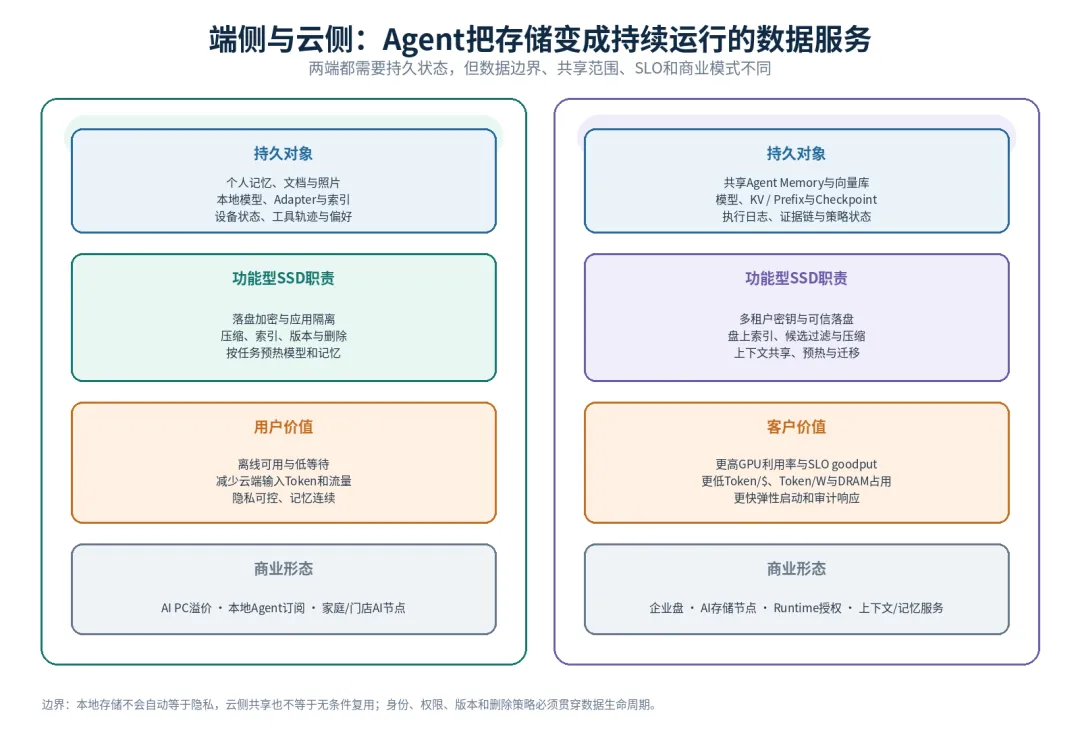
Figure 2 shows the typical division between the end-side and the cloud-side of Agent storage. The end-side emphasizes personal data, local models, offline capabilities, and privacy control; the cloud side emphasizes context-sharing, multi-tenant governance, GPU utilization, and token economics.
The value boundaries of HBM, HBF, DRAM and SSD will be redistributedThe storage reconfiguration brought about by the agent should not be understood as replacing SSD memory. SK hynix's Tiered Memory idea in FMS 2026 is to connect HBM, DRAM, NAND/HBF to SSDs at speed, capacity and cost, with a focus on reducing data mobility[11]. This corresponds to the reality of the agent system: the data that must be used by the current token, the data that will be used in the next few milliseconds, the data that can be replicated across sessions, and the long-term archiving data that requires different mediums.
HBMs are still the closest to the core layer of GPU computing, carrying the current weight, activation, heat KV, and the intermediate state of the calculator, indicators being Token/s, bandwidth, and computational utilization. The agent adds context and multi-model collaboration overhead to further boost HBM demand rather than degrade its value. HBMs are constrained by capacity costs and supply, so the system needs to move data without immediate access to a lower cost layer and precise pre-use heat.
HBF, or High Bandwidth Flash, is a new layer that has been forming rapidly since 2025. The first open specification published by SK hynix and Sandisk in August 2026 covers a maximum of 512GB of capacity, with a bandwidth of about 0.4TB/s to 3.0TB/s in three levels, and uses a UCIe connection processor[12]. HBF uses NAND to obtain a larger capacity than HBM, with the goal of undertaking intensive large-scale inferencing work between HBM and SSD.
The H3 study gave a clearer breakdown: placing read-only data in HBF and keeping the rest in HBM to build a hybrid reasoning system with the dual advantage.[13] For Agent, HBF is better suited for model weights, MoE experts and read-dominated large workstations; frequently updated KVs, activation and running conditions are still better suited for HBMs or DRAMs.
DRAM and CXL are in the middle range of variable state and shared capacity. Host KVs, index hotspots, pre-buffer and Agent operating states require lower latency and frequent modification; CXL expansion, pooling and sharing can reduce memory islands and provide more flexible capacity for multiple hosts.[14] SK hynix also shows a mix of CXL pooled memory and DRAM-SSD in FMS 2026 for KV sharing, forecasting and pre-purposing, but these are specific demonstrations that need to be validated on more platforms.[11]
Functional SSDs take on larger, more durable, and more manageable cool objects: models, adapters, KV/Prefix, vector indexes, agent memory, logs, and checkpoints. Compared to HBF, SSDs are farther away from computing, but have standard formats, mature ecosystems, capacity, and cost advantages, and are better suited for node-level sharing. Future competition will not only revolve around medium bandwidth, but around who can deliver the right objects within the right time frame, and who is responsible for effective Token, retrieval throughput, and data governance.
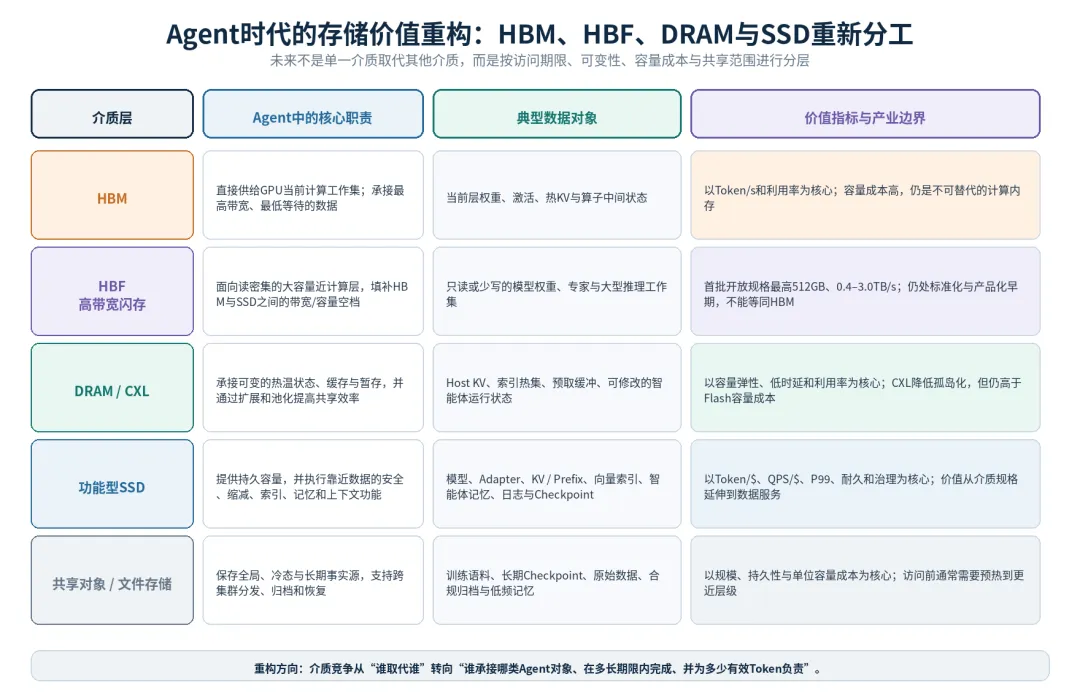
Figure 3 Agent-era HBMs, HBFs, DRAMs/CXLs, functional SSDs and redistributions of shared storage. The HBF specification uses the first open standard calibrations of SK hynix and Sandisk published in August 2026[12]; layered logic references FMS 2026 Tiered Memory, H3 and CXL data.[11][13][14]
AI SSDs are the first industrial samples of functional SSDs.Existing AI SSDs generally enter this trend from both ends. On the one hand, AI-loaded enterprise-grade SSDs provide a middle ground for model caching, checkpoint, and vector indexing through low latency, high IOPS, continuous bandwidth, durability, and capacity density. On the other hand, they address whether AI data can be steadily loaded, continuously written, and retrieved in a timely manner, as it does not automatically engage AI with Agent Memory, indexing, or subtexting. On the other hand, they begin to actively participate in logical data paths: SSDs no longer only receive general block requests from the system, but also represent the ability to process the middle-time, three-time run or storage side of the system, to operate step-by-step to identify the model Vache, and have the ability to send specialised CacheV, CacheV, CacheV, CacheV, and CacheV, and others.
AiDAPTIV takes the "mature SSD capability+intermediate+complete toolchain" approach. AiDAPTIVLink is responsible for managing the memory between GPUs and Flash, cutting the model weight while running, prioritizing the active weight in VRAM, unloading the non-active weight to aiDAPTIVCache SSDs, and saving the deleted KV Cache to avoid the removal of the context.[15] The commercial value of this route lies in supporting the synthesis of SSDs, software licenses, deployment tools, and system permissions: customers do not have to redesign the chip, they can expand the models available on workstations or local servers to the text capacity.
SPU+iSA is closer to a combination of "Storage Execution Layer+Software Decision Layer". SPU is responsible for lossless compression on the device side, HLC Advanced Caching and data mapping between different NAND mediums; iSA is responsible for decision-making around MoE expert unloading, KV Cache lifecycle and Device Smart Prefetch, converting AI load characteristics into pre-loading, refilling, compression and cold heat migration.[16] Therefore, it focuses not only on putting more data into SSDs, but also on reducing AMDRs, improving efficient capacity, and matching storage side processing with terminal side reasoning rhythms.
Synchronization takes the routes of computing and storage co-definitions. Synchronization starts from model structures, runtime, operating systems, CPU/GPU/DRAM synchronization and integrated reference design, observing expert activation, KV lifecycle, data accuracy, and computing windows; synchronization maps these needs to SSD controllers, solids, cache segments, queues, NAND adapters, and mass production systems.[17][18] This allows product definitions to be derived from token delays, model capacities, and integrated SLO counter data, when to enter the SSD, how to store at what particle, and which operations are suited to immerse themselves near the controller, rather than just in the I/O framework. In comparison to the previous two routes, this collaboration requires deep computing systems for cross-infrastructure storage, and offers new opportunities to develop and evolve new data models.
The three routes are not mutually exclusive. The advantages of clustering are that the capabilities are quickly packaged into deployable software with mature controllers, SSD products and software tool chains; Jiang Bolong tries to put more processing and scheduling on the storage side with SPU and iSA; spectroscopic connectivity reverses the interface between computational semantics and storage execution to defining devices. Together, they explain that the core innovation of AI SSDs has shifted from "switching a faster disk for AI" to "redistribute between Runtime, memory levels, controllers and Flash". This is also the reason why SSDs can become functional SSD precursors: once software is able to express object types, priorities, life cycles, and service periods to devices, SSDs have a more definitive capability base.
Similar R&D ideas are entirely possible to migrate to the next generation of functional SSDs. Along the cluster routes, manufacturers can add encryption, compression, indexing and memory service modules to the SSD and the intermediate package managed by the Agent or the tenant to reduce the deployment thresholds with software compatibility and delivery tools; along the Jiangbo Long Routes, compression, cold-heat mapping, indexing, or data sorting can be executed by storage at the same time as processing units, and then by upper-level intelligent mapping routes; along the spectrum mapping routes, the need for long-term memory, permissions, TTL, search SLO and Token costs when running the Agent can be eliminated, and then controller commands, combined elements, solid-state arrays and deployments can be co-defined.
In the future, many storage functionalities will not be purely on-board algorithms: encryption needs to understand the limits of user and task permissions, compression needs to know when data is to be computed again, indexing needs to collaborate with Embedding, Retriever and Model Router, and Agent Memory also involves writing, embedding, forgetting, versioning, and proof chains. If only from the middle end, the problem can be easily shortened to bandwidth, capacity, or a single algorithm; if only from the end of the model, it can be ignored to write FTL, enlarge, delay output, disable power protection, and volume constraints.
From a functional SSD perspective, the importance of these schemes lies not only in whether a model can be extended, but also in the way that they establish a channel for software and media exchange information. Today, the model layer, experts, KV blocks and pre-emptive tips are delivered; in the future, they can be extended to Agent identity, memory objects, versions, TTLs, access strategies, indexing tips and deadlines. Those who can make the function a stable interface, rather than customizing a one-time path for a single model, are more likely to cross the model and expand single-disc revenues to runtime authorization, storage nodes, context services and data services that are valid for a token fee.
Automatic compression does not mean that all data can save the same capacity, disk indexing does not mean that SSDs understand the meaning, and agent memory does not mean that vector libraries are moved into solids. Each function should be proven by end-to-end indicators, including compression ratio with additional time delays, callback rates with QPS/、P99 and SLO, write magnification and durability, key isolation and deletion verification, and ultimately Token/ and Token/W.
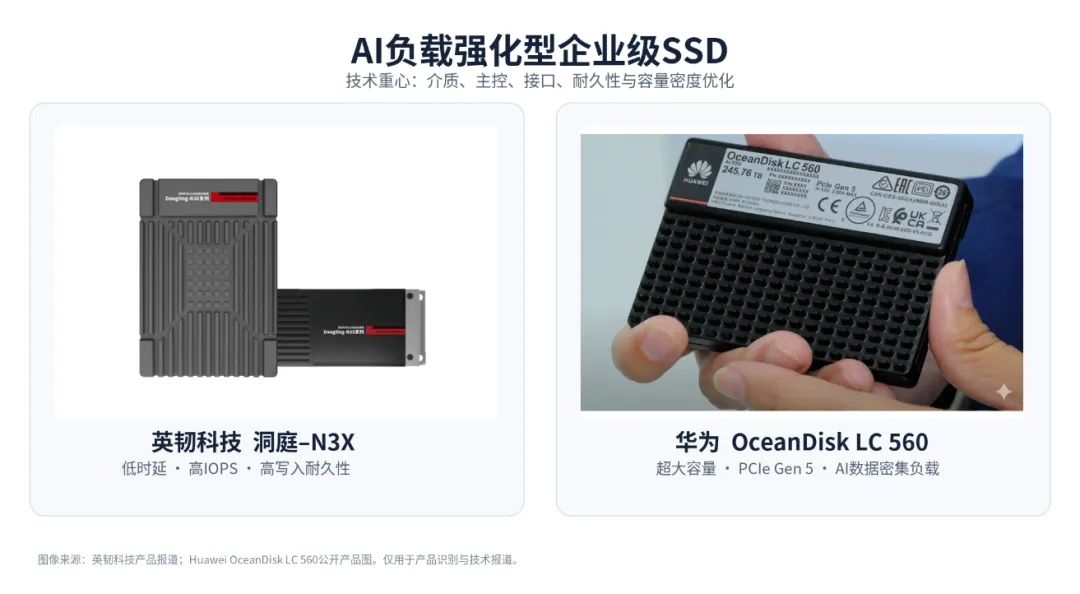
Figure 4 Representative products of an AI-loaded enterprise-grade SSD: Acre Tech Hole Garden N3X and Huawei OceanDisk LC 560.
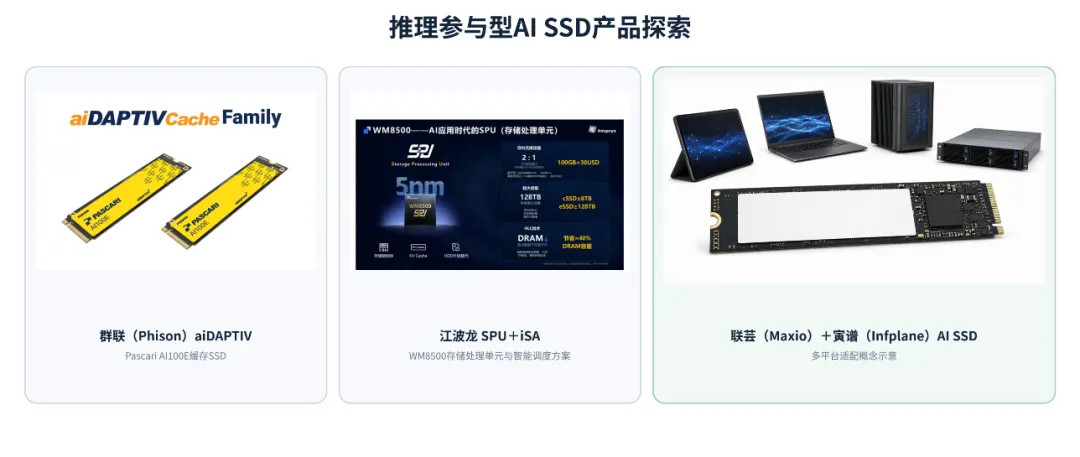
Figure 5 Reasoning for participatory AI SSD exploration: cluster-connected aiDAPTIV 江波龙SPU+iSA, and spectroscopy-connected AI SSD schemes. Along with the original layout and route information see[15][16][17][18]
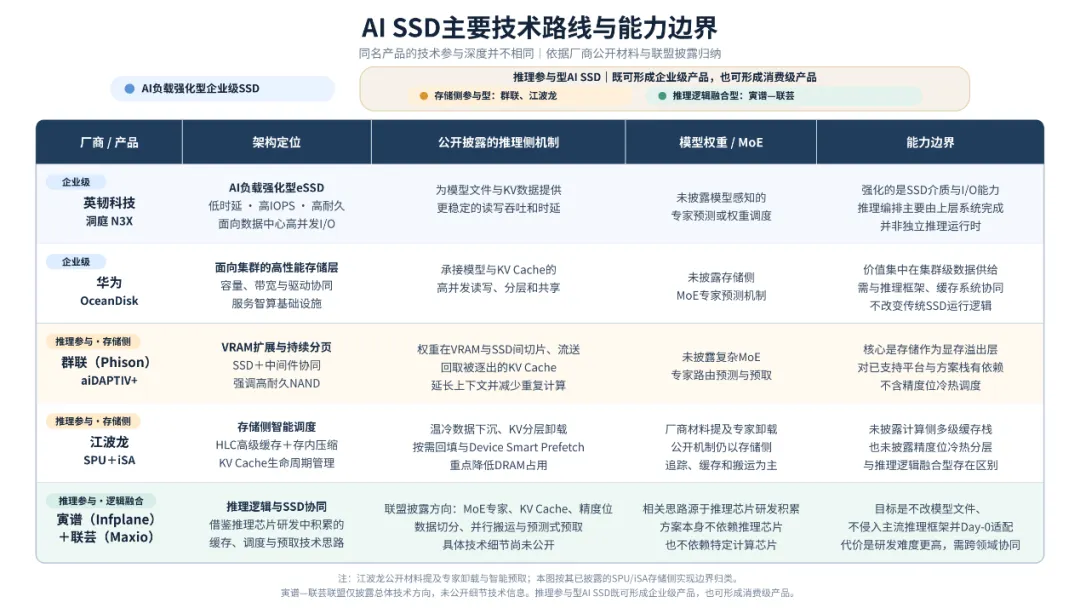
Figure 6 The role of AI SSDs in LLM reasoning pathways, as well as the main manufacturer's technical routes for drafting manuscripts. The newly added encryption, compression, indexing, Agent Memory, HBF and layered storage viewpoints in this article extend the industry on this basis without changing the logic of the diagram.
The future of the industry could move in three directions simultaneouslyThe first direction is the functionalization of SSDs. The SSDs continue to exist, but capabilities such as security, compression, retrieval, memory and context will be configured into products with consolidation capabilities, downloadable programs or software definitions. The final market does not necessarily need five different SSDs, but rather a set of detectable, compactable, and detachable functionality frameworks, with different capabilities for consumer, enterprise and cloud service products to choose from.
The second direction is the nodulation of storage. Single disk addresses native capacity and close-to-data processing, while AI storage nodes combine multiple disks, networks, object directories, keys, indexes, contextual services and observability, and are responsible for end-to-end SLO. End-to-end node service personnel and device arrays, cloud node service GPU clusters, and multi-agent systems. Competitors will expand from "per disk" to "how many valid tokens and retrieval requests each station, shelf, or POD can deliver".
The third direction is the recombination of memory levels. HBM continues to pursue the highest bandwidth, HBF tries to provide greater read density capacity near the packaging with NAND, DRAM and CXL for variable states, expansion and polarization, functional SSDs for durable objects and near data services, shared storage for global cold storage. The most valuable system capability in the future is to allow Router and Runtime to simultaneously see the location, authorization, duration, and median state of computational data, and to collaborate between multiple levels rather than continuously stacking a single median.
This will redistribute industry barriers. Medium manufacturers will master capacity, bandwidth and energy efficiency, controllers and hardware manufacturers will determine if functionality is stable, runtime and agent platforms will master object semantics and scheduling, OEMs, cloud manufacturers and system integrators will determine how functionality enters real products. Companies that can cross these boundaries, build standard interfaces and demonstrate customer outcomes with token economics will have more opportunities to move SSDs from data containers to the base data layer of the agent era.
Summary: Storage will become part of Agent's capabilitiesAI Agent extends the value of storage from "preserving the past" to "supporting the next action". Models require weight, context-based reasoning, long-term memory and credible evidence, and enterprises need security, compliance, auditing and cost control, encryption, compression, indexing, memory maintenance, and context-based services. The closer data is to data, the more opportunities are available to reduce transportation, recalculation, and DRAM occupancy, but the more clear limits, semantics, and responsibilities are needed.
Thus, AI SSDs are just the beginning. In the future, there may be more SSDs with specific functionalities, as well as unified programmable functional SSDs and Agent storage nodes. At the same time, HBM, HBF, DRAM, CXL and SSDs will not evolve in a simple alternative chain, but will be redistributed around heat, variability, sharing range and access duration. The real industry opportunity is to transform the advantages of each medium into lower Token costs, higher Agent continuity and more reliable data lifecycles.
NVIDIA, Introducing NVIDIA BlueField-4-Powered CMX Context Memory Storage Platform for the Next Frontier of AI, 2026. R. Qin et al., Mooncake: Trading More Storage for Less Computation A KVCache-centric Architecture for Serving LLM Chatbot, USENIX FAST, 2025. SNIA, Computational Storage Architecture and Programm SNIA, "Storage Security: Encryption and Key Management", 2023. NVM Express, "NVM Express Releases Specifications to Unify AI, Cloud, Client and Enterprise Storage", 2024. Samsung Electronics, "Samsung Electronics Develops Second-Generation Smart SSD Computational Storage Drive", 2022. KIOXIA, "AiSAQ Achieves 4.8 Billion High-Dimensional Vector Search Database on a Single Server, 2026. Y" Wang et al., "Are We Ready for an Agent-Native Memory System?", arXiv:2606.24775, 2026. P. Chhikara et al., "Mem0: Building Production-Ready AI Agents with Scalable Long-Term Memory", arXiv:2504.19413, 2025. SK hynix, "The Next-Generation Memory Architecture in the AI Era? SK hynix Charts the Direction at FMS 2026, 2026. SK hynix, "SK hynix Unveils First HBF Standard Specifications with Sandisk, 2026. Im, and H. Kim, "H3: Hybrid Architecture Using High Bandwidth Memory and High Bandwidth Flash for Cost-Efficient LLM Inference", IEEE Computer Architecture Letters, 2026. Compute Express Link Consortium, "Overcoming the AI Memory Wall: How CXL Memory Pooling Powers Scalable AI Computing, 2025. Phison Electronics, "How aiDAPTIV+ Works", official product documentation. In addition to this, there is a growing interest in the development of new technologies in the field of entertainment technology, "CFMS 2026 in the era of AI reasoning, the leap in the value of mainframe storage chips" in 2026. Economic Observation Network, "Infplane Mini AI Workstation: Hilbert" in 2025 by AMD.