
It's the first time in the history of the world.
When the big model comes to grips with conversations, reasoning, programming, and tool calling, it's going to make a difference.Autonomous research is considered "The Next Big Thing" in the field of AI.
Autonomous research means that the development of AI will no longer be confined to the boundaries of human knowledge, forming a whole new scaling law aimed at intelligent production. "How much energy is spent, how much intelligence will be converted".
Normal questions only need to locate one fact, while autonomous research faces a set of interrelated, mutually constrained conditions. Intelligent entities need not only to locate candidate answers from a vast information space, but also to integrate scattered or even conflicting evidence, and confirm that the final answer meets all the key constraints as long as there is an unverified answer. The core problem of autonomous research is not "not searching long enough or finding evidence difficult", but:
It is not possible for an intelligent organism to know what the current answer is, what is missing, and what should be studied next.It's about how to keep an intelligent body close to the right answer in complex constraints.
The AREX, published by the Institute of Intelligent Design, is the one that addresses this core issue.It captured the key breakthrough in autonomous research: "discovering asymmetry by verifying asymmetry": complete answers are often difficult to generate one-time, but once a candidate solution is formed, it is possible to quickly locate insufficient and guide subsequent explorations through one-by-one verification of critical constraints.
Verification is not just about determining whether the answer is correct, but more importantly, it helps the intelligent to understand "what we already know, what we still lack, and what we should study next", so that each round of research is more accurate and more directed.
The foresight of this idea is confirmed by the recently founded Discovery Loop by Jeff Dean: the future of AI requires not only stronger reasoning, but the ability to form self-discovery through ongoing experimentation, feedback, and modification.
AREX's exploration of the dual cycle of "solution-of-the-cycle verification" reflects the forward-thinking nature of the AI research team in the direction of autonomous research, and reflects an important trend in the development of AI that is promoting continued evolution of intelligence through closed-loop transformation.
The main page of the project:
Model weight:
I'm going to try it again.
AREX is designed to train for long-term operation.Self-tested, continuously modified research-based AIAREX's goal is not to get the model to write a "seemingly more complete" answer in a single round of replies, but to train an autonomous research body that can run for a long time, continuously verify, and iteratively modify, not to give a one-time answer, but to keep approaching a complete solution in a cycle of "research→verification→re-research", so that the model truly has the ability to continuously improve its current solution.
In the face of complex tasks, an intelligent organism can first give a phased answer; it then checks whether the constraints are met, retains evidence that has been verified, positions claims that have not been solved, and initiates more targeted follow-up research. When new evidence arrives, the intelligent organism updates the answer again, revalidates it, and decides whether to continue deeper, or ends the study and draws final conclusions.
This process can be traced back to the execution of multiple rounds: research→ temporary answers→ incremental verification→ positioning gaps→ directed research→ updated answers. Here, "self-improvement" does not mean that the model updates the parameters online during the execution of the task, but that the intelligent body makes continuous modifications to its own research status and current answers.
It is no longer just a tool for "searching for answers", but rather a research assistant that repeatedly checks research progress, corrects research pathways, and accumulates valid evidence. AREX opens the loop between "finding answers" and "improving answers" through a two-cycle framework.The overall approach to AREX can be summarized as:A two-cycle recursive solution framework.The inner circle is responsible for "research" and the outer circle is responsible for "improvement".
The collaboration between the two allows the intelligent body not only to search forward, but to inherit progress in each round, correct the wrong direction, and keep getting closer to more reliable answers.
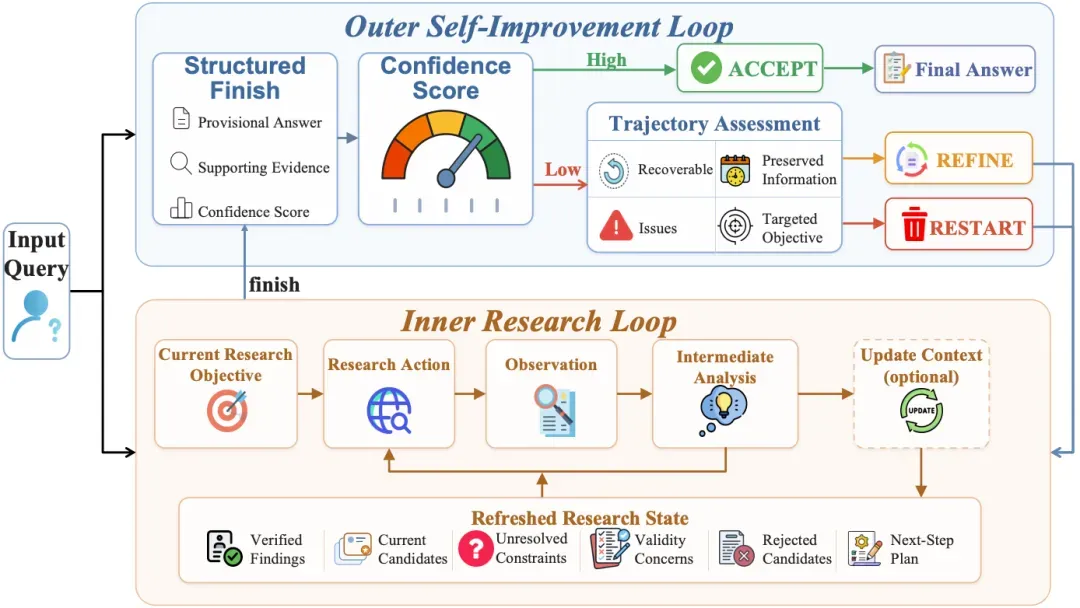
Inner Circle Research Loop: Inner Circle is responsible for completing a relatively complete round of research.At this stage, the S.I.P. searches for information, calls for tools, collects evidence, compares candidates, and builds a provisional answer around current research problems. Its goal is not to have a one-time final solution, but to form a complete structure, traceable evidence, and subsequently auditable present solution.
If this is the first round of research, intelligent perception faces the original problem posed by the user. If it has already been verified externally, it faces a new problem that has been redefined, more focused. For example: to compensate for a lack of evidence, eliminate contradictions between the two sources, or replace a candidate answer that does not satisfy all the conditions.This means that each round of research is not a simple repetition, but a continuation on a clearer issue.
External Self-Improvement Loop: External Loop is responsible for determining exactly where the current answer has gone.AREX will conduct a case-by-case audit of the provisional responses based on the constraints in the mission and form a constraint-level judgment of confidence: which conditions have been fully supported, which are still uncertain, which key claims lack evidence, and which conclusions need to be re-examined.
If all the necessary conditions are sufficiently supported, the intelligent organism ends the study and produces the answer. If the conditions are still unresolved, the verification results are transformed into the research goal of the next round of the inner circle. Therefore, the outer circle is not simply saying, "The answer is not good enough, try again".What has already been solved and what needs to be solved next. This allows each iteration to inherit the results that have already been achieved, rather than starting from scratch.
Mechanism analysis:Improved performance in maintaining long-term research statusAREX's reasoning mechanism consists of two cycles: the internal research cycle is responsible for searching, accessing web pages, verifying evidence, updating context and generating temporary answers; the external self-improvement cycle is based on answers, evidence and confidence, deciding to accept, continue refining or restart.
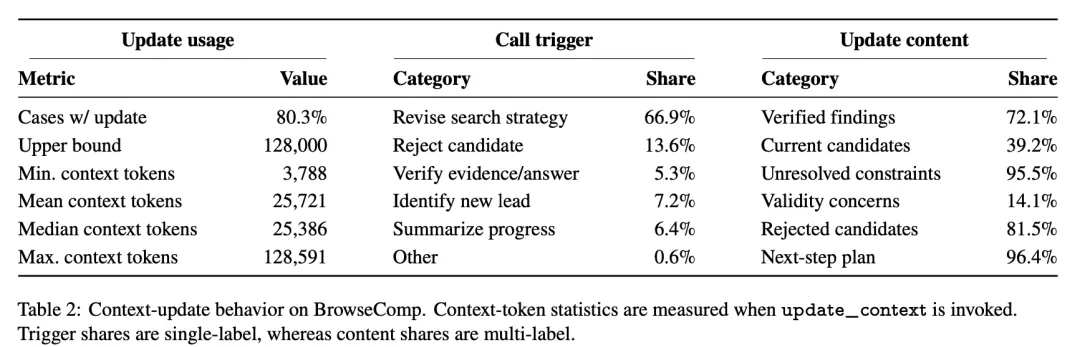
Among them,It's important to keep the ACU up to date.It is not a general summary, but rather a state of study for the next action: retaining verified findings, excluding candidates, unresolved constraints, and the next action plan. Analysis on the browser comp shows that AREX typically actively updates the context, rather than passive compression until the context window at 128K is filled.
Controlled experiments have shown thatThe complete AREX system reached 82.5 on the BrowserComp, 22.9 percentage points higher than the version that switched off the ACU and the outer loop.Training meltdown also suggests that progressive multi-cycle capability training, key steps focused on supervision and step-perception reinforcement learning contribute to tool interaction, key decision-making and long-term strategy optimization respectively.
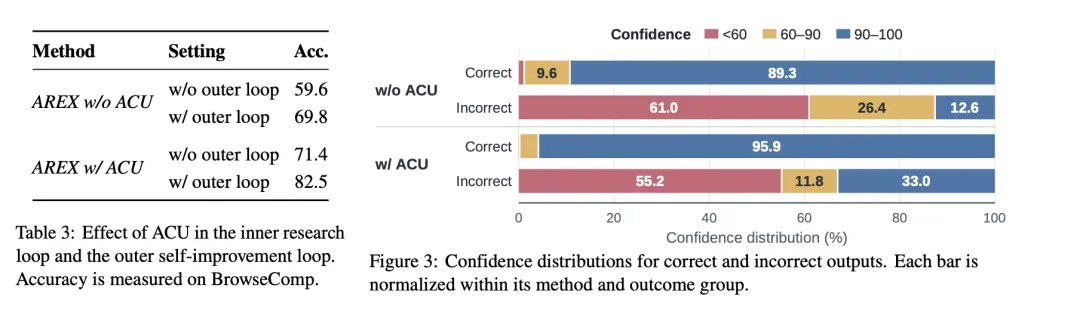
Moreover, the improvement of AREX comes from a combination of several factors. Gradual multi-cycle capability training first establishes stable tool interaction capabilities, key steps focus on monitoring the concentration of training signals on evidence detection, path negation and redirection, and key context updates, while step perception reinforcement learning continues to optimize long-term decision-making strategies.
This also explains the core idea of AREX: what's really hard about long-term research is not routine searches and access to web pages, it's what's really hard about long-term research.It's important to make the right decision at a critical moment.When to believe an evidence, when to abandon a candidate, when to rearrange the context and change the direction of the search, these are the steps that determine the study of success.
AREX allows the autonomous study of intelligent agentsContinuous self-evolution in long-range missionsLong-term studies are not "memories": they translate "historical envelopes" into "pathmarks of progress".The core challenge in long-term research is not just whether information retrieval is adequate, but whether the model can keep track of current progress steadily over the course of ongoing research. As the interaction trajectory continues to grow, the historical record will contain both verified evidence, overturned hypotheses, abandoned plans, and a large amount of repetitive information. Retaining this content makes it easy for the model to lose direction, while simple interruptions may lose key clues.
AREX's approach is to allow the model to actively call on context updates during the research process to organize the ever-growing history of interaction into a research state that can be continued. This update is not a general summary, but a "research progress chart" that helps the model clarify: where is the current research? what has been established? what has been excluded? what should be checked next? In this way, the model can continue to inherit effective information, compress redundant content, and form more robust optimizations at the current stage.
Constructing verifiable training data: from identifying answers to generating verifiable research trajectories.Self-improvement is not built up by extending the search trajectory. AREX needs data that really teaches how to find clues, cross-validate, overturn wrong candidates, adjust directions and move forward.
AREX is designed for this purpose.A verifiable set of autonomous research task generation methods:Starting from a definite physical answer, a set of constraints must be constructed around it that are supported by real evidence, and then translate these constraints into open questions that cannot be solved directly by keywords. Such a task forces the model to actually search, compare, and validate, rather than "find the answer" in a text statement.
Subsequently, the strong teacher model executes these tasks completely in the same tool environment, leaving the research trajectory of the entire process behind. However, if there are any direct guessing answers, ignoring observations, insufficient evidence or conclusions that contradict the evidence, the entire trajectory is eliminated.
Strengthening step-by-step training with key steps: enabling models to master coherent strategies for self-improvement.After obtaining high-quality training data, the training sequence is equally critical. AREX does not simplify all trajectories by mixing training, but adopts a phased strategy. The model first learns the basic capabilities of multi-cycle tool calls and evidence acquisition, then gradually progresses to long chain reasoning, candidate comparison and difficulty problem solving. At the same time, AREX also consolidates specialized capabilities such as paper research, high difficulty knowledge reasoning, to avoid interference between different tasks.
AREX will not treat every step of the long trajectory the same way. The real determinants of whether research achieves breakthroughs are often a few key tipping points, such as finding critical evidence, rejecting erroneous candidates, switching search directions, and updating research status. These key steps will be focused on in training and continue to optimize model research strategies during the reinforcement learning phase.
Therefore, AREX's ability to self-improvement is not a natural result of "searching multiple rounds".Instead, it is shaped by verifiable mission design, high-quality trajectory screening, step-by-step training and key step reinforcement.Its goal is to bring the intelligent body closer to the real researcher: to be able to judge when to hold on to the current direction, when to fall back in time, when to stop and confirm the answer.
Experimental evaluation:AREX at the forefront of autonomous research with 10B activation parametersIn order to verify whether AREX has genuine independent research capabilities, the Intelligent Research Institute evaluated them on six benchmarks, including: BrowseComp, DeepSearchQA, WideSearch-en, GAIA, xbench-2510 and HLE with tools. They cover information depth, information width, depth-to-width combinations, and end-to-end Agent capabilities respectively.
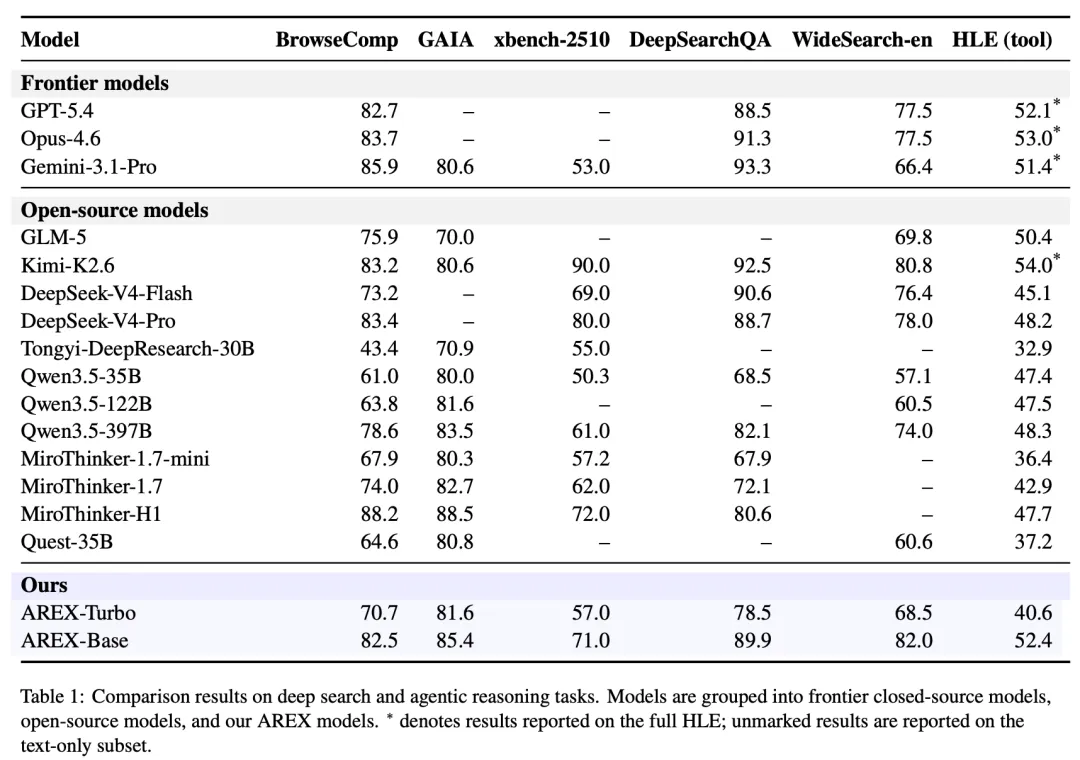
The task design of BrowseComp and xbench-2510 is demanding: the problem is often embedded in multiple interdependent conditions, with the correct answer hidden in scattered web pages and indirect evidence, and the model needs to be dig deeply along the clue. AREX-Base on BrowseComp reaches 82.5, close to GPT-5.4, Kimi-K2.6, DeepSeek-V4-Pro and Claude Opus-4.6, while exceeding GLM-5 and Qwen3.5-397B.
On xbench-2510, it is closer to the MiroThinker-H1 and better than Qwen 3.5-397B and DeepSeek-V4-Flash. The results show that the AREX capability improvement comes not from more rounds of search stacks, but from more stable study status maintenance.The model is able to retain verified information, exclude erroneous candidates, and continue to move around unresolved constraints.
Information breadth: comprehensive coverage in a large information spaceWideSearch-en explores another capability: to find target entries as fully as possible in large-scale search space, and to complete re-evaluation, verification, and synthesis. AREX-Base achieved 82.0 Item-F1 on this benchmark, the highest result in the dissertation comparison range, surpassing models such as Kimi-K2.6, DeepSeek-V4-Pro, and GPT-5.4. The results show that AREX is not only good at "digging a deeper answer, but also at managing large-scale search tasks".Continuous maintenance of coverage and remaining gaps during long-range retrieval.
Combining depth and breadth: Movable research methodologyDeepSearchQA also requires multi-step retrieval, evidence reasoning and answer completeness, a comprehensive test of depth and breadth. AREX-Base here achieved 89.9 F1, overtaking GPT-5.4 with DeepSeek-V4-Pro and Qwen 3.5-397B, and approaching Claude Opus-4.6, Kimi-K2.6 and Gemini-3.1-Pro.It's about finding, comparing, verifying, correcting, aggregating.
End-to-end capabilities: from search to complete research processGAIA and HLE with tools further required the model to combine search with planning, reasoning, and tool calling. AREX-Base scored 85.4, 71.0 and 52.4 on three tests, respectively. On GAIA, it outperformed Kimi-K2.6, Gemini-3.1-Pro and Qwen3.5-397B; on HLE text subset evaluation, it outperformed GLM-5, DeepSeek-V4-Pro, Qwen3.5-397B and MiroThinker-H1.AREX's ability to migrate from search tasks to a complete workflow of smart objects:Models can not only find information, but also plan actions, call tools, verify intermediate conclusions, and organize final answers.
Overall performance contrast: open-source front-end, closed-source flagship and equivalent modelIn comparison to the open-source front-end model,AREX-Base led all of the reported BrowserComp, GAIA, WideSearch-en and HLE text subset. Compared to DeepSeek-V4-Pro, AREX-Base is higher in the DeepSearchQA, WideSearch-en and HLE text subset.
Compared to Kimi-K2.6, AREX-Base leads on GAIA and WideSearch-en, close to BrowserComp, but with a gap on xbench-2510 and DeepSearchQA.A balanced comprehensive competitiveness between deep-search, broad-search, end-to-end intelligence and tool logic has been achieved.
In comparison to the closed-source flagship model,In the face of closed source flags such as GPT-5.4, Claude Opus-4.6 and Gemini-3.1-Pro, AREX-Base also enters the competitive spectrum with a number of high-difficulty benchmarks. It almost parallels GPT-5.4 on the BrowserComp, overtakes GPT-5.4 on the DeepSearchQA, and overtakes GPT-5.4 on the WideSearch-en, Claude Opus-4.6 and Gemini-3.1-Pro. This indicates that AREX is already able to compete with the closed source flagship model in key autonomous research tasks, particularly in large-scale information coverage tasks.
In comparison to the same quantitative base model as the Intelligent Body model,The total parameters of the AREX-Base are 122B, with only 10B parameters activated per reasoning. Compared to the Qwen 3.5-122B of the same total parameters, the AREX-Base improves completely on the indicators reported by both parties; compared to the larger Qwen 3.5-397B, the AREX-Base takes the lead on all six comprehensive parameters.
AREX-Turbo has only 4B parameters, but exceeds Qwen 3.5-35B, Quest-35B and Tongyi-DeepResearch-30B in many indicators; AREX-Base exceeds MiroThinker-H1 in the DeepSearchQA and HLE text subset, and is close to it on xbench-2510. This indicates that the ability to do independent research is not only due to the expansion of parameters, but also due to specialized training in long-range research processes.
The AREX research platform:Encapsulating autonomous research capacity into everyday research toolsAREX LLMs address how smart bodies conduct long-term, reliable, independent research, and AREX Research Platform, on the basis of this, encapsulates this capability as a daily research tool for research and industrial users.
Academic and industrial communities produce a large number of new information papers, technical reports, conference talks, open source releases and industry analysis on a daily basis. The current information distribution mechanisms are more organized based on the time or intensity of publication as a ranking dimension, rather than on the specific research concerns of users. High-value information is presented in fragments, often requiring users to self-spell backgrounds between multiple sources, with high cost and low efficiency in obtaining information.
AREX is a model-driven content access and research intelligence platform that provides independent input to three different types of information: information continually tracks daily dynamics in a given area, papers filter out high-concentration research work and support deep understanding, and podcasts extract key insights and industry trends from long-term interviews.All three are powered by AREX smartphones, supporting both wide-area browsing and custom configuration for segmentation.

AREX homepage ((Final Effects Overline Version is updated)
Customized information services:In terms of information organization, the AREX platform supports users to specify directions of focus (such as Coding Agent, progress in the chip industry, etc.) and thus generate a continuously running proprietary information intelligence to be retrieved, filtered and aggregated at a set frequency.
Compared to traditional "source subscriptions", this mechanism uses "user focus" as a filtering dimension, shifting the flow of information from "heat-ordered" to "relevantly organized", thus reducing unrelated information interference and improving the targeting of information acquisition.

Customized AREX news
The expansion of freedom:In addition, the AREX platform provides a direct link between information discovery and autonomous research. An autonomous research input is provided alongside each newsletter, paper or podcast.
Smart entities have perceived the current reading content and the context, without the need to repeatedly swap the context, so that they can address specific questions such as "is there a follow-up discussion in this direction?" "is the benchmark selected authoritative?" "is there a relevant viewpoint in other interviews?" and start searching, contrasting, analyzing and aggregating, producing complete knowledge connections.
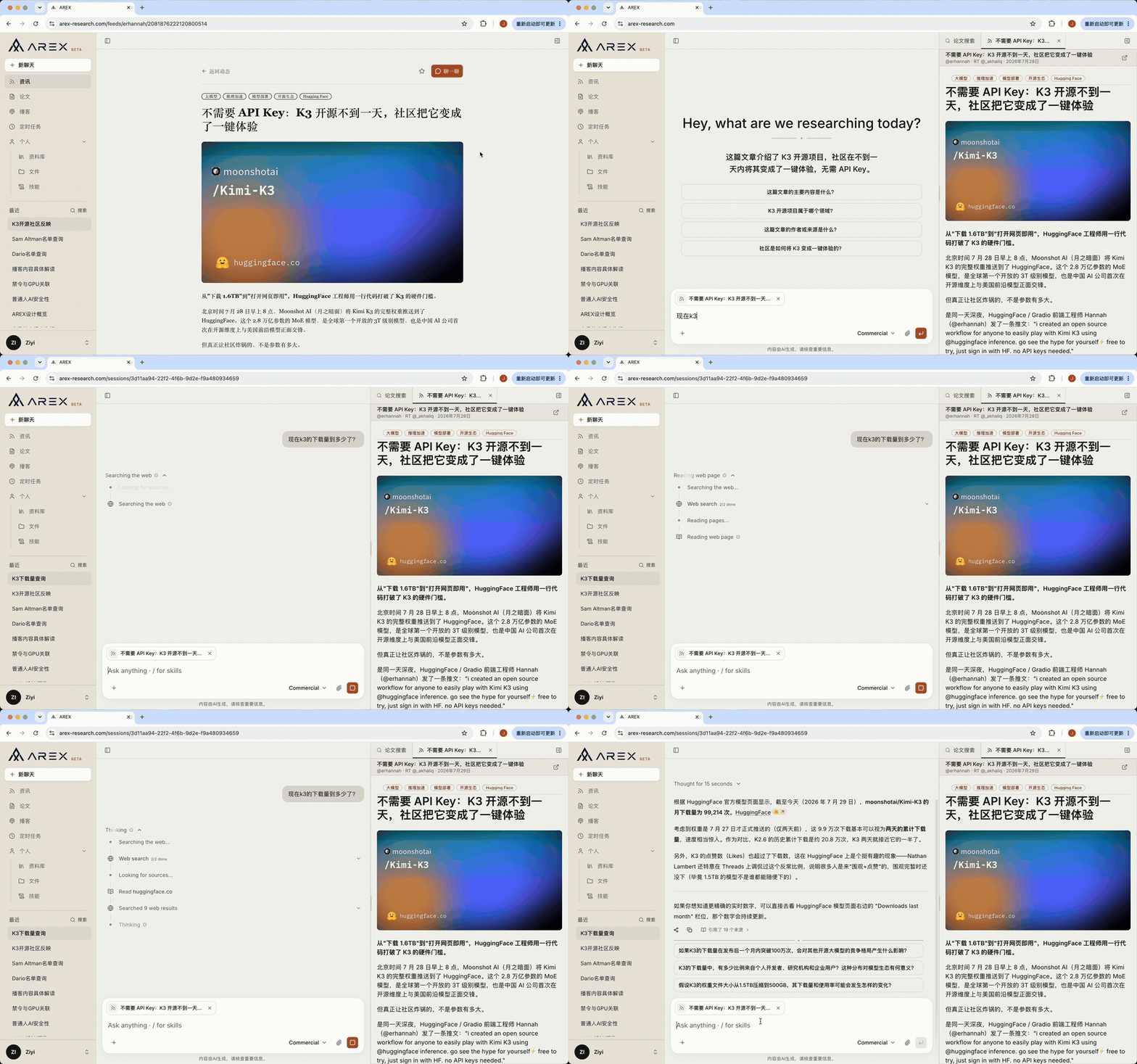
Talk about it.
The platform takes on the content of the discovery that intelligent entities take on the understanding and analysis, which are linked together in a unified context. This design is at the heart of what differentiates AREX from purely informational tools.
The current version of the AREX Research Platform covers two stages of "information acquisition" and "cognitive construction" in the research workflow, which helps users discover relevant information and understand their research context.Further development of supporting programmes through the provision of reference information.
The focus is on end-to-end autonomous research, which includes the following three links: program design, experimental design, and contrasting strategies after understanding the problem with existing methods; engineering implementation of AI to directly generate operational code frameworks; training configuration; evaluation scripts; and access to computational resource execution; performance optimization of AI analysis results; identification of bottlenecks; automated iteration of iteration; adjustment of structure; continuous optimization of iteration.
The ultimate achievement: user-defined research problems, explored, experimented and optimized by AREX itself, and delivered verifiable results.
AREX is currently open for beta testing and you are welcome to experience and get feedback:arex-research.com