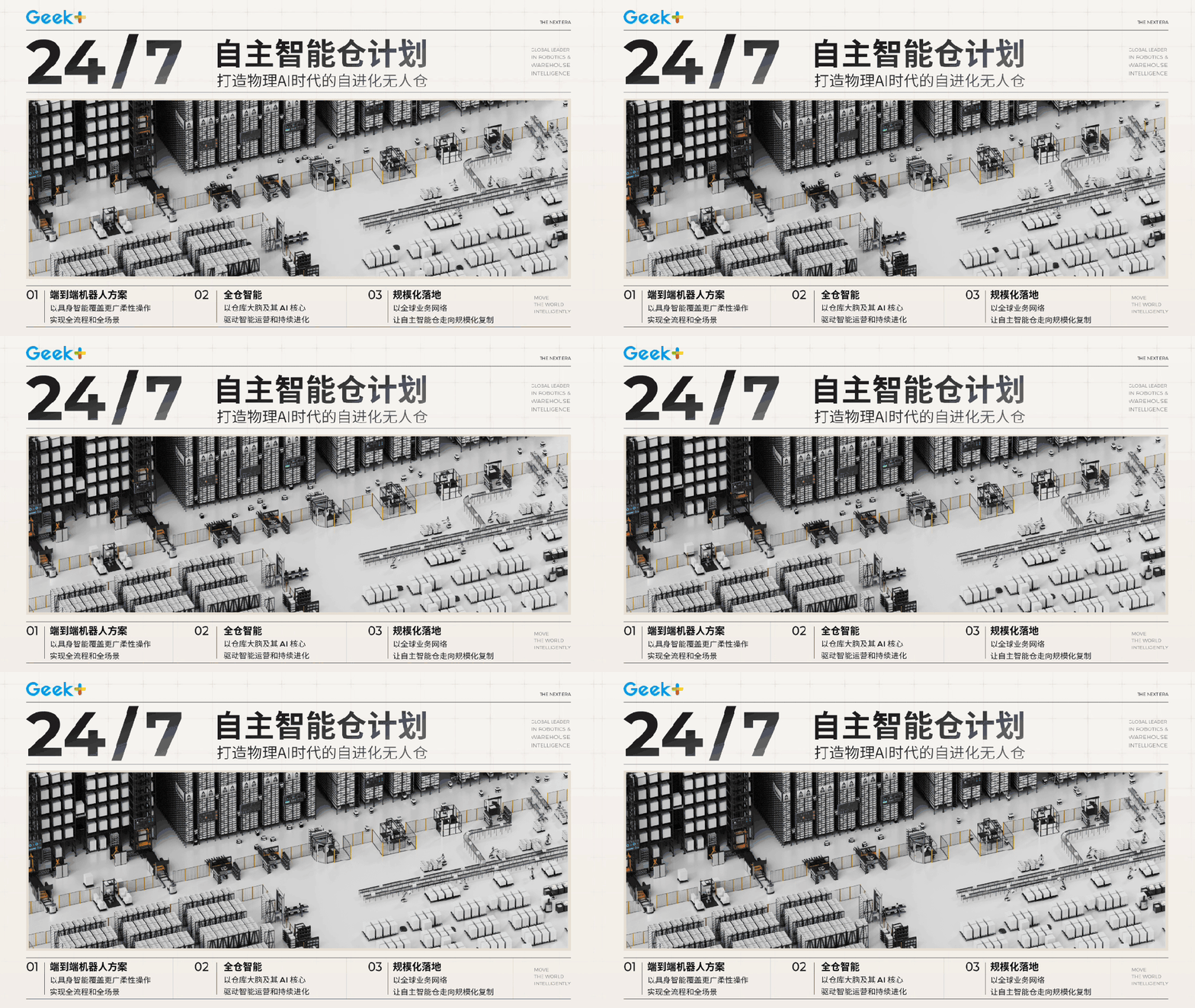
 24/7 autonomous smart warehouses, breaking traditional warehouses' reliance on manned shift and on-site vigilance. Whether at night, on weekends or at peak orders, warehouses can continue to respond to business demands, not only improving order fulfillment efficiency, supply chain response speeds and operational resilience, but also alleviating the pressures of night shift workers and on-site management, fully unleashing the capacity potential of warehouse facilities and robotic systems, driving the boost in overall warehouse productivity.
Achieving 7×24-hour unmanned autonomous operation poses a higher level of technical challenge to warehouse intelligence. Faced with complex and varied real warehouse environments, a large number of long-tail scenarios and unknown anomalies, widespread scenarios for body-intelligent models, multi-mode perception, physical world modeling, and long-range task planning capabilities, it poses higher demands.
The dynamic combination of large-scale clusters of robots, automation equipment, and business processes tests the real-time decision-making, adaptive scheduling, and overall optimization operational capabilities of software systems. The deeper challenge is how to improve the robustness, fault tolerance, and self-recovery of entire robot warehouses in the face of uncertainty and sudden failures, and to allow systems to evolve over the long term through continuous learning and cross-scenario knowledge migration. Only by overcoming these technical challenges can we truly transform full-time operations into stable, reliable, and cost-effective productivity.
2. IntegrationWhole warehouse intelligenceofWarehouse brain software platform
3. Verified on the global marketScale delivery and localized operating system
End-to-end robotic solutions
Expand the boundaries of physical execution with physical intelligence
In order for a warehouse to truly move towards autonomous intelligence, it first needs robots to cover a sufficiently complete chain of physical operations.
Over the past decade, AMR has enabled a large number of structured tasks in warehouses to be efficiently automated. But real warehouses are far more complex than standard processes: SKUs are constantly changing, commodity formats vary, business needs are constantly adjusting, and a large number of flexible operations and abnormal processing still depend on man-made materials.
With the development of physical AI, this frontier is being reopened.
Based on self-developed Gravity integrated intelligent frameworks and Gravity 4D embedded world models that combine multi-modal perception, long-range mission reasoning, 4D physical world modeling and action planning, robots can not only understand complex tasks, but also predict the spatial position and motion of objects, generate more reliable operational movements, and improve their autonomous execution capabilities under complex physical tasks and abnormal scenarios.
At present, it has one of the industry's most comprehensive end-to-end robotic storage solutions, capable of meeting the needs of different storage processes and a wide range of operating scenarios.The combination of all types of AMR schemes, comprehensive coverage of containers, trays, shelves, and structured operations such as transportation and pick-up in warehouses of different types of storage, to achieve efficient order fulfillment. Intelligent, however, expands complex and flexible operation links, improves the ability to handle abnormalities and autonomous recovery, providing important support for autonomous operation in all weather conditions.
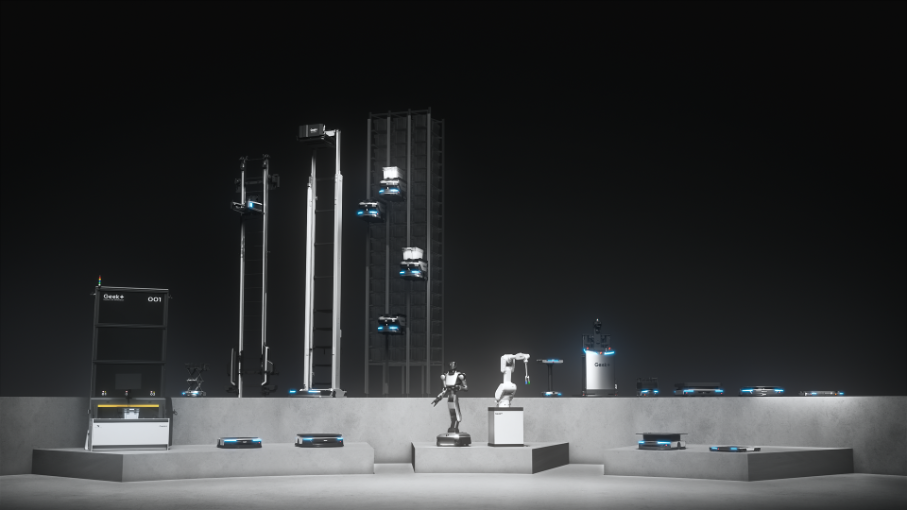
End-to-end robotics solutions not only expand the physical operating boundaries of robots in warehouses, but also provide warehouse brains with a wealth of real-world operational data and feedback, driving continuous synergy optimization of robotic execution and warehouse intelligence decision-making.
Whole warehouse intelligence: the core of the warehouse brain
Driving Intelligent Operations and Continuous Optimization
End-to-end robotic solutions continue to expand the autonomous scope of warehouse operations, while AI-powered warehouse brains enable more efficient collaboration, intelligent decision-making and operational optimization across the entire robotic system.
Geek+ Warehouse Brain is a software platform.It consists of three core modules: RMS robot-managed scheduling systems, WES storage execution systems, and IOP intelligent operating platforms, which combine AI capabilities with the knowledge base of data to form a software base that supports stand-alone warehousing.
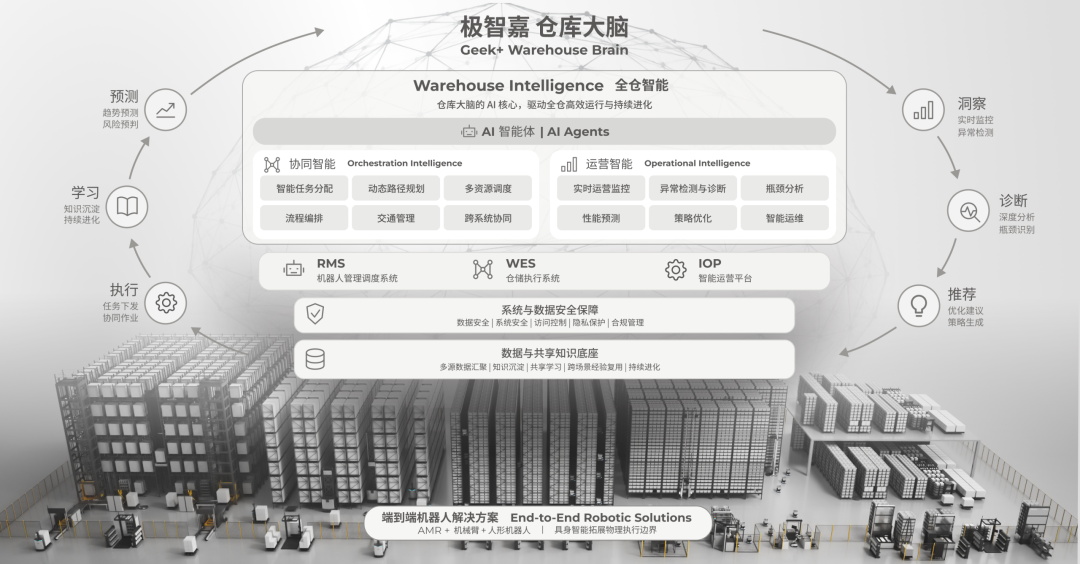
As the core of the warehouse brain, Geek+ Warehouse Intelligence continuously enhances the ability of AI to co-operate with AI and AI to operate smart devices.
Orchestration Intelligence (originally known as Orchestration Intelligence)
Based on collaborative scheduling algorithms based on RMS, WES and multi-robot, it achieves task allocation, path planning, traffic management, resource scheduling and operational process planning, and supports efficient collaboration between robots, devices and warehouse business processes. On this basis, it further enhances AI-driven dynamic decision-making, resource adjustment and process optimization capabilities to make the system more flexible in adapting to real-time business changes.
Operational Intelligence (OIA)
Real-time monitoring, efficiency analysis, anomaly detection, bottleneck diagnosis, performance prediction and strategy optimization, and continuous improvement of inventory operational efficiency through AI smart bodies. At the same time, gradual improvement of fault self-diagnosis and intelligent operation, combined with physical intelligence to complete fault repair, reduces the reliance of 7x24 operations on compliance with artificial values.
The continuing evolution of real operations drivenBased on the accumulated storage knowledge and operational experience of large-scale commercial deployments around the world, as well as the underpinnings of data and knowledge sharing, AI continues to immerse, share and replicate the operational experience of different robots, projects and scenarios, transforming it into ever-increasing AI capabilities.AI capability barriers that are difficult to replicate, based on real operational experience and industry knowledge.
The continuous enhancement of AI capabilities is also changing the way AI creates and delivers value.Smart subscription servicesIt helps customers continue to gain insight into their in-store operations, diagnose operational bottlenecks, and optimize operational strategies so that the robot system can continue to be efficient after deployment.
It is a 24/7 self-service smart warehouse program.
Launching the next generation of warehouse intelligence revolution
With end-to-end robotic solutions, warehouse brains, and AI-powered operational services,He believes that the key to the next generation of warehouse intelligent revolution is to achieve 7×24-hour unmanned autonomous operation and continue to evolve in real operations. For this reason, he introduced the 24/7 self-contained smart warehouse plan kit, establishing the strategic direction for the next stage.
Physical intelligence and full-stage intelligence are the two main lines of AI technology that support this goal.The autonomous operation and abnormal response capabilities of physically intelligent robots, the autonomous decision-making and optimization capabilities of entire warehouse intelligence enhancing software systems. Together, the two form one of the most comprehensive AI capability systems in the industry, jointly advancing autonomous intelligence from a single operational link to an entire warehouse.
On the basis of the project, Zhixia will focus on three directions:Opening up the entire process, strengthening the smart closure, allowing autonomous smart warehouses to scale up.
Complete the Flow
AI will continue to push for the application of physical AI in more tasks such as capturing, operating, and abnormal processing.With the intelligent addition of flexible operations and complex tasks in the entire warehouse process, a complete, continuous robotic process is gradually formed, covering the entire scene.
Strengthen the Intelligence Loop
Building on a warehouse-based brain, we will further strengthen the full loop from perception, analysis, decision-making, execution to feedback and learning to fully leverage the data flywheel.It's a great way to keep up-to-date with AI.Among them, the focus is on improving operational intelligence, enabling warehouse systems to move from finding problems, making recommendations, gradually moving towards autonomous decision-making, implementing optimization and continuous improvement, and improving the reliability of dehumanized operations in all climates.
Scale Autonomy is an autonomous smart warehouse.
Based on its global layout and local deep farming strategies, GE has established a well-established system for the commercialization and deployment of robots globally.Have a well-established local sales, channels, delivery and service network and continue to advance the localization of R&D, supply chain and manufacturing capabilities.
Based on this global business network, ZTE will continue to promote more economically viable autonomous smart warehouses for value deployment and scale replication, making them a new generation of warehouse operating models that will be widely adopted.
Making autonomous smart warehouses the infrastructure that supports modern life
Storage logistics, a combination of global manufacturing, commerce and consumption, is an important foundation for the efficient functioning of modern society.The long-term value of autonomous smart warehouses lies not only in improving overall warehouse productivity, reducing operational management costs all year round, but also in enabling robots to handle more repetitive, high-intensity and overnight operations, focusing more on complex problem-solving and operational optimization, creating safer working environments, enhancing resilience in business and supply chains, promoting more energy-efficient and sustainable business operations, and supporting better everyday lives through more reliable and continuous supply flows.
He said: "Over the past 11 years, Nokia has demonstrated that robotics technology can achieve large-scale commercial applications in the field of global warehouse logistics. At the next stage, we want to drive the entire warehouse to achieve 24/7 autonomous operation and continuous evolution.
Starting from warehousing, expanding the boundaries of machines and productivity
Warehousing is at the heart of AI's long-term efforts to scale up global applications and is an important technological and business base for the deep integration of robotics, AI and real operations.
In the future, AI will continue to advance autonomous smart warehouses and will gradually expand the real-world capabilities of robots, AI and systems into a broader field of physical operations.With real business needs driven by technological innovation to scale up the application to validate the value of technology, GE will start from warehousing and continue to expand the application boundaries of intelligent robots in the real world, creating a broader productivity value.