On November 2, at 10 a.m., in a convenience store in the Xuex district of Shanghai, employees were replaced by six G2 humanoid robots.
They are divided into departments: Ahoa is responsible for receiving guests and consulting with customers, Rubeo is responsible for picking up supplies, Nan Wang tours the shelves, the cafeteria is a full-time cafeteria, the mother is responsible for financing and cooking services, and the sister-in-law is responsible for cleaning tables.

During the live broadcast, the shops are in business as usual, customers are in the shop as usual, robots operate continuously 24 hours a day, from noon peak to evening passenger flow, from late night watch to morning peak, four shifts a day.
The evaluation criteria are entirely comparable to those of the real stores: time spent, business completion, customer reviews, combined with task success rate, response time, abnormal processing ability, all constitute conversion scores.

Overall, the robot is still able to handle the drilling task as well, and occasionally has lost hands. In the end, the four robots were successfully turned around, and the cold and sleepy king were temporarily unable to turn around due to the lack of enthusiasm and stability in their positions.
This unmodified result is rare in an industry context that has become accustomed to the perfect receiver. The gap between robot demonstrations and deployments has rarely been publicly measured.
Challenges of perception, operation and scheduling in real stores
Assessment of physical intelligence has long faced a structural challenge: laboratory control, real world uncontrollable; and most assessed environments are "semi-real" silicon light-wire controlled, position-labelled, process-predictable, and systematically skewed from deployment environments.
Convenience stores are one of the most open and severely underestimated scenarios in urban business. From a technical point of view, real stores give robots at least three levels of robustness.

One is the fine-grained operation of flexible objects. Soft packaging commodities change shape when grabbing, requiring the system to adjust control parameters in real-time based on gravitational and tactile feedback; extracting gold pastes, a type of perishable object, poses higher requirements for force control accuracy.
For example, the complete process involves multiple sub-tasks, such as target identification, inventory judgment, path planning and state maintenance, and there is a strict dependence between the sub-tasks: the operational feasibility must be assessed prior to loading, and the targets must be blocked before they are cleared.
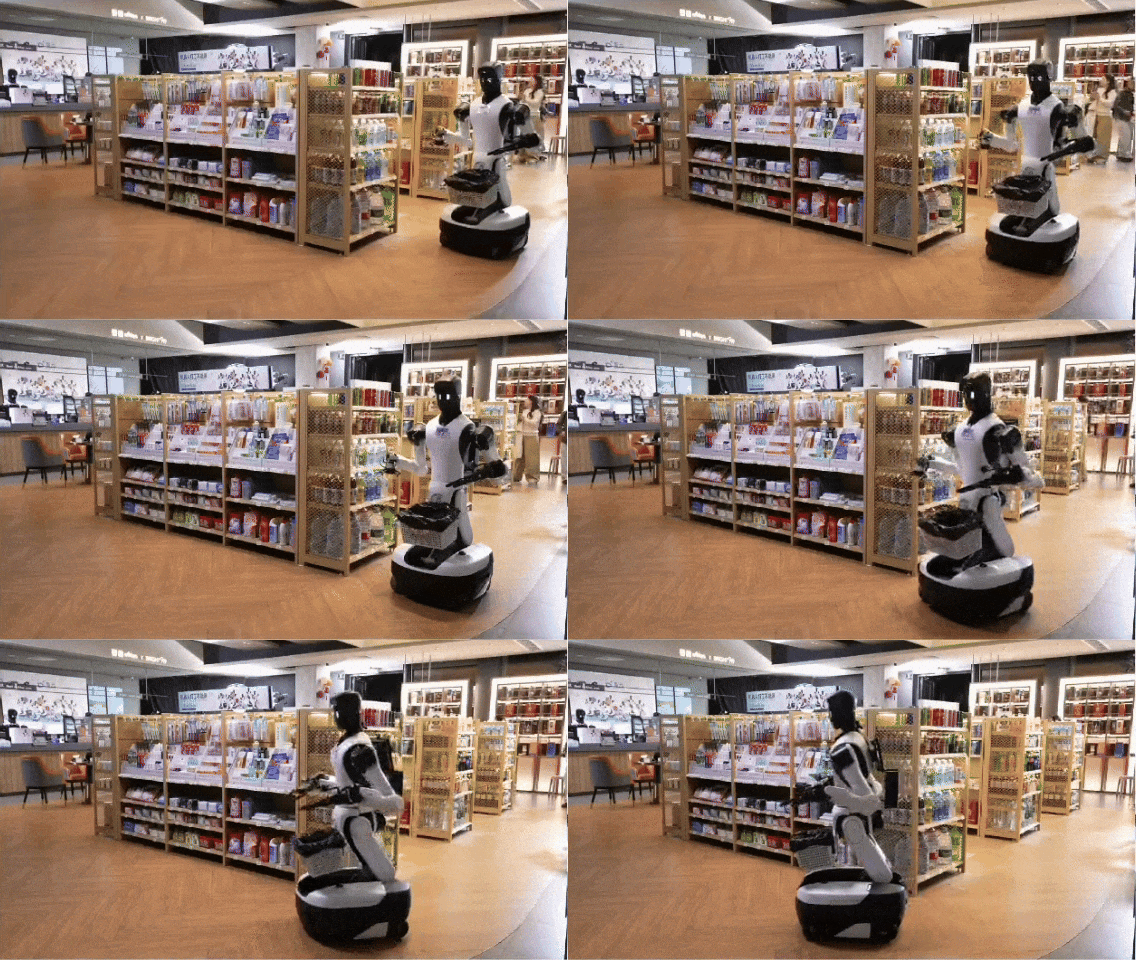
The movement of customers and pets in stores is unpredictable, and the system must complete real-time sensing and avoidance solutions under strict security constraints, actively slowing down or even suspending movements when necessary.
In comparison, the lighting of the laboratory environment, the positioning of objects and the operation of the process can be predetermined, belonging to the internal distribution conditions; real stores continue to produce extra-distributed samples.
Live broadcasting also set up a dedicated experience officer tour link, with only one real-world task: to give the robot a boost in intensity. For example, allowing the robot to recognize and extract specified goods from sugary and unsweetened coke; temporarily arranging and roaming boxes along the route; and intentionally stirring boxes while the robot is cooking.
In the live broadcast, the robot complained about the difficulty of working on the steering wheel, a series of operations to identify the goods, bypass the obstacles, adjust the movements in the steering wheel and complete the steering wheel.
The ability to build post-deployment conversion circuits
In 24 hours of operation, robots are not in the hundreds, and there are occasional losses on the ground.
The hard indicators used in the industry to evaluate intelligent systems are success rates, rhythms, and so on. But in an open environment, the most important indicator is resilience. After a failure, the system can autonomously attribute, self-adjust, and transform lessons into repeatable experiences.

According to information previously disclosed by the Genie Master, it is the brainchild of six robots: both responsible for task scheduling and for connecting execution results to follow-up learning. Its core execution protocol uses the execution process to judge, execute, react, connect to, and control each robot's capabilities and give execution instructions, execution results, and real-time feedback.
This allows robots not to rely on artificial demonstration and modulation, to locate their own failures, or to adjust their strategies. In previous tests, Genie Master's G2 success rate increased from 28.6% on the first day to 85.7% on tasks such as cooking, packing, unloading, and filling.
The newly acquired skills of robots will gradually be absorbed into repeatable experiences: trajectories of success and failure are summarized daily into long-term memory, encountered in direct calls to similar tasks; effective adjustment processes are transformed into training data, and anti-inflammatory action strategies are optimized.
The two paths work together, so that each round of assignments provides feedback for the next round of learning, i.e. upside-down, alongside unlocking new skills.
This has led to a direct change: the more robots, the longer the upload time, the more experience accumulated, the faster the speed of improvement.
The perspective has been raised, and this solves one of the most realistic bottlenecks in terms of the large-scale deployment of physical intelligence. The more robots are deployed and the higher the cost of human resources, the more difficult it is to build a business model; while the route represented by the Genie Master is to hand over these tasks to robots themselves.
At least according to data from convenience stores, the route has been initially closed.
All-in-one collaboration is a prerequisite for physical AI.
If you break down the tasks in the convenience store one by one, you will find that there is no single problem that can be solved with just one long board.
Capture accuracy, relying on physical performance, joint accuracy, force control capability, hardware consistency; movement fluidity, relying on strategy and control collaboration; reusable experience, relying on a complete data recording and evaluation system.
The breakthrough of single-point technology, which cannot replace full-frame collaboration, is one of the industry's hallmarks of physical intelligence.
Since the launch of AI WAVE on 22 October, the company has launched seven products in succession: the fourth data set of AGIBOT WORLD 2026, the operating platform Genie Studio 2.0, the robot G2 MAX, the Agent framework Genie Master, the simulation platform Genie Sim 3.5, the base model GO-3 Preview, and group experience learning (CEL).
The body's stability determines the quality of data, data goes through pre-training, post-training and continuous learning after deployment, model landing also depends on system integration, process adaptation and equipment synchronization.
The fact that convenience stores broadcast live 24 hours a day, throwing all the technology into real stores, and accepting all-network supervision itself, is the open pressure test of this option.
The failure of the two robots to translate also allowed the test to retain the complexity of the real-life scenario. Success and failure were presented simultaneously, giving the opportunity to see how far the robot was still required from the position.
The importance of public testing is being further enhanced by allowing technology to be tested in real-world operations.
The 24-hour live stream of the robot convenience store is over, but it has only just begun.
© THE