Since September, almost all of the world's top models have been shown in 3D.
From GPT-6 Astra, Claude Opus 5.5 to DeepSeek V4.1-Flash-1017, Kimi K3.1 Pro, 3D creativity is becoming a new scenario for demonstrating modeling capabilities: building rooms, building mechanical devices with code, and even directly generating 3D web pages that can be operated.
When a demonstration becomes a real creation, the problem becomes concrete.
Can the characters be more like a reference picture? Can the parts of a mechanical device move independently? Can the assets generated not go smoothly into the game engine?
On October 30, the official public edition of Kimi released a 3D creation tutorial, which stated that large language models such as K3.1 Pro "don't do very well for a while" for fine-tuning web modeling for characters, animal characters, statues, monsters, and complex props, and that in order to ensure a good experience, Kimi would arrange suggestions and reference charts on its own to complete models such as Tripo when the user initiates tasks to model characters, animals, and more for networking.
This reveals a change that is taking place: the more complex 3D projects large language models can deliver, the more specific the needs for native 3D capabilities become.
The agent can plan tasks, write code, and check out results, but it also needs to be accurate enough to produce fast, structured, and clear three-dimensional objects to continue to edit, control, and organize interactions. A new collaboration between code intelligence and 3D native intelligence is emerging.
For researchers, this also means that a new set of questions has begun to emerge: how should three-dimensional structures be represented? how should production and editing be consistent? how do models understand component functions and spatial relationships? how can a generated object move further into a continuously evolving, interacting world?
The company behind Tripo, VAST, is pursuing two main lines of research on these issues: one is the creation and understanding of native 3D at the core of Tripo, and the other is the exploration of the world model represented by Eden.
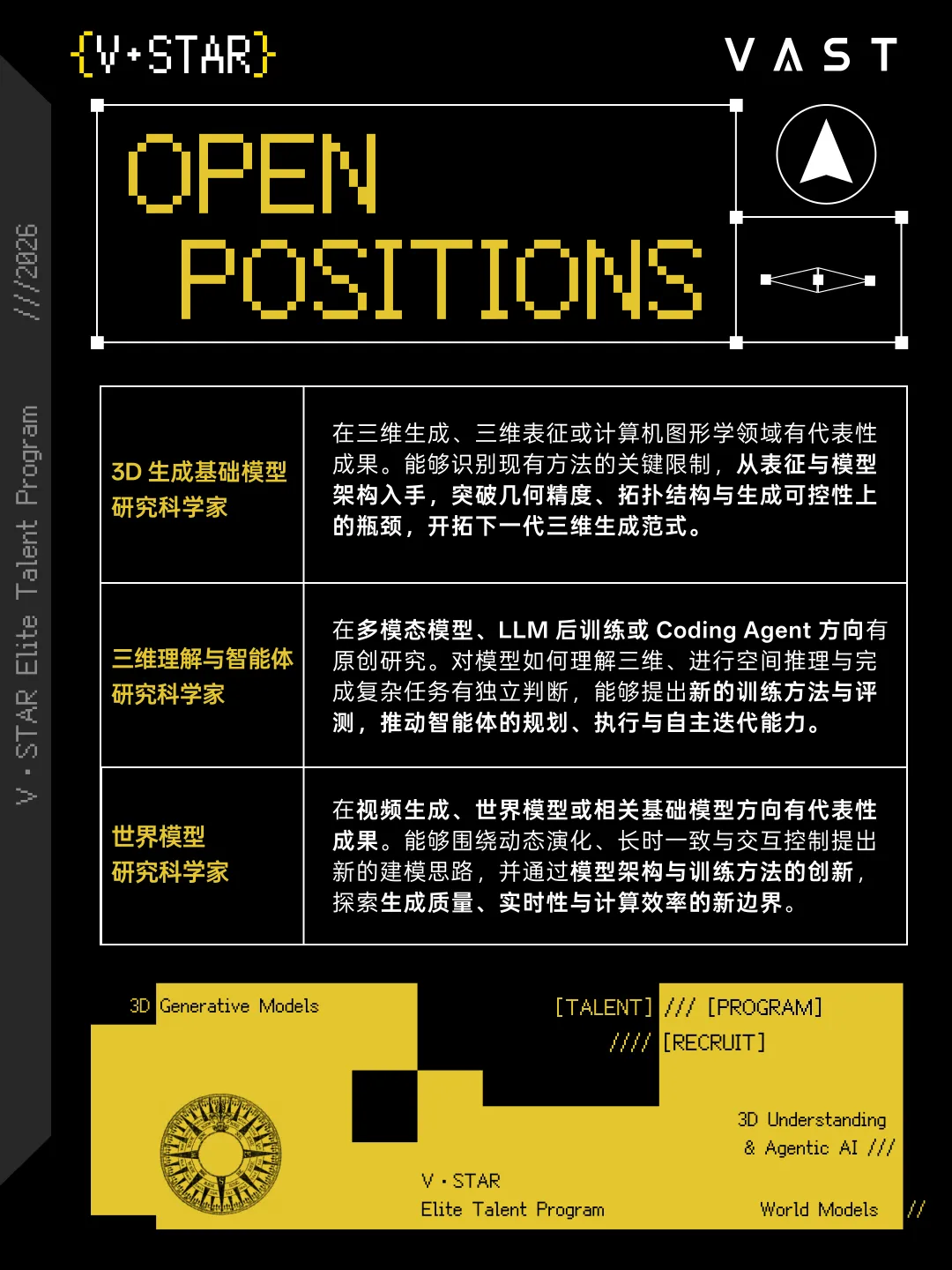
Recently, VAST has released a new edition of the V-STAR Top Talent Program. In addition to the basic model of 3D production, the 3D understanding with the intelligent body, the world model is also explicitly listed as a recruitment direction for young researchers in the field of 3D production, video generation, post-LLM training and coding agents.
Why are these directions and why do some of the top young researchers choose to start their careers here?
The answer lies in the process of moving models to users, and in research questions that have already begun to be discussed and experimented when they have not yet become an industry consensus.
The 3D base model required by the Agents era
Looking back at the LLM+3D project that drew attention over the past year, Tripo is a name that has come up repeatedly.
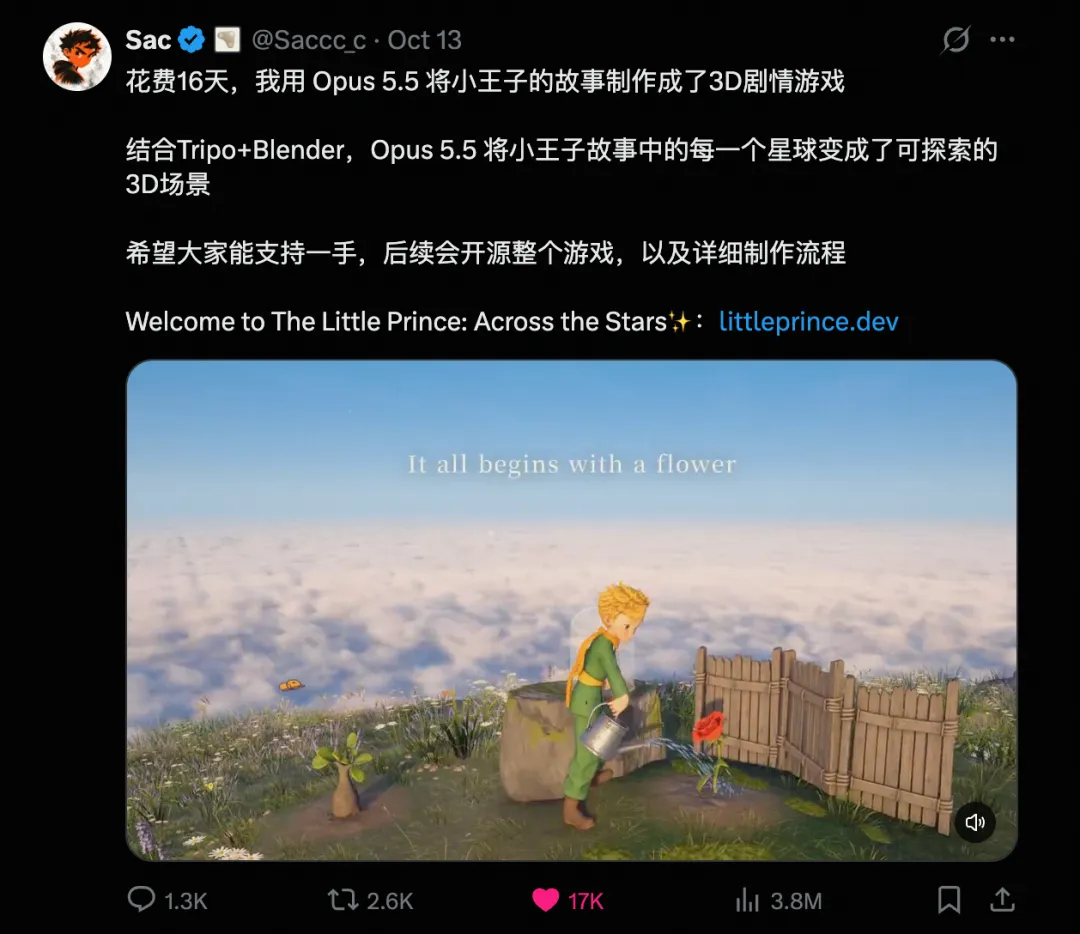
Independent developer Sac used Claude, Tripo and Blender to create the workflow, transforming the planet in Prince's nest into an explorable 3D scene in just 16 days, garnering tens of thousands of likes on X and receiving referrals from top institutions such as a16z, Marc Lou and KOL.
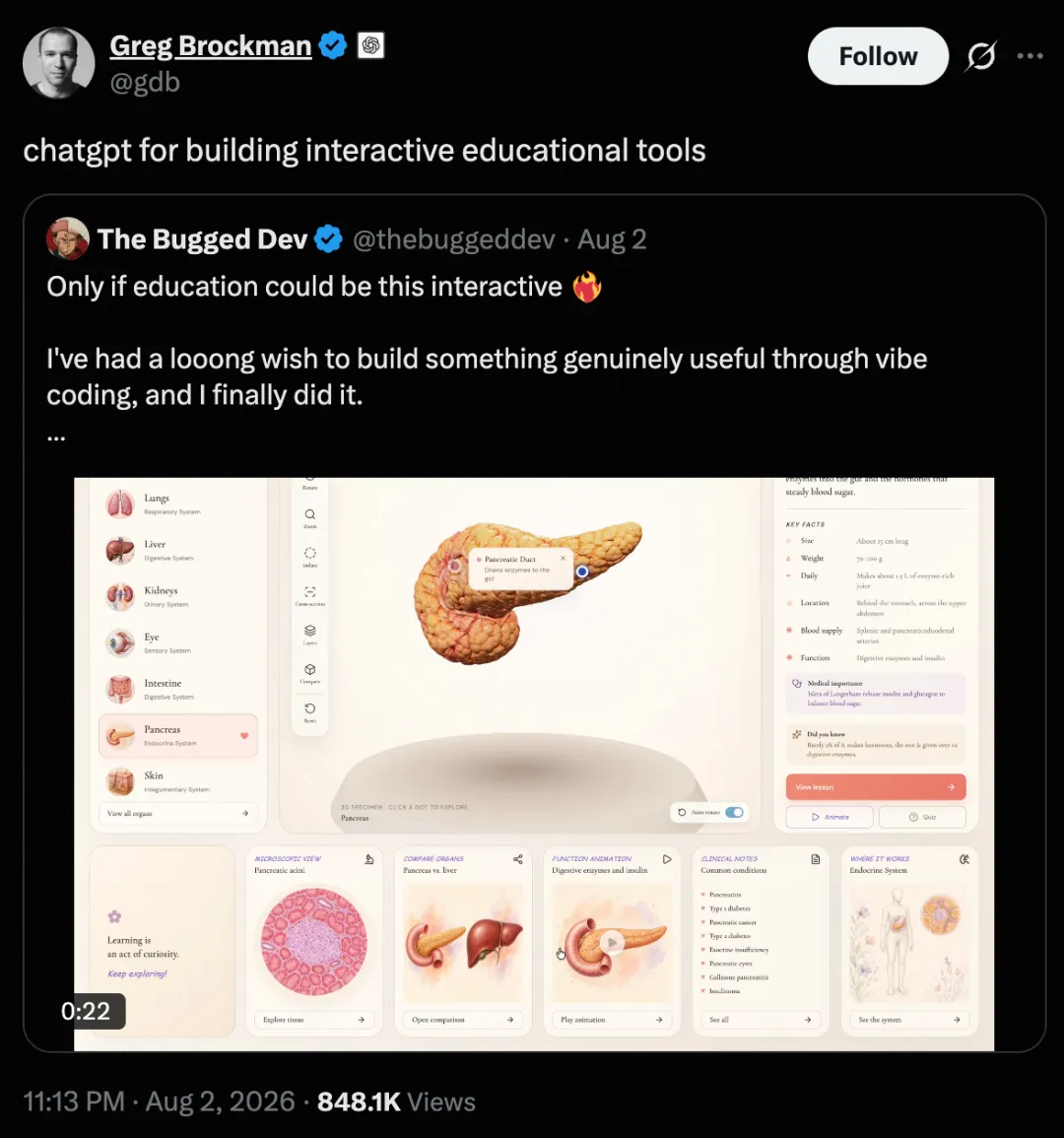
Developers @thebuggeddev combined GPT, Codex, and Tripo to create a 3D human anatomy application that could view and operate organ models on a web page and was later forwarded by Greg Brockman, co-founder and president of OpenAI;
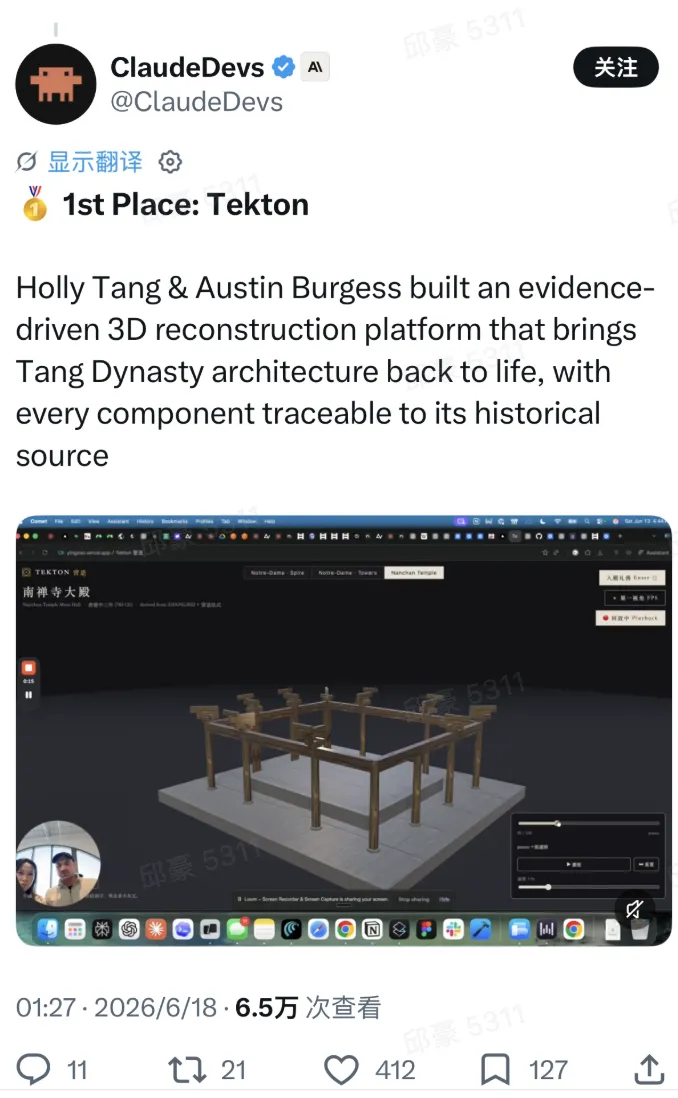
In the Claude Build Day hackathon hosted by Anthropic, creator Holly won first prize for her work with the Tripo restoration of the five Buddhist temples in the South Zen Temple;
In collaboration with Tripo and Kimi, the three-dimensional reconstruction of the Silk Road across the Millennium, led by the SITU SITU's Space Intelligence and Virtual Reality Fusion Design Laboratory.
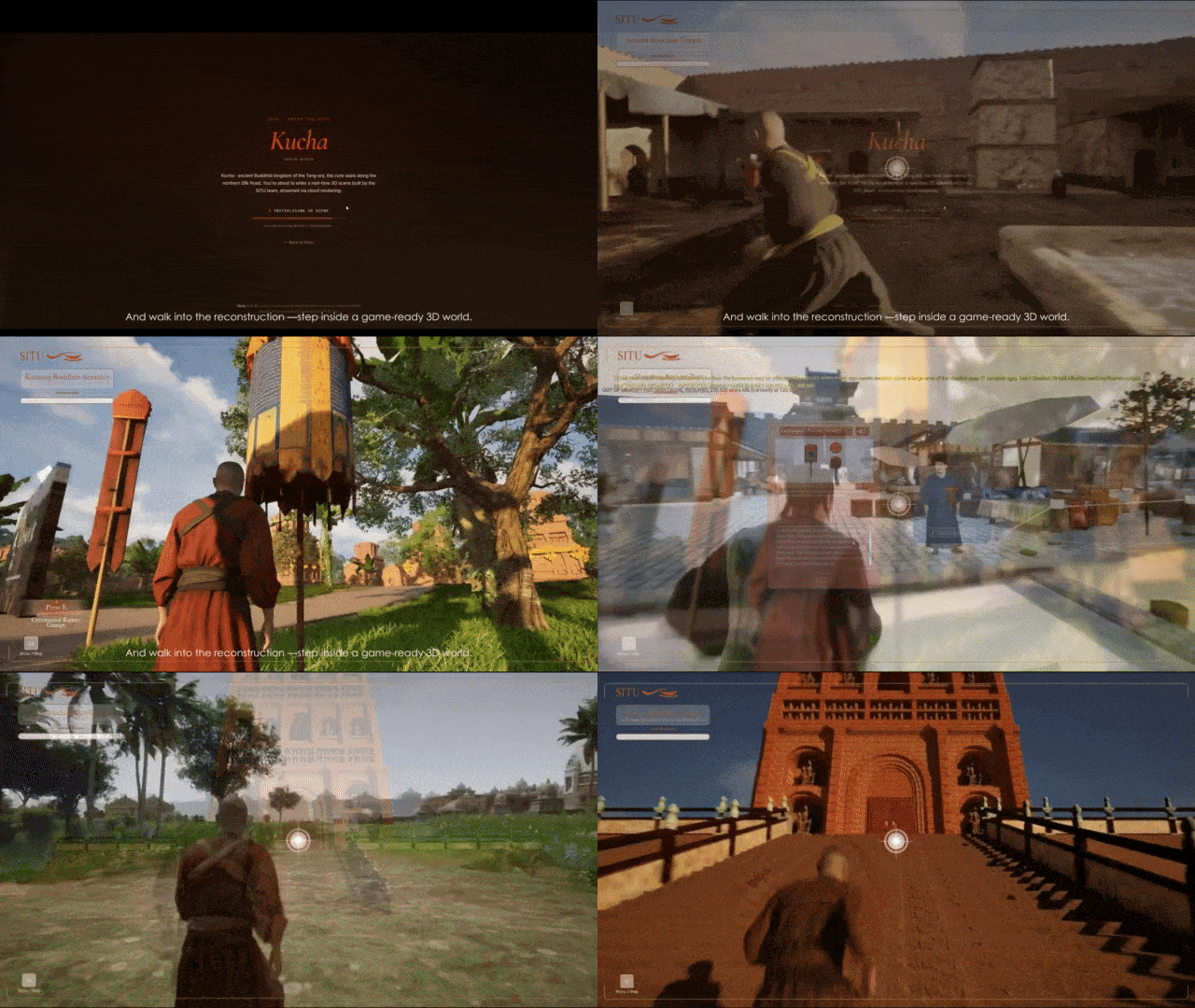
These projects share a unique creative path: big language models undertake planning, programming and process organization, Tripo provides professional 3D generation capabilities, and the creators combine them into truly experiential works.
Supporting this collaboration is primarily based on basic modeling capabilities.
From March this year to date, the Tripo series model has been at the top of the cumulative third-party rating list of more than 200,000 users voted for eight consecutive months. Among them, the H series continues to refresh the industry-precision ceiling, while the P series is the only large 3D model in the world that can deliver a birthrate grid in seconds, implementing the underlying philosophy of available silicon generation from another path.
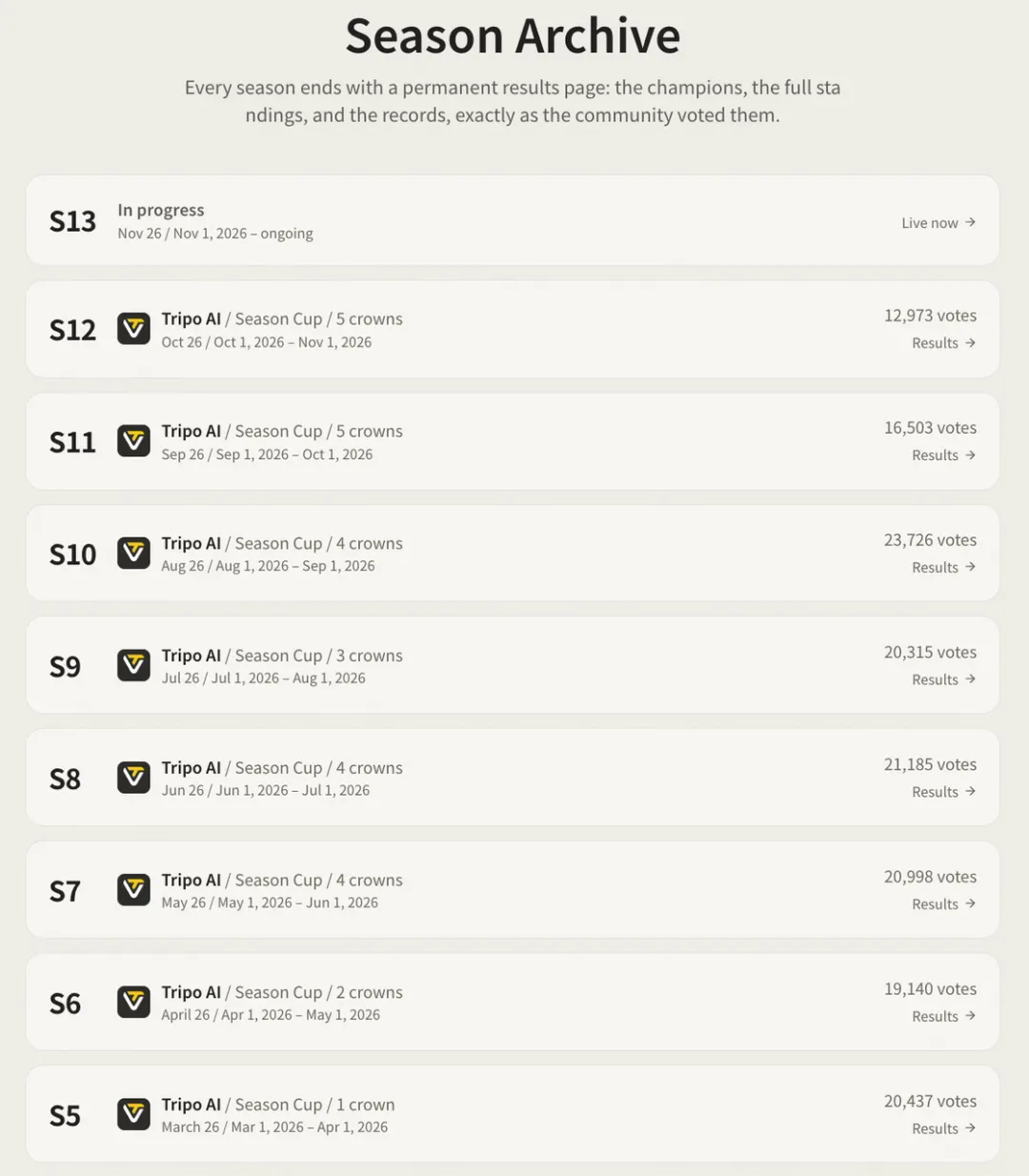
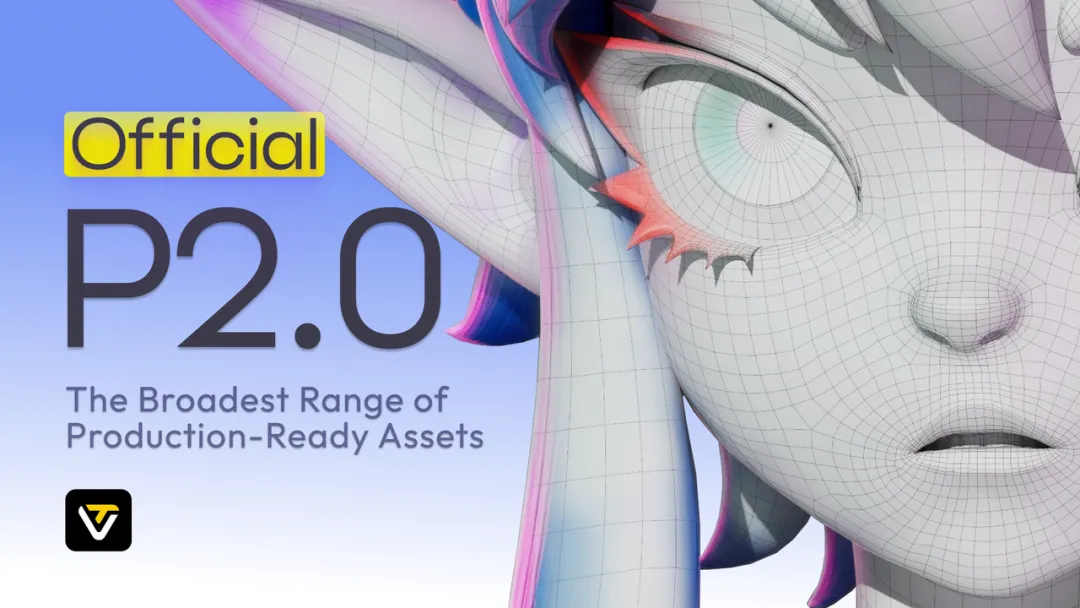
In March, VAST launched the Tripo P1.0, and in September updated the P2.0, which can directly generate more reasonable 3D objects in a matter of seconds based on four faces, controllable faces and parts.
These features may not be obvious to ordinary viewers, but they are critical for developers and agents.
Production is fast enough to support pump generation, pump operation, pump inspection, pump modification; the geometric complexity is controllable to accommodate the performance budget of web pages, mobile devices and real-time applications; the topology is more streamlined to reduce the barriers to subsequent editing and animation production; the component breakdown is more reasonable and the code is easier to locate and manipulate the different parts of the object.
In an intuitive experiment, VAST's chief scientist, Cao Lat Ba, produced a mechanical spider using P2.0, and then a natural-forming component structure based on the model, allowing the LLM to name, write, and modulate the motion logic of independent components, ultimately achieving component-level animation control of the entire mechanical spider.

Once the Agent has written the code, the 3D native base model will be complemented by three-dimensional objects that the code can understand and manipulate.
Starting from production demand
How to reconstruct generation
To obtain such a result, one process cannot be added only after the end of production.
In the past, AI-generated models, even if they looked good, often needed to rearrange the grid structure in order to go into post-production. Especially in editing, detail and animation, lateral topography was important, but when manual retouching took time, automated processing could also lose details or produce unstable results.
The option for the Nexus underlying algorithm framework of the P series is to advance the problem to the generation stage.
In contrast to the industry-default transformation of 3D grids into sequential, step-by-step generated routes, Nexus unravels the generation of vertices from rough to fine-constructed vertices through a distributed model, and expresses topological relationships in a new encoded way, achieving native grid generation without prior ordering. The relevant paper was collected by the International Graphics Summit SIGGRAPH and received the Best in Show award for SIGGRAPH 2026 Real-Time Live! based on P1.0 real-time presentations.
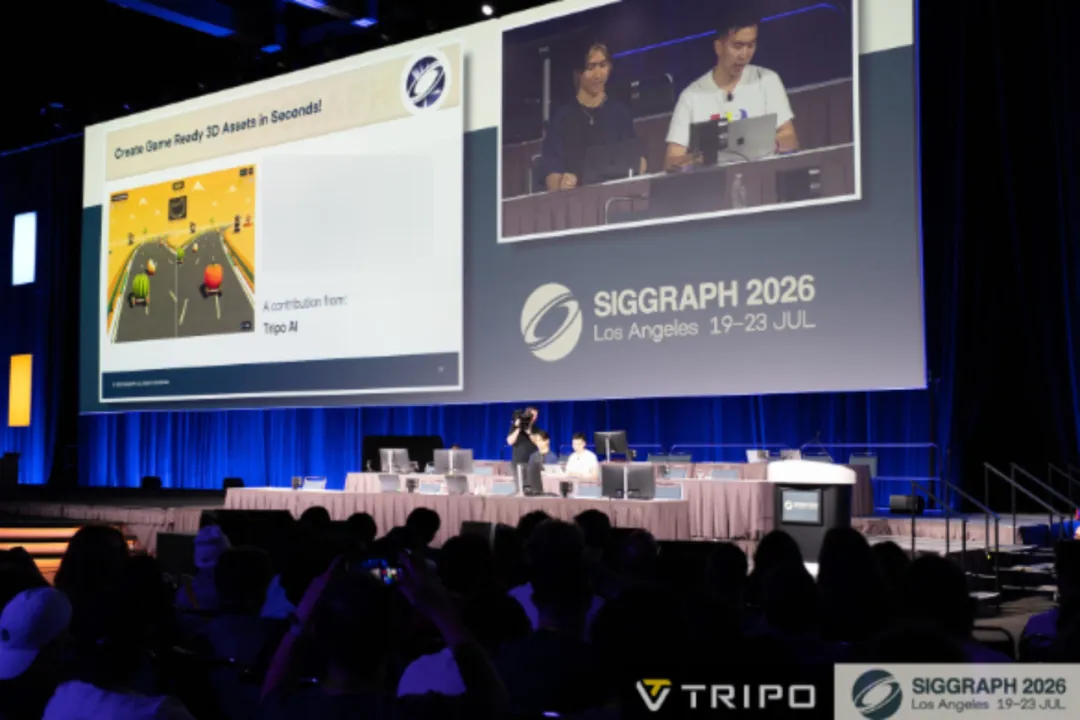
On this basis, P2.0 further supports the native all-round topology, so that the model does not always have to go through the process of "Mr. Finish, Rebuild Topology Structure".
The trade-off behind this route is clear: instead of merely equating the quality of production with visual details or figures, it takes into account shape restoration, speed of production, geometric complexity and downstream availability. The core goal is to get it into the real workflow, which remains in place.
The Tripo P series, which has become the flagship model today, was not originally a well-planned product task.
Ronnie, a key contributor to the P-series, joined VAST early in his internship and graduation. He recalled that he was initially only interested in some areas of research and had no preconceived notions of what to make of the product. As experiments progressed, the exploration gradually evolved into the P-series, which eventually became the company's flagship model line.
He had no such goal at the time, but was interested in it, exploring it step by step, and finally got this result.
In order to make research a product, he began to communicate frequently with colleagues from different backgrounds: how to explain what algorithms can do, how to understand what users really need, and how to transform the ability into an experience that others can understand and use.
His most impressive feedback came from the San Francisco Game Developers Conference GDC in March of this year.
At the time, the team was present with the newly launched Tripo P1.0. A passing game developer, after seeing the demonstration, was amazed at what it could do, stating that he had never seen such a capability before. For Ronnie, the stranger's reaction hit him more directly than many abstract reviews.
A few months after the release of P2.0, more and more developers began to share their workflow. Ronnie felt a sense of recognition and value once again as he watched the model be incorporated into a different Agent to build work he had never imagined.
From an interest in research, to a flagship model, to a way of creating in the hands of others, this is the growth trajectory of the P series, and a path that young researchers can take here.
Before the industry consensus:
The world can't just look good.
If the P series is responding to the question of how to better continue to use a three-dimensional object, then Project Eden raises the question further:
When these objects are placed in the same interactive world, how can the world itself continue to exist and evolve?
The motion-condition video model represented by Google Genie 3 was widely regarded: inputting a text or a photo, pressing a keyboard, turning a view, and the model generating the next image. But these models were essentially still predicting the "next series of pixels", and the model's "understanding" of the entire world was compressed into a very short historical image that could disappear once the object left the lens and returned.
In early June, World Labs founder Li Feifei published a signature article titled A Functional Taxonomy of World Models, which proposed a world model framework consisting of planners, simulators and renderers.
Incidentally, just four days before the publication of this article, VAST announced its World Model Research Project "Project Eden", which explicitly proposes a three-tiered framework to unravel the evolution and visual rendering of the state of the world:
Continuous evolutionary state of the world: recording the location and properties of objects, the rules of interaction and the consequences of their actions, without attachment to any lens;
Interface from state to image: Convert the current state into a set of layouts, geometries, and event constraints from a particular perspective;
Production-specific renderers: Based on these constraints, high fidelity images are generated.
Since then, more and more studies have begun to explore similar functions. Since August, Code World Model, Magpie, Programmable World Model, GameDirector and CoDeR, Agent Garten, Matrix-Game 4.0, Streaming Code World Model, SolarRenderer, and NVIDIA's StreamRender-H3 are similarly thought-about.
On October 18, VAST opened EdenLive. It is the first video model in the industry that can generate different styles of images in real time based on any visual reference. On a single GPU, EdenLive can generate 720P images at speeds of more than 24 FPS, supporting minute-to-minute continuous generation.
Zion is one of the core contributors to EdenLive, and one of the youngest members of the team since 00. When VAST was founded, he was still studying pre-research during the summer, coming here to do internships for multi-visual generation and 3D production.
At the beginning of the year, the world model was hot. The main practice was the action-condition video model, which was to input an image, then press the keyboard, point the mouse, and generate new images in real time. The VAST algorithm team also found this direction interesting, but they first asked themselves a question:
What is the use of a model of the world in which the mouse is used as a condition?
Well, we think that in order for it to really work, there has to be an explicit state of the world. For example, in a game, the bottom has to maintain the bloodlines, the skills to cool these states, but not in the previous paradigm.
The program was initially challenged repeatedly internally.
The first concern is that it differs greatly from the mainstream routes of the community. The only way to interact is by entering a single keyboard mouse operation, and the end-to-end approach seems to have more technical content.
Zion recalled that the discussion eventually returned to the original goal and principle of primacy: did they want to make a video that responds to operations, or a world with clear rules that can continue to interact?
It's not easy to just look at a certain technological route, but to look at something more substantial.
For the controllable interaction that the team wants to achieve, visibility is an important foundation. Months later, industry trends confirm this judgment.
It's harder than suggesting a route.
It's about keeping it running.
There are still a number of specific issues waiting to be resolved once the route has been established.
Zion has previously worked primarily on 3D production, real-time streaming video model training, a new field for him. He initially undertook the construction of an underlying R&D framework, hoping to follow up with easy access to new video base models and quickly verify different streaming training and distillation methods.
Early experiments did not go smoothly. After trying different configurations and implementations, the model may still appear to drift when generated for about half a minute.
He continued to work on positioning problems, correcting numerical accuracy, and adding updated algorithms and repeat tests to produce results that were able to maintain quality. This R&D framework was also an important support for early experiments in Eden and subsequent iterations of EdenLive.
Front-end exploration does not mean that everything has to be done by researchers alone. As the project progresses, the company is equipped with data and infrastructure support for this direction and provides the computation needed to train models. When problems arise, team members can directly discuss and come up with validated next steps.
For Zion, the most important growth of this experience was the gradual clarification of why he was doing his research.
In the past, he was more interested in exploring a particular direction or seeing a new model emerge. He has now started to organize his research with two longer-term goals: interaction and simulation.
How can 3D content support new interaction experiences? How can we more efficiently build the simulation environments that intelligent agents and robots need? These questions make the connection between 3D creation, coding agents and world models more concrete.
They also explain why VAST hopes to attract more than just 3D researchers.
Freedom to define issues
Behind the two main lines of study, there is a similar way of working: first to determine what problems are worth solving and then to find a way; allowing different opinions to be put forward and allowing experiments to overturn the original assumptions.
For every VAST algorithm classmate, "freedom to research" is not futile, but more importantly, defines the problem itself.
Ronnie believes that the important driving force behind VAST's work is the team's respect for objective facts and respect for the scientific process. When problems arise, the discussion is about how to solve them, rather than asking for breakthroughs to be made on a predetermined date.
Zion used an early exploration of his own to explain the boundaries of "permitting trial and error".
Before joining Eden, he had attempted to create scenes using LLM or VLM Agent combined with 3D generations. But the basic model at the time may have known an object was heading in the wrong direction but could not steadily reverse it. After some time of verification, the subject was temporarily suspended.
Suspension is not the same as denying the researcher. The team will first verify the critical assumptions with limited resources; the results meet expectations and then continue to invest; if they cannot be established on a small scale, they will re-discuss the definition and route of the problem.
It is an exploratory mechanism with judgement, with phases of feedback, rather than unlimited support for any idea.
Similarly, opportunities are not entirely determined by qualifications.
Stewie, who is still an intern at VAST, has been involved in the complete process of the core model from data to training since coming to VAST. This has exceeded his expectations. In the past, in the lab, he has focused more on the methods and indicators in the paper; after participating in the online model, it is necessary to simultaneously address user needs, stability, and the experience details that are difficult to generalize by a single indicator.
His most accomplished moments are often when a data set or a technical approach really solves a product problem, giving users better output results, rather than multiple papers.
Someone is willing to challenge your ideas.
Someone else is with you to solve your problems.
Algorithm team member R compared such a research team to a research team.
In the face of the unknown, members need not only a certain technical proficiency, but also a sense of direction, understanding the product, coordinating different professional skills. A team cannot rely solely on a well-drawn map, because sometimes the boundaries of a problem need to be discovered by itself.
He expects his partner to be "high capability, low ego": strong, but without proving himself to be a problem solver.
There is a more routine version of this requirement in Stewie's experience.
When faced with difficulties, peers share their understanding and technical experience, rather than ceasing to communicate because they are different in their profession. Someone asks questions and someone is willing to solve them together. He is therefore able to focus more on the problem itself rather than worrying about whether he is "not good enough".
For him, the high talent density of the VAST team does not bring more peer pressure, but rather more support: people around you who understand what you are facing and are willing to help you move forward.
This also means that "non-consumption" is no longer just an atmospheric label. It really means that researchers can express their differences directly, exchange ideas across teams, and take responsibility after discovering a problem, without having to work hard to confirm that this is not their own boundary of responsibility.
Leave results that are relevant to you
Several of the respondents had contacts with companies of different sizes. They did not simplify their career choices to be a brick-and-mortar or start-up company.
Zion makes it clear that different choices are rational. Some people are more interested in the support and stability of mature organizations, others in the direction of research and personal freedom.
R is more interested in what a team can offer in a specific area: whether it can reach out to frontline problems, work with people who truly understand them, and produce results that represent its own.
From exploration to industry SOTA, from road debates to open source releases and industry-recognized P-series, interns are fully involved in core model training. These experiences all present one possibility: at VAST, young researchers don't have to wait until they are qualified enough to start taking on important issues.
Their research can be discussed by peers, accessed by developers, or accessed by users' everyday creations.
This is also the story that the new V-STAR project hopes to continue.
Currently, V-STAR's top talent plans are open in three directions:
Scientists studying 3D basic models: starting with 3D representation and model architecture, exploring geometric accuracy, topological structure, and the next breakthrough in generating and editing controls.
Researchers in 3D understanding and intelligent systems: multidisciplinary models, post-LLM training with Coding Agent researchers, advanced 3D understanding, spatial reasoning, and autonomous planning, execution, and iteration of complex tasks.
Scientists studying world models: around dynamic evolution, long-term consistency and interactive control, exploring new boundaries between generating quality, real-time and computational efficiency.
These directions address not only three job titles, but also three unresolved questions: how to generate truly available objects, how to make intelligent objects understand and operate them, and how to make them part of a continuously interacting world.
VAST hopes that candidates will have an in-depth knowledge of at least one area and will be willing to understand new developments in other directions. The team focuses more on whether a study has led to a substantive breakthrough than a mere number of papers, and whether researchers can explain why the issue is important, why this pathway was chosen, and how the results of the experiment changed their judgments.
According to the plan, candidates will be given space from zero to promote projects, participate in defining key technical directions; the remuneration scheme breaks the traditional entry level and salary limits, is not limited to particularly good ones, and supports long-term incentives.
Freedom, of course, also means responsibility. Here it is not necessary to wait for the task to be fully dismantled and carried out again, but rather to be able to make judgments, move forward independently, and be willing to correct themselves in the presence of evidence.
AI is becoming more and more effective at execution and implementation, and a more irreplaceable part of human research is perhaps determining what is worth achieving.
When asked if he would choose VAST again if he came back, Zion's answer was straightforward:
Oh, I should have been stronger than I was then.
His reasoning was not grandiose, but rather very simple and concrete: what Liu was expecting at the time was indeed answered in less than a year.
The next opportunity for top AI researchers is not necessarily in the most crowded racetrack centers. It can also be found where different capabilities begin to converge, where problems have not yet been fully defined, where there are both long-term problems worth solving, and where there is room for a young researcher's judgment to truly change the direction of the project.
VAST is looking for people who are willing to work together to define the problem and break the ice.
(In the text, Ronnie, Zion, R, Stewie are all pseudonyms.)
The following are the delivery methods:
School admissions: Looking forward to graduating in 2027.
Internships: For non-recurring students (not limited to grades)
Location: Beijing / Hangzhou / Shanghai / Shenzhen / Overseas Distance
The official channel:
This is the first time I've ever heard of Vstar.talent@vastai3d.com

© THE