
It's the first time in the history of the world.
It is up to the AI to give life to the AI, and it is up to the AI to send the AI to participate.
On November 2, Tibo, the head of OpenAI's ChatGPT and Codex, tweeted two tweets to X, revealing a key upgrade to the dots:
For the same task, the dots will be broken down into several sections and assigned to different models.
In Tibo's first tweet, he revealed that the model lineup for the drive-dots is expanding: in addition to the flagship GPT-6 Astra, Terra is about to join the lineup, and more models will be added later.
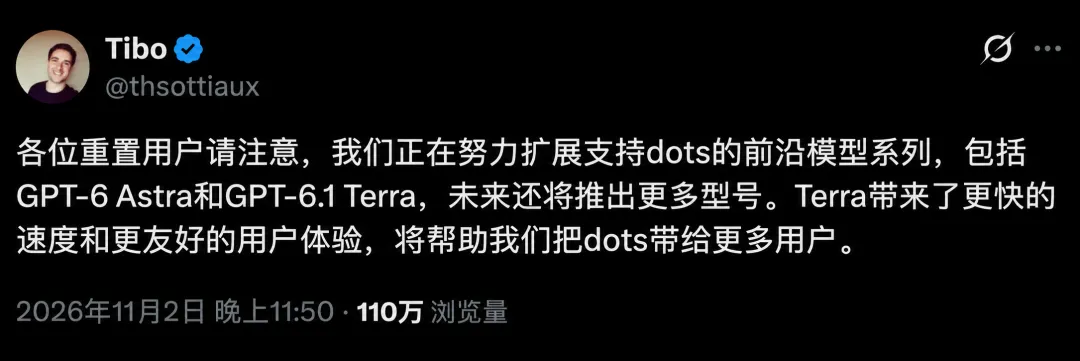
The real change is hidden in his second tweet:
Your dot will select the most appropriate model for the task and call different models in different parts of the job.

Don't underestimate the phrase, it changes the logic of AI.
Previously, AI was used to select a model to do exactly what it did; after upgrading, the dots were used to change the model step by step.
For users, this change is crucial.
Those executable steps can be given to a fast-paced model, you don't have to wait; only give some of the core nodes of the burning brain to the flagship model, and you can use good steel on the blade.
In this way, you can allow AI to save time and costs while doing the right thing.
Astra doesn't have enough to live in.More than three times as fast as TerraThe dots are a personal smartphone from OpenAI released on September 29th on DevDay.
It carries cloud computing, is online all year round, and can focus on your targets while you're on a mission.
For the first time, it was given the flagship GPT-6 Astra as its brain.
Astra is smart enough, why keep a terra fortress?
Tibo's answer is:Terra is faster, "character" is upgraded, and chatting is more enjoyable.。
Let's see the strength.
In the comprehensive list of third-party rating platforms Vals.ai, Terra scored 60.17%. Out of 28 reviewed models, it ranked 10th.
While running scores aren't high, they hit two of the biggest pain points that users care about:Fast and cheap.。
OpenAI has also released a number:
In computer operational assessments, Terra completed the task at more than three times the speed of Astra and Sol.
But this figure is just a single score, and if you put in the dots and the whole set is live, the probability is almost three times greater.
Because evaluation is comparable to a single-country sprint, real work is an obstacle course.
The time it takes to complete a task is not only to see the hardest bones, but also to see if the connections between the models are effective.
In comparison to Astra, Terra's strengths are computer operations.
Seeing the screen, filling out the form, pointing buttons, switching back and forth between different software... it takes time to get it out, mainly on the links of these motionless brains.
The next step that really burns the brain, how long will it take, and how long will it take, to leave to the flagship model?
The price difference is even more disparate compared to the speed gap.
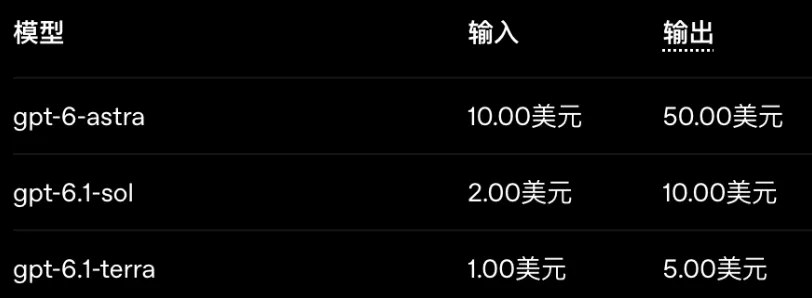
Astra is 10 times the price of Terra and Sol is 2 times the price of Terra.
However, the single price of an API is not the same as the subscription fee for the dots, nor is it the total cost of doing something.
It's a little bit more than that.
One-on-one runs are dozens of steps of long-term mission intelligence, saving a bit of time, a bit of money, going through dozens of rounds, saving not a star and a half points.
For the flagship model to be responsible for the "town square", it is enough to specialize in the most difficult reasoning tasks, and if it were to encompass every step, it would be a waste of computing and time.
A four-step reportSeveral models of water supply connectionsFor a long time, choosing a model has been the user's own problem.
Even Tibo himself couldn't bear it.
In October of this year, Tibo speaks on Lenny Jones' Podcast about AI's busy settings, saying:
You just have to have a "Model Selector PhD".
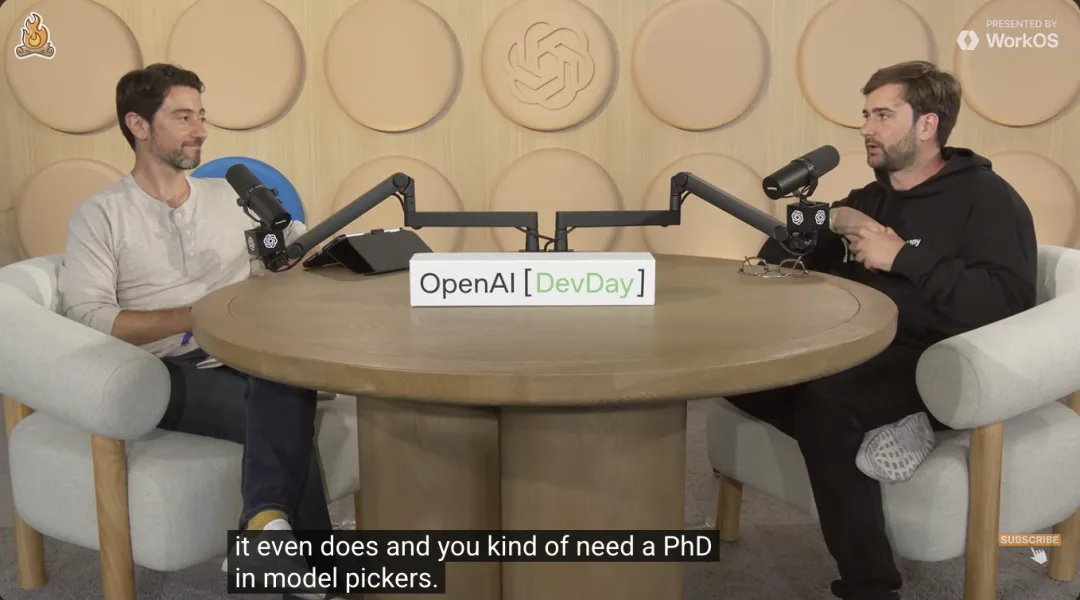
Tibo discusses the additional burden of model selection and reasoning on users.
If you want to make AI work, you have to get a feel for each model and guess how hard it is to survive.
It's not open yet, and there's a very difficult selection question ahead.
So Dots cut out the model selector from the first day they were born.
All you have to do is choose which channel to talk to it through.
This upgrade takes the selected particle size to a deeper level: from task-based model selection, refinement to step-by-step replacement.
This is one of the most familiar examples in the workplace.
If you ask Dot to do a project postponement report, the whole process goes through four steps:
First, extract the progress and budget from the document; then verify the data in several tables; then analyze why the project was delayed; and finally, rank the conclusions in PPT.
These four steps and the difficulty are not at all on the same scale.
For example, it is possible to use the data to determine which qualities are most reliable when fighting; to do PPT, and to test refinement, editing, and manual operation.
If the whole process involves paying for the most expensive Astra, like asking the chief scientist to help you fill out Excel, your wallet and patience will spill blood together.
However, it is easy to misunderstand or misinterpret the key elements of the report when it comes to analysing the reasons for the delay.
The cleverest solution is the flow line operation: who is good at what step, let's get who up.
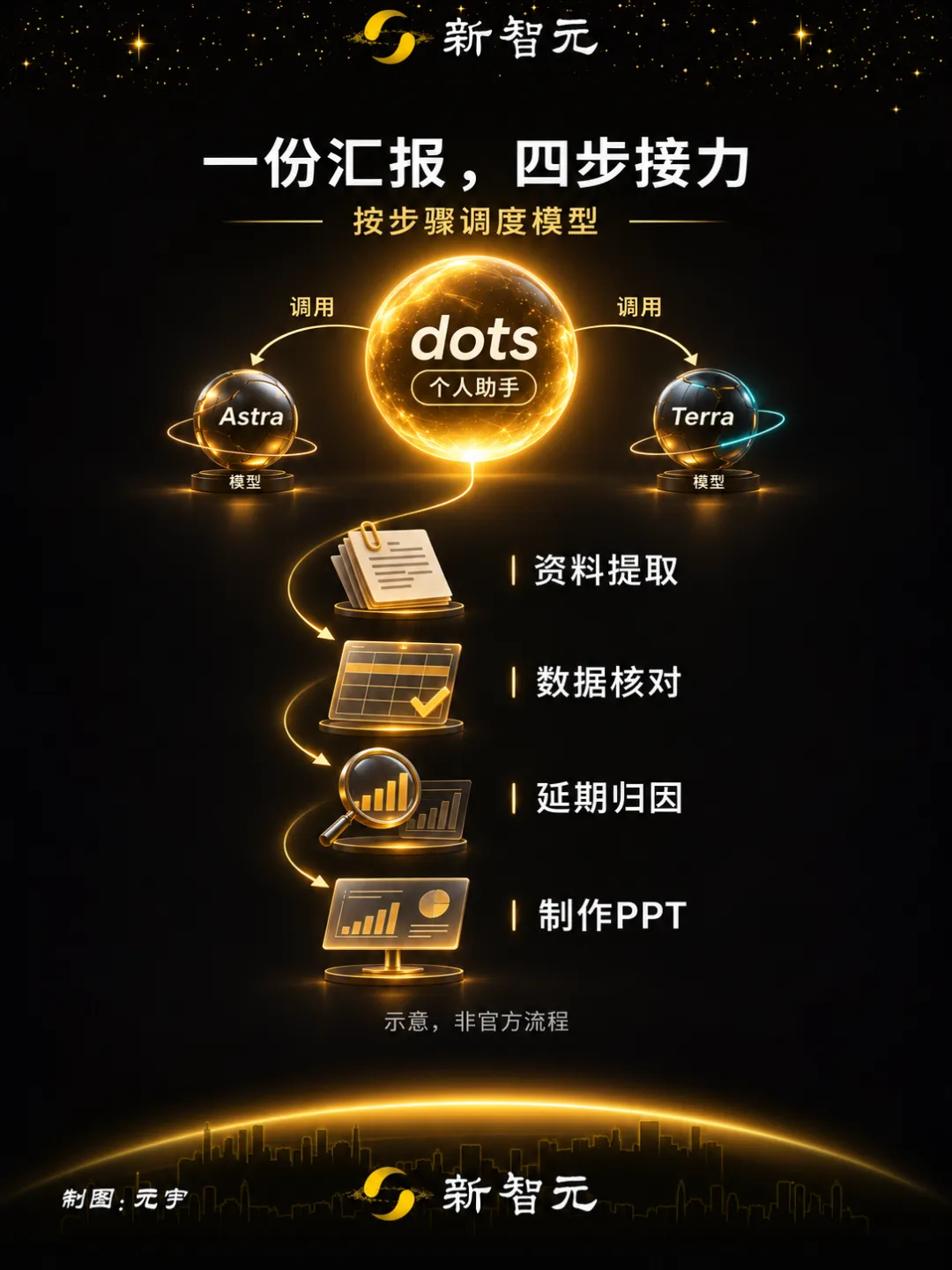
Currently, no specific regulation has been released, so it is not possible to conclude that the analysis must go to Astra and the edition must go to Terra.
It's the same dot working in the background to change the model, and it's a two-digit thing to do with a group of smart bodies running at the same time.
So for users, the front desk will also be very clear: you can only ask for it and the back desk will be able to drop off whoever comes in.
Last time you picked a modelOpenAI overturned the carThis is what OpenAI has been doing for over a year.
On August 7, 2025, GPT-5 was released.
At the time, the Crown points of sale were real-time routing, with each question answered by who, and the system automatically distributed.
Prior to the release, Ottman had also spat out the old model menu to prevent it from disintegrating.
I didn't expect to hit my face so fast, but the first day I went online, the road was blocked.
Ottman had to admit publicly: the route was halted once, and the GPT-5 appeared to be a bit clumsy.
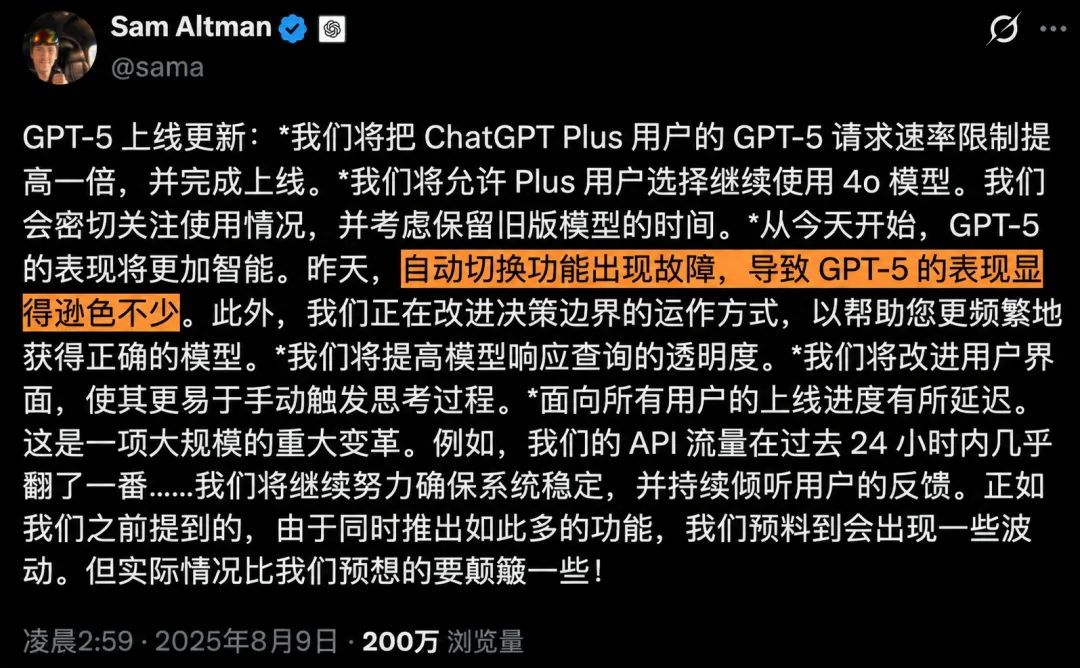
After a few days of folding, OpenAI had to add the model menu back, and GPT-4o returned to the list of paid users.
More than a year ago, the psychological shadows of some users were still there.
The Chinese technology community LINUX DO has already warned netizens: Will this be another "dynamic decline"?

Some people asked in the bottom of Tibo's tweet: Are those dots really Sol?
Once the model selection is in the black box, users may not even know who is working for them.
Moreover, the timing is more difficult this time.
The GPT-5 route, for each question-and-answer model, is a one-time buy-and-sell. Dots must be lined up on the same long task.
The smaller the line, the greater the risk of mistaken connections.
The data that comes out the next step, can a new model completely catch up? Can a data caliber be changed in the middle, and will the PPT model still be using the old data?
In long-chain tasks, one-step running is just the surface, and not going back to work is just a mile away.
Once you've turned around, the time you've saved is not enough to fill the pit. Are you willing to spend money on AI shows, or do you really want to make them work?
The real difficulty in making choices for users is saving computing power and not being able to use it.
Wanting to get out of a $100 clubBefore the delivery of this linkTibo tweeted: "Terra will help OpenAI bring the dots to more people".
Today's dots are exclusive to high-end players.
Individual users who want to taste fresh must first subscribe for at least $100 a month Pro-$20 Plus users, which is still not available.
Another netizens said it was true:
Tibo, I don't want the dot, I want the plus to give the dot quantity.
What if the dots are cheap enough?
Officials are talking about functional upgrades, user memory or old limits.
Faster, cheaper terra, getting the dots out of the "100 Dollar Club" is a step closer.
A long-term tracker of AI's new capabilities, TestingCatalog, saw Tibo's prediction only responding with one word: there's testing to be done.
The results of these tests are as follows:
How long will it take to complete a complex task?
How much do you burn in one run?
How many times do you have to fire in the middle?
What is the ultimate delivery that can be transferred directly?
For users, these four questions are much more important than more than one Terra in a model list.
But the wind has shifted: the model selector has not disappeared, just moved from your screen to the brain of the intelligent body.
Today, Meta has the Muse, Musk has the Grock Bot, Google has the Gemini Spark, and they're all trying to get access to the "personal first assistant".
The user handed out the task and wanted to save not only the few minutes of typing time, but also to select the model, etc. results, and all the effort to change the wrong iteration.
In this battlefield, it's not just the flag runners who fight, but those who wait and bend the least and give up a life without having to return to work.
The smartest models are no longer scarce, and it will be rare to see a live person, a housekeeper who makes a live caterpillar.