Can AI really understand the three-dimensional world?
Planning the next steps, timely adjustments after the cups are removed, completing operations before the environment changes, and dynamic tasks are constantly making more complex spatial demands on AI. One of the bases for these actions is a reliable understanding of the space in front of us: where objects are, can observations from different angles be consistent with each other?
Researchers at Princeton's AI Lab came up with a new test for space intelligence: Same Space or Not (SSoN) which takes real-time change and motion control and gives only four static indoor images, allowing the model to find the one that violates the same scenario and explain why.

The main page of the project:
Link to the paper:https://arxiv.org/abs/2610.23959
The data collection:https://huggingface.co/datasets/HuiziCao/SSoN
The code link:https://github.com/sson-benchmark/SSoN
Weighing:
The results drove a clear gap: the human accuracy rate was 83.3% for the entire 1,000-track problem. In six VLM-tested visual language models, the GPT-6 Astra Pro led by 39.7%, while the remaining five were all below the 25% random baseline of the four-choice.
Why would it be less than 25%? This is the expectation of probability blind guessing, not the limit of ability. SSoN has specially constructed a strong interference view that looks like it has changed, but is correctly blinking in space. If a model can detect a difference in appearance but cannot determine whether it is due to a change in perspective, it may be systematically biased and performs less than blind guessing. This is not the same as having no visual ability, but exposing the gap between identifying differences and understanding space.
And 39.7% were just voting for the answer, and some of the reasons for the answer were still untenable.
Why is it that 17 visual encoders are all below a random line? Why is it that the model actually performs a three-dimensional reconstruction and still doesn't answer for half?
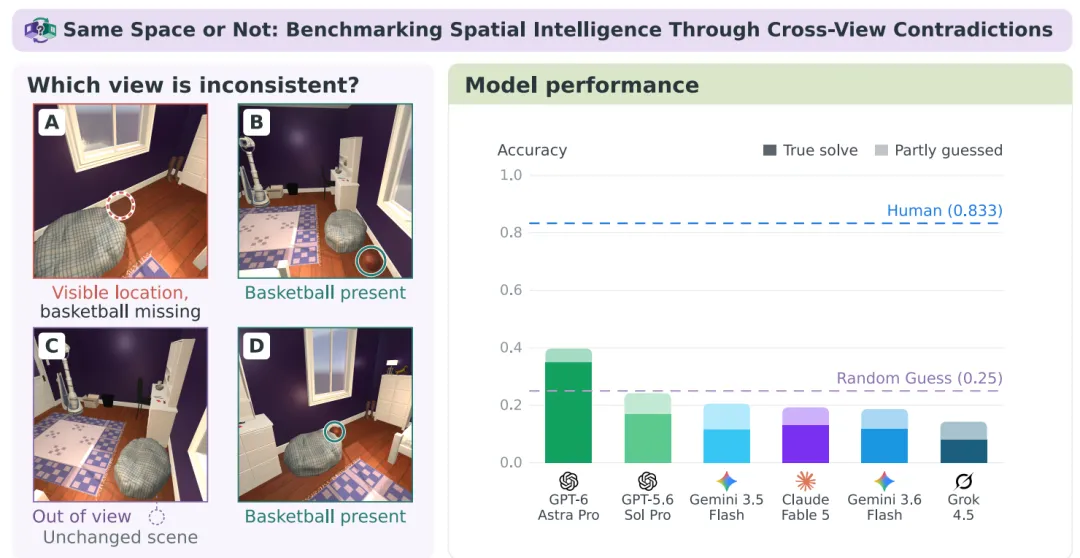
Figure 1 illustrates the SSoN mission with a complete 1,000-question score. Human response accuracy is 83.3%, VLM is up to 39.7%; the column diagram further distinguishes between the correct choice with sufficient evidence and the correct choice with no explanation.
The collective bias of spatial intelligence:
Exchange and detail are relatively easy, but rotation and movement are common blind spots.
The rules of SSoN are simple: three of the four graphs are from unaltered three-dimensional scenes, one is from an edited version. There are no correct reference tables and no predetermined anomalous objects. The model decides for itself: which observations are mutually valid and which cannot coexist with them.
The basket in the diagram is a shorthand. B and D jointly confirm its position; C does not capture that position and reveals other objects that are not shown in the view, but this can be explained by a change in perspective.
By breaking the results down by topic, the six categories of editors present roughly three levels of difficulty and outline different gaps in the current model space capabilities.
Exchange and detail changes are the relative advantages of the model. Two object exchange positions, or changes in appearance such as the shape, color, or texture of the same object, provide clues as to whether the object corresponds to the difference in appearance. Six models in these categories have accuracy rates that are higher than their overall scores; the best scores of both Astra Pro classes are over 80%.
The mirror and removal are in the middle layer, but it is still difficult for most models. The mirror questions need to determine whether the structure of the room is actually reversed to the left and excluding the visual changes caused by the changing sides of the camera; the removal questions need to distinguish between the fact that the mirror objects really disappear and the mirror is simply obscured.
Movement and rotation reveal more common geometric reasoning shortcuts. The six models had the highest accuracy on moving subjects at only 27.20 percent; the lowest and highest at only 9.54 percent; and humans reached more than 70 percent in both categories. In subsequent experiments, although it was clear what the six-category editors of the model were, it was still not possible to effectively increase the scores of the two categories.
When there are several chairs with the same appearance in the room, the model must first identify the same instance, then combine the table, the wall, etc. in reference to its position and direction. After identifying objects, discovering the differences in appearance, the model must also cross the three-dimensional relationship link.
SSoN extended the test to seven indoor scenic sources, covering switching, changing details, mirrors, removing, moving and rotating six-dimensional editing; 1,000 triads, 4,000 images, showing the difference in overall capabilities: which change models are easier to capture and which spatial relationships still cause them to collapse.
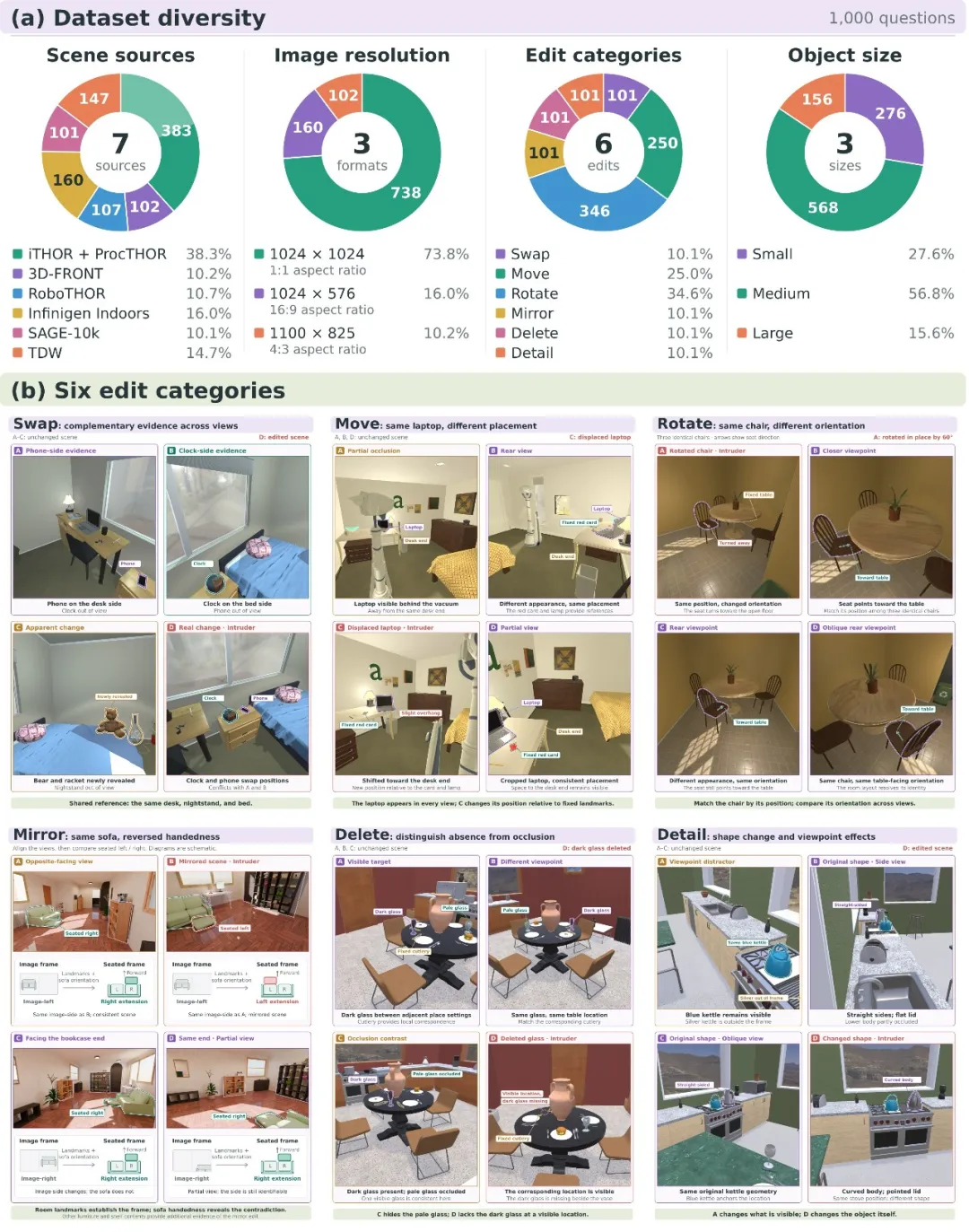
Figure 2 contains seven scenarios, six categories of three-dimensional editing, as well as different image formats and object sizes. Changes in perspective can create visual differences, and real editing may leave only local clues.
Instead of 17 visual encoders, they are still all below the line.
What is another solution? If there is only one abnormal graph, is it enough to find the one that is the least similar to the other three?
The researchers tested this idea with a total of 17 visual encoders from the CLIP, ViT and DINOv2 series. They selected isolated views with similarity to image characteristics, with accuracy ranging from 16.9% to 21.7%, all below 25% of the random baseline.
This result specifically demonstrates the role of strong interference: the right new perspective may change the big visible content, while the real editor may leave only local clues. Selection rules dependent on global appearance differences cannot be reliably divided into regions.
VLM will also be biased by this surface difference. In diagnostic experiments at the development stage, a legitimate but easily misleading view attracts more erroneous choices; replacing it with a clear positive reference significantly improves the performance of multiple subjects. Replacement also reduces interference, adds direct evidence, and makes the difficult position clearer: changes can be recognized at a glance, and do not guarantee that a different viewpoint can still be reasoned out.
A person can temporarily accept an unfamiliar perspective and then verify that the object is associated with other graphs. The SSoN test determines whether the model can complete this step of spatial integration across the perspective.
The answer is yes, and almost 30% of the answers are unanswered.
It is even more remarkable that some of the correct options do not necessarily correspond to the correct spatial judgments.
The model may choose A, but claim that an object that has not changed at all has been moved; it may also give real but insufficient clues to exclude other views. Just look at A, B, C, D, and these answers are assumed to be correct.
SSoN therefore checks the answer with the evidence. True solve requires the correct choice, and the interpretation is consistent with the facts of the image, enough to support cross-sectional contradiction judgments. Six models combined 1,368 correct choices, with 29.5% not passing this test. The highest model score also decreased from 39.7% to 34.9% for True solve.
Nearly three percent of the correct choices lack effective support, indicating that the screening of the model is still not a replacement for the model. This examination explains why the model was written without inferring exactly how it was thought inside.
If so, would the title itself be too vague, without enough evidence at all?
SSoN performed verification at both ends of the questionnaire and the scroll: when constructing an abnormal graph and at least two normal views to provide available evidence, excluding polynomials and obviously rendering shortcuts; when scrolling, all model responses to the selected pairs were verified by artificial evidence. More than 10,000 development candidate questions were iterated, leaving the problem of artificial discovery as a continuous new generation constraint, ultimately leaving the 1,000 questions behind.
Exams need answers, and answers need evidence. Models are required to truly point out the contradictions in the scenarios.
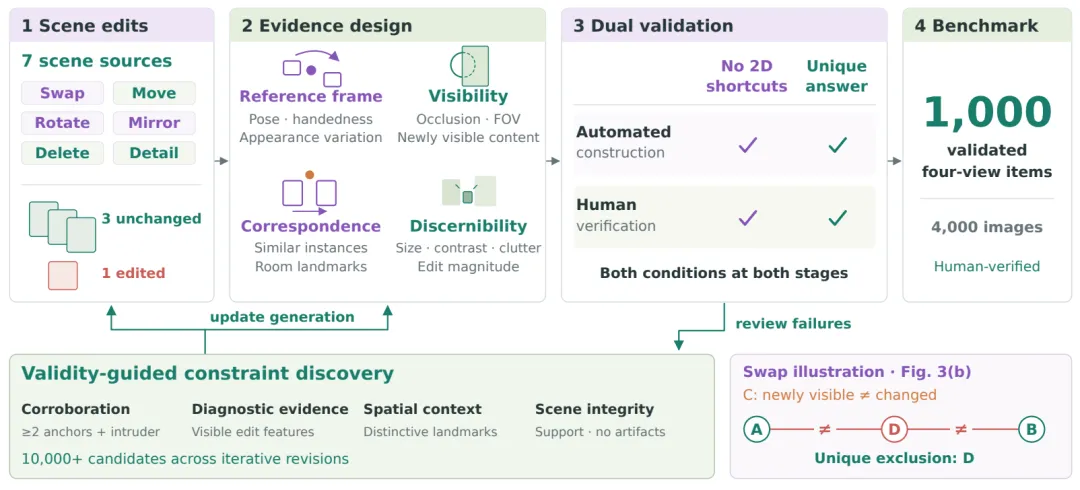
Figure 3 SSoN guarantees the subject's evidence with the only answer by automated inspection and subject-to-subject verification, and excludes visual shortcuts. Explain the alternative evaluation covering all the correct options, by artificially determining the final label.
So, what's going to help you save the field?
Since it's difficult to reason from a cross-sectional point of view, to solve a polynomial model a little bit, or to actually reconstruct a three-dimensional scene, will the results change?
Alternatively, the researchers selected an intervention set of 100 questions with an original answer accuracy of 24% and a true solution of 12%. The following comparisons were made within this set of fixed questions.
The researchers guided the model to look for environmental references, matching objects, judging shadows, or describing a scene layout; and told it directly about the six possible types of editing, but did not reveal the type of the current topic. The accuracy rate was 48% when the guide was combined with the editing category knowledge, and True solve was 34%.
This complete process, after verification, has a 47% accuracy rate, a 34% True solve. Removing and detail classes are better, and moving and rotating are still difficult. Simply adding 3D reconstruction to the puzzle process is not enough to eliminate geometrical shortcuts.
The most noticeable improvement comes directly from providing real camera information.
On the basis of the comparison guidelines, the accuracy of the input, output and image dimensions of the ground truth camera is 61%, and the true solution is 48%. The model thus obtains information about the position and orientation of the image geometry relative to the camera, without having to deduce these relationships entirely from the image itself.
Moving class subjects are particularly prominent: under comparison guidelines, accuracy and True solve are 20%; after adding camera information, both are up to 70%. This suggests that the geometry of the camera can help models distinguish between the fluid objects moving in the image and the fluid objects moving in the room.
But 61% and 48% are still far apart. Even with the real camera parameters, less than half of the 100 questions have adequate evidence to support the correct answers. Tips, tools and geometric information can alleviate difficulties but do not make cross-sectional understanding reliable.
Are you able to practice spatial intelligence? almost double the scores in the unseen room
What if the help of reasoning is not enough to train this skill specifically?
The researchers fine-tuned the Qwen 2.5-VL-7B and isolated the train, val and test by the associated room and the scene family. The model ultimately faced 201 test questions from the unseen room.
Unadjusted, the accuracy rate was 21.89%; only monitored responses, up to 33.33%; while providing reasoning and response supervision, it reached 41.79%. The accuracy rate was nearly doubled in the relatively original model.
The difference here is whether the training tells the model why the evidence supports the answer. Reasoning based on supervision provides further variation types, related objects and supporting views, allowing the model to learn how to link cross-sectional evidence and final choices; while testing still needs to see the answers on its own.
The most prominent changes also occurred in the rotation questions. Answer supervision has brought the accuracy of the rotation classes to 32.84%, and the accuracy of the rotation classes has increased to 58.21% following the addition of the reasoning basis. After replacing the order of the four graphs, the average accuracy and cross-sequence consistency of the responses have also improved.
This gives a direction worth pursuing: spatial consistency judgments can be improved by directed supervision and migration to rooms not seen during training. The improvements are still uneven, and the additional overall benefits of reasoning require further training and re-validation, but the questionnaire has begun to point out which capabilities can be supplemented.
Before AI enters the physical world, it learns to understand the same world.
SSoN's demands are simple: the camera moves and the scene stays the same; the image changes and the spatial relationship remains the same.
Dynamic spatial intelligence requires that observations be transformed into planning, decision making, and action, and a reliable understanding of the present space is the basis for these behaviors. SSoN takes action control and real-time change apart and allows this basis to be tested separately: can models integrate different perspectives, accept reasonable visual differences, and then find true scenario contradictions?
The AI Vision Exam, which uses controlled indoor scenarios to test this capability separately, reveals the current shortcuts, hints, geometry and training experiments, with a gap of 83.3% and 39.7%, which gives us the direction to continue to ask: What kind of models and supervision do we need to make AI understand the same three-dimensional world after changing perspective?
You are welcome to take the test yourself and bring your model to participate in this space intelligence test.
Information from the author
SSoN was completed by the AI Lab team at Princeton University. The first author, Huizi Cao, an undergraduate student at the Carlton School of Ophthalmology who had previously published a paper in Nature Medicine, included researchers from the University of Pennsylvania, Adobe Research. The project was co-directed by Shilong Liu, a professor at the AI Lab at Princeton University, and Mengdi Wang, a professor at Manling Li, who taught and taught at Northwestern University.

© THE