
It's the first time in the history of the world.
Or OpenAI will play!
The front foot has just doubled the Pro quota, and everyone is not happy for two days, and the head turns and announces the boycott.
Starting in December this year, the "use limits" of ChatGPT and Codex will be officially merged!
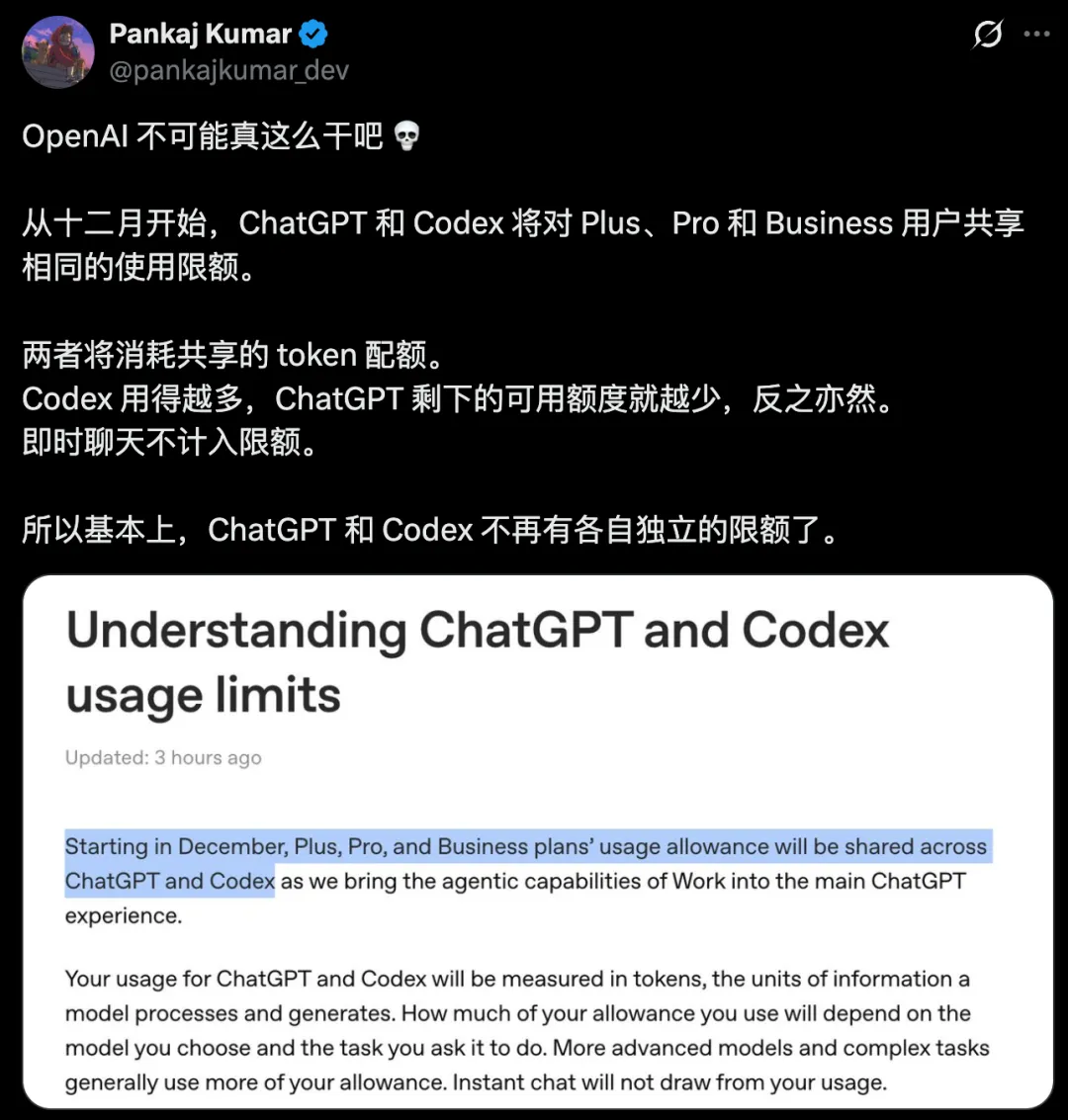
Put the emphasis on it!
Whether you're a Plus, Pro or Business user, deep questions in ChatGPT and running code in the Codex are all in the same pool.
Even the underlying billing logic has become "all-in-one with Tokens".
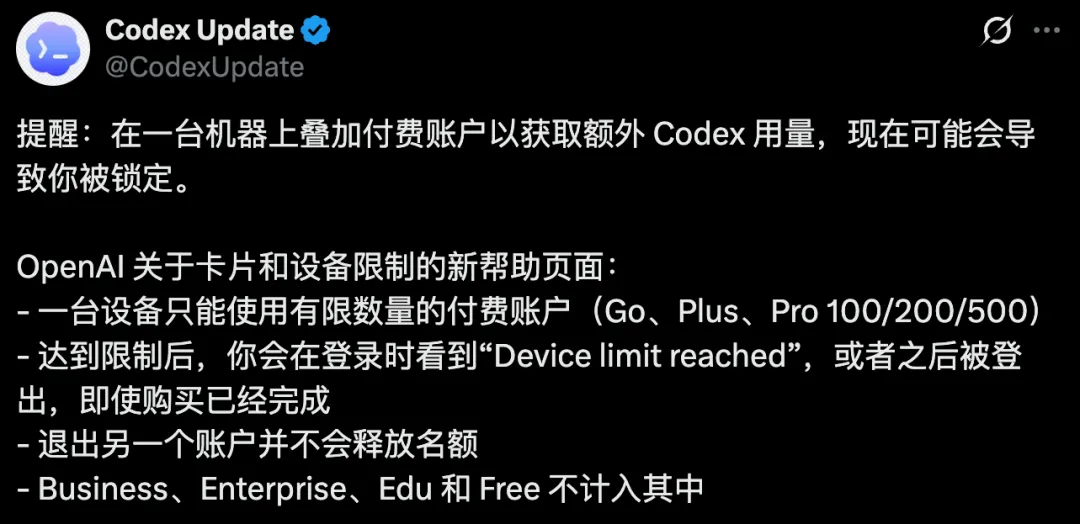
Almost at the same time, OpenAI also launched a strict "device-binding cap". A device is blocked if it binds too many payment accounts.
Now that all the web developers are overwhelmed, everyone is more concerned about the same monthly fee, how much more can you do?
 ChatGPT and Codex combinedShare a quota in December
Just 6 hours ago, the official OpenAI support page uploaded a new document file.
"Understanding the Restrictions on the Use of ChatGPT and Codex".
First, the quantity pool. Second, it is measured by Token. Third, it is instantaneous. Fourth, it uses only three rows.
This major change is intended to integrate the workplace's capabilities directly into the main ChatGPT interface.
This means that from December this year, the usage quota for the Plus, Pro and Business packages will be fully shared between ChatGPT and Codex.
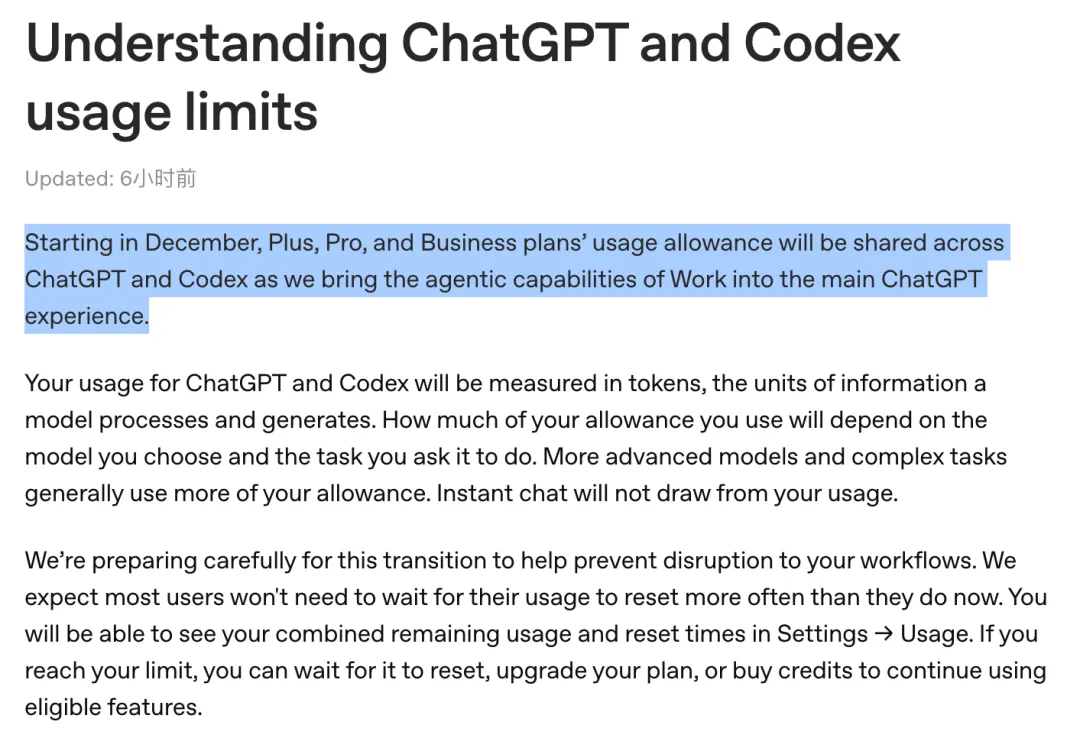
In the past, it was used to roughly calculate "how many messages can be sent in a few hours". By December, the scale had been completely changed to "Token measurement".
Officials have given a clear definition of how many quotas you consume, depending entirely on the model you choose, and the number of live ones that make it work.
Calling up more advanced models, executing more complex reasoning and long-code tasks, typically consumes more quotas.
In the case of OpenAI, there is still an unlimited supply of daily "instant chat" and no amount of casual chat.
As far as the quota is concerned, there are three paths ahead:
It's time to sit down and wait for a refresher.
It's about making money by upgrading to more expensive subscription ratings.
Direct extra credits are "lifelong".
After the merger, how many tokens can each of the Plus, Pro, Business classes get? How do you calculate the ratio of consumption between different models?
At the moment, OpenAI has not released any specific token quota figures and discount tables.
However, they specifically hit a "strength needle" in the document, promising that the original line would probably read:
The vast majority of people will not be charged more frequently than they are now.

That being said, in the major developer communities, heavy users have gone crazy behind their backs.
The developers' concerns are very real: the deep reasoning of the previous ChatGPT and the Codex's Agent run codes were different: well water didn't violate river water.
In December, the two sides shared a meal together.
During the day, we used ChatGPT to do a lot of in-depth document analysis, run a few complex Agent tasks, and in the evening, when we opened the desktop ready to rebuild the codex project, the system suddenly popped a window that prompted a callback.
Looking at the full-screen "quantitative anxiety", it's easy for a lot of engineers to say, "Slow down".
Next door Claude: It's been a while.Claude at Anthropic has been doing that for a long time.
The Pro and Max packages, which are shared between Claude Chat and Claude Code, have the same upper limit for all activities on both sides.
There's a lot of chat on the web during the day and less Claude Code on the terminal at night. And just yesterday, Anthropic just started its own package:
The original Max 5x was renamed Max and the monthly fee was still $100; the original Max 20x was renamed Ultra and the monthly fee was still $200.
The biggest change is that the 5-hour usage limit has been lifted through verified Ultra accounts, but the total weekly limit remains unchanged.
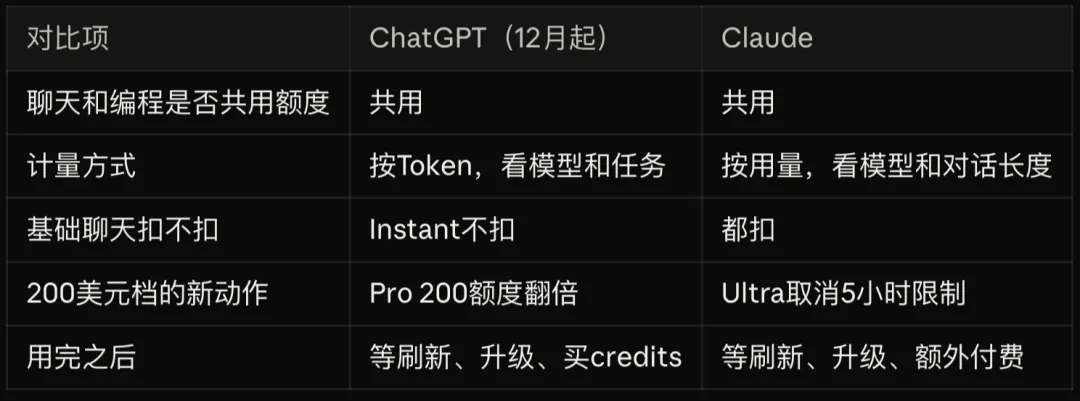
The two were put together, and the contrast was immediately clear:
 Within a week, OpenAI added three tricks
On October 30, Pro users' promotional quota multiples are about to be recalled, according to the previous transition plan.
At the time, the entire developer community was complaining, and many people even asked to unsubscribe.
As a result, Tibo, the head of OpenAI's Codex, suddenly switched on the "pollination mode", with a breath of fresh air:
Pro 100/200/500 Full Grade and Business Premium, which doubled in size.

While people were still immersed in the frenzy of "doubling the quota", an e-mail smoothly brought out the real backhand.
Chat and Work tag pages are about to be merged, and the ChatGPT and Codex quota will also be fully opened in the coming weeks.
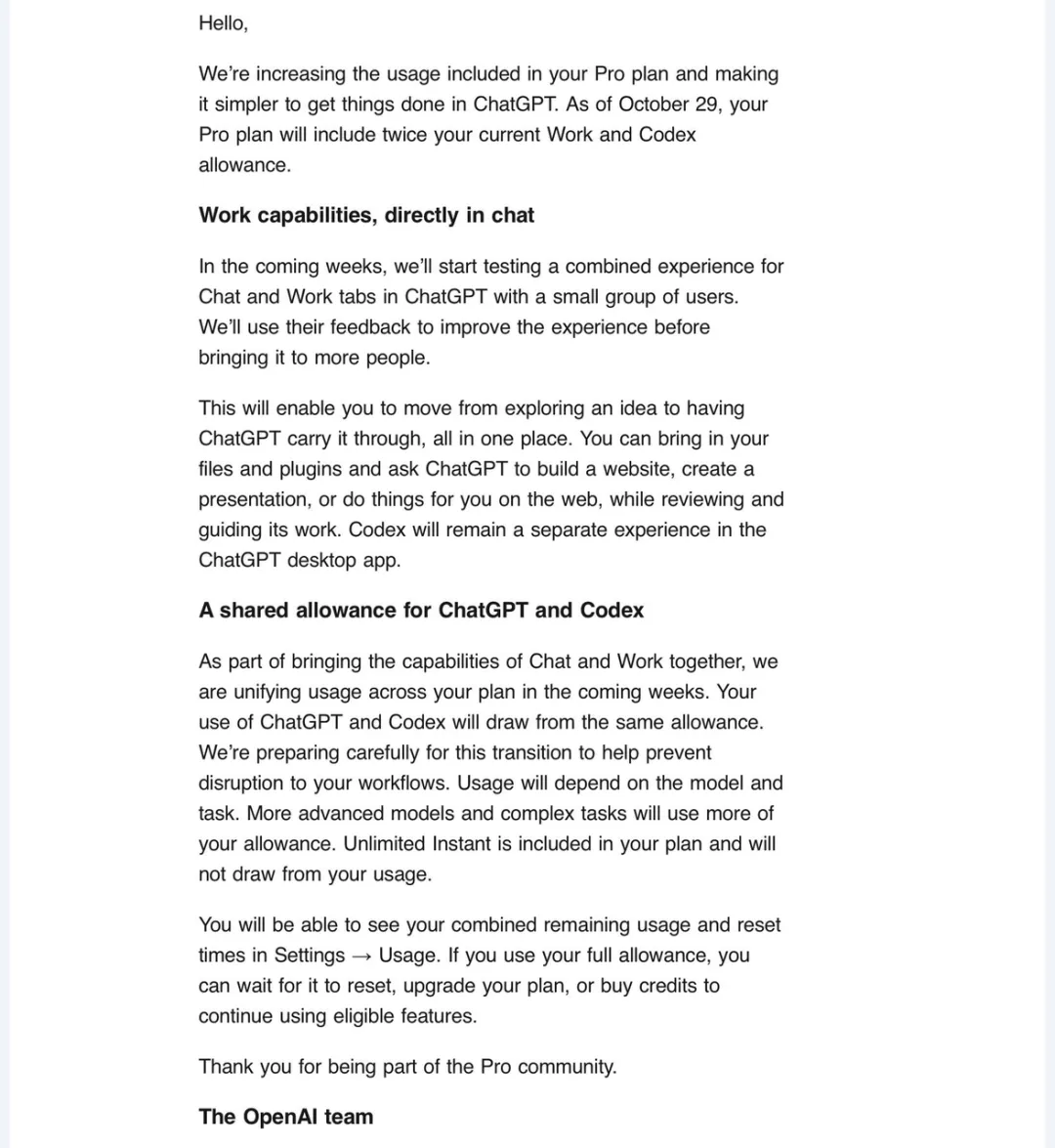
The email revealed that over the next few weeks, OpenAI will first test a whole new interface for "Chat and Work Integration" among small-scale users.
You don't have to jump back and forth between the chat box and the desktop to drag files and plugins right into the same place, allowing ChatGPT to help you build a website, do PPT, run tasks automatically on the web, and humans just have to review and guide you next door.
As for the Codex, it will continue to retain independent inputs in the ChatGPT desktop end of the App.
Just a few days ago, people noticed that the ChatGPT input update, the top "talking job" switch, disappeared.
This new feature, which came online in July this year, doesn't look ideal inside OpenAI.
President Brockman acknowledged in an interview that the new version of the app was a bit of a mess and promised not to have a separate Work label by the end of the year.

OpenAI operates in a way that is logically back and forth.
By the end of October, the pool had doubled in size, calming the anger of the community; in November, the testing interface was consolidated, and people developed the habit of frequently calling agents; and in December, ChatGPT and Codex were officially integrated into the same token billing pool.
Looking at toothpaste, people have already completely reconstructed this underlying logic of subscribing.
Restrictions on upstream equipmentIt's been a long time coming.Just a week after the announcement of the quota pool merger, OpenAI's opponents gave him the "multiple overlay" route.
OpenAI has launched a new hardcore rule for "device restrictions":
The number of paid accounts that a device can log in to now has a strict hardness limit!
The scope of impact: covers Go, Plus, and Pro's 100/200/500 full range of personal payments.
Exemption: Business, Enterprise, Edu and Free accounts are excluded from this device.
Once you've reached the limit of the payment number you're tied to on a device, you'll directly hit a freezing frosted pop-up window when you sign in.Device limit reached(It has reached the device limit) or is forced to shut down while in use.
Even if your subscription payment has been successful, you will not be able to log in.
Finally, the anti-Bug mechanism is to avoid thinking that "withdrawing from an A account, you can get a hole in the B account". The official document clearly states that logging in to an existing account will not release a new device number for you!
A lot of people who rely heavily on the Codex to write code or small workshops, who have previously been unwilling to directly buy the official expensive add-on package in order to break through the quantitative bottlenecks of a single account, tend to "overlay numbers".
That is, on a mainstream developer, while logging in several $20 Plus or low-end Pro units, the number runs out, and the next one goes on for seconds.
Today, this road is no longer possible.
"Reset the Company" graduatedDuring this time, Tibo's best operation was to give everyone a free repositioning limit of three to five.
The user shouted that it wasn't enough, and he came out and pressed Reset, and the comment section cheered.
But two words for "graduation" have already spoken out: the days of manual reset are over.
Instead, a cooler set of rules dictates that every token has a price, and every call is accounted for.
Subscriptions purchased are a mass-consuming "calculation wallet". From "random use" to "clearly calculated use", AI subscriptions are undergoing a bottom-up shift.
For heavy-duty developers, every time they call a high-end model, they have to memorize the arithmetic.
What are you going to do after December?