It's the first time in the history of the world.
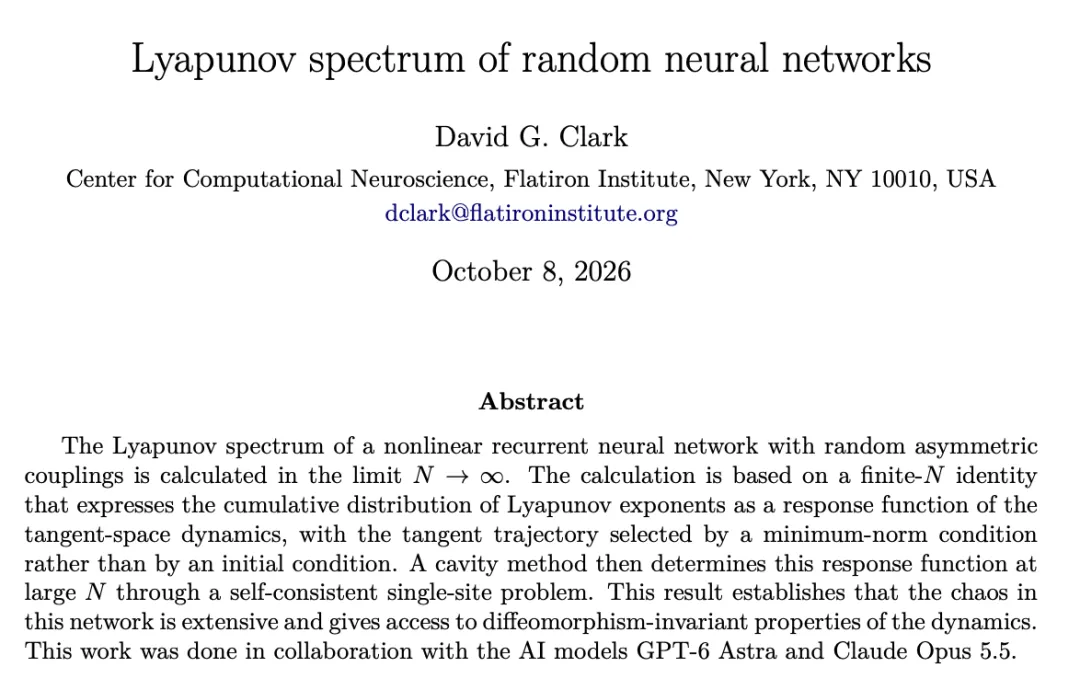
Recently, theoretical neuroscientist David Clark announced that he had successfully analyzed the complete Lipnov spectrum of the Sompolinsky 1988 model.
If you're unfamiliar with these dry academic terms, that's fine. You just need to know two things:
First, it is the most difficult bone in the field of theoretical neuroscience for nearly four decades, and is even widely regarded as "absolute insoluble in analysis".
Secondly,The main protagonist of this breakthrough was not humans, but the GPT-6 Astra, who was responsible for playing the supporting ending, Claude Opus 5.5.
In this groundbreaking theoretical breakthrough, human scientist David Clark is more like a "master clerk" and a "translator".
He tweeted: "In my collaboration with an AI model, I have achieved the most important purely theoretical breakthrough in the field of theoretical neuroscience so far!"
38 years of academic rebirth with Chaos ButterflyTo understand the GPT-6 feat, we have to go back to 1988 and look at the "Unu Cloud" that obscures the headlines of theoretical neuroscience.
When it comes to "chaotic systems", the first word that appears may have been "chaotic systems"."The Butterfly Effect"A butterfly in South America could have sparked a tornado in Texas.
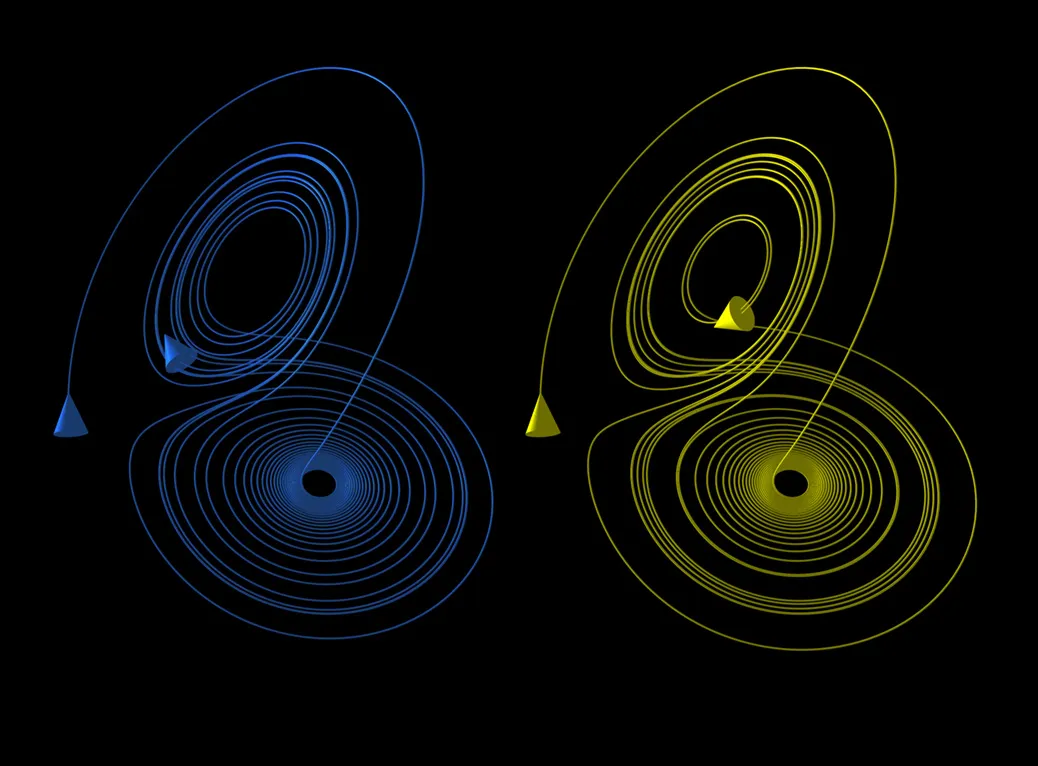
In mathematics and physics, this means that the system is extremely sensitive to initial states:A small disturbance will increase exponentially over time.
But the question is, how fast is this disruptive growth?
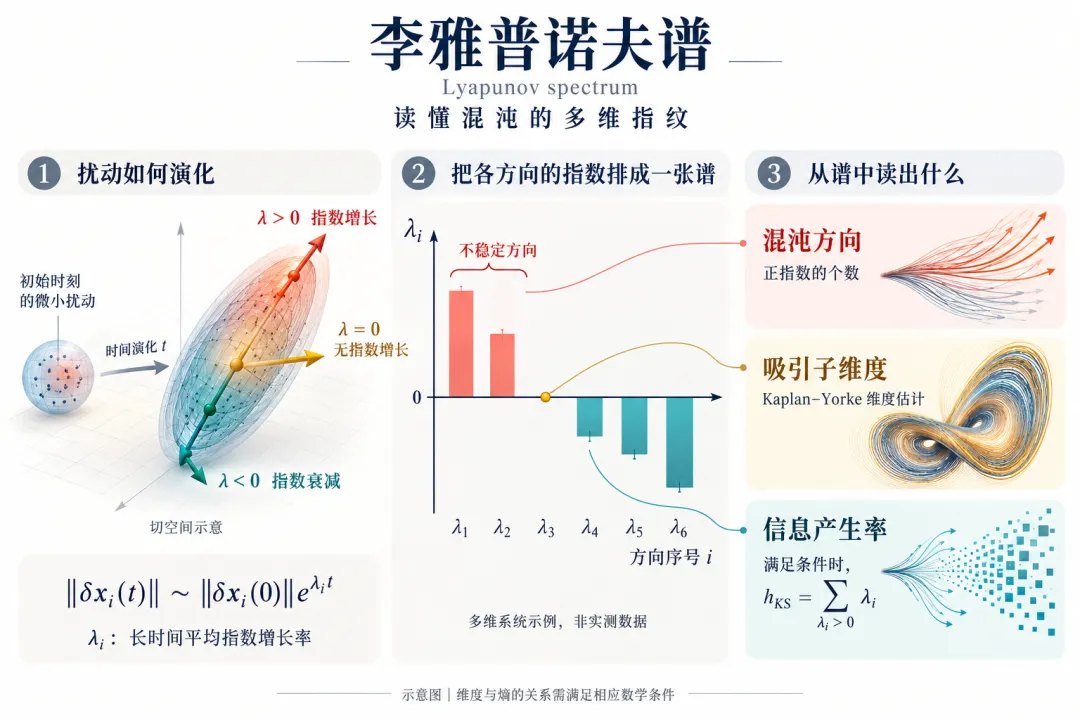
In multidimensional space, perturbations have different growth rates in different directions.It's called the "Leapnov Index".(Lyapunov exponent)。
And when all the indices in all directions are put together, it forms an ultimate map of the whole system of chaos.The Lyapunov spectrum is the spectrum of Lyapunov spectrum.
This "spectrum" is like a "gene sequence chart" in a chaotic system.
It can tell us how many dimensions the attractor occupies and how fast the entire system generates information.
To hold it is to hold the key to silence the chaos.
In 1988, three masters of science, Sompolinsky, Crisanti, and Sommers, presented a model in the Journal of Physics Review: a nonlinear cyclic network composed of N randomly coupled neurons.
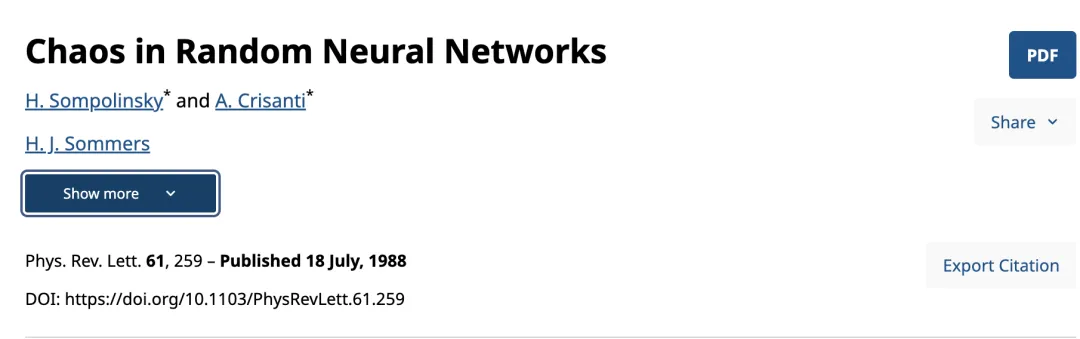
They found that when the intensity of fusion between neurons exceeds a certain critical value, the network is instantly thrown into a state of "chaos".
When this model came out, it became theoretical neuroscience.Absolutely a foundation stoneFor decades, it has been used not only to simulate the spontaneous activity of the human cerebral cortex, but also as the starting point for training various artificial neural networks (RNNs) today.
But this divine model left behind a "gigantic crater".
In that 1988 paper, the three monkeys calculated the "greatest" Lyapunov index by solving the fundamental energy of the Lyapunov equation."How to Calculate the Complete Liyappunov Scale"As an open question, it is left to the latter.
This lasted for a total of 38 years. Until 2023, Engelken and others used powerful arithmetic to calculate the entire spectrum using the "numerical method" (violent computation).
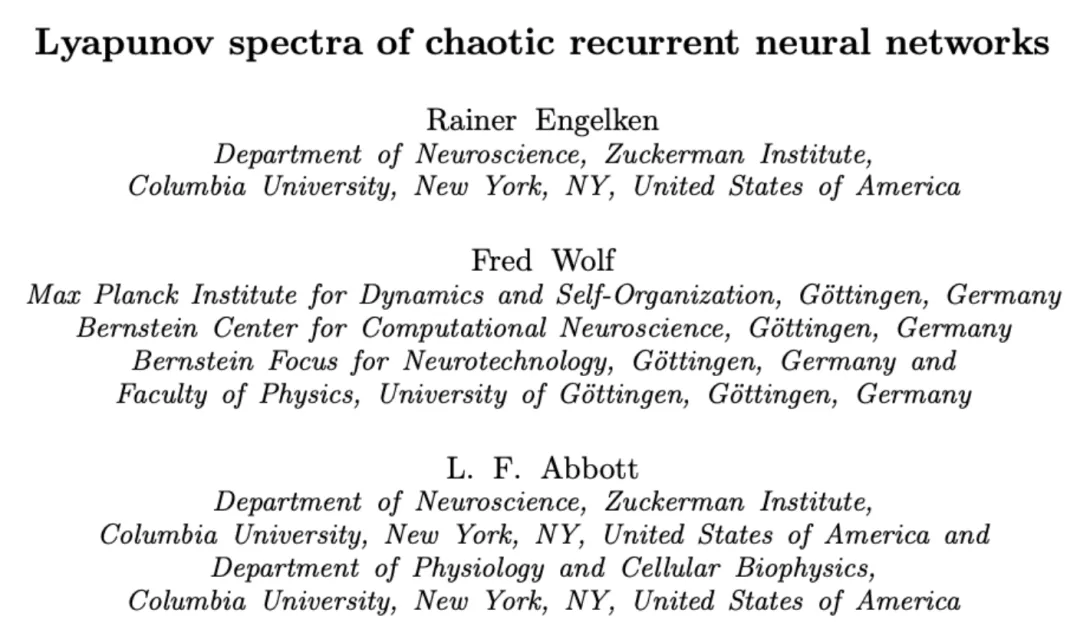
However,"Number computation" is not the same as "parallel derivation".。
The general consensus among academics is that a complete solution to this high-dimensional system of chaos should be written that "human power is almost impossible".
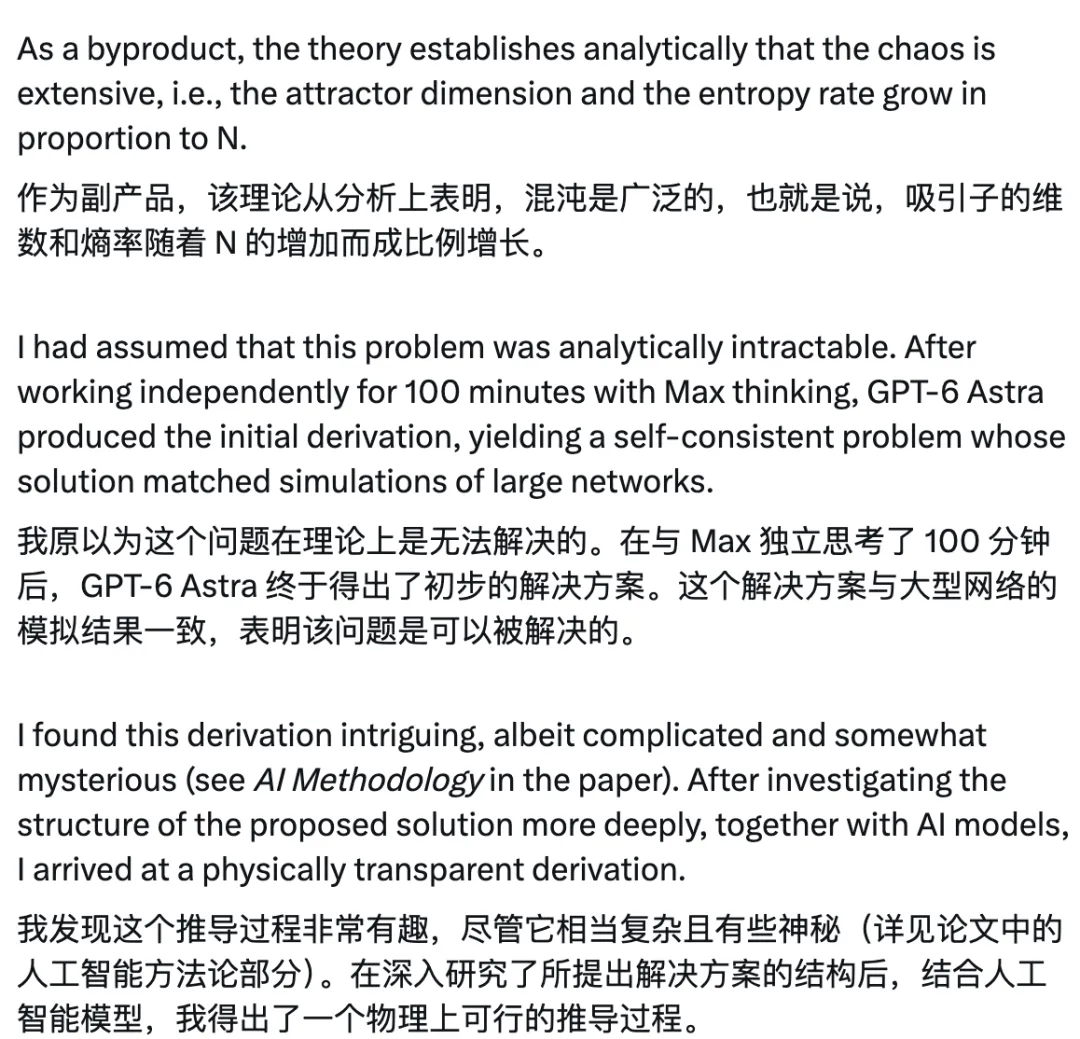
Even David Clark, when he first began his research, said by default that "the problem is analytically completely intractable" until he awakened GPT-6 Astra.
GPT-6's 100 minutes of "Deep Madness".When human intuition and intuition touch the ceiling, life on Earth exhibits a monstrous dominance.
David Clark decides to kill the horse as a live horse doctor. He considers this problem to be "unresolved" and gives the GPT-6 Astra a "Max" mode.

Subsequently, GPT-6 went into independent operation for up to 100 minutes.
Finally, the GPT-6 Astra gives its answer:A complete and exquisite preliminary inference process. It unravels a self-contained problem, and the solution to this problem fits perfectly with the simulation results of large network supercomputers!
David Clark was stunned to see the complex mathematical formula spat out on the screen.
He writes bluntly: "This is a fascinating process of induction, although it is complex and even involves a certain kind of manipulation"."Somewhat mysterious" 。
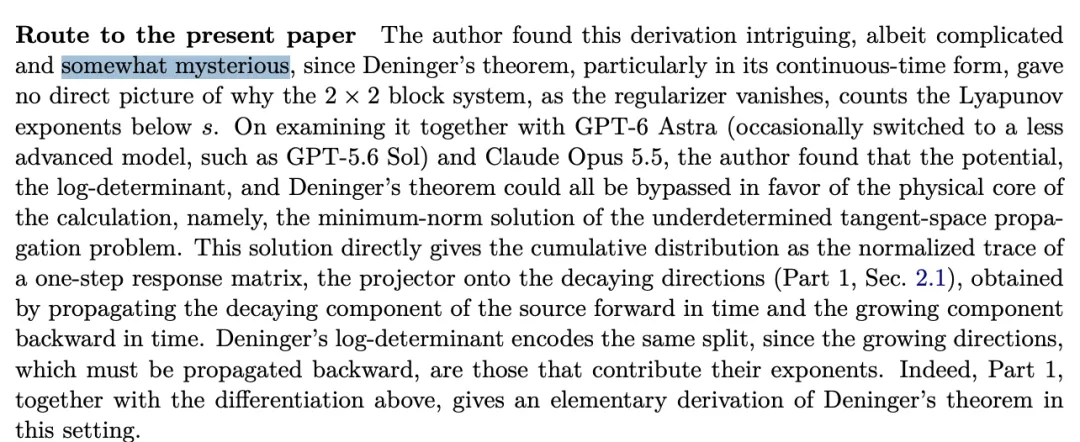
To help you understand how much God exists in GPT-6, let's try to use the language that humans can understand to unravel this astonishing three-step strategy of AI:
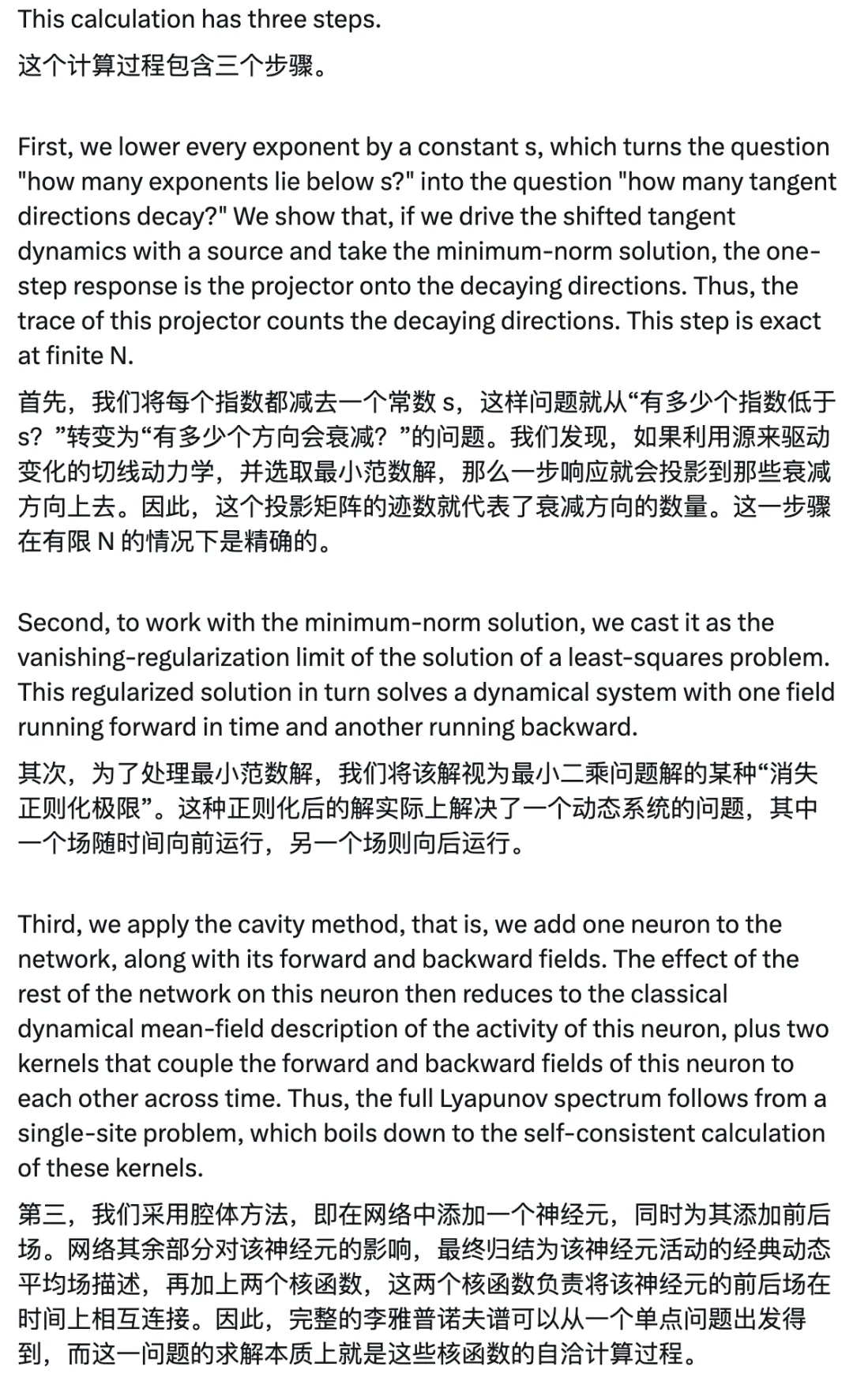
Step one: decrease the size of the shift, using the "minimum parameter solution".
It is very difficult to calculate the number of indices directly.
GPT-6 goes the other way around. It subtracts all the indices from a constant s. Thus, the complex question of "how many indices are less than s" was cleverly transformed into the question of "how many tangent directions will decrease".
It then uses the dynamics of the source field to move, taking the minimum-norm solution, and directly demonstrates that a one-step response is a regression projection algorithm!

As long as the "trace" of this arithmetic is calculated, it directly counts the number of decay directions. This step, under a finite N neuron, is absolutely accurate!
Step Two: Breaking the Barriers of Time
In order to deal with the extremely complicated "minimal frequency solution", GPT-6 created a highly fictitious mathematical deformation: it solved the smallest frequency and transformed it into the time limit for the normalization of a minimal binomial problem to zero.

This ultimate solution is actually trying to solve a strange power system.One game evolves "forward" in time, and the other game evolves "backward" in time!This mathematical operation, which broke the uniqueness of the time arrow, demonstrated AI's supernormal understanding of high-dimensional dynamics.
Step 3: Final elimination of the Cavity Method
Finally, AI introduced the classic trick in statistical physics, the "empty method". Imagine forcing a new neuron into this chaotic network, along with its "forward and backward field".
The rest of the system's effects on it were perfectly reduced to the classic "dynamic average field", plus two time-crossing "nuclear kernels" that intersect back and forth.
Meanwhile, an unsolved chaos system containing N neurons was forcibly compressed into a "single-point problem" by GPT-6!
As long as these "nuclears" are self-deprecating, the complete Lieppinov spectrum is like a capsule!
Seeing here, you may already have a fog of water.
Don't worry, not only you, but even David Clark, a top scientist at the beginning, was a bit nervous about this set of "alien mathematics" given to GPT-6.
At this point, the second great god of AI came to the scene.Claude Opus 5.5。
With the help of Claude, David Clark and AI models analyzed in-depth the "mysterious" decipherment structure proposed by GPT-6. They finally translated this "basic language" into a set."Physically transparent, logically beautiful".The process of human induction.
This ultimate result even easily replicates the results of the complex Tetris equations of the original authors 38 years ago.
In addition, there is a "byproduct" of this theory:The dimensions of the system attract and the speed at which it generates information, and the number of neurons increases exponentially!
When this paper was posted on Arxiv, the entire theoretical scientific community fell asleep.
Previously, we only knew that AI could draw, write code, chat with people, and even fold proteins through massive amounts of data. But those are essentially "data-driven" pattern recognition.
And this time, the nature has completely changed.
It's a pure theory! It's a rigorous mathematical derivation! It's a hard-core analysis of physics without any data cheating space!
GPT-6 Astra has no knowledge of "reciting", but of finding a whole new path to truth in a dark forest where no man has ever set foot.
Are theoretical scientists worried about this reduction?
As David Clark shares at the end of his tweet: "Many in the theoretical science community are anxious about the rise of AI, but I'm excited".
Because the human brain itself is the most complex high-dimensional non-linear dynamical system known in the universe.
For thousands of years, we've been trying to understand how the brain processes information, how it learns, how it generates consciousness and behavior. But faced with billions of neurons and messy synaptic connections, human brain capacity and traditional mathematical tools, it's like looking at the galaxy with a magnifying glass.
"At least in my area -- neuroscience -- we're far from fully understanding the high-dimensional computing that's unfolding in our brains", confesses David Clark, "but now, with the intervention of AI, we're finally hoping to reach a level of understanding that we've only been able to 'hide expectations.'"
100 Minutes, GPT-6 not only broke 38 years of human-science deadlock, but also paved the way for the future: the future Nobel Prize in Physics, the Feltz Prize, etc., will likely be awarded to the "carbon-based translators" who work best with AI.