"From a global resource allocation point of view, letting everyone put a shortage of DRAM on their computer for most of the time is a 'quite terrible' arrangement, and memory should be concentrated in cloud data centers".

It's all over the place.
In an interview with YouTube channel Cheeky Pint on Thursday, Sam Altman, CEO of OpenAI, drank beer all the time, and the atmosphere was easy to talk about the local logic of the big AI model, and the lack of memory on the extended home computers that led to the accidental explosion.
We know that the rise in memory prices triggered by the current global wave of AI has pushed the price of PCs and mobile phones up a notch, which individual consumers have long been unable to afford. At the same time, the expansion of the capacity of large memory factories has to wait a while.
Ottman mentioned a hypothesis that people could run local AI on their own computers, which might be computers they already have, or maybe because of the rise of AI big model technology that they want to assemble. He thought it was a bad idea.
"From a global resource allocation standpoint, it's really bad for everyone to have limited global DRAM memory on their computers when the utilization rate is only 5 percent", said Ottman. "If you want to work in an environment where the supply of resources is extremely tight, the cloud should improve resource utilization as much as possible.
OpenAI's main business today is based on a closed-source model run by large data centers, which has sparked controversy in the AI community for its own business model.
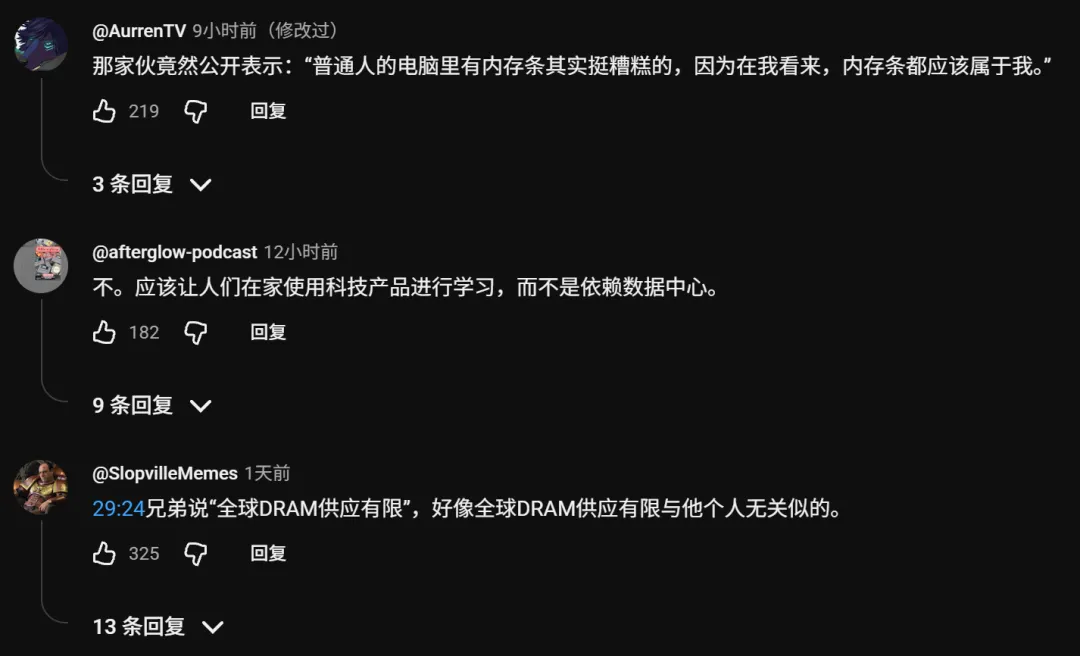

This has also raised concerns that in the future it may be more difficult for us to own our own hardware or software, and only consider renting smart phones and computers in the cloud.
Although the memory used by ordinary PCs, mobile phones, and AI accelerators is not the same, their production will compete for upstream wavelength capacity. Ottman discusses the resource allocation of DRAM globally to talk about who is eligible to decide where and most of the time is the user who will naturally order the larger one.
Some of Ottman's views are based on the assumption that the construction of data centers will not slow down. In addition, he assumes that the memory of AI data centers is more valuable all-weather than that of spreadsheets, web browsing, games, and even occasional memory for local AI.
In fact, the interview was a long one, and Ottman talked about the PHP vulnerabilities that sparked the global panic in the last two weeks, the sandboxing of training models, and research into AI in mathematics.
He said: "I'm sorry, but I don't know.
AI is blowing up a loophole.
With regard to PHP's super-massive vulnerabilities, Ottman's judgment was that the ability of large models to detect vulnerabilities continues to improve rapidly, while the code landscape on the Internet is enormous, and that when people start systematically scanning all code with AI, "we'll find ourselves in a world where a serious vulnerability far exceeds expectations". He believes that light patches are insufficient and that the architecture, routers, operating systems, and application layers need to be reconstructed for a "more intelligent redesign of the world of vulnerabilities".
He rarely criticizes himself in the industry: "I don't think we're very good at explaining to people why all the potential downside risks of this technology are worth it". He says that the narrative of the AI industry is poor sales rhetoric, with promises to cure cancer, reduce costs, and depict the future of unemployment, uncontrollability, and the need for strong regulation.
Asked if a "highest-security-level prison" could be built for the model, Ottman responded pessimistically: Sandbox is only effective to some extent, and monitoring (including mind-chain review and activation monitoring) can go further, but ultimately requires a high degree of trust in alignment. He replied, "Do you really trust a sandbox that is a million times smarter than the smartest security researcher who can discover new scientific models that humans don't yet understand?"
He explicitly said he hated the term "agent swarms" because swarms were similar to worms, insisted on the name "agent teams" and believed that the mutually balancing properties between teams were the safest direction to take against a mechanism that relied on pluralism to achieve robustness.
The cost of intelligence explosion and scientific discovery
In the GPT-4 era, it was difficult to spend $1 on a single problem effectively; the chain of thought enabled the model to "think powerfully", but now we can align an entire team of intelligent beings a thousand times. The usage gap between ordinary users and the most advanced users is increasing.
Regarding how computing power is allocated within OpenAI, he said employees enjoy great freedom, but never reward high token consumption, "the high token rankings are actually a little lost, certainly not a reason to be promoted". Proof of the Navier-Stokes equation was brought to him as an example: a single proof costing about $10 million, during which "a week was out of control because people didn't know the rules for the expansion of a team of smart entities at the time. But he expected a year later to do it again with smarter models and methods, costing 1/100".
He also rarely expressed his emotions: the situation was so bad that, on the weekend when a new model went online, people threw all kinds of tricky problems into the model, and it was able to solve them one by one. People had never expected the model to do this.
"There were two nights when I slept almost all night, because I was so excited that I couldn't sleep at all. Many of the results we published later were actually the problems that were solved at the time".
At the same time, Ottman felt unexpected excitement and joy, as well as unexpected sadness, grief, and a sense of "an age is coming to an end". Not only was he nostalgic, but there was also a sympathy for human scientists' "good tidings, dead ends". He insisted that humanity should have basic knowledge, but the industry owed a solution to practitioners in these fields.
While it's too early to talk about superintelligence, Ottman believes that trillions of tiny superhumans outnumber a trillion IQs:
"I would much rather intuitively have a trillion AIs of slightly superhuman intelligence join society than one AI of one trillion IQ join society."
"Intuitively, I'd rather have a trillion AI with slightly superhuman intelligence joined society than a trillion AI with an IQ".
His argument was that the strong resilience of society comes from a large number of members balancing and cooperating with each other, and that the "one-minded" world does not have this resilience.
What about market regulation and AI?
On the global memory shortage issue, Ottman describes the layout of OpenAI: self-developing chips, improving smart performance per watt, self-building data centers, robotic projects, and a bolder concept, "self-replicating data centers", to use AI to control robots to run waffles, build turbines and solar panels, and build data centers.
Talking about why "market self-regulation" has been delayed, he believes that the current progress is bad and gives the logic of memory manufacturers: the industry is a long-term investment of $20 billion in capex, a $1.9 billion bitter business, and several times in history that giants have been on the verge of bankruptcy due to overbuilding factories.
He distinguished between the two types of capabilities of the chip industry: lighting "seems like only one company in the world knows how to do it", but chip design (which eventually sends the files to the Wavelength Factory) has become the ultimate weapon of AI.
Talking about the real level of recursive self-improvement (RSI), Ottman said that the model can now accomplish tasks like "looking for a 5% computational efficiency improvement", but no one knows how to get AI to discover a new architecture at the level of a transformer, where there is a shortage of smarter models. He even predicted that society might have to agree for a while to limit the intelligence of a single model, saying, "If the future progress is poor, it will come from this decision, not AI's ability to do research".
He highlighted his belief in decentralization: The current cost of every 5 GW of leading AI computing is about $70 billion, which would be more ideal if it were reduced to $20 billion, while the model would be upgraded 10 times more every year. The path to achievement is to make energy cheaper, compressing the layered arrays "from sand to token output".
He believes that the current more prevalent problem with token budget concerns is that AI is not used enough, not too much.
What is the price of an individual's smart body?
With regard to the most recent hot personal smartphone products (such as Muse), Ottman's current judgment is that "the Macintosh is not here yet". People like these products, but not yet "unimaginable without it", and the winner will look like the current product, but "it'll just work", reliable, capable of handling more complex tasks.
When it comes to the commercialization of smartphones, Ottman believes that companies are stuck with the AI pop-ups and HTML in their products, fearing that they will lose customer relationships, but consumers want AI to replace everything in their main chat applications. He believes that the real shield river comes from brands, products and delivery networks, not HTML. He actively exposes himself: he has chosen Amazon Pay 10 times, even if the price is higher, and praises Amazon's delivery network, while acknowledging that the collaboration platform within ChatGPT is not doing well enough. He also calls all the web forms "fake work", and compares the current analog to the App Store era of the time.
That's why, when it comes to design pricing, OpenAI is studying AWS's approach to task-based pricing, completely abandoning token billing, but has been strongly opposed by customers: "I need to know why I'm paying", and even if I pay more, this understandable unit of token.
References are given below:

© THE