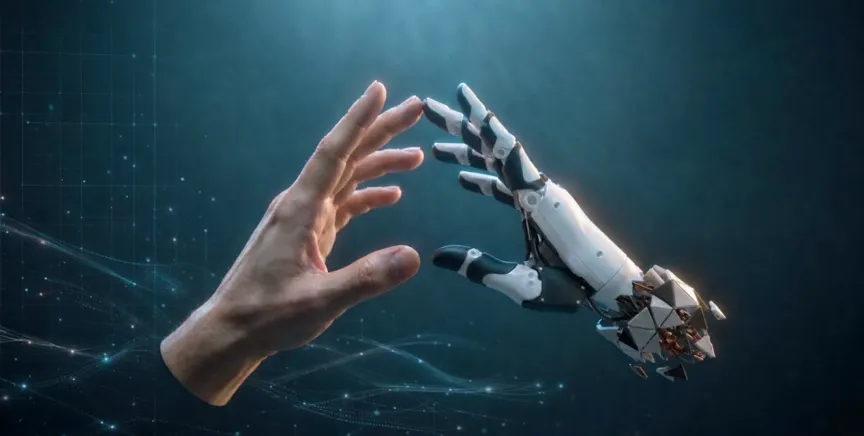
“ Simulating the bioscale grid, creating a balanced soft touch skin.
This is one of the core shortcuts of human robots today.
We humans reach out and grab things without having to look at them, and finger-touching tells us how much energy to use. But for human robots, this innate ability remains a problem today.
Vision can locate objects, but it is not soft and hard to distinguish. For this pain point, the mainstream breakdown in the industry has been transformed by the sensory functional layer itself. Recently, the head of the Institute of Human Robotics Research at the Chinese Academy of Engineering and Technology, University of New South Wales, University of Sussex, University of Wollongong, Northwestern Industrial University, and a research team have jumped on the inherent idea of material improvement.
Instead of modifying the core functional materials of gels and electrodes, they added a new layer of direct printed gradient lattice between the electrode and the ion gels, achieving gradual contact regulation, simultaneously with high sensitivity and broad-linear measurement.
01.
The challenges of the century of limitations of vision and touch
Today's robots, with large-scale models to identify objects and plan their paths, are no longer a technical problem. But once the smart hand really touches the physical world, the inherent defects of vision are exposed.
The mechanical arm causes a sharp decrease in its ability to detect under shadows, dark light, and fog; more troublesome is the appearance of almost the same silicon-elastic body, which is completely different from the actual soft hardness, and the mechanical differences that the camera cannot fully distinguish.
Humans use their fingertips to solve this problem. Mechanical sensors distributed under the skin can convert pressure, vibration, and sliding into neural signals, and we pinch eggs and bottle caps, all relying on touch feedback to regulate grip in real time.
However, the field of flexible touch has been deeply embedded in the difficulty of making triangles impossible. The three core indicators of sensitivity, linear measurement, and linearity are elongated and difficult to pull together.
Off-voltage sensors are currently a highly potential technological route, relying on the nano-dual electrode layer effect between ionic hydrogels and electrodes, and are inherently highly sensitive. However, it has a fatal flaw: once the contact area is aligned, the signal is quickly flattened, and the pressure loses its ability to distinguish slightly.
In the past, the industry's solutions have mostly focused on transforming the sensing function layer. Complex microstructures are made on the surface of the water gel, stacked with elastic gradient layers of different moulds, although the scale can be extended, but depends on the pattern, folding, multi-layer bonding, the process chain is heavy, and large-area arrays are difficult to prepare.
02.
Impersonate gradual contact with a grid that mimics the distribution of finger-point sensors
In order to jump out of the process of functional layer transformation, the team looked for ideas from human fingerprint sensing mechanisms.
The distribution of the mechanical sensors at human fingertips is not uniform, the center density is high, gradually decreases outwards. The light touch center sensors respond first; the pressure increases, the actual contact area expands outwards, the peripheral sensors gradually participate in perception, naturally compatible with weak touch and high pressure two working conditions.
Inspired by this mechanism, the team selected the Dragon Skin 20 Series, which uses the direct-writing printing process to create a gradient grid layer. The grid consists of three layers of symmetric circles, with a diameter of 4 mm, 8 mm, 12 mm, a line width of 100 μm, a thickness of 100 μm, and a porosity gradually enlarging from the center to the outside.
The mesh size is higher than that of ion gel. When pressurized, the gel is bounded by the mesh border and can only be pulled upwards from the position of the mesh hole to contact the upper electrodes. The contact is initiated from the center hole; the pressure continues to rise, and the contact area expands outward along the diameter of a circle. Limited meta-imaging and optical observations have confirmed this gradual contact behavior.
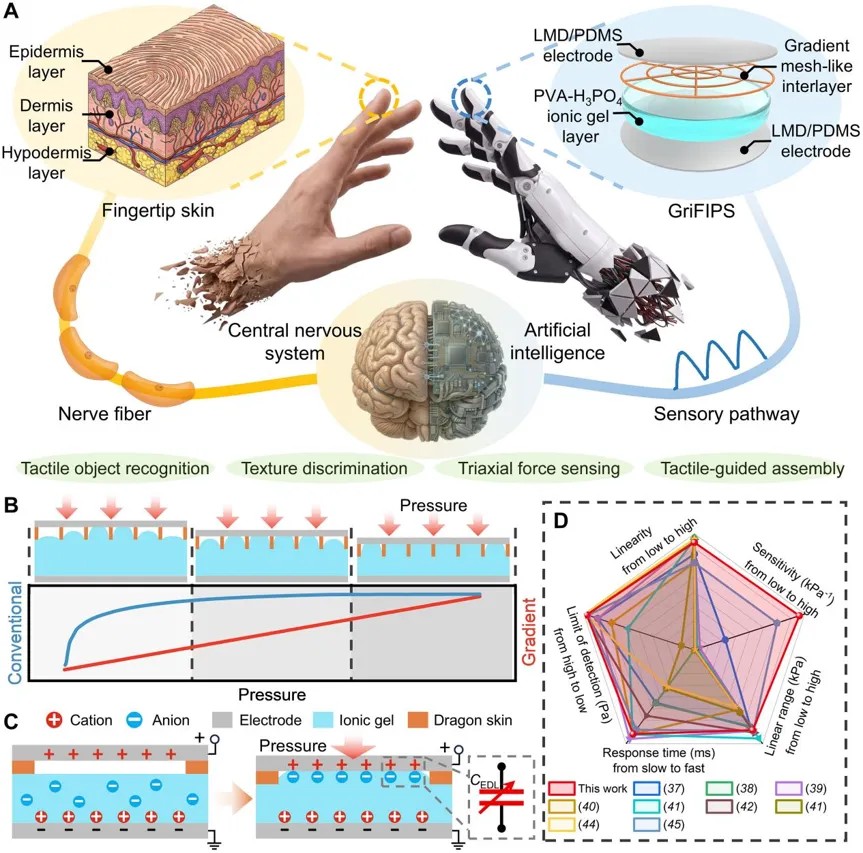
The design and operation of the gradient-based flexible off-electrostatic pressure sensor (GriFIPS) inspired by mechanical skin sensors.
The macroscopic gradual contact with the grid alone is not enough to suppress the two-strata silicon. Another key to the device comes from the liquid metal composite electrode.
The electrode is composed of lithium liquid metal and PDMS compound, which is insulated in the initial state; after ultrasound combustion, the metal liquid droplets merge to form a conductive pathway, while producing a microscopic rough structure on the surface. Control experiments have shown that smooth copper electrode signals are very easy to melt and that rough liquid metal electrodes can maintain continuous changes in capacitance in the wide pressure range.
The whole set of devices forms a two-dimensional synchronization mechanism. The macro contact range is regulated by gradient grid geometry, and the microscopic contact interface relies on electrode surface microstructure optimization, both of which synchronize to delay capacitance.
Medium radiation band density, 100 μm thickness grid, achieved the optimum balance of sensitivity and high-pressure linear response through multi-group parameter comparison.
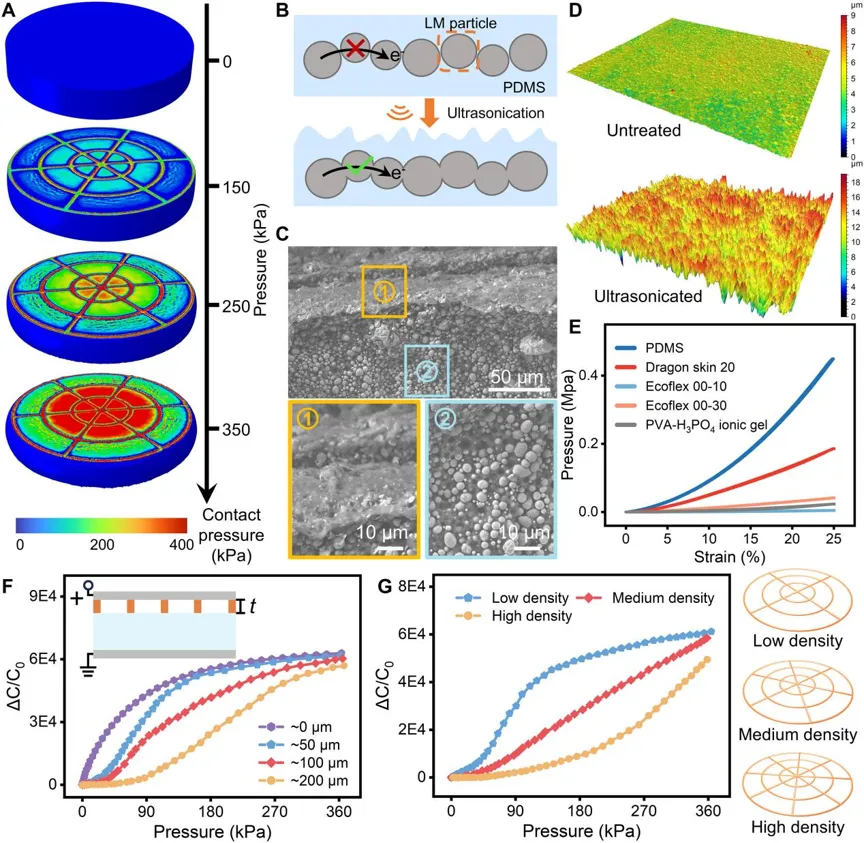
Design principles and material foundations.
03.
Microscopic perception of worms covering the touch area of the human hand
Named for the GriFIPS sensor, it measures core performance under laboratory control: sensitivity of 175.9 kPa−1, linear detection of about 360 kPa, fit range of up to 358.2 kPa, and determines coefficient R2 = 0.997; pressure detection of about 2.1Pa, roughly equivalent to the weight of a worm, response time of 25ms, recovery time of 50ms.
The natural range of human touch perception is about 0.1-100 kPa, measured at 2.1Pa-360 kPa, covering the entire range of human touch, with sufficient excess quantity.
In the actual operating scenario of the robot, when grabbing heavy objects and operating tools, the local pressure of the fingers can reach hundreds of kPa, sufficient high-pressure measurements, which can avoid the direct loss of the signal under high pressure.
The stability test also yielded good results. After completing 6000 loop loads at 150 kPa pressure, the signal output remained stable; after 2000 cumulative 50% width stretch cycles, the sensor response and initial state at 200 kPa pressure remained essentially consistent; five independently manufactured devices performed consistency well.
It is also worth noting that even under high static pre-load of 100-300 kPa, the sensor is still able to detect small pressure fluctuations of about 40Pa, and the faint signal will not be overshadowed by the large base pressure.
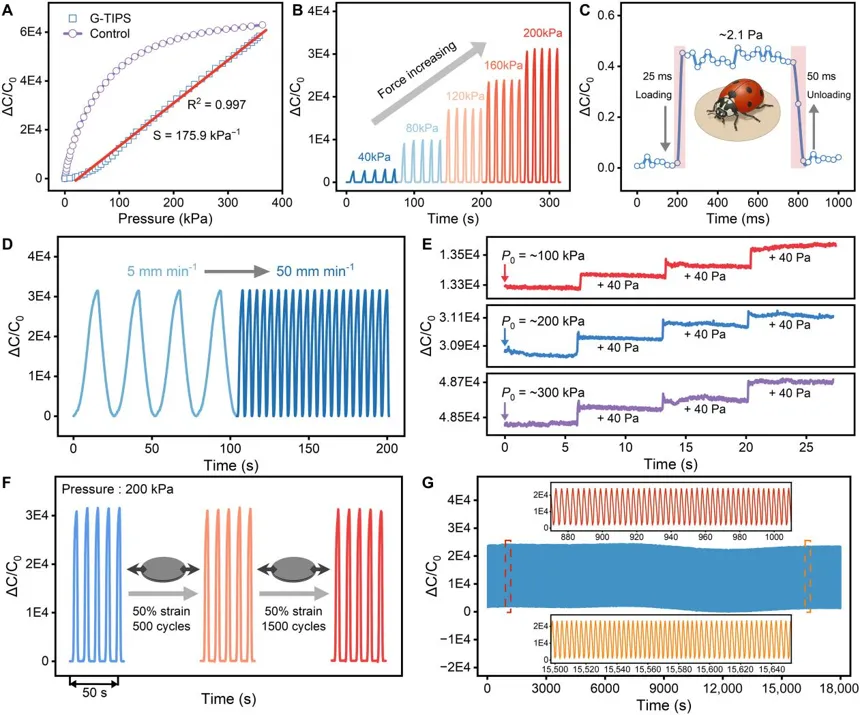
The static and dynamic sensing performance of GriFIPS.
04.
Flexible integrated tests: achieving material recognition, texture recognition and multidimensional perception
The team integrated the sensors into the fingertips, collecting circuits and TCN timing neural networks to analyze tactile signals.
In 14 different material-identification experiments involving iron blocks, sponges, soft hardwoods, bubbles, fabrics, concrete, etc., the accuracy of identification of samples in the 1,400 group tests was 99.86%. The replacement of a completely new sensor collection did not modify the model, and the accuracy of identification remained 97.5%, with good cross-device generalization.
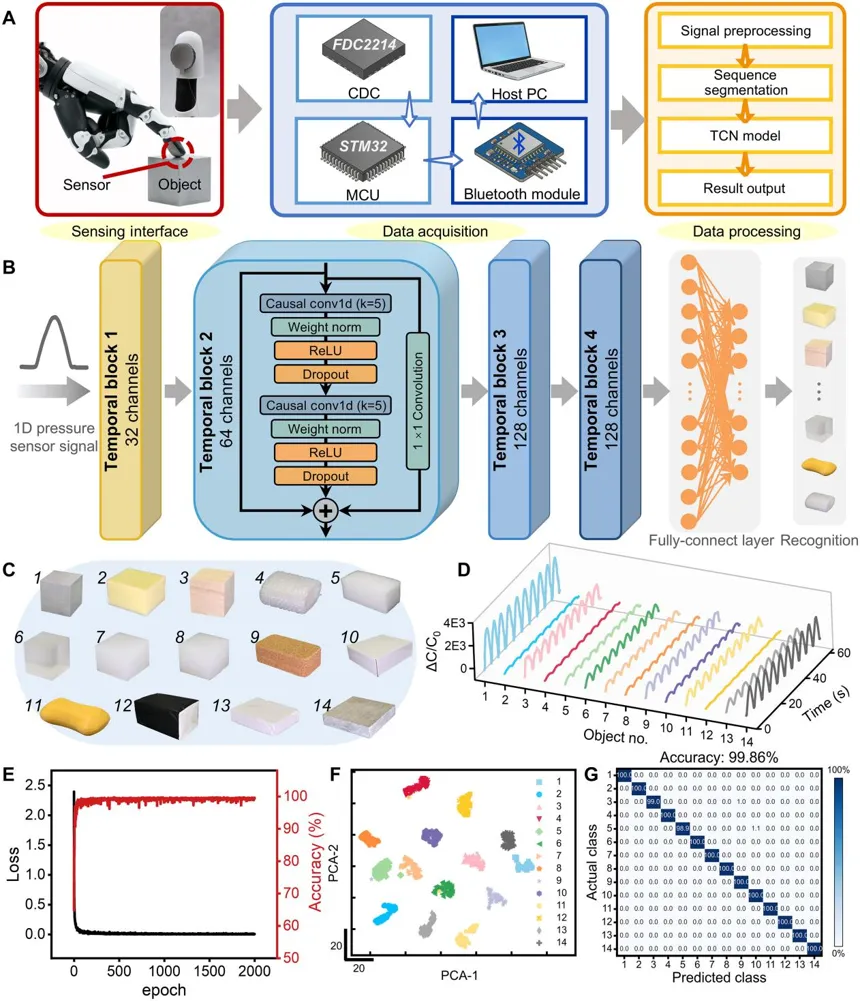
GriFIPS is used for tactile object recognition on finely machined hands.
Based on this, the team cut the electrode laser into a four-square structure, coupled with a helium hemisphere contact head, developed a three-axis force sensor, which analyzed the three-way force of X/Y/Z. The vertical method is to force, the four-way path signal rises simultaneously; the hemisphere slopes when the cutting action occurs, and the angle of the path signal increases and decreases, thus determining the size and direction of the external force.
The study also used sliding scans to perform textural classification tests, specifically for 12 real fabrics such as Oxford cloth, lamp core cloth, cow's cloth. The results showed that, depending on four-way multi-dimensional tactile information, the classification accuracy was 99.72%, significantly better than the single-way signal program of 76.81%-83.19%.
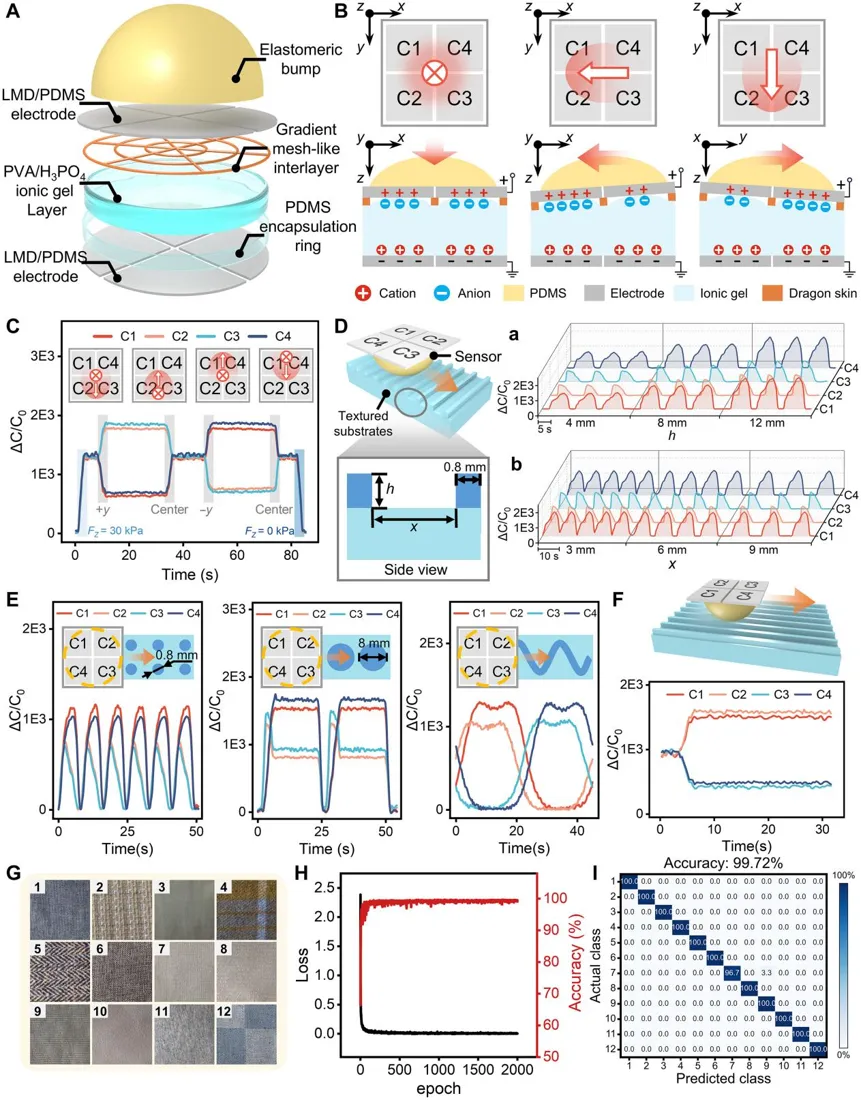
Three-axis GriFIFS is used for three-axis sensing and texture recognition.
Based on the three-axis touch signal, the team completed a demonstration of three sets of robot functions.
Grabbing the burning glass gradually adds water, depending on the weight of the cutting signal sensing the container changes; the human hand sideways to the drawer is grabbed the parts, the robot autonomously loosens the tactile capture of the external force; the blind hole assembly test, the parts encounter 15 ° inclined blind hole generate directional resistance, the robot stops backward after detecting resistance, and encounters vertical blind hole is inserted smoothly.
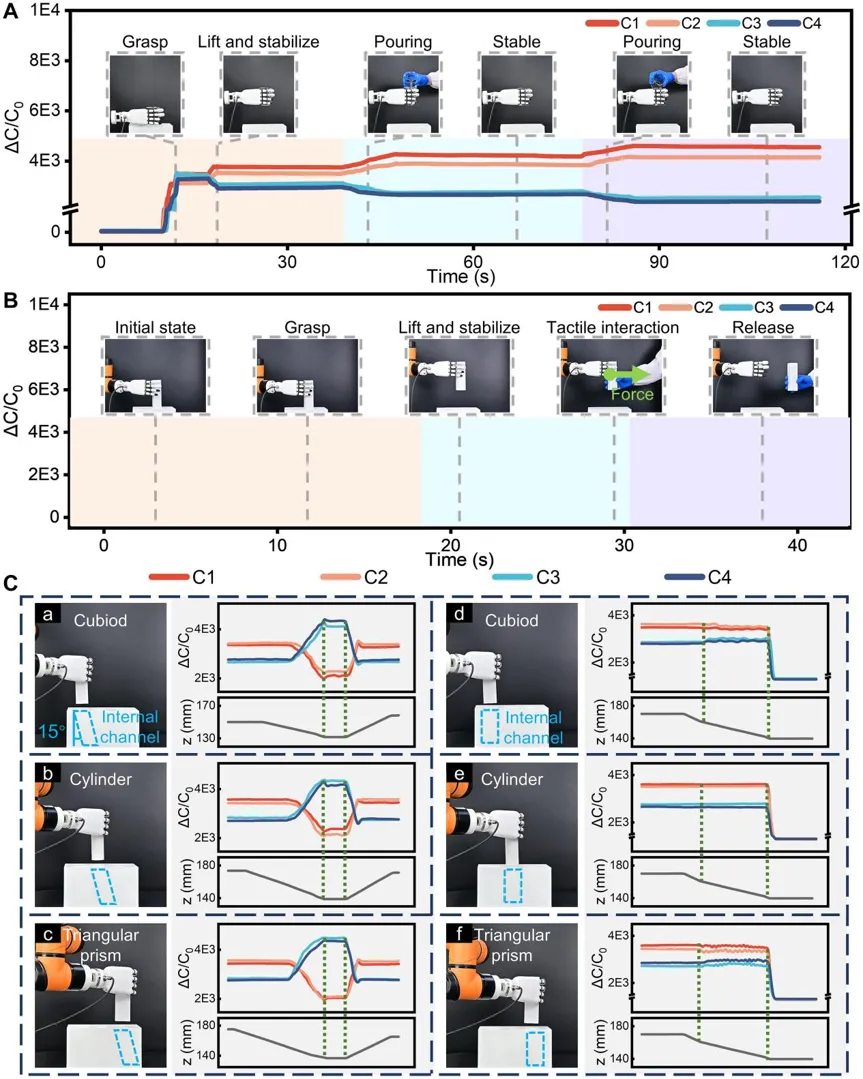
3 axis GriFIFS is a robotic application in crawling, human-machine interaction and tactile guiding assembly.
05.
The Future and Limits
The central highlight of this work was not to refresh the performance thresholds of a single unit, but to provide a decomposing silicon design idea: to make the gradient control structure an independent silicon layer, no longer embedded within the sensor function layer.
This set of design ideas is generic and has similar relevance to pressure-resistant and ordinary capacitance electronic skin; the direct printing process also provides new pathways for low-cost production of large-area touch arrays.
The paper also objectively lists the shortcuts of the current scheme: the grid parameters are currently only three degrees of discrete contrast, lacking full-parameter space optimization; the current stage is the flat grid structure, and if the finger curve is to be attached, it is necessary to develop an adaptation process; the three-axis sampling uses wired extraction, large-scale array threads, and flexible integration is still difficult; while the training and testing of TCN algorithms is the same source, the generalization capability in the face of foreign organisms should be continued to be verified.
Of course, it has given a clear path. The human touch landscape, the device's performance is just a loop, consistency, curve integration, array threads, and perception algorithms are all unstoppable engineering nodes. This layer of small printing grids jumps the idea of the interior of new materials, from a structural design level, giving a direction for robots to touch that is worth exploring continuously.