“ U.S. Navy robots are starting to sweep the battlefield
For the second time in less than two years, Beauty has bought her own direct rival.
The Boston-based company recently announced its acquisition of Nimble, which includes 47 patents, more than 6,000 cumulative shipments of manufacturing experience, and Nimble's CTOs, CEOs, and R&D VPs combined revenue system.
The last time was in February 2025, when it was acquired by a buyer called Clockwork. After that deal, Clockwork shut down all 22 devices distributed throughout the United States, and the brand didn't survive, despite having completed over 500,000 nail polishes.
While the entire robotics industry is still debating when humanoid robots will enter the factory, a smaller, quieter battlefield is completing its first merger.
By this time, the three early pioneers of the U.S.A.A. Robot Race had grown from a three-foot-tall stand-up to a one-man show.
In such a small, new category, merging partners often means that the race's first trial and error cycle is over, and someone is starting to sweep the battlefield.
It's a real starting point for an industry that moves from storytelling to accounting.
01.
In less than two years, the track completed the first round of the race.
Let's take a look at these three companies.
Founded in 2018 in San Francisco, Clockwork is a 10-dollar, 10-minute-long minicure that solves only one problem. It has installed 22 devices in channels such as Target and funded more than $10 million with investors including Dropbox co-founder Arash Ferdowsi.
But commercially, it's always in an awkward position, neither replacing the full-fledged salon experience nor being as expensive as an automated vending machine. Eventually, all equipment is shut down and the company is taken over by 10Beauty.
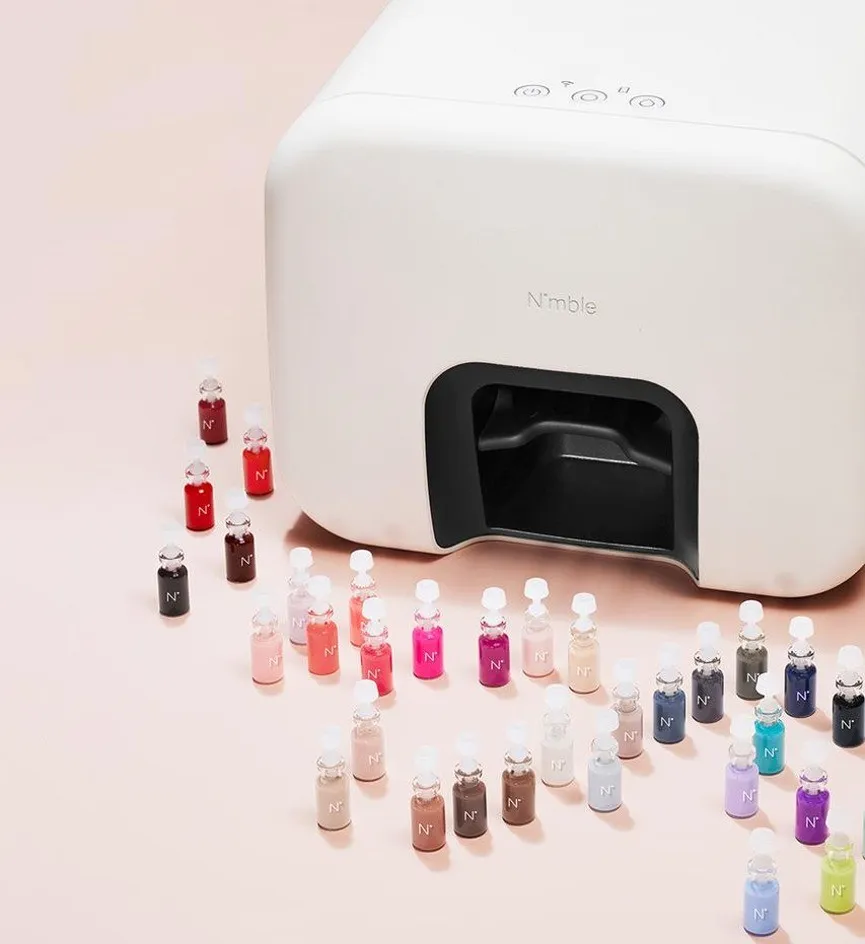
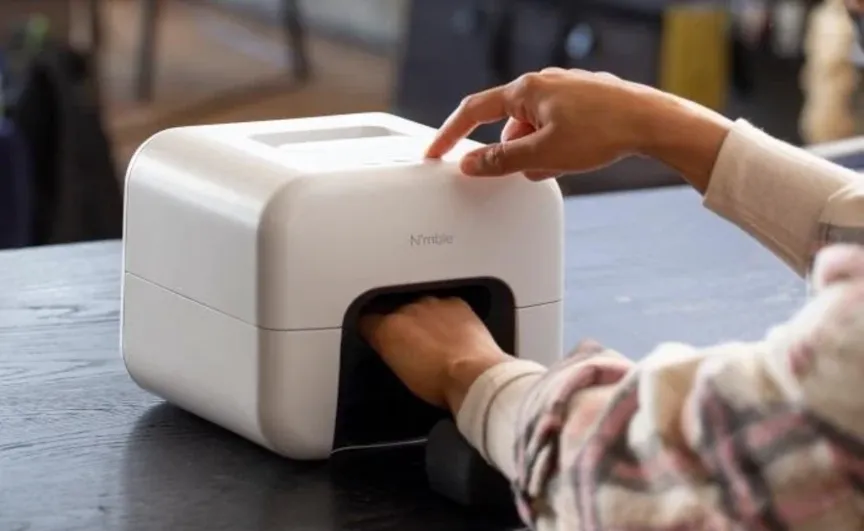
Nimble is betting on the home scene, with the idea of selling desktop devices into the living room and allowing users to finish coloring at home. By the time it was acquired, it had shipped more than 6,000 AMD machines and 60,000 methane capsules, and Ron Miller was leading the technology development for nine years. But the home route had to be overturned, not only the technological heights, but also the psychological thresholds. Hundreds of dollars of hardware plus locked-in consumables, which is the frequency with which users are willing to do this at home.
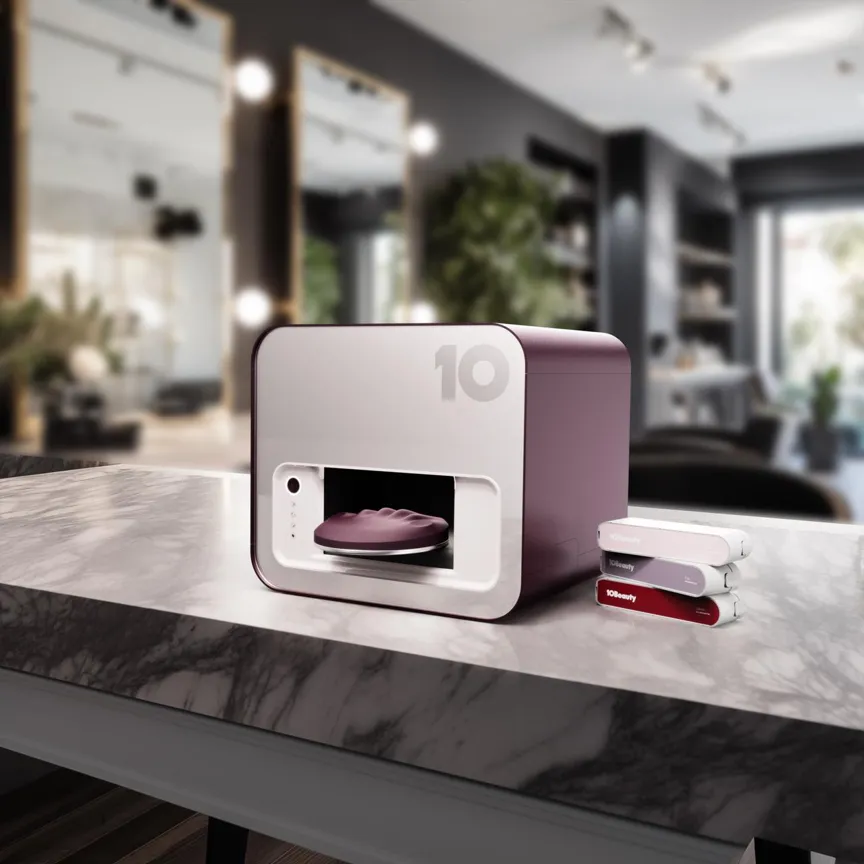
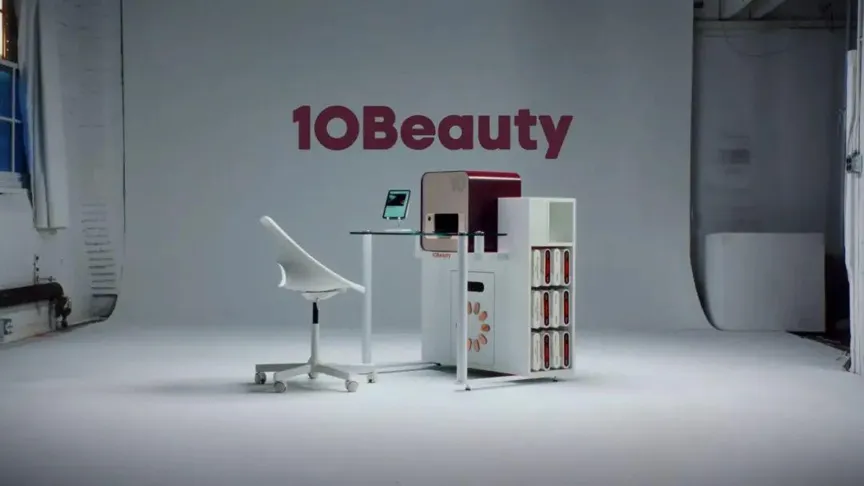
Two of the founders of 10Beauty moved to the US after selling hotel software company Alice. They hired Chris Casey, robotics expert who built the original Roomba, as CTO, and spent four years, dozens of engineers, tens of millions of dollars, building a complete set of equipment that could take off, shape, shield, color, and coating The 10.
In July 2026, the company completed a new round of financing of $23.5 million, totaling more than $70 million. During the pre-sale phase of the first 1,000 machines, the capsule subscription business generated about $13 million in annual recurring revenue.
The three companies represented three routes, almost a shortened history of hardware startups. But only 10 Beauty survived.
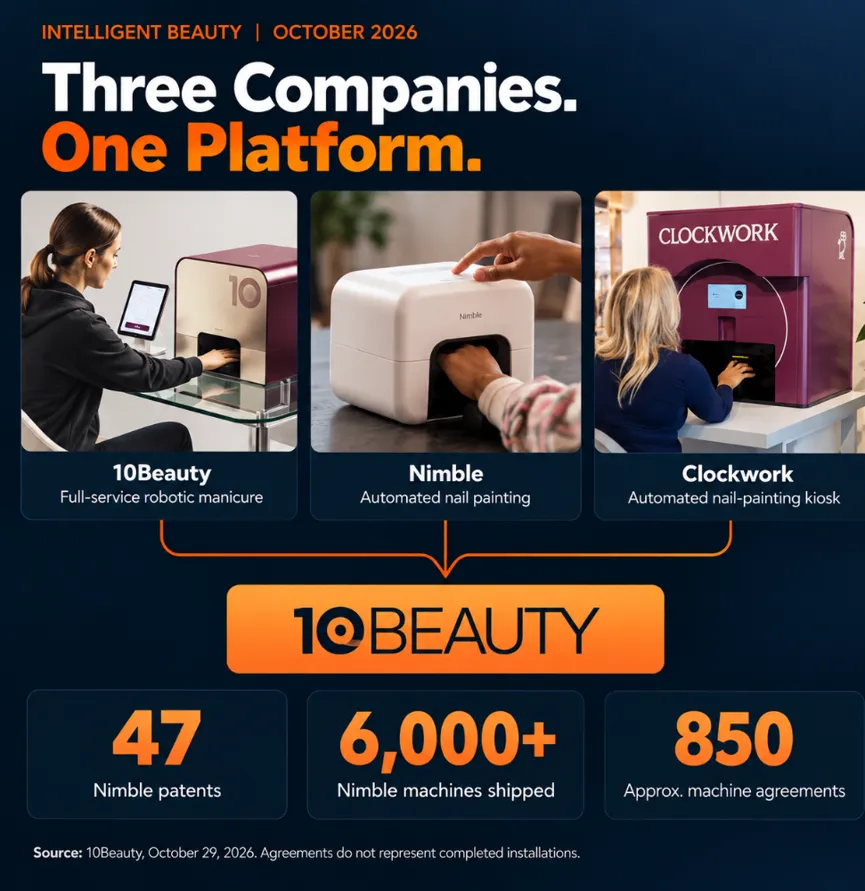
Two acquisitions combined, the logic is not hard to unravel. The first came with Clockwork, 10Beauty was complemented by computer vision, marking tools, datasets and algorithm pipelines; the second came with Nimble, which took nearly a decade's worth of machinery, five-axis motion control systems, a global patent wall, and a run-of-the-mill package of household capsules.
Early racetrack mergers were essentially time-buying. Patent and real-life scenario data accumulated from years of engineering craters were used by others, and one-time compression into their own product cycles. Clockwork's structural 3D scanning and AI vision capabilities, and Nimble's household integrated machinery and consumables system, were both gold and silver-burning engineering assets.
Being acquired is not the same as being retained. Clockwork-verified short, low-price, high-frequency filing routes are actively discarded after merging into 10Beauty, brand termination, machine offline. This illustrates that in 10Beauty's acquisition logic, filing out competitive narrative filings is at least as important as filing for technical assets. After all, buying off other people's failed experiences is sometimes cheaper and more fatal than buying successfully.
It's worth noting that 10Beauty's founders initially wanted to do home personal machines, but later switched to B2B, and explicitly stated that consumers such as filters were familiar with the technology and then introduced home consoles. So, this acquisition of Nimble was actually a reboot. In a business model that was centered around the use of bags, shops and living rooms were two natural traffic entrances, while Nimble was the one that was already available.
More importantly, the two acquisitions also pointed to a lower commercial structure. Equipment is a traffic entrance and supplies are the source of profit. 10Beauty's capsule subscriptions generated about $13 million in ARR during the first 1,000 pre-sales phase, with management expecting capsule revenues of up to $50 million after 3,000 locations.
In September 2026, Kickstarter launched a $459 early bird, a $899 planned retail price, and the official announcement that it could not fill the filling tank itself, attracting nearly 900 supporters in less than a month, raising more than $500,000.
02.
Why the US Navy became one of the earliest service robots to break even.
The robotics industry is currently lacking in over-the-counter scenarios. The company is one of the earliest vertically operated categories of service robots, primarily because of its large-scale, but long-term lack of technological transformation, labor-intensive market.
According to Global Market Insights, an industry report released in September 2026, the size of the North American salmon market is estimated at $16.2 billion in 2025, of which the US market is estimated at $14.3 billion, or 88.3% of the total area; the global salmon market is estimated at $38.8 billion in 2025, and is projected to grow at a compound annual growth rate of about 8% to $83.4 billion by 2035.
At the same time, it has been reported that labor costs account for about 50% of operating costs, and the increasing training cycle for DMOs ranges from 200 to 600 hours. Training cycles, license thresholds and the structure of industry practitioners together limit the flexibility of the supply of labor; at the same time, social platforms continue to manufacture new DMOs, with demand-side heat and not affected by labor shortages.
The tension between supply and demand is ultimately amplified by the price. In the United States, a full man-made suit takes an average of about 60 minutes, priced at about $50; while 10Beauty's robotic service takes 25 to 45 minutes, priced at about $30. For stores and tunnels, this means that it is possible to recalculate unit area efficiency while compressing service life; for consumers, double price and time savings are the basic motivation for trying to automate services.
The rigid constraints on the supply side are real, and the economic motivations for automated alternatives are real.
Of course, 10Beauty's integration addresses a centralized problem of supply-side capability rather than demand-side acceptance. Business of Fashion documented the objections of the MMA community in a report in early 2026.
New York fashion designer Anna Miles is frustrated with the premise that fashionable fashions involve robots. Consumer differentiation is even more subtle. At the Ultra Beauty store, machine usage is not low, and rush hour workers and student parties are the main users; but at the same time, some Chinese consumers have made it clear that they do not believe in robots, or are more willing to spend money to find my fashionable fashions.
A Fast Company reporter recorded a more specific detail in an independent test at the Ulta store in February 2026: a dead skin care link saw almost skipped the task bar, painted steps left a gap at some of the nail edges, and a real American soldier was still standing by the machine correcting the error.
Mermaid as a service, carrying both the demands of efficiency and the experience of relationships. 10Beauty's $30 and 30 minutes of hitting was the former; while the tactile feedback, aesthetic consultation and social presence provided by Mermaid belonged to the latter.
The robot can move at the same time on both axes, but its speed is uneven. The efficiency end can be approached or even surpassed by the artificial by engineering iteration, but the experience end needs to redefine how a rotating machine provides a relationship sensor, which is much more difficult than increasing the freedom of a mechanical arm.
The significance of Beauty's continuing acquisitions therefore needs to be re-evaluated. It is unified in North America, unified by the path of the supply side of technology rather than the value consensus on the demand side. When only one mainstream narrative remains on the track, suppressed differences are more easily exposed in operational data.
03.
Concentrated entry of Chinese athletes
Outside of the U.S. market, the layout of the Chinese track will accelerate significantly in 2026.
Of course, it is not without its pioneers in the country. The company, which has been listed on the A-list, started its research and development in 2017 with a front-facing intelligent identification algorithm and 3D modeling technology that can complete high-precision pattern printing in tens of seconds, the equipment has been installed in multiple AMD stores, and supports cloud storage and AR virtual test functions; Shenzhen's AI is cutting from the shop efficiency point, self-developed bio-based three-color ink printing program, single-finger painting about 20 seconds; Hangzhou's cloud-based intelligence uses the equipment as an unmanned self-help terminal in high-flow scenarios such as shopping malls, KTVs.
These early players largely revolved around the use of stamped pattern bricks as a replacement for full-service bricks, which were not the same starting point as their American counterparts.
At the beginning of 2026, the hardware executives of Daejeon, Huawei, Shadowstone, and Anc backgrounds were almost simultaneously embedded in the course of the U.S. Open.
First-generation products focus on home desktop-level automatic AMERICA printing equipment, oriented in the direction of inkjet printing; 3D AMERICA printing equipment positioned by Self-Impression Technology, closer to the category of personal creative tool kit; R3 team flagship product positioned desktop-level fully automatic AMERICA equipment, advanced precision three-dimensional visual recognition of micrometer-level motion control precision painting route, claiming a single finger operation of about 8 minutes.
A centralized explosion of AI robots was essentially a landing point in the service industry's vertical landscape: a change in the way in which AI understands visually; a decrease in the cost of motion control and supply chain; the data plane begins to rotate. Robots provide physical execution bodies, AI provides understanding and judgment brains, and AMC only finds a paid scene after combining the two.
04.
Link to the Future
After the acquisition of Nimble and Clockwork, the first trial and error cycle of the American Robot Raceway officially came to an end.
Is it possible to increase the opening of stores and to open psychological accounts of household appliances?
Moving the gaze away from the nail, you'll find that eating, washing, brushing, foot care, skin management... a lot of craft services have a similar structure.
Today it stands on its fingertips to test the water, and tomorrow it will be able to grind and mature, possibly moving to the next craft market that has been frozen for decades by technology.