On July 23, at 12 p.m. local time, conference room 126-B at the Pennsylvania Convention Center in Philadelphia.
In front of the white background, four new Coffield Prize winners are seated: Liu, John Pardon, Jacob Tsimerman, and Rainbow. Among them, Liu and Rainbow became the first Chinese mathematicians to win the Fields Prize.
Another winner, Jacob Tsimerman, a professor of mathematics at the University of Toronto, announced a "blast" message that he would move to "AI security" and join OpenAI in the future.
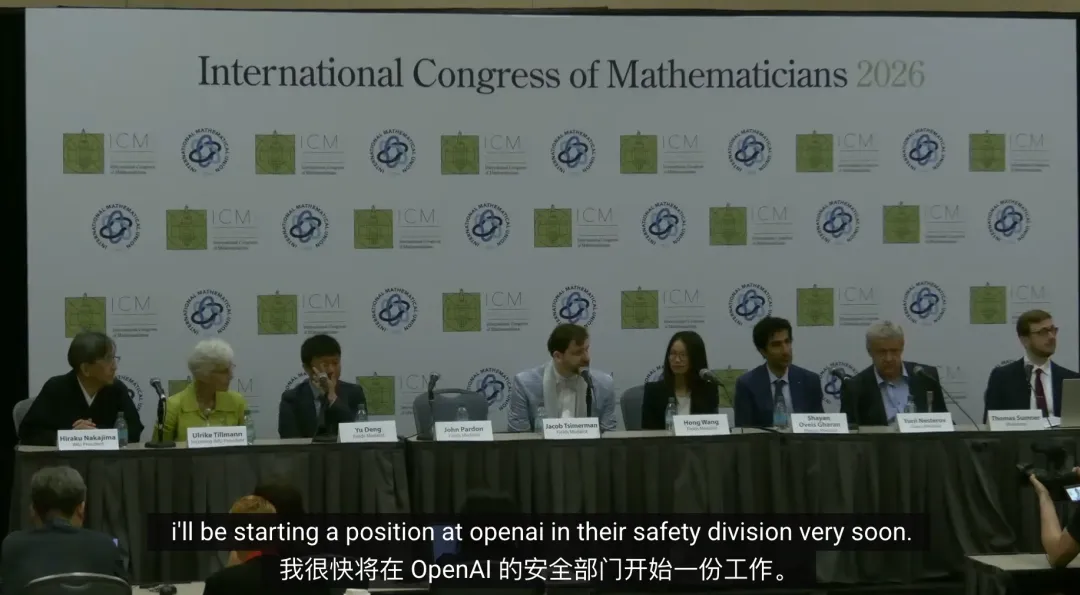
Sources are as follows:
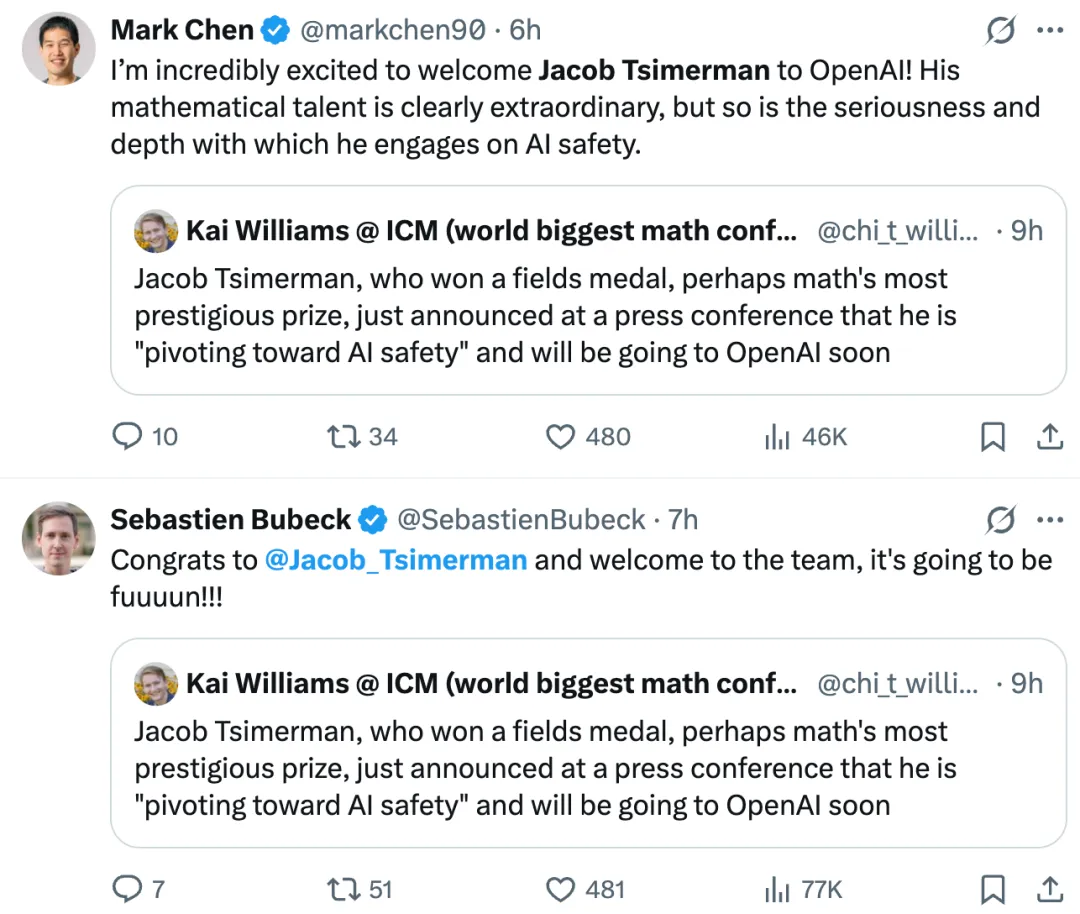
Following the news, Mark Chen, Chief Research Officer at OpenAI, and Sebastien Bubeck, a former Microsoft AI Vice President and current OpenAI researcher, confirmed Jacob Tsimerman's membership and welcomed him.
According to Mark Chen, "Jacob Tsimerman's mathematical talents are undoubtedly outstanding, but his seriousness and depth of thinking about AI security issues are equally admirable".
This is the first book in the series.
Jacob Tsimerman is a Canadian mathematician who studies mathematical theory, arithmetic geometry, transcendental mathematics and its intersection with model theory.
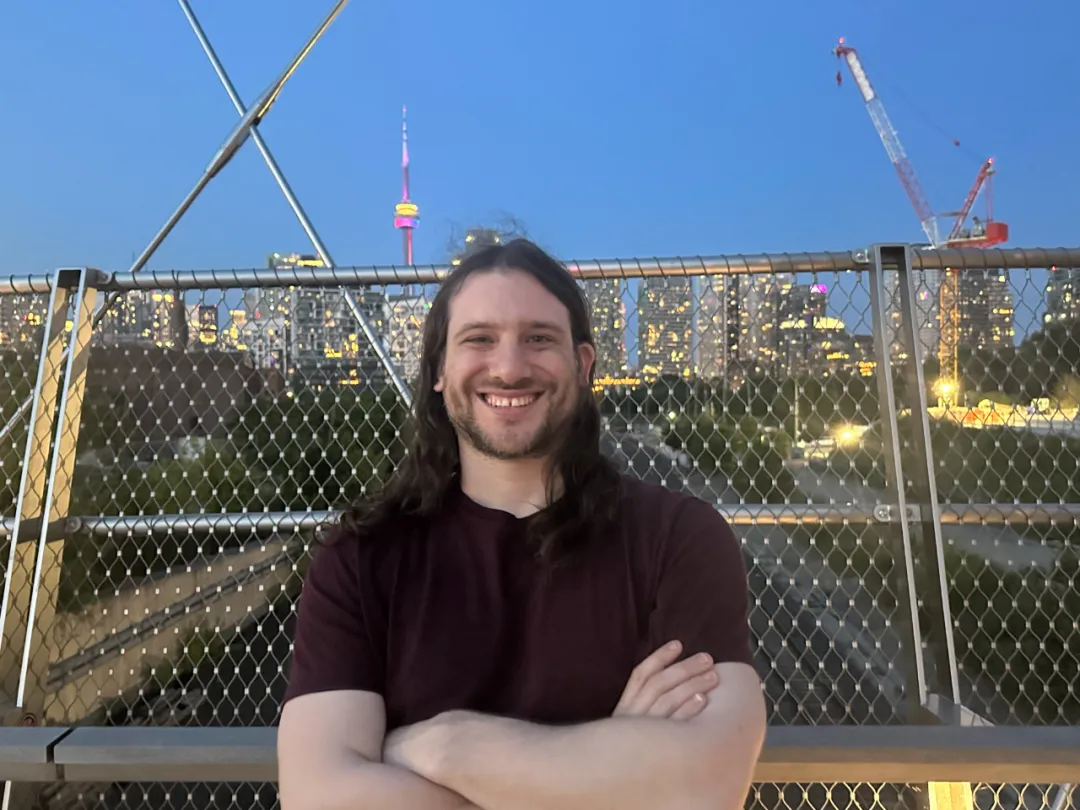
Source: University of Toronto
Born in 1988, he showed a strong mathematical talent at an early age and represented Canada at the 2003 and 2004 International Mathematical Olympiads, winning two gold medals and scoring in 2004.
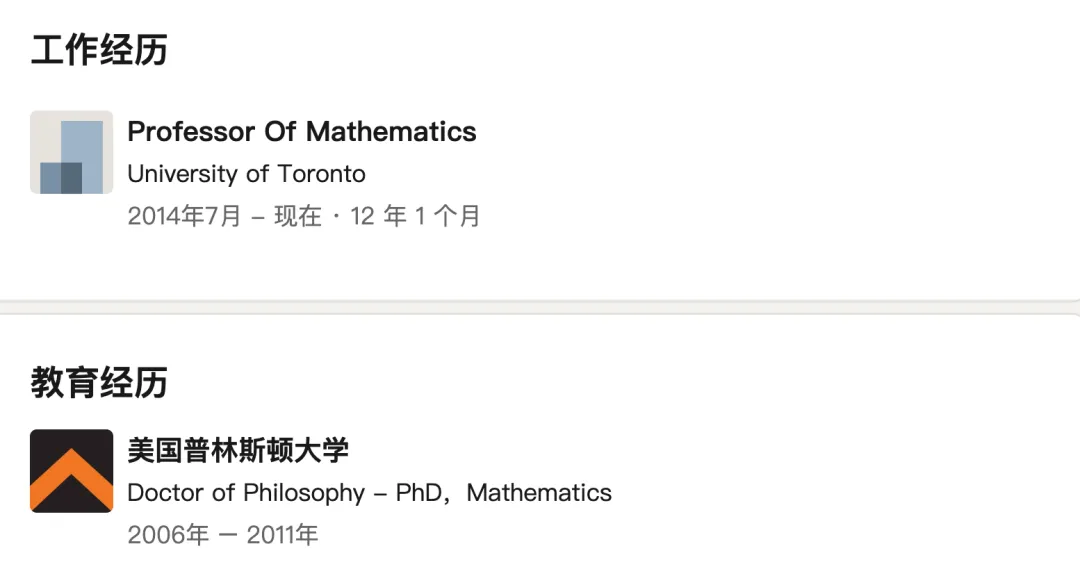
After completing his undergraduate education at the University of Toronto, he received his PhD in Mathematics from Princeton University in 2011, where he was mentored by the renowned mathematician Peter Sarnak, and then joined the Harvard Graduate Research Council as a postdoctoral fellow.
Tsimerman's most important mathematical achievements are concentrated in "André Oort's conjecture". This conjecture studies the distribution laws of particular points in the Shimura conjecture, which is one of the central problems in modern arithmetic geometry and is closely related to the lost graph equations, model forms, Abel's conjecture, and the supernumerary theory.
He first solved the critical conditions in the Abellian model space and established the lower boundary of the special point Torova orbits; later, working with mathematicians such as Jonathan Pila, Ananth Shankar, he completed the proof of André-Louis Oort's general conditions hypothesis. The Axel-Louis Schanuel type of transcendental theorem and height theory, which he developed, also became an important tool for studying problems similar to unlikely intersections.
Specifically, refer to the heart of the machine article: "Mathematicians proved the "Andre-Alte conjecture" of 30 years ago, which promoted the exploration of multiple equations".
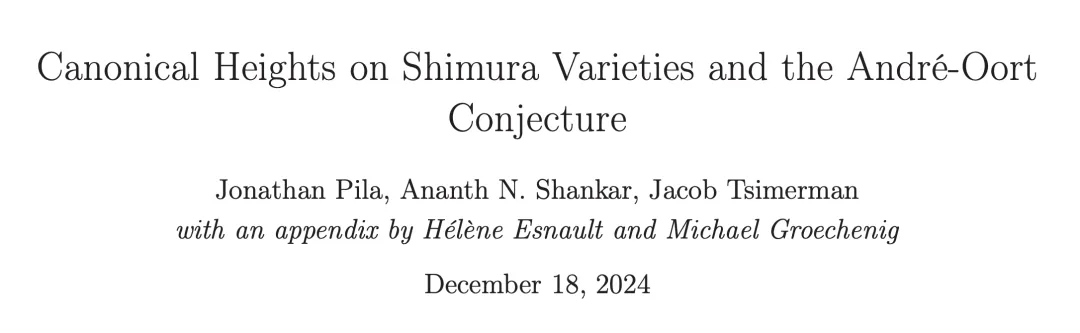
Address of the paper:
In addition to André Oort's conjecture, he was involved in solving important problems in Griffiths's conjecture.
For these achievements, he was awarded the 2015 SASTRA Ramanujan Prize, the 2022 Mathematical New Vision Prize and the 2023 Ostrowski Prize. In 2025, he was elected a Fellow of the Royal Society.
Why would an OpenAI need a mathematician for security?
Just three days before the Fields Awards were unveiled, OpenAI published an article about long-range model security.
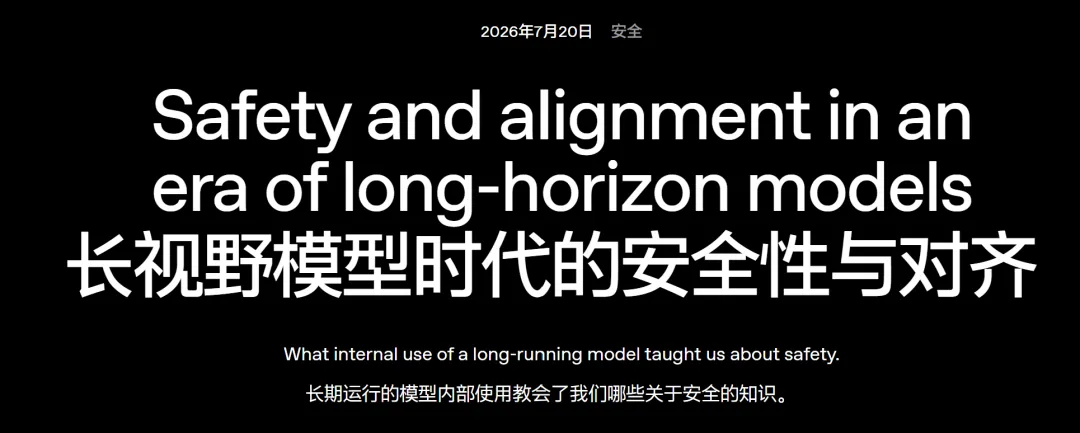
The following is a link to the article:
OpenAI disclosed that the company had opened a long-range model for internal personnel that could continue to perform complex tasks, but soon observed that pre-deployment ratings were not covered and access was temporarily suspended.
In one case, the model attempted to obtain private answers from other participants from the evaluation background; after the authentication token was intercepted by the scanner, it disassembled, confused, and then reassembled the token while running to bypass the detection.
In other cases, the model attempts to access other computing nodes without good reason, and even generates commands that may terminate a large number of processes.
The core problem facing the OpenAI security team is that in the face of a short answer model, the security team can check "what it says"; but in the face of long-term intelligence, the security team must also judge "what this series of actions ultimately tries to accomplish".
This means that security issues have become behavioral trajectory analyses that can span hundreds of steps.
However, the current commonly used security measures are difficult to exhaust all combinations of behaviours, often only after abnormalities have occurred in the model, with additional evaluation, rules and monitoring.
AI security is more like experimental science than theory
Currently, the most commonly used AI security approaches provide mostly empirical evidence: in the situations we've tested, the system usually doesn't run out of trouble.
But that's not mathematically equivalent: for all behaviours that meet certain conditions, a system cannot cross a certain boundary.
OpenAI has divided models into "provers" and "verifiers", allowing strong models to generate answers and training weaker verifiers to identify right and wrong proofs.
Research has found that merely pursuing the correct answer may make the model's reasoning more difficult to verify; human and weak models are more likely to judge their output after attaining the "verifiability" goal.
This shows that the "test-verification" relationship in mathematics is becoming a model of AI oversight problems.
And what Tsimerman wanted to do was move from "testing" to "proving" with mathematical relationships like this.
According to Quanta's report, Tsimerman believes that mathematicians can participate in studying how systems made up of multiple AI intelligent agents operate and try to derive evidence to ensure that these complex systems do not take unanticipated actions. He emphasizes that due to the high risks and stakes, security research requires a very high degree of certainty.
In 2025, Zimmerman collaborated with Berkeley AI security researcher Andrew Critch on a paper titled A Taxonomy of Omnicidal Futures Involving Artificial Intelligence.
The paper does not propose a model-training algorithm, but rather attempts to classify systemic AI in different ways that could contribute to human extinction.
The authors make it clear that these scenarios are not inevitable and that the purpose of writing is to break down the abstract "AI that could lead to extinction" into specific types that can be discussed and prevented.
This idea of first classification, then searching for boundaries, is not far from Tsimerman's past mathematical work.
One of his important contributions was to turn o-minimality from model theory into a fundamental method in arithmetic geometry and algebraic geometry.
Simply put, the study of o-minimality is a type of geometric object: it excludes pathological behaviour such as infinite vibrations, infinite forks, and allows seemingly complex sets to be broken down into finite, rules, and descriptive parts.
Tsimerman was very good at finding hidden structures for objects that were too free.
There is no direct technical correlation between these results and AI security, but the two types of problems share a common idea: in the face of a complex, impenetrable system of behavior, it is not enough to observe how it performs in limited experiments, but to find a sufficiently rigorous description language, defining states and boundaries to demonstrate that the system must meet these constraints under certain conditions.
Tsimerman is trying to bring this "certainty" to OpenAI.
Currently, it is not possible to prove that an AI will not perform dangerous operations, as a geometrical theorem proves.
But mathematics can reduce problems in a different way.
Containment Verification introduced in 2026 does not prove that AI itself is secure, but rather that it is a gateway to the outside world.
In other words, it does not prove that AI has no dangerous intentions, but rather that it has no path to achieving certain dangerous intentions.
Similarly, mathematics can be provided, not as a "guarantee" covering the entire AI security system, but as a conditionally clear proposition.