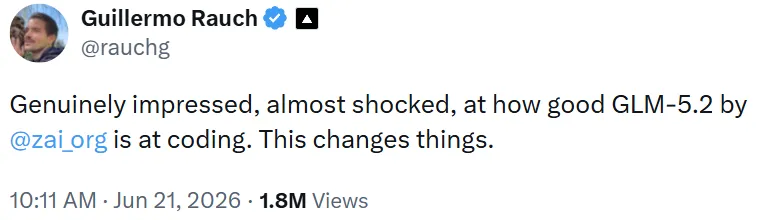
In June 2026, GLM-5.2 was released as open source. This large-scale MoE model performed so well that even Next.js author Guillermo Rauch, the founder of Vercel, was shocked.
GLM-5.2 is indeed a very strong underpinning, but a stronger underpinning, with training ending, parameters freezing, and deployment, makes it difficult to continue to grow in real use. In the planning for GLM-5.2, Intel speculates that the next key technologies to be mastered include memory, continuous learning, and self-assessment.
The Macaron-V1, a front-end Mind Lab lab owned by Mind Lab, has been pushing in this direction. It doesn't have another boiler, but stands on the shoulders of giants: the base is upgraded to GLM-5.2 (a smaller version based on Qwen 3.6) and supports the context of 2M, and then, on top of this powerful base, does something GLM-5.2 is planning to do: keep the model learning and allow a large number of models to collaborate.

That is, Macaron-V1 is betting on these two keywords: continuous learning and group intelligence. They correspond respectively to adaptation (adaptation) and collaboration (collaboration) in its technology blog.
In Mind Lab's view, the decisive factors for the next generation of AI are no longer the ability to continue to expand a single single model, but two complementary ones: the ability to continue to generate experiences, learn from them, and improve their behaviour through post-training through recurrent self-improvement (RSI) and multi-intelligent collaboration, allowing specialized models and intelligent entities to build and integrate on shared infrastructure.
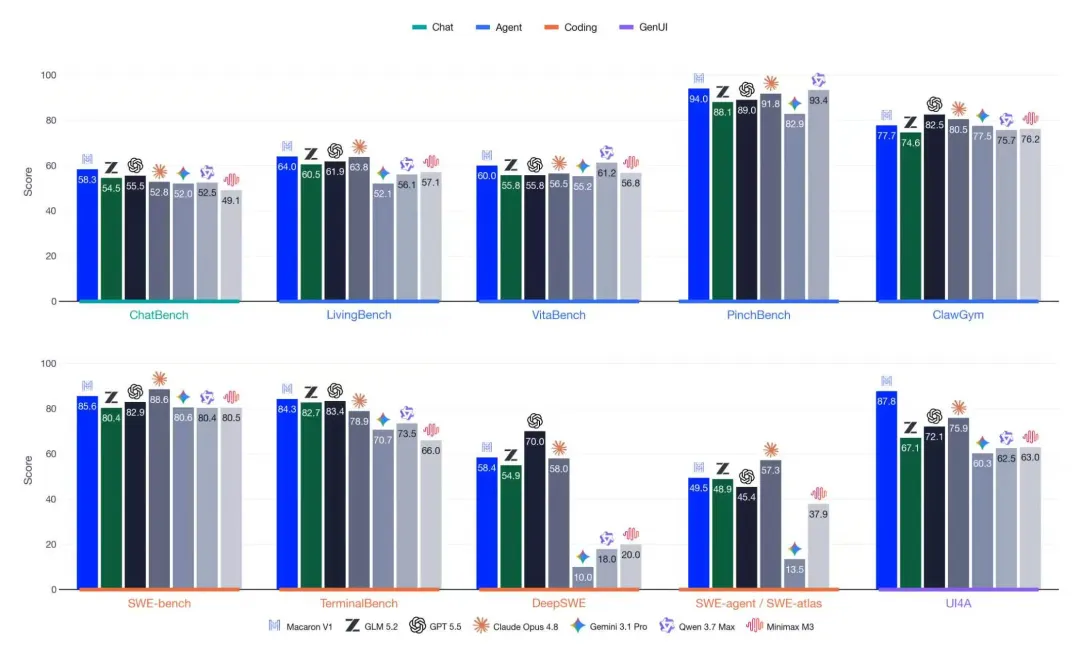
The benchmark gives a definitive answer: the Macaron-V1 outperformed the base GLM-5.2 on the task tested, while achieving current bests and even far ahead on some benchmarks. For example, on the UI4A benchmark for test front-end design capabilities, the Macaron-V1 outperformed Claude Opus 4.8 by 87.7 points.
This is confirmed by our experimental experience. Below is a web file built with the Claude Code of Macaron-V1, a single simulation of macOS. The entire execution process takes 22 minutes, resulting in a 67 KB HTML file, but the effect is a bit more than expected: not only are calculators and photos highly available, but also supporting applications that require weather, browsers, translations, etc.
In addition, we had it generate a physicist-simulated chat group dynamic screenshot, which was quite interesting, and Macaron-V1 even generated SVGs with their own characteristics for physicists as headings:
It is worth noting that these capabilities to transcend the basement come only from the few small LoRAs mounted on it.
And behind this is a consensus in the industry that is building: to use "experience" on data as fuel for the next generation of AI.
Richard Sutton and David Silver, in a famous blog post in 2025, called the next stage "the age of experience" and in the recent four-hour Investor Exchange speech, which was streamed online, he also mentioned continuous learning and predicted that "after continuous learning, we might come to a strange point".
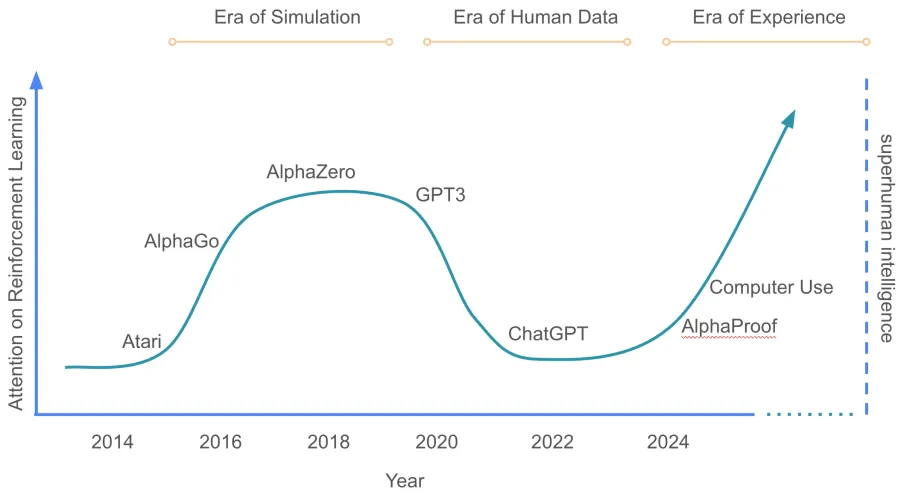
Welcome to the Era of Experience by David Silver & Richard S. Sutton
On the engineering side, the star startup Thinking Machines Lab is also validating a highly similar technological path: using efficient post-training tools such as LoRA, if configured correctly, to achieve effects that are close to full parameter dilution, while significantly reducing computational expenses.
On the one hand, the directional judgement at the conceptual level, on the other hand, the verification of feasibility at the engineering level, and on the other hand, the Macaron-V1 to do is to actually run both at the same time on an open source model at a parametric level of 100 billion.
Training is over
It's not the end of learning.
To answer this question, we need to look at the ceiling common to today's large models.
Today's large-scale models already have extensive knowledge to accomplish complex reasoning, planning, and tool calls. But their capabilities are essentially acquired in a few sessions of training, after which the parameters are frozen and entered into a relatively fixed state of deployment. However, many valuable information emerge only after deployment, such as long-term user preferences, the unique architecture of specific code libraries, and why a task repeatedly fails.
Concentrated training can cover commonalities, but it is impossible to predict the preferences of each environment and each user. For a long-running intelligent body, deployment is the beginning of a huge surge in experience, and this should be the starting point for a new round of learning.
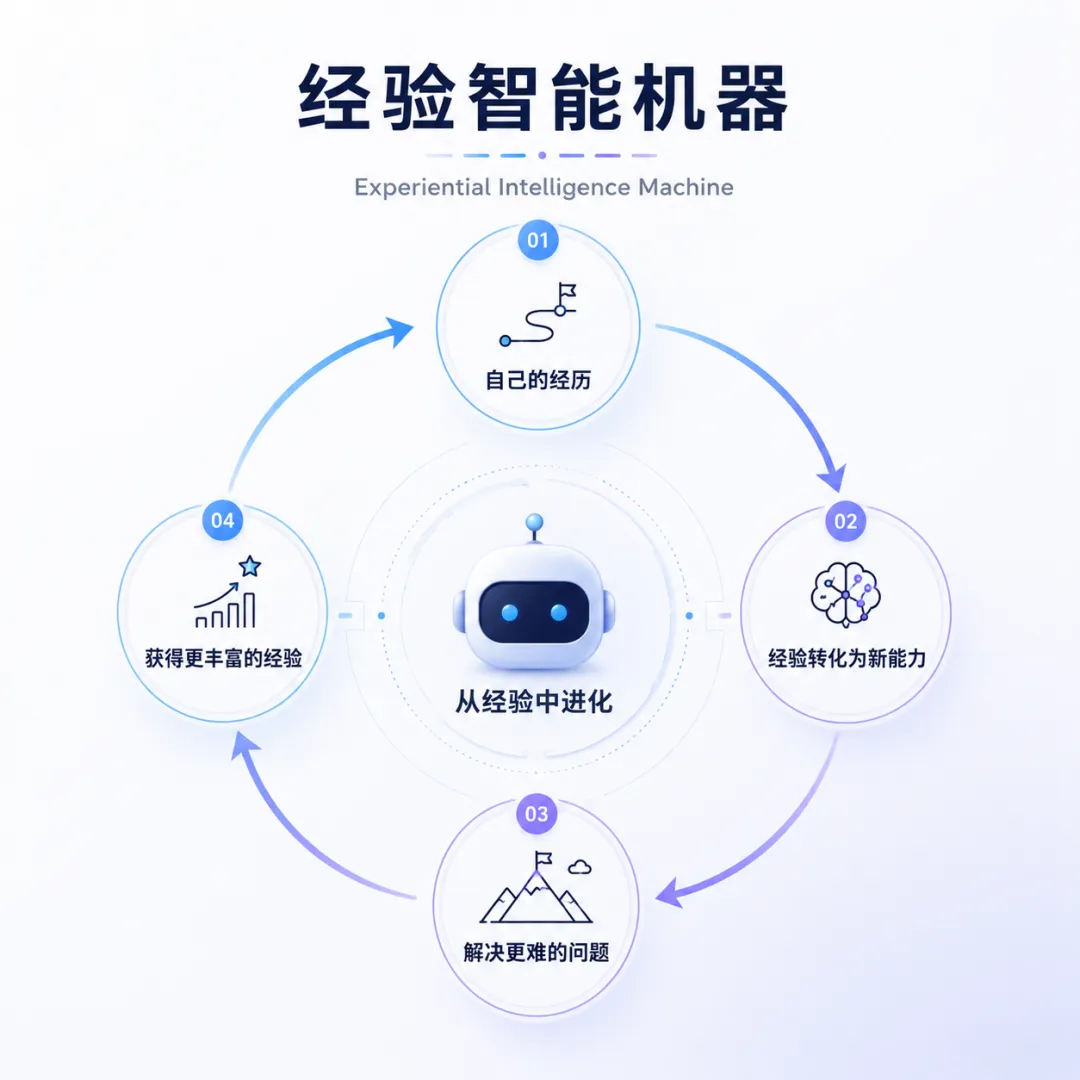
Mind Lab calls what it wants to build an "experiential intelligence machine": a machine learns from its experience, transforms experience into new capabilities, new capabilities allow it to solve more difficult problems, and more difficult problems lead to richer experiences.
So the question is, what exactly do we do?
According to Mind Lab, there are roughly two paths:
Alternative spatial prompts: to preserve the experience outside the model through prompts, out-of-hours memory, RAG, skill, harness, and re-read each time it is used;
Alternative to the parametric space: Write experience into the trainable state of the model.
The former has brought significant value, but there is a structural constraint: experience exists outside the model, the cost of re-reading and re-understanding increases as experience increases, and inserting information into context does not mean that the model actually mastered the rules of the model.
The Macaron-V1 bet on the latter, and it chose a lighter route: LoRA.
MoL architecture
It's important to make "continuous learning" a plug-in module.
The core of the Macaron-V1 is the Mixture-of-LoRA (MoL) architecture. Its mindset is easy to understand: tasks that are similar to skills and thinking patterns are integrated into the same LoRA, allowing them to reinforce each other; tasks with different skills are divided into different LoRAs that are independent and uninterrupted.
Specifically, the Macaron-V1 was mounted on a frozen GLM-5.2 base with four 1B LoRA specialists:
L0 Chat: Responsible for Conversations and Following Directions
L1 Agent: Responsible for the use of gravity tools and long-range complex tasks
L2 Coding: Responsible for Code Understanding and Terminal Use
L3 GenUI: Responsible for generated UI rendering and UI drive operations
The new capabilities include plug-in-like LoRAs, unshakeable knowledge, and experts from different sources can freely assemble on the same platform.
This is the total parameter of the configuration:748B of the flagship version of the Macaron-V1 Venti, consisting of one GLM-5.2 base for the 744B and four LoRA specialists for the 1B. The other is the locally deployed Tall version, General Interface 50B, consisting of 35B base and four LoRA specialists for the 3.7B, based on Qwen 3.6.
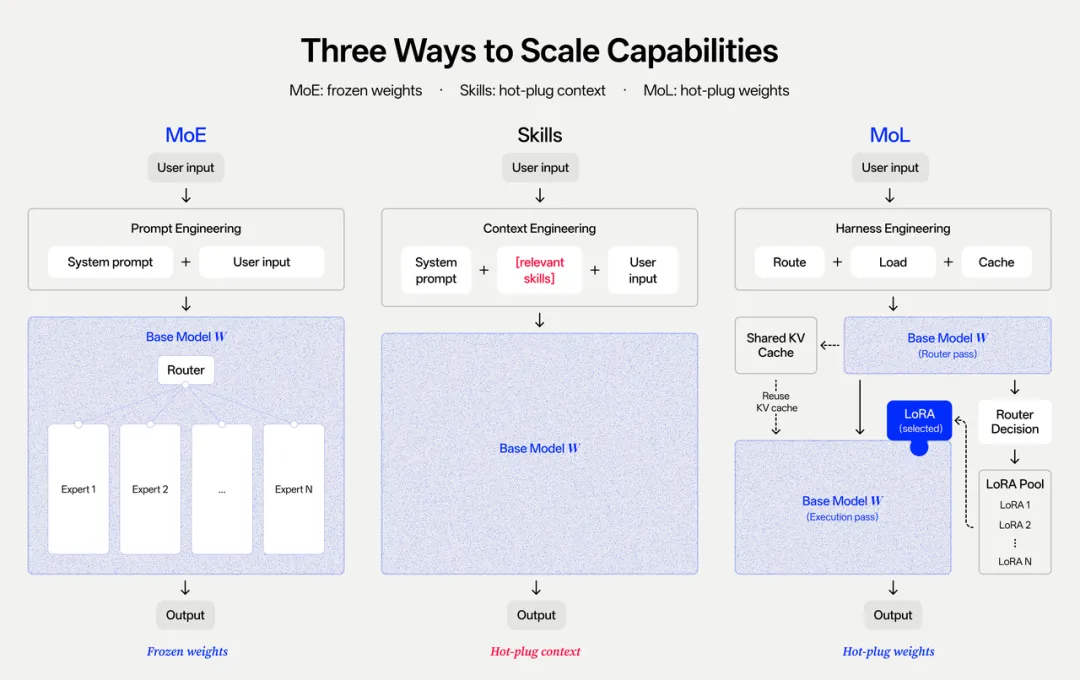
There are three different ways to expand capabilities: MoE, Skills, and MoL.
However, the importance of MoL is reflected in the fact that it has turned LoRA upside down.
In the past, PEFT methods such as LoRA have long been regarded as a "cheap alternative" to all-parameter mitigation.
Mind Lab gives different answers in practice: the adapter should not only be seen as a money-saving tool, but should be seen as a "permanent local state". The general ability of a shared base model to provide is "commonity"; the adapter carries personalized behaviors of a specific instance (such as preferences, skills, tool use habits, and similar memory updates) is "personality".
This judgment has been supported experimentally. In Mind Lab's On the Scaling of PEFT study, the team has run LoRA reinforcement learning on the trillion-parameter rare MoE model Kimi K2, with calculation and communication expense pressures to about 10% of full-parameter RL, stabilizing the training curve.
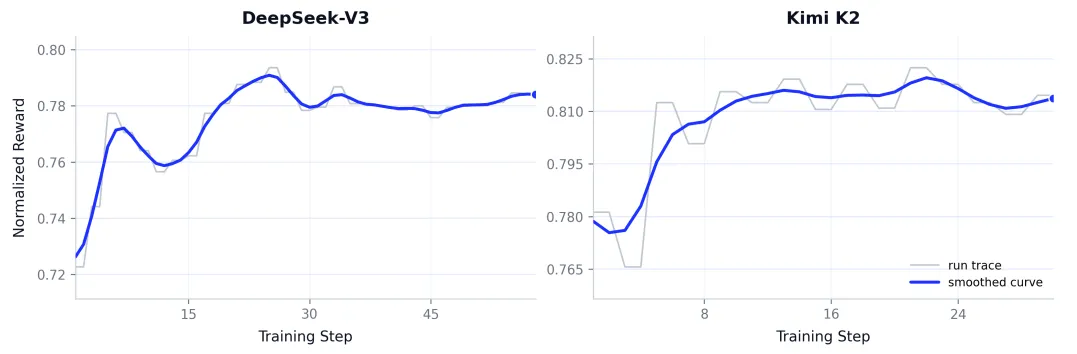
The application of GRPO LoRA training to large-scale LLM. The steady reward and task success curve suggests that it is possible to adapt a trillion-parameter MoE reasoning model to a jointly designed rollout, training and mixed parallelism through LoRA-based reinforcement learning.
Another comparison is worthwhile: under a similar RL budget, 1.5B models do full-parameter RL, which can be trained at 1.5B, with an 8.33% increase in integration on AIME 2025; 7B models with a LoRA of r=64, which can be trained at 0.16B, with an increase of 11.31%; 32B models with a LoRA of r=8, which can only be trained at 0.07B, with an increase of 20.61%.

Under similar reinforcement learning budgets, large-scale and small-scale LoRA updates can outperform full-scale reinforcement learning on small models.
Group intelligence
Multiple LoRA collaborations to achieve continuous improvement
Since LoRA is scalable and sustainable, the question naturally arises: can it allow multiple LoRAs to collaborate?
The answer from Mind Lab: Group intelligence.
Logic is easy to understand: once a model can continue learning along its own path, different instances will gradually move in different directions: different users provide different feedback, different tasks generate different strategies, different environments shape different capabilities. Even from the same basic model, long-term learning will result in a large number of different LoRAs, Agents and strategies.
The paper gives experimental evidence. Mind Lab starts from the same basic model of Qwen3-30B, keeping training goals and reinforcement learning methods consistent, only changing data sequence and masking. On AIME 24, the accuracy of a single adapter is 36.44%; the accuracy of 198 different adapters is increased to 48.67% by a majority vote; and repeat sampling of the same size from the same adapter is up to only 43.78%.
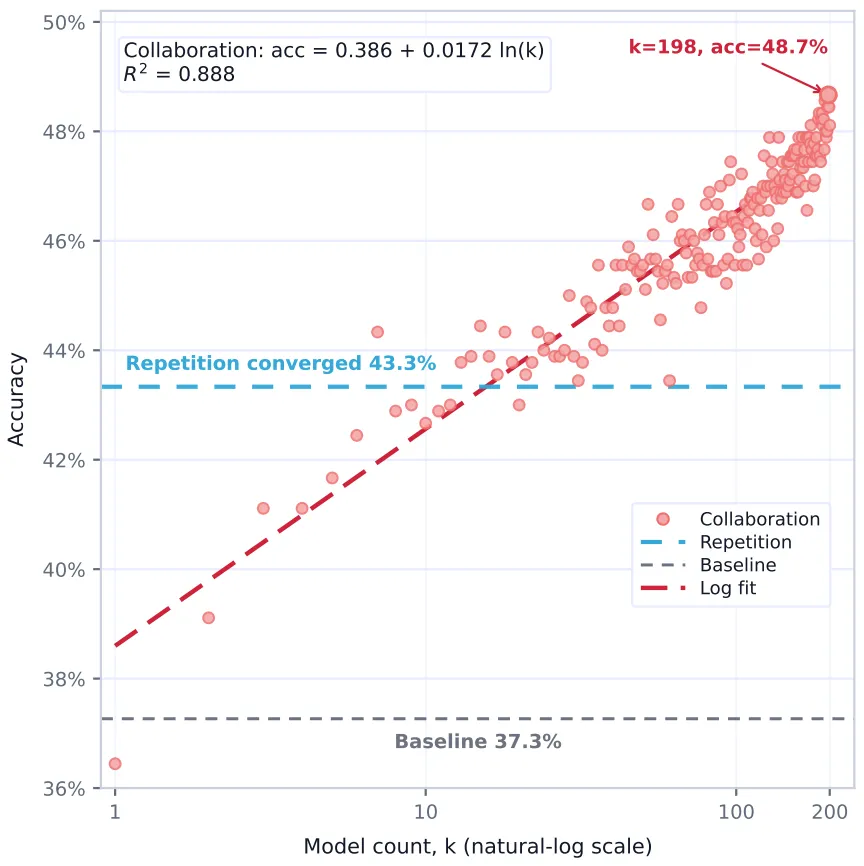
Expanded model counting based on majority voting
The results show that differences in learning trajectories involve complementarities beyond ordinary sampling. This further demonstrates that groups are not simple repetitions, but actually smarter.
A complex task may require planning, programming, retrieval and UI production at the same time, and different LoRAs or Agents may be responsible for different stages or dynamic switches in the execution process. Specifically, the Macaron-V1, MoL allows several independently trained specialist LoRAs to coexist on the same basic model and to be selected and combined according to the dynamics of the task.
From the results of voting to the skills route, the route "Expand Model Number" has received initial validation here.
On a large scale
Let the reinforcement learn
It's hard to do that, as long as reinforcement learning is done on a large scale.
It is important to note that reinforcement learning has a tricky problem: training is inconsistent. The precision deviation in training and reasoning will keep drifting, which will ultimately make the results uncomfortable. To compress it, the infrastructure must be aligned to a high precision. When a large-scale MoE model is doing reinforcement learning, it needs to be distributed over multiple GPUs, with communication between different chips, and parallel computation, all aligned to the same precision.
For this purpose, Mind Lab is equipped with two complementary systems.
At the bottom is the flagship post-training platform of MinT, MindLab, and the infrastructure that enables Venti to scale.
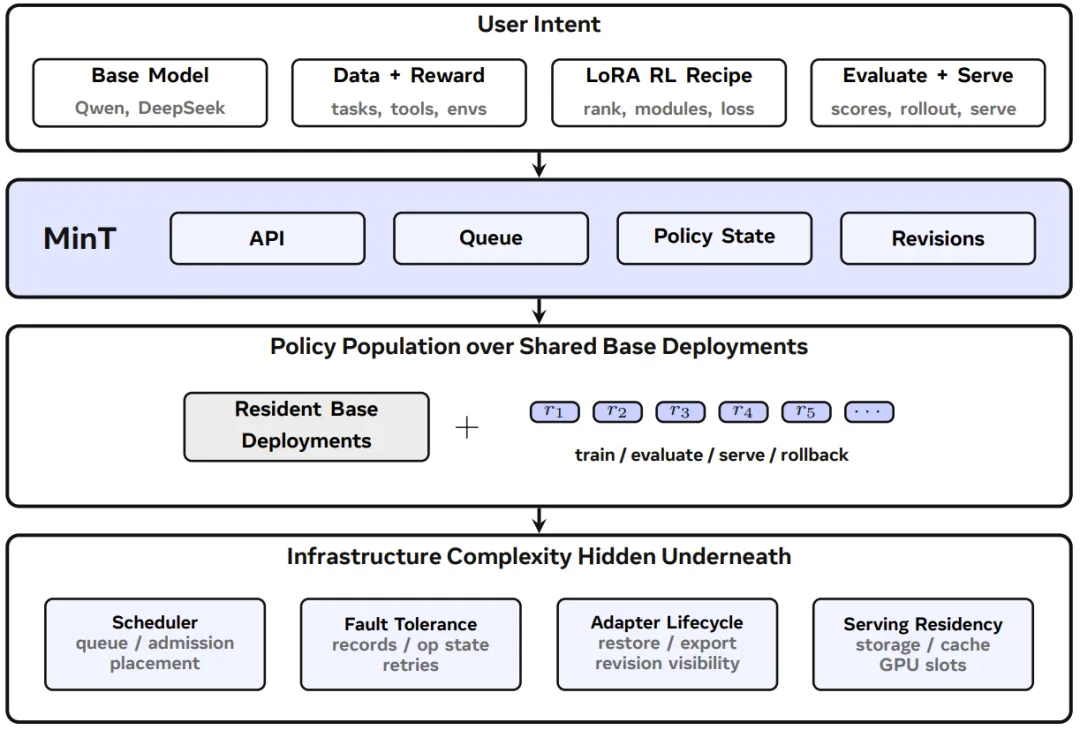
MinT: Managed Infrastructure for Training and Serving Millions of LLMs, arXiv:2605.13779
Several key capabilities of MinT coincide with MoL naturally:
Actor and Learner only pass on the Adapter to avoid the expense of carrying the full weight of the model;
Supports a million-scale Adapter directory, which can host, call, run millions of LoRA versions based on a single baseline, each LoRA has independent identity and version history, and can be deployed after evaluation is approved or rolled back at any time;
End-to-end support for models with up to a trillion parameters.
Mind Lab has worked with the veRL and AReaL teams to create two open-source implementations of MinT: verl-mint and AReaL-MinT.
At the top is MindForge, a training framework for intelligent body reinforcement learning. It introduces Harness with production-ready capabilities directly into the reinforcement learning loop, using the same routing tools, memory layout, tool calling methods, and Harness structure to ensure that the conditions when the model is trained are consistent with its final operation.
The communication layer that aligns training and service is called the Harness Context Protocol (HCP). Because training and service use the same set of HCP schemes, any information the model sees in the training rollout can be used in the production environment as well.
MindForge thus forms the RSI closed loop: from seed tasks to automatically constructing increasingly difficult tasks, verifying their learning value, rollout and auditing of generated trajectories, iteratively improving configurations until there is no benefit, and finally consolidating the optimized experience into model parameters. Repeat this cycle, updated models can generate more difficult tasks, improve Harness, and continually expand their capability boundaries.
Another engineering detail worth mentioning is the LongStraw, which runs on the training side of MinT, and solves the problem: Contextual reasoning has already crossed a million tokens, but reinforcement learning training hasn't yet.
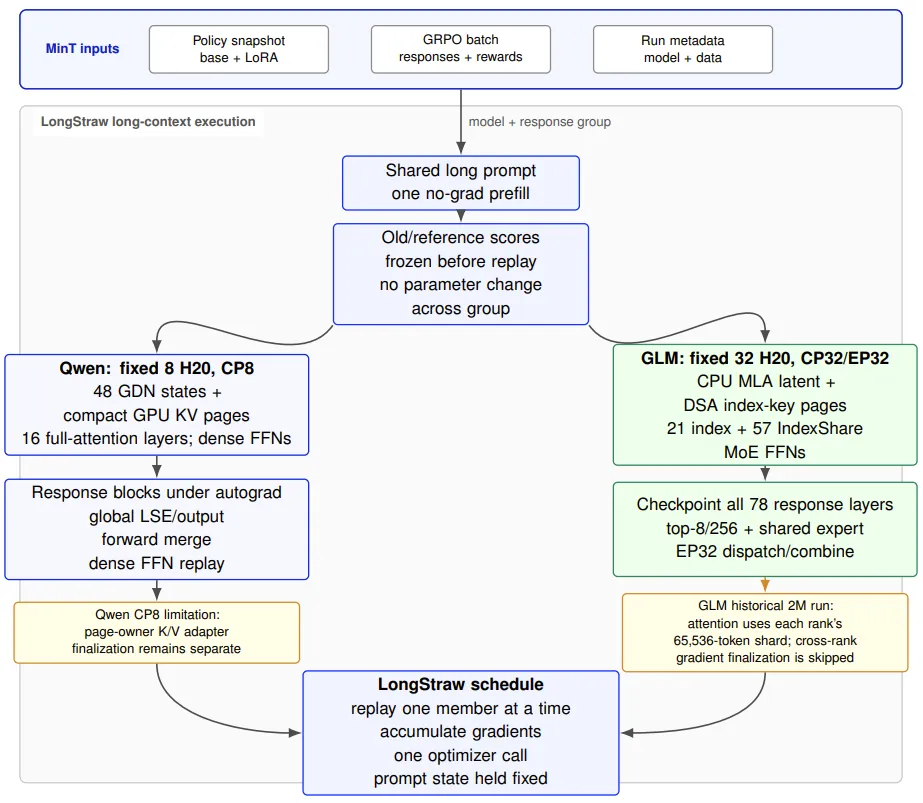
LongStraw: Long-Context RL Beyond 2M Tokens under a Fixed GPU Budget, arXiv:2607.14952, Open Source Implementation: MindLab-Research/longstraw
Traditional full-sequence GRPO post-training requires evaluating multiple responses to the same cue word and maintaining or reconstructing reverse transmission dependence on the context, so even if the context has reached a million tokens, the open RL post-training workload typically stays at 256K or below.
LongStraw brought about a change: it first handled the shared prompts in a seamless manner, preserving them as a replicable model native resident state, and then repositioning the replica branches in sequence, reverse propagation and cumulative gradient. The results of the experiment were striking: on the 32×H20, it allowed GLM-5.2 to complete the same 2,097,152 positions in all 78 layers with two complete reverse propagation.
Reinforcement of millions of tokens under a fixed GPU budget has gone from demonstration to engineering feasibility.
Models and Harness train together
The Macaron-V1 has a less common design option: its harness is not a model-trained overcoat, but is trained with the model.
One is UI4A, which is Macaron's code-native Generative UI program. It retains the inherent flexibility of HTML while supporting direct importation of libraries and components from the NPM registry or arbitrary URLs, allowing the model to instantly deliver rich interactive content. UI4A is designed to drive even models that are not specifically tailored to it, so it is a universal interface layer rather than a Macaron exclusive capability.
Using a few examples of UI4A, open source addresses:
The second is REPL Harness, which gives the model a durable Python naming space, organized around the ToolProxy model: the model can directly write code and string together dependent steps; save_tool can pack runtime processes into replicable tools; promote_tool can keep verified tools in session. Once a task is built, the next task is in step, so the model can generate a set of tools that belongs to it, rather than starting from scratch each time.
Function call method vs REPL: A function call returns each intermediate value through a model, while REPL keeps the dependent computation in a single executable state.
The third is HCP. This configuration standard combines the complex settings used by different agent harnesses (AGENTS.md files, skills, hooks, system instructions, model provider configurations, etc.) into a unified format, making it easier to standardize and optimize the configuration of the agent session, migrate, and stay consistent between training and production environments.
What is the meaning of this verse?
Mind Lab has released the flagship model Macaron-V1-Venti, the integrated programming base Macaron-V1-Coding-Venti, the small model Macaron-V1-Tall, based on Qwen 3.6 35B, with three variants of the open weight:
The official hosted API went live on the same day, the fastest way to try Venti. There is also a plugin called Macaron Artifacts that can be used to visualize UI4A output:
Overseas:
Mainland China:
Macaron Artifacts:
The Macaron-V1 has already given a preliminary answer.
But experiencing intelligent machines is still a long-term goal, with several unresolved core problems ahead: feedback is often delayed, vague, difficult to attribute, model self-reflection can still be misattributed and self-rationalized; learning itself is not efficient enough; stability issues constantly updated...
But Mind Lab has moved experience intelligence to the point where it can be downloaded, self-managed, and replicated: on top of a strong enough open-source platform, with loadable LoRAs carrying continuous learning, with collaborations with multiple LoRAs, and with a set of infrastructure that can drive millions of adapters at the same time.
The future of experienced intelligent machines is increasingly worth looking forward to...