“ The first scoreboard, how did Utrecht perform?
On the 28th of October, the share price of the company rose 8.74% to US$695.90.
More than two months ago, it went public with an initial public offering price of 150.80 yuan, hitting 1,100 yuan on its opening day, with a total market value of 44.5 billion yuan. It subsequently fell to a record low of 404.03 yuan on 15 October, with a high retraction of more than 60 percent.
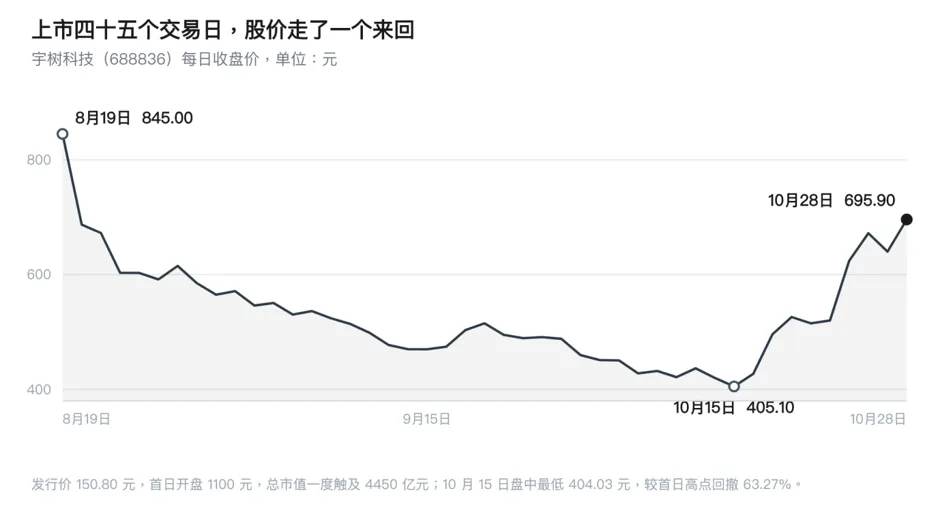
Graph: The daily closing price of Yuke's technology was 695.90 yuan on October 28.
At the end of the night, the results came.
In the same report, there are two sets of numbers in opposite directions.
On the one hand, net returns for the first three quarters amounted to 387 million yuan, an increase of 270.54%. On the other hand, non-net returns for the first three quarters amounted to 349 million yuan, a decrease of 18.78%.
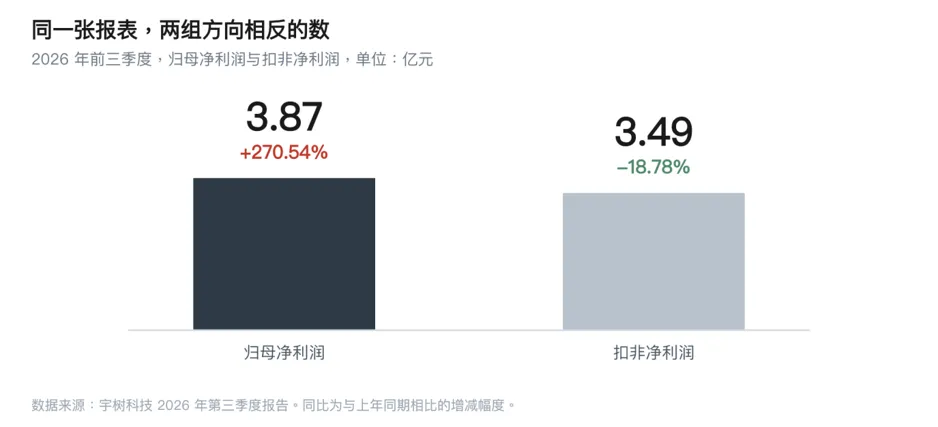
Image source: According to the company's third-quarter report, the chart shows a net profit of US$387 million and a net loss of US$349 million in the third quarter of 2016.
The two numbers are written on the report, and they are respectively formed. To read them, you have to see how the two sets of numbers come together.
01.
Where did 270% come from?
270% isn't a blank slate, it has a one-time account in it.
The company's statements are straightforward: the net returns in the first three quarters increased significantly, mainly from two quarters. One was the increase in gross earnings driven by revenue growth.
In the first half of 2025, the company confirmed that shares paid 349 million yuan, directly squeezing the net profit of the first half of the year into the negative of 320.245 million yuan. This year, the cost was not, the net profit of the first half of the year was 274 million yuan.
One in and one out is sent in two negative directions.
Looking at the first three quarters, it's the same logic. Last three quarters, the company returned a net profit of about 104 million yuan, which lies in the impact of that 349 million yuan expense.
In other words, after the decline of the one-time factor, the answer given by the accounting quality is not equal to the growth rate of the operation.
Read this layer and there's another set of numbers worth checking out.
Net returns for the first three quarters were 387 million yuan, exceeding 288 million yuan for the full year of 2025.
Revenue also increased by 48.54 percent in the first half of the year and 69.93 percent in the third quarter of the year, which was one-half faster than the previous half. After the volume of revenues reached tens of billions of dollars, the growth can still go up, which illustrates the problem more than the high growth in small quantities.
02.
Where did the money go?
After the decline, it is still positive 349 million yuan. A company that is increasing its R&D and sales investments at the same time, profits can still remain. This is not easy in itself, the numbers are falling, the focus is not on how much the money is going.
The trend is clearer by dividing the non-quarterly deductions. In the first quarter, 402.36 million yuan, in the second quarter about 204 million yuan, in the third quarter 105 million yuan, of which the second quarter deducted non-net profit from the first half of the year.
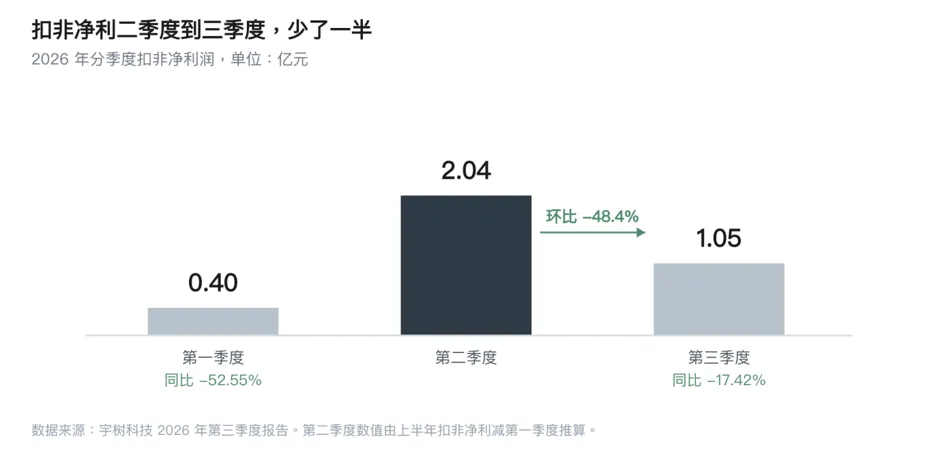
Notes: Non-net profit deducted in the quarter, RM204 million in the second quarter, RM105 million in the third quarter, with a 48.4% decrease in the ring ratio.
The money went both ways.
One is R&D. R&D expenses were 263 million yuan in the first three quarters, up from 99.21 million yuan in the same period last year, an increase of 191.48 percent. In the third quarter, single-quarter R&D expenses were 127 million yuan, accounting for 19.10 percent of the current revenue, up by 9.82 percentage points from the same period last year.
R & D invested more than US$173 million in the same period last year. In the same report, the deduction of non-net profit decreased by 18.78%.
In September, the company launched WLA-1.0 with 6 billion parameters and open source, training with about 2,500 hours of machine data. The model is open source, colleagues can take it directly, take it away, and how much data they train with it is written in plain text. Taking it with them is like skipping a touch.
This direction, and the open judgment of the founder, is correct. Wang said at the World Robotics Congress in August this year that the lack of widespread capability is the biggest bottleneck facing the global robotics industry.
The other was sales. Sales expenses in the first three quarters were 233 million yuan, up about twice from 76.6 million yuan in the same period last year. Two expenses spent 327 million yuan more than in the same period last year combined, adding up to 493 million yuan, equivalent to 27.1% of revenue in the same period.
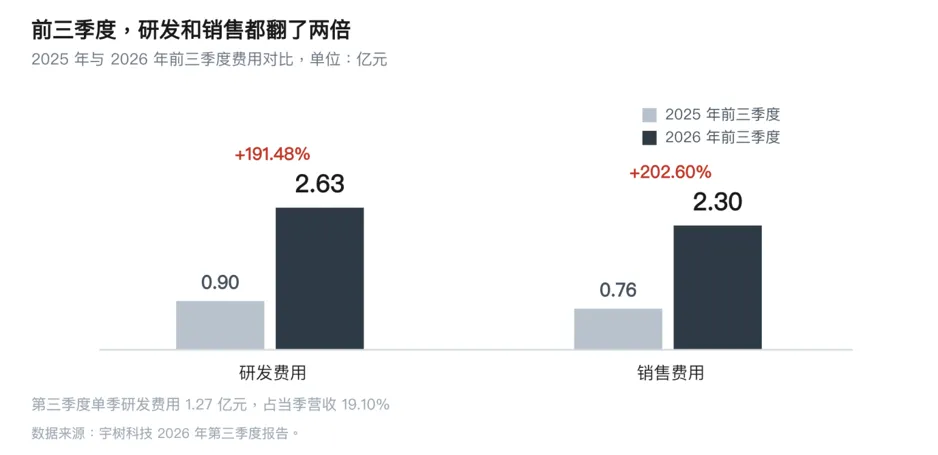
Figure: R&D expenses increased from RM90.21 million to RM263 million and sales expenses increased from RM76.01 million to RM230 million. Image source: Drawing based on the company's three-quarterly report
The gross margin for the first three quarters was about 54%, about 59.7%, down 5.7 points from the same period last year, according to the financial statements. Operating costs for the same period amounted to 836 million yuan, an increase of about 77.9%, faster than revenue growth.
Less than this 5.7 points, 54% of the gross interest rate still needs to cover the above two expenses first, and the rest is profit. Both are adding money, deducting non-net interest rates and 19.21%, with the balance remaining, depending on the gross level is thick enough.
03.
What's next?
In addition to the two groups of numbers, there are three other groups in the financial statements. The three groups answer the same question, on which the company's next steps will depend.
The first group is buyers. In the third quarter of 2025, the company's human robots earned US$595 million, accounting for 51.53% of revenue, the first time it surpassed quadruped robots, becoming the first major source of revenue. Of these US$595 million, 73.6% came from research and education customers, 17.39% from commercial consumption, and industry applications accounted for 9.01%..
In the third quarter of 2025, the company's core customers ranked first in the list were the Jingdong Group, with many overseas customers and domestic tech companies. A more accurate reading is that the largest buyer group for human robots is the global body intelligence developers. This means that it is closer to selling tool development infrastructure than it is to selling tutoring.
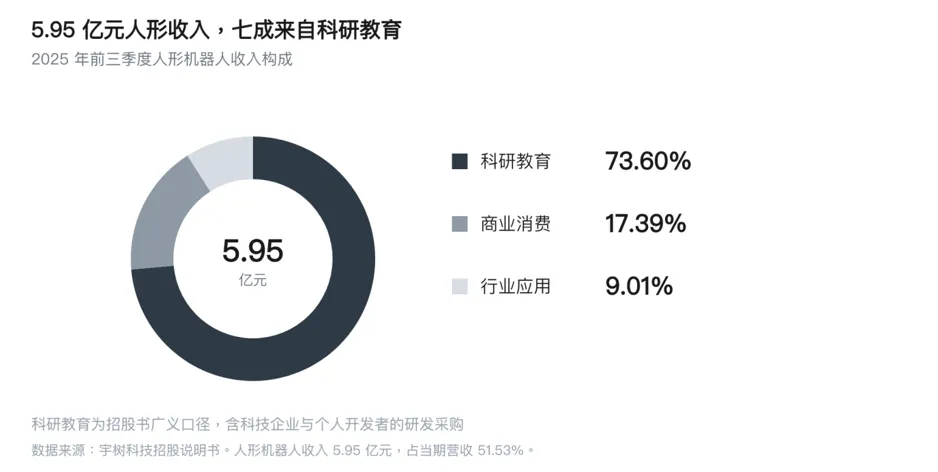
Figure: Human robots earned US$595 million, research and education accounted for 73.6%, commercial consumption accounted for 17.39%, industry applications accounted for 9.01%.
In 2025, the company shipped more than 5,500 humanoid robots, leading the way in the global ladder. These are the developers who raised a company with revenue of $1.817 billion in the first three quarters, which is still profitable. These buyers get the robot, the first thing is to dismantle it.
The quarterly newspaper of October 28 did not update this group of figures. A chart of where the buyer structure is headed can be consulted first. The share of robotics in scientific research and education revenue decreased from 68.61% in 2022 to 31.58% in the third quarter of 2025.
Chart: Quad-foot robotics revenue for science and education decreased from 68.61% in 2022 to 31.58% in the first three quarters of 2025.
The second group is inventory and cash flow. At the end of September, the company's inventory was ¥1.019 billion, and at the end of 2025 it was ¥368 million. Net cash flow from operating activities in the first three quarters was ¥194 million, a decrease of ¥54.69%, and receivables increased from ¥58.73 million to ¥143 million.
The company's calibre is that the increase in inventory mainly corresponds to the demand for spare parts brought on by revenue growth, as well as the provision of spare parts during the new product recession.
The third group was two other papers issued on the same day. On October 28, along with two other announcements issued by the Financial Times. One was the company's "Suiyu Creative Plan" jointly established with Redwood China, an early project to invest in artificial intelligence and robotic applications, the funding size of which has not yet been disclosed. The other was the company's 20 million yuan test base for artificial intelligence applications in Hangzhou.
In addition to the launch of the "Young Innovation Plan" at the Ecological Congress on October 22, the five-year goal is to catalyze more than 200 ecological enterprises. All three moves came in October. The company is moving its business from "selling robots" to "selling platforms".
The project is worth adding a background. In 2019, Red Sage first invested in Yu Tree through the seed fund, which it has held three times since then, and currently holds 7.11% of the shares.
Institutions are also reading the same material. On 25 October, JPMorgan upgraded the rating of U-tree from a low to a high of two levels. The target price for December 2027 was raised from 300 yuan to 995 yuan, according to reports from South +, Hangzhou Daily and others. The reason for JPMorgan is that physical AI's breakthrough window is likely to be more fragile than anticipated in the early industry.
Put it here because it explains one thing: after the financial statements come out, what the market really cares about is how to write the next chapter of the company.
At the beginning, the numbers in opposite directions, after reading this table, each has a drop. 270% behind a one-time charge, the drop is not behind the spending on research and development and sales.
Revenue is accelerating, profits are higher than the previous year, money is spent on models and calculations, buyer structure has a reference coordinate.
The first company to write a humanoid robot into a report, the first report to be submitted, is closer to what it is now than any of its conferences. In this industry, making a robot is one thing, fixing a bill, making a business a line that can be repeated is another more difficult thing.
The first report was the beginning of something else. The company switched money from ability to ability to return revenue, the second half of the way.
NOTE: All data is from the announcements and public financial statements of Yuke's Technology Corporation.