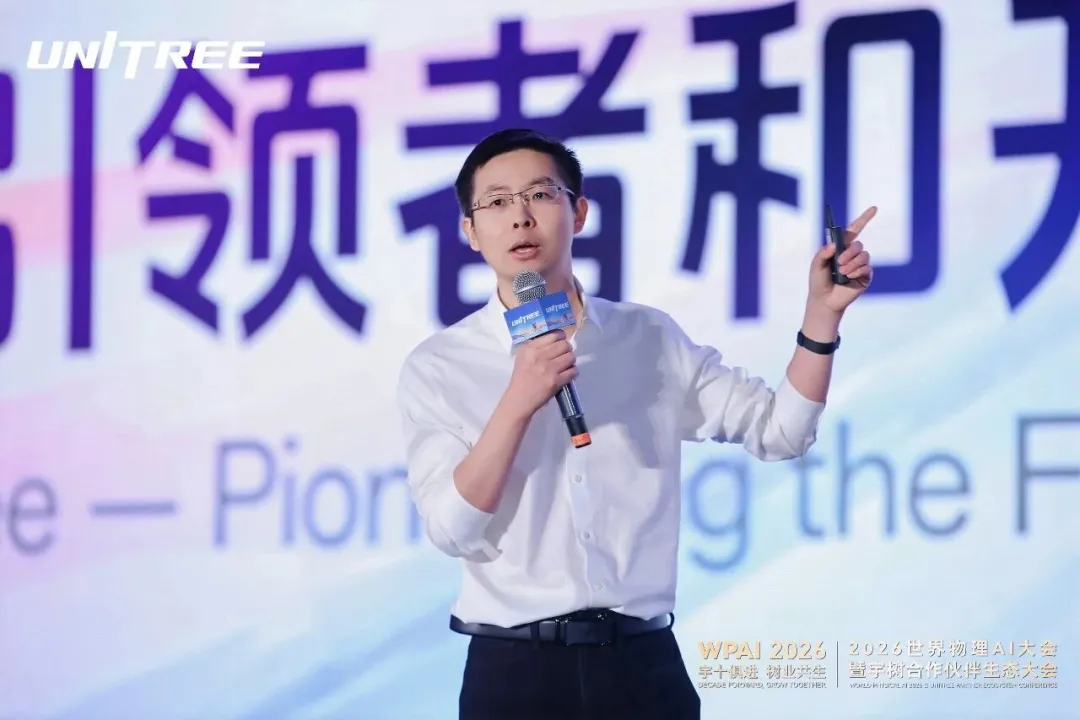
“ Wang Xiang appears to be more optimistic and mature.
An entrepreneur who built his home with two-legged robots said at a conference he didn't believe enough in AI.
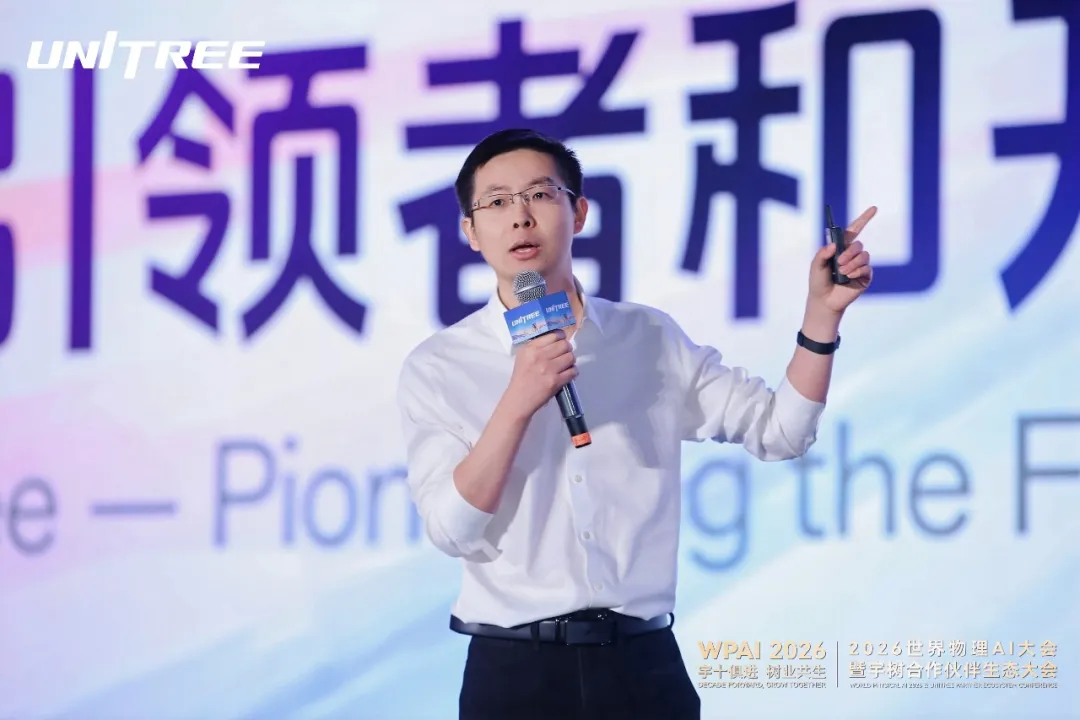
On the morning of 22 October, at Hangzhou, the theme of Wang Xing's speech at the 2026 World Physical AI Congress, the Ecological Congress of Ningbo Partners, was "Believe, Believe in AI as Much as Possible".
He stood on the stage, smiling and tearing down his desk: until now, I felt that I wasn't convinced enough, that I wasn't firm enough. He then listed a fact that had already happened: OpenAI conquered 372 of the top mathematical problems, the barriers of traditional software companies were broken down by AI reverse engineering, the characters in AI videos were better than real actors, Tesla's fully autonomous cabs were online.
He concludes that the problems of the information world have been overwhelmed by the current model capabilities, and most people simply haven't reacted yet.
01.
The world of information has been consumed by AI.
He discussed the four facts, each in detail.
Mathematics, which he discusses, is the response within the circle. After the publication of these questions, the world's top mathematical circles have raised a great deal of controversy and hype. According to him, mathematics is the most remarkable cutting edge of human intelligence, and this piece has been done by AI. Not that problems are completely solved, but that AI does better than humans.
The software issue, he said, was more straightforward. Many of the software problems that people usually do have been solved by AI reverse engineering for the most part. The barriers to traditional software companies are gone, which is a very real problem.
The video, which everyone in the audience can verify for themselves. He asked who now downloads fewer AI videos, including himself. The image, expression and emotions of the characters in the AI video are much better than real actors.
Tesla's fully autonomous taxi is already online, but the service is not yet available in the Chinese market, and domestic users don't feel it directly enough.
In addition to the four facts, he gave a more dramatic figure. The founder of OpenAI has said that around the world, only about 5,000 people really understand or develop cutting-edge AI models. Wang Xing stressed that this is not what he said, but what the top AI scholars say. Very few people have actually seen the top AI effects.

So why don't most people feel it?
It took about 10 years for the Internet to really get into everyone's hands from the 2000 bubble. It took years for even the simplest Internet to get into everyone's phone. From the most cutting-edge AI model to everyone's personal assistant, a pure AI phone, he thinks it will take 5 to 10 years.
This lack of time is the source of his anxiety. With the current model capacity, even if it does not continue to improve, the information world has been destroyed. The software on mobile phones, software on computers, all kinds of cloud platforms, the problems of the information world are all eaten up.
From mid-to-late last year onwards, many customers used the robot development algorithms of Utrecht to develop open-source algorithms, which were then adopted by global robotics companies. He saw this as the source of the collective progress of human robots over the past year. The ability to run fast in circles and fall into everyone's hands would have to wait five to ten years.
02.
GPT-6 is not trained, the robot washes the pen itself.
At the end of the information world, he turned the subject to the physical world.
He first put together a group of third-party tests, and Stanford and Ingrid both tested GPT-6, which was a huge change for the entire physical AI industry. He then put out a demonstration of his own company. GPT-6 is completely zero-trained, directly controlling robotic drawing. Zero-training means that the model can be deployed to the robot, and he doesn't write any complex code.
His judgment was that the problem of robotic planning, navigation problems, in a sense, had been solved. What was not solved was the success rate of interacting with real objects. It was relatively simple to install small objects, and the finer parts had not yet been assembled. The rest of the problem was the alignment of AI models' inputs and outputs with the real physical world, sensors with errors, execution with errors, and the model's ability to correct errors.
He gave two timetables. The big model solves the installation problem of physical AI, fast one to two years, slow two to three years. The voice command to get the robot to clean the room, fast one can be achieved next year.
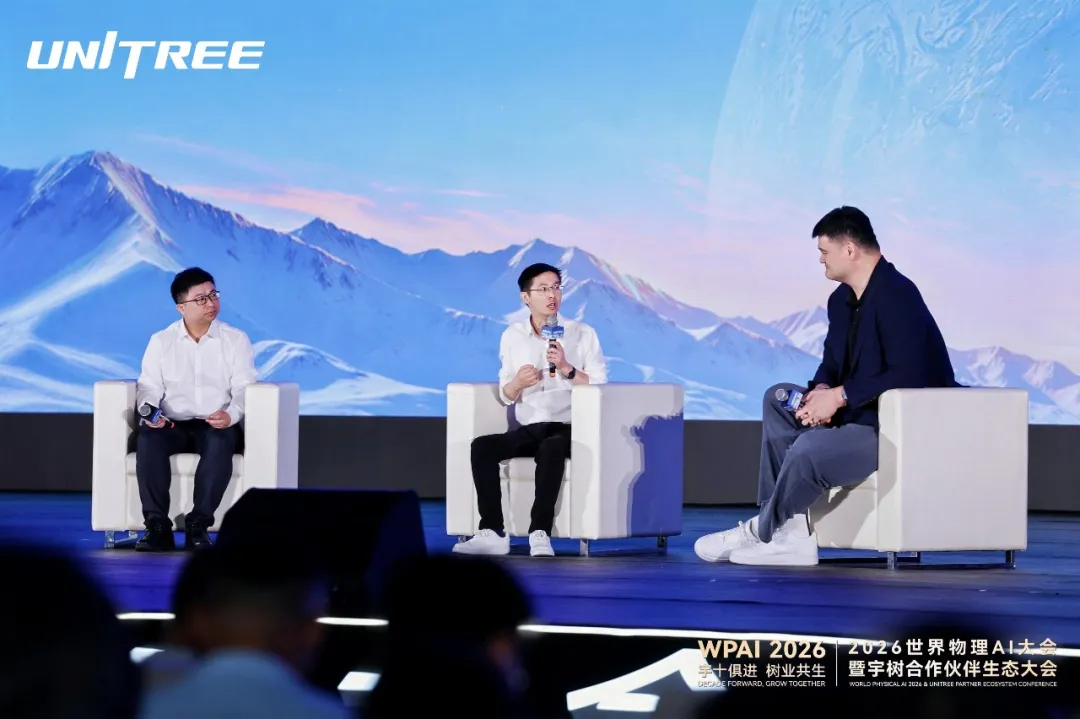
He came up with a concept last year. In about 80% of life scenarios in the future, humans will get robots to complete about 80% of the tasks through voice and language instructions.
He dared to push the timetable forward, and there was another reason. The model himself went to search for papers, wrote the code himself, trained himself in the web environment, tested himself in the real environment. The test results were scored by the model, and people occasionally participated, and the result was that the model was rearranged.
The external environment is also changing. Big model companies are increasingly interested in the robotics industry. He is developing the model himself while working with big model companies at home and abroad. According to him, physical AI will pass through critical points faster than expected.
03.
Tomorrow is ahead of us.
After talking about technology, he found it difficult to talk about his condition.
He said that he had too much to do every day, and that there were too many new things to learn about robots. Too little time, too fast, too fast. He used a word that rarely appears in tech talks, afraid. He was very afraid to waste every day.
At the age of 10, he began to make touch gloves, or data collection gloves, and that year became interested in artificial intelligence. At the time, artificial intelligence was a very cold-blooded industry, and the neural network was just a branch of many algorithms. He preferred neural networks because it resembled a human brain. In his first year of computer class, the teacher asked everyone to write a short essay, entitled "As the size of the neural network increases, it may become more like a human brain".
He expects that in 27 or 28 years, robots with physical AI models will really come into the family.
The industry is very hot, the future of cake is very big, the prospects are very wide, but the competition is very fierce. He says that it is necessary to do better every day. As long as the company and all its partners keep progressing every day, the future is theirs.
He attributed this urgency to the opportunity itself. For thousands of civilizations, hundreds of years, many people didn't have the opportunity. He felt that this generation really had the opportunity to realize super-intelligence or AGI and raise productivity to the next level.
Finally, he put out an action, the World Physical AI Contest. He cited the fact that the progress of AI over the years has been achieved through collaboration, from the Transformer architecture published in Google 17 to the Great Britain GPUs, open source algorithms, GPT models, which laid the technical foundations for global AI and physical AI. He wanted to increase the power of the world, the competition offers prizes of tens of millions of yuan per year, regardless of geographical location, and is good enough to reward. There are eight races, arbitrary mobility, athletics, wrestling, agility operation, construction, sports events, full-model interaction, and maintenance.
He said, "I think tomorrow is ahead of me".
NOTE: The above content is based on the 2026 World Physical AI Conference, the Ecological Conference of the Wu-Tang Clan Partners, where Wang believes and believes as much as possible that AI will record and organize the writing.