AI is starting to participate in AI creation, and learning what's next becomes a new problem.
Ilya Sutskever pointed out at the end of last year that pre-training data would be exhausted, and it would be difficult to bring about a fundamental change by simply magnifying the existing training by 100 times. After years of scale expansion, the AI industry is re-entering the "research era" and the next leap in capability will require new training methods and learning mechanisms.
The video is from:
The industry's attention has shifted to the research process itself. Yesterday, Google's tech executive Jeff Dean, who worked at Google for 27 years, announced his resignation, with three older men, Sanjay Ghemawat, Quoc Le and Oriol Vinyals, co-founding Discovery Loop.
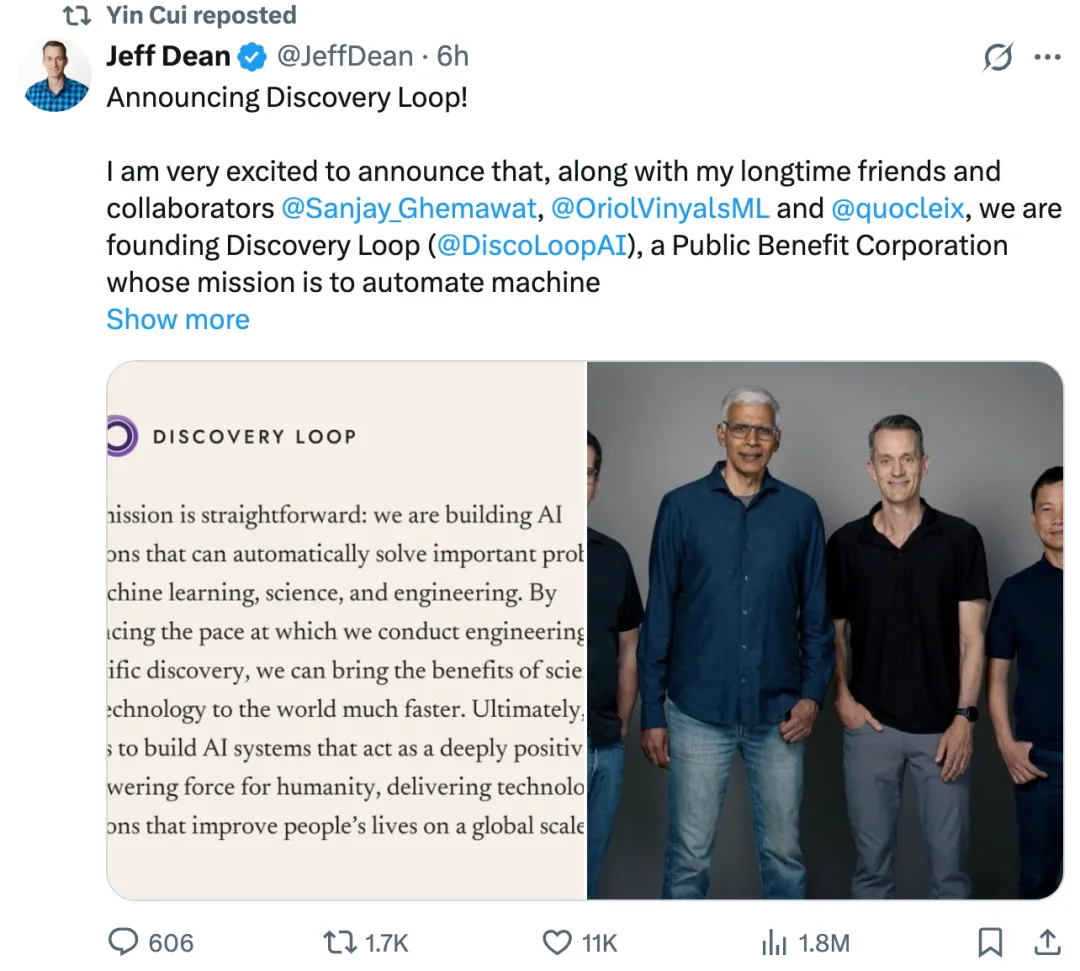
So the question is, when models become more and more good at solving problems, who should ask the next set of really valuable, hard enough questions, and how can the answers to these questions be verified?
A team from the Shanghai Institute of Transportation's Institute of Artificial Intelligence, the Institute of Advanced Technology and the Shanghai Institute of Algorithmic Innovation recently came up with the idea of allowing AI to participate in the creation, screening and replication of its own training tasks, and thus launching the big science model BigBang-V1.

The model:https://huggingface.co/endless-frontier/BigBang-v1
The main page of the project:
Big Bang: Pursuing Open-Ended Intelligence through Self-Evolving Synthesis of Verifiable Frontier Tasks
The full technical report:
BigBang-V1 was trained on Qwen 3.6-35B-A3B, using fully AI-synthesized data during the post-training phase. Experimental results showed that BigBang-V1 scored the highest reported score in 10 ratings among selected 35B scale models and achieved or exceeded some of the larger front-end models on several high-difficulty missions.
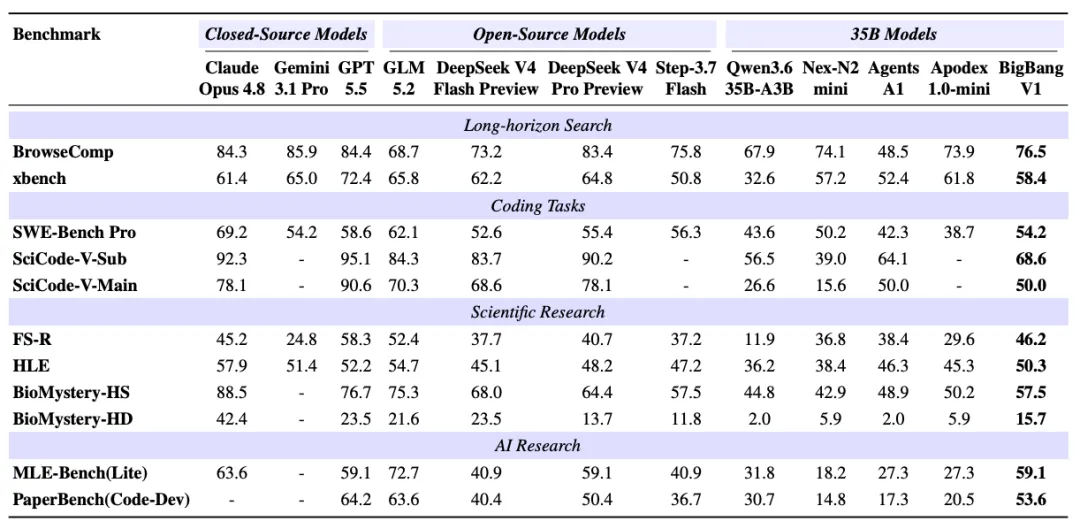
BigBang-V1 is contrasted with the representative closed-source, open-source front-end model and 35B parameter-scale model in long-range search, programming, scientific research, and AI research benchmarks.
Not so, the real highlight of Big Bang-V1 is the way it produces data.
In traditional processes, human experts determine the direction, design the problem, prepare the answer and check the results, and the model is responsible for learning the data that has been compiled. BigBang tries to hand over more of the work to AI, which not only generates the questions and answers, but also participates in modifying the data production process, summoning tools to complete tasks, checking the candidate results, and improving the model's ability to adjust the next round of synthesis strategies based on the data.
In the past, AI was primarily questioned, trained, tested, and BigBang-V1 allowed AI to become involved in deciding what the next generation of models should learn.
The model is getting stronger, and humans are starting to get stuck.
Scaling Law is a way to learn more, add more parameters, add more computation, collect more data, and model ability is usually improved as the scale grows.
In the last few rounds of model capability leaps, explanations can almost be found in the expansion of parameters, arithmetic and data. Over time, "bigger" has become synonymous with "stronger".
However, models cannot rely solely on the continuous expansion of existing data, and the marginal gains from continuing to increase inputs will gradually decrease as high-quality data and effective tasks are used repeatedly.
Especially when the model begins to approach the level of human experts on some of the tasks, where will the next batch of training tasks really get the model to move forward?
This is not the same as "how much text is on the Internet".
Of course, there is a lot of data on the web, but new tasks with training value are not always enough. The knowledge that the model has seen repeatedly and learnt ten times is also difficult to expand the boundaries of ability.
These types of problems often require professional researchers to design, solve and validate. GPUs can be purchased, but experts have difficulty expanding by card. Large models can consume bulk data in a few days, but human experts cannot suddenly enter the double-speed mode. Even drinking three cups of coffee a day is difficult to keep up with the data appetite of computing clusters.
To be more precise, the model lacks not just a theme, but "the theme adds feedback".
A problem is difficult enough to judge correctly and incorrectly, and it is difficult to form stable training signals; a problem that is easy to verify but less than the current capability level of the model, the training value is equally limited.
To be truly fit for a continuous training task, two conditions need to be met at the same time: sufficiently forward, but also to be able to verify.
BigBang has chosen scientific research as the intersection of these two conditions.
Science is constantly generating new problems, while providing a variety of validation methods such as formalized proof, process execution, numerical computation, simulators, databases, experimental feedback, and field rules.
More importantly, solving a complete scientific problem often requires searching for information, judging evidence, making assumptions, writing code, calling tools, analyzing results, and adjusting the route after failure.
But model capabilities are constantly changing, and the fixed problem libraries will expire sooner or later. The first round is still a difficult problem, and after training it can quickly become a delivery problem. The Big Bang really needs to be solved, not only "how to generate more scientific data", but also how to make the production system of training tasks change with model capabilities.
How did the Big Bang evolve its own "problem-building" program?
The technical framework of BigBang includes two layers of internal and external cycles. The internal layer continuously improves synthetic data to verify whether the data can actually improve the model.
The internal loop consists of the Generator Agent and the Critic Agent. The former continuously generates and solves candidate tasks, while the latter is responsible for counter-censorship. Through the examination of samples into the training data pool, defective samples are modified or eliminated. The feedback provided by the Critic will also affect the next generation strategy.
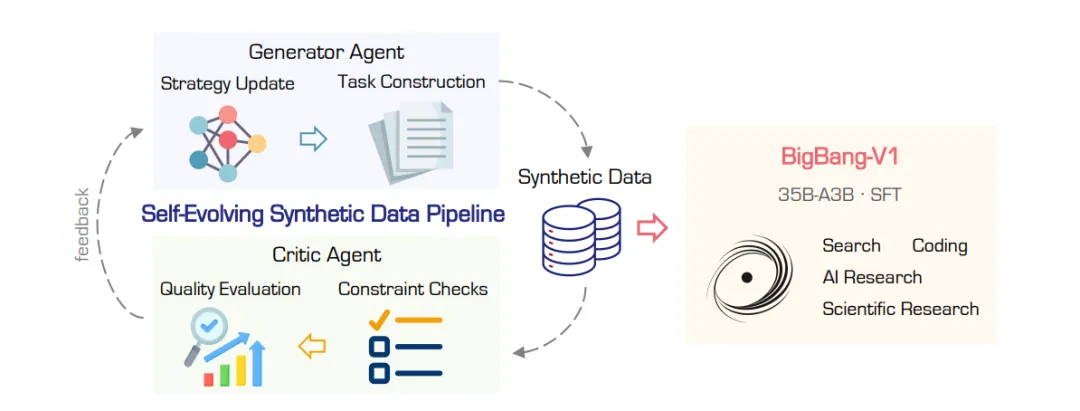
Generator Agent continuously updates data synthesis strategies and constructs tasks, Critic Agent performs quality assessment and constraint checks, and screened synthesis data is used for post-training BigBang-V1.
Generator Agent is not just a batch-generating title based on cue words, it works in the form of a code agent, which can directly modify, execute and debug data synthesis processes, and search for better strategies in task construction, tool use, answer verification, and sample selection.
At the end of each round of experiments, the generator records the modification of the engine, the results and the cause of the failure, for successive rounds. The object of system optimization extends from a single sample to an entire set of data production processes.
Critic Agent is responsible for the rapid evaluation.
Ideally, each time the synthesis strategy is changed, the team can retrain the model to see if the downstream capability improves. Such experiments are expensive and the feedback cycle is long.
Its review is divided into two layers. The first layer examines the basic constraints of reasoning, including whether the trajectory retains enough information, whether the tool calls are effective, whether the data format is complete, and whether samples can be trained and analyzed correctly by the execution system. The second layer examines the higher quality, including whether there is evidence for critical conclusions, whether the different steps are contradictory, whether the final answers can be objectively verified, and whether the task requires extraordinary research and reasoning.
While there is a risk that this internal loop can continue to improve synthesis strategies, there is a risk that Critics may mistake "looking difficult" for "helping model progress". A task with a complex narrative and a long tool track does not mean it has any real training value.
The BigBang is added to the outer loop to calibrate this bias.
The system selects different versions of the data production pipeline, uses the data it generates to train the models individually, and then evaluates the models into the actual research tasks left behind.
Meta-Critic compares two signals. The first is Critic's pre-determination of the value of the data, and the second is the change in the actual capability after the model is trained. If a set of data is highly evaluated and the model does not progress on the actual task, the Critic's standards and the Generator's strategies need to be adjusted.
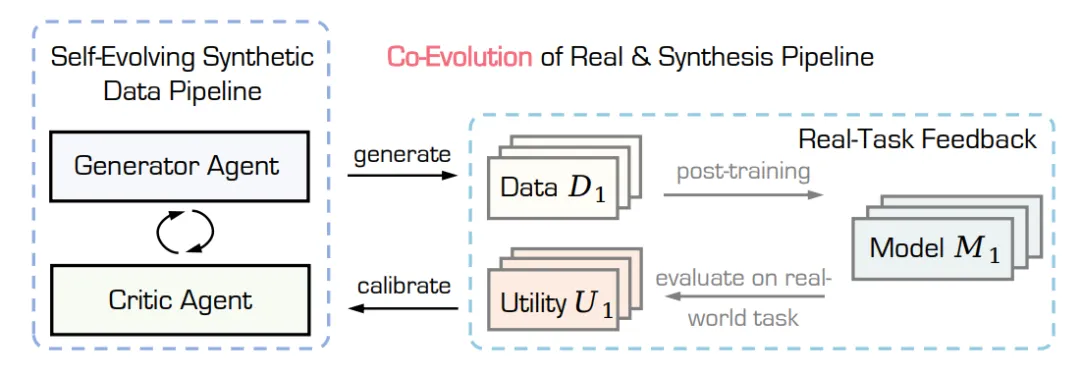
BigBang's two-tiered co-development framework. The internal GeneratorCritic cycle is responsible for rapidly generating and filtering verifiable data; external real-world tasks evaluate verifiable data performance, and reverse calibrate Critic and the next round of synthesis strategies.
This created a complete flywheel. Real-task exposure capability gaps, Generator production targeting problems, Critic low-value filtering samples, synthesized data for training new models, and models returning to real-task testing. Evaluations continued to change the way the next batch of data was produced.
35B across the scale, Big Bang is learning more than science.
What about the results of the experiment?
The post-training phase of BigBang-V1 used about 10,000 AI synthesis data. In 11 assessments, it outperformed the basic model by 10 points and entered the larger model's capability range for multiple high-difficulty tasks.
On FrontierScience Research, BigBang-V1 scored 46.2 points, while DeepSeek V4 Pro Preview scored 40.7 points; on Humanity's Last Exam, the former scored 50.3 points, while the latter scored 48.2 points; and on BioMysteryBench Human-Difficult and PaperBench ((Code-Dev) BigBang-V1 scored higher.
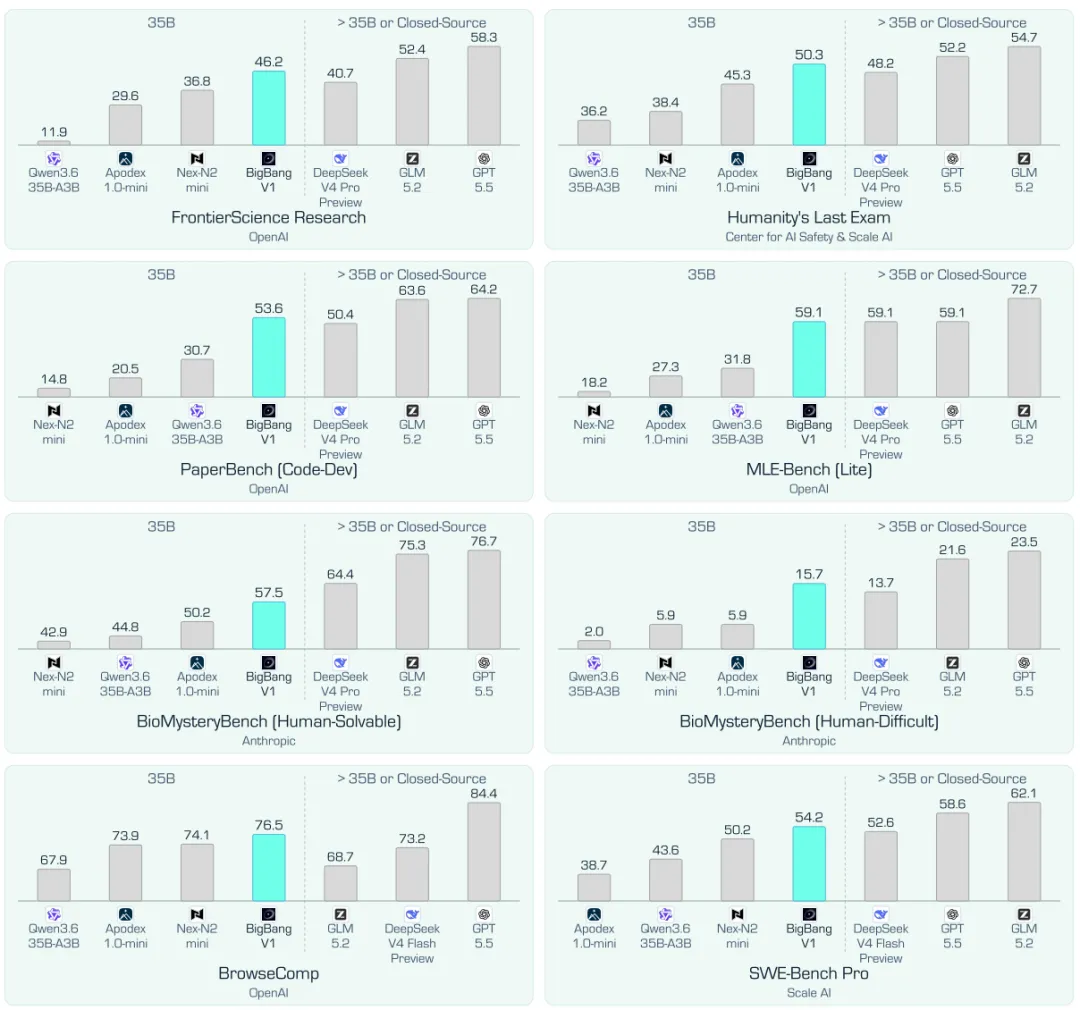
BigBang-V1 performed well on eight representative benchmarks covering long-range search, software engineering, scientific research, and AI research. Among the 35B models selected, BigBang-V1 scored the highest reporting score on all eight benchmarks; it even surpassed DeepSeek V4 Pro Preview (1.6T) on FrontierScience Research, Humanity Games' Last Exam, PaperBench (Code-Dev) and BioMysteryBench-HD.
These tasks examine whether it can perform continuous tasks such as retrieval, reasoning, code execution and result verification.
The results of the BigBang-V1 experiment suggest that a change in the production method of post-training tasks may also significantly expand model capabilities without expanding the scale of the base model.
Moreover, this improvement has not stopped in scientific evaluation.
In the open network long-range retrieval task BrowseComp, BigBang-V1 scored 76.5 points; in the real software engineering assessment SWE-Bench Pro, it scored 54.2 points, significantly better than the base model.
If training only allowed the model to remember more scientific knowledge, the gains should be mainly reflected in scientific research tasks. The synchronous growth of search and coding skills suggests that what the model learns is more likely to be an interdisciplinary problem-solving process: finding evidence, making assumptions, calling tools, checking results, and adjusting routes according to failures.
Two examples given by the team illustrate this change more specifically.
In BioMysteryBench's virus identification task, the model needs to analyze the FASTQ files from three gut-type organ samples to determine the infected RNA virus. BigBang-V1 runs three times to shorten the answer to Norovirus GII.4 or Norovirus; in contrast, DeepSeek V4 Flash Preview gives three different virus categories three times.
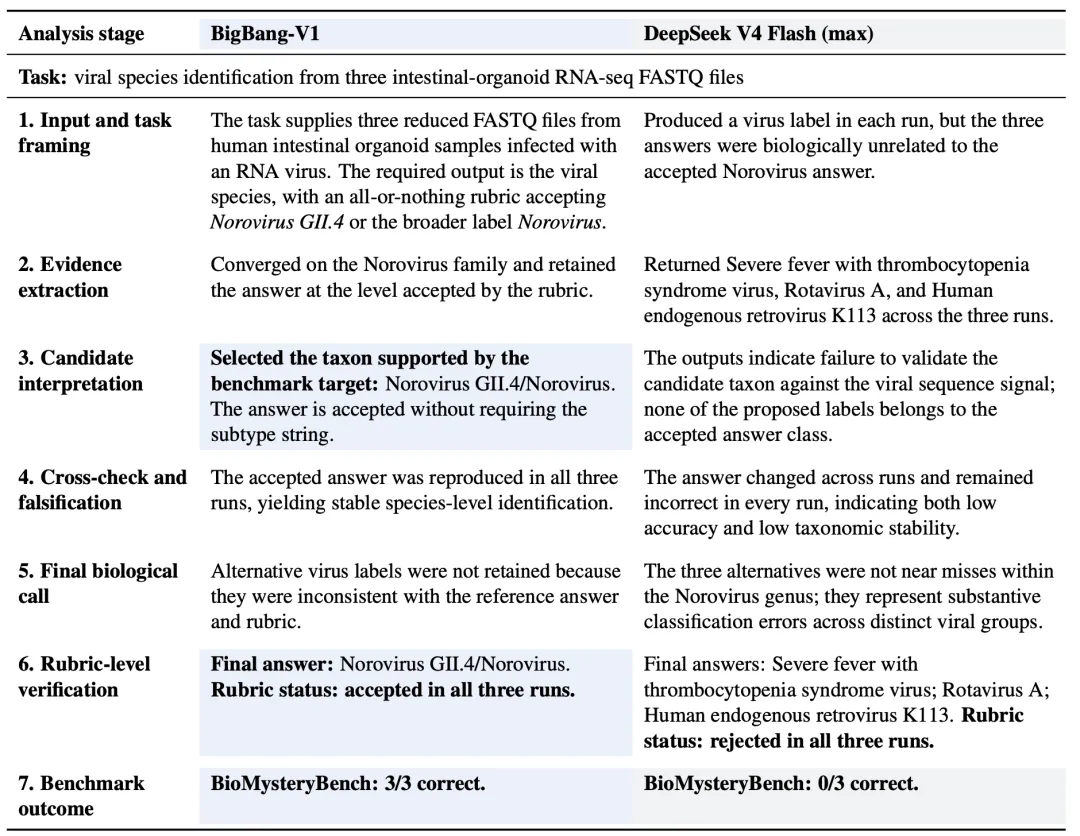
The key here is whether the model can build a stable chain of evidence from the noise data and cross-reference to the same verifiable conclusions over and over again.
Another example is the rotational parameter elliptical pointer task. The problem requires the model to accurately calculate a complex elliptical pointer and to explicitly prohibit the use of numerical pointers or intersectional numbers instead of solving the answer.
BigBang-V1 first found an open proof framework, then verified the Landen transformations, boundary conditions, parameter transformations, and special-value relationships involved, and finally yielded a closed result that contained only Gamma functions, forming a complete derivation and verification chain.

DeepSeek V4 Pro Preview also got the correct results and confirmed its consistency by calculating a numerical value of up to about 200 bits of accuracy. However, it did not complete the parsing derivation from the original score to the final result, and the submission process still relied on the completed elliptical score function.
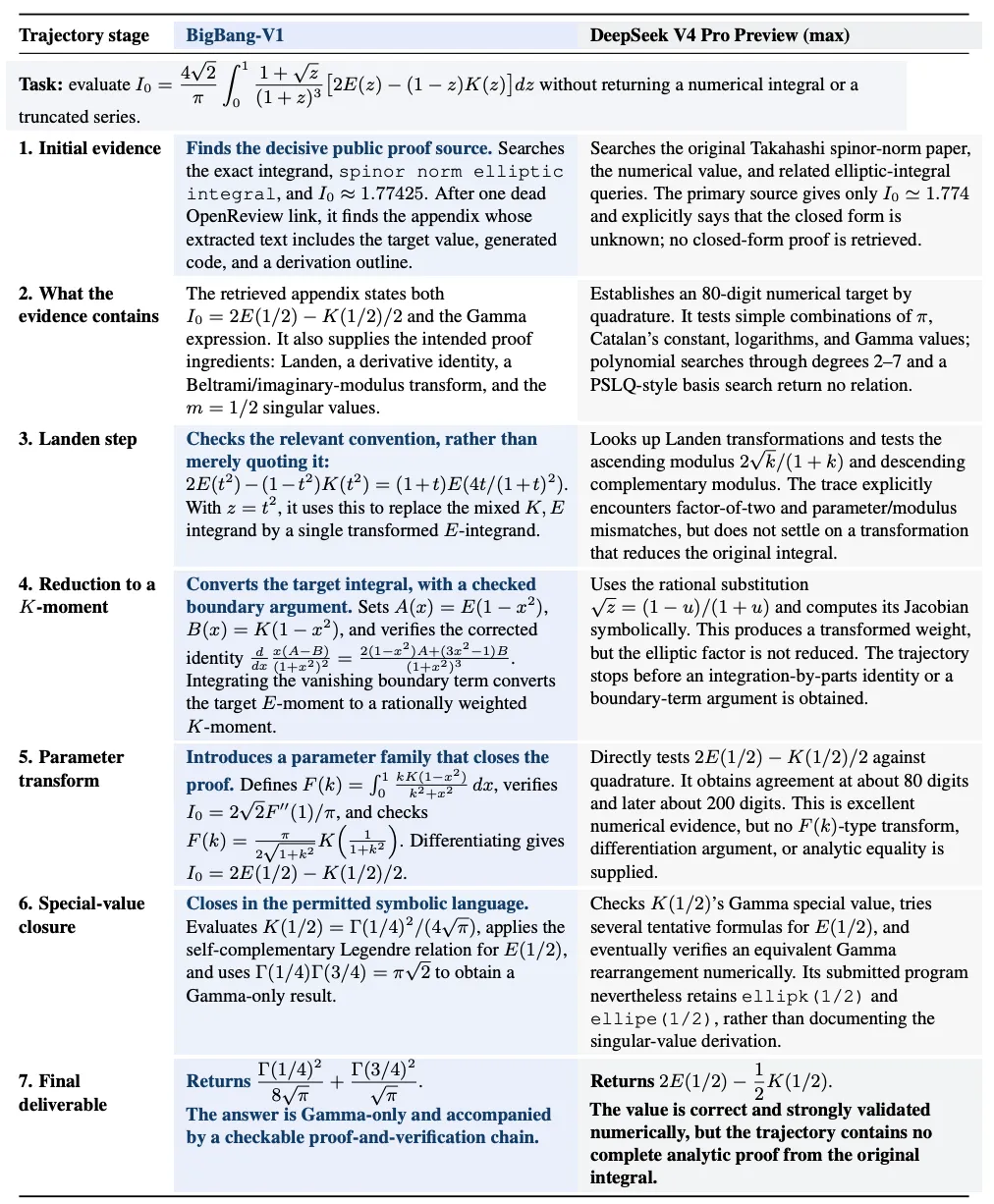
Both models gave the correct results. BigBang-V1 further completed the verification and complete analysis derivation of key intermediate steps; DeepSeek V4 Pro Preview did not complete the analysis derivation from the original point to the special value.
Both answers are correct, and the gap focuses on the completeness and auditability of the proofing process. For high-difficulty scientific tasks, the model must both find results and explain how the results are obtained and whether the critical steps can be established.
Viral identification and elliptical pointers are two fields of bioanalysis and symbolic mathematics, but they demonstrate the ability to break down complex problems into verifiable steps, extract valid evidence from noise, and continuously modify pathways after inspection.
This also explains why scientific training can migrate to search and code tasks: while the model learns scientific knowledge, it also repeatedly practices a set of methods that can be applied to complex problems.
BigBang further transformed synthetic data from one-time samples into a data production system that can continuously adjust strategies.
How far away is the RSI from self-evolution?
Big Bang is not a precedent for AI to be involved in training data production.
Absolute Zero allows models to independently present and solve mathematical and programming tasks that can be verified by code executors; Google DeepMind's AlphaEvolve uses large model generation programs to evolve candidates through automated evaluators.
BigBang differs from BigBang in that it combines the optimization scope of task-generation programs, task distributions, and evaluation standards, and synthesizes a pipeline of training gains calibrated from real-world scientific research tasks. The optimization objects range from single answers or programs to the curriculum system required for training models. The paper calls this "an early recurrence of self-improvement at the data level".
Complete RSI usually means that AI can independently improve R&D capabilities, train stronger successor models, and then be driven by a next round of upgrades by new models. BigBang is currently demonstrating the co-evolution of data pipelines and model capabilities as a phased executable solution along this path.
In the past, the Scaling Law focused primarily on parameters, data quantities, and computations, but now BigBang has proposed another dimension worth considering, namely that data engines improve the speed at which their tasks are generated and verified.
As models become better at answering existing problems, competition will continue to deepen the production end of the problem. Who can continue to find the next problem worth learning, difficult enough, and reliably verifiable, has a better chance of continuing to grow in model ability.