The smart industry is undergoing a change in rating standards: in the last few months, the most eye-catching cases have been demos, financing, single-point landings; but when the industry enters the deep water zone, the real determinant of whether a company can cross the cycle is never once enough to show off the ability to be replicated, deployed, and continuously optimized.
The DM0.5 is the answer to this proposition. It is not a model ready for a single demonstration, but a foundation for the ability to scale landings in the future: not to pursue a better-looking demo kit, but to turn the model from the research assets of a few teams into a real infrastructure that developers can use.
In a nutshell: DM0.5 uses reproducible training to deploy thresholds, go through simulations and real-world scores, and accelerate quantitative reasoning, for the first time, to scale-in to the scene shell from a slogan to a verifiable ability.
DM0.5 Excellence in all subjects, open source and reproducible
The DM0.5 first solved the problem of silicon not being able to use silicon: it supports fine tuning training on a 4090 consumer-grade graphics card, and deployment of a downstream task can be completed in as little as 18 hours, with a 60% reduction in fine tuning costs. The body model is moving from a display silicon to a development silicon, so more developers have the opportunity to actually participate in the verification and expansion of model capabilities.
A common phenomenon in today's smart industry is that many models excel on a task, benchmark, or robotic platform, but the advantages are difficult to maintain once switched to different task formats, body structures, and evaluation settings. DM0.5 exhibits precisely the less common type of multi-channel dynamic capability structure, which is not limited to simulation environments, but permeates machines and simulations, operations and navigation, tasks and multi-channels.
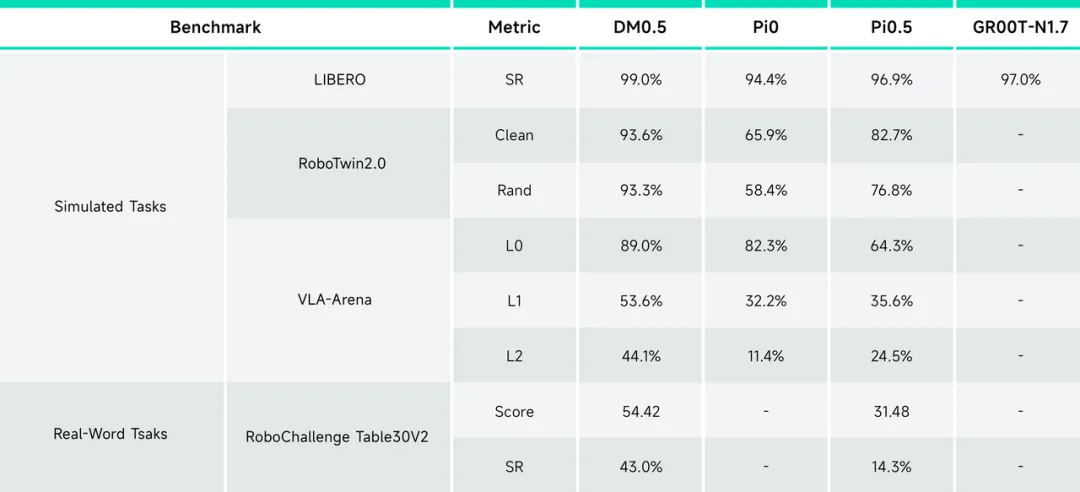
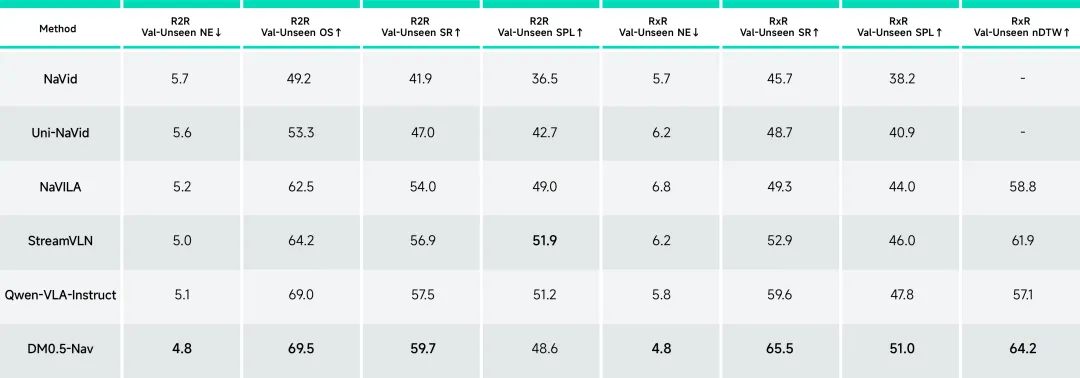
On the public Benchmark side, DM0.5 also demonstrates strong academic advantages: LIBERO's overall rating reaches 99.0%, and refreshes several public rating results such as RoboTwin 2.0, R2R, and RxR. It is more important to emphasize that these assessments themselves cover the dimensions of desktop operations, long-range tasks, navigation understanding, and other capabilities. DM0.5 is not only strong on one project, but builds strengths on multiple core dimensions at the same time.
In the RoboChallenge Table30 V2 rating for real industrial and life scenarios, DM0.5 was ranked first with a 43% success rate and a total score of 54.42. The rating covers four robotic platforms ARX5, UR5, ALOHA and Dexmal-Mirror, including single-arms and two-arms shapes, tasks involving target positioning, precision crawling, multi-step operation tools, interaction with two-arms synchronization and other complex scenarios.
In terms of generational improvements, the Zero-shot success rate of DM0.5 is up 31%, Few-shot is up 45%, Fine-tuning is up 20%. This indicates that its progress is not limited to a specific capability pathway, but covers the three different uses of direct generalization and downstream fine-tuning. For real scenarios, this overall improvement is more meaningful than a single indicator, as real robot systems almost never consider only one capability.
DM0.5 performance in complex, precise and long-range tasks
Data and bi-wheel-drive architecture, the core of a real-life model
Supporting this set of capabilities is the design of models with larger data and closer to the needs of the real world. The Dynamic Machine DM0.5 uses a 4B parameter scale, based on 150,000 hours of source high-quality data training, with 400% improvement in data volume compared to previous generation models, and 100% improvement in parameters. Data sources include 50,000 hours of high-precision real-machine operating data, 100,000 hours of Egocentric scene video, and site reconstruction data covering 1 million square meters of space: the former provides real-world operating experience, the latter helps the model learn more rich spatial relationships, physical changes and environmental precedents, then combines high-precision reconstruction, further narrowing the 2Real Sims scenery gap.
In architecture, DM0.5 introduces the context-abstract layer, physical mind-chain tasks and trajectory alignment layers. The context-abstract layer allows the native model to support the longest 60s sequence memory, no longer confined to step-by-step commutation; physical mind-chain tasks allow the model to not only generate movements, but also to co-modulate instructions, essence, and environments, improving task planning and state understanding; trajectory alignment movements are upgraded from simple point-by-point monitoring to more stable trajectory alignment, enhancing consistency and robustness in complex learning.
DM0.5 performs well under camera interference
Systematic reasoning accelerates to make the model really useful
For real robot systems, speed is never just an engineering optimization indicator, but directly related to whether the model can enter continuous operation, real-time interaction and high-frequency task scenarios.
The DM0.5 single-card logic delay decreased from 534.04ms to 57.49ms, achieving 9.29x acceleration, and the API delay p50 was 67.75ms; p90 was 70.01ms.
This set of accelerations does not stop at optimizing a particular kernel, but allows the entire VLA reasoning system to accelerate to a quantitative level: combined optimization of Vision TensorRT, Tuned FlexAttention, FP8 E4M3 Tensor Core Prefix MLP, Triton Suffix convergence algorithm, and startup CUDA Graph, which will compress the online execution to static data transport + a single graph replay, no longer requiring repeated capture when requested.
The DM0.5 model is fully open source
The kernel DM0.5 is open-source, with ecological inputs such as GitHub, Hugging Face, and gradual release of models, documents, and practice references, reducing the developer's thresholds. At the same time, it has contributed core code to the LeRobot community, more model weight, cross-platform deployment cases, and application practices will continue to be open.
GitHub:
HuggingFace:
Based on DM0.5, the latest Demo 1.0101 crawler-square-block task supervision fine tuning (SFT) demonstrates DM0.5's powerful Few-shot and Fine-tuning capabilities. The model is able to quickly adapt to SO101 and synchronize open-source related models, datasets and complete LoRA SFT training workflows to provide reproducible and scalable practice references for developers.
The video:
Scalability will not grow naturally from demos. Especially at this stage, the industry needs more than to continue to showcase stack points, but rather to consolidate basic models, development thresholds, reasoning efficiency and cross-scenario generalization capabilities. DM0.5 is also here: it is not claiming that physical intelligence has completed the scale landing, but rather using a more complete set of model capabilities, stronger list performance and more user-friendly developer pathways to scale into the scenarios.
In this sense, the release of DM0.5 is not just a model update, it's more like a clear expression of an industry line: the first step is not to do more one-point demonstrations, but to create a developer who is willing, able to use, able to use, and who does showcase all-disciplinary advantages on real machines and open lists. DM0.5 is not just a basic model of a power machine, but an open platform that can be shared by the entire community.
Large-scale landings won't come overnight, but they probably start with a model like this.