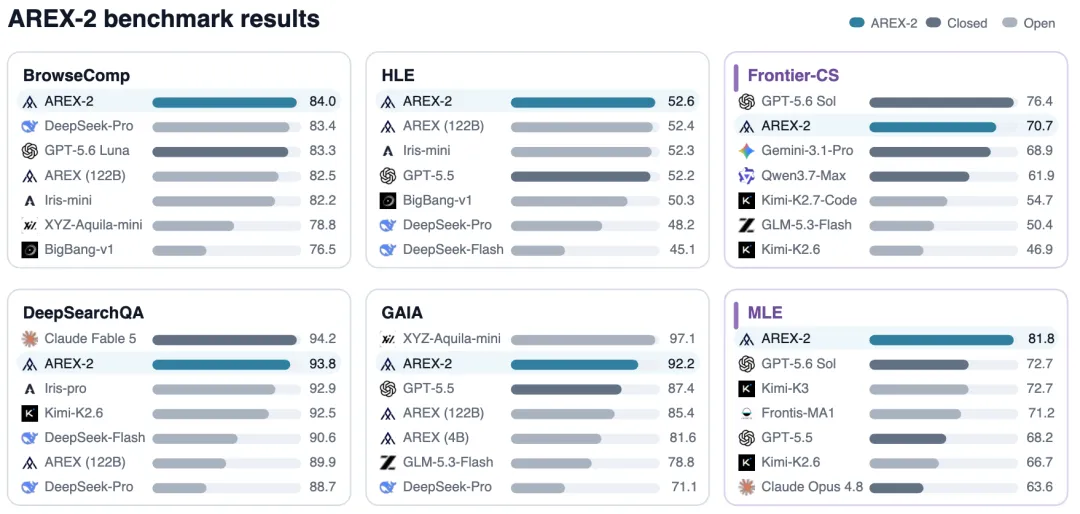
Recently, an AREX-2 model was released by a team of researchers from multiple institutions such as the Institute of Intelligent Studies, the Chinese University of Science and Technology, the People's University of China. The model is based on the lightweight Qwen3.8-27B model, based on long-term reflection data training built around machine learning and algorithmic programming scenarios, which not only demonstrates leading machine learning and programming capabilities on MLE-bench Lite, Frontier-CS, but also transfers this capability to deep research and scientific problems to solve important benchmarks such as BrowseComp, HLE. These results show that long-term testing helps to improve the self-training model's capabilities while continuing to transcend the field of training.
In the first three weeks of September, flagship models such as the GPT-6 Astra, Fable 5.1, and others joined forces. While people were still amazed at Claude's first formalized proof of Fermat's theorem in 11 days and 13 million lines of code, just four days later, OpenAI announced that its model might solve another mathematical problem: the Navier-Stokes equation, one of the Millennium Grand Prix problems.
Recursive Self-Improvement (RSI) has thus become a common concern for researchers, entrepreneurs and investors. However, a fundamental question remains to be answered: what is the RSI and how to develop and measure this capability?
The AREX team gave a specific point of entry: in a single mission, allowing the intelligent body to continuously improve its own solution solution by continuously reflecting and iterating while testing. From this point of view, RSI is not mysterious, but a new test-time scaling paradigm that allows more rounds of input and continuous conversion into better results.
The core of this ability lies in reflection and duration. The former determines the quality of each round of improvement, and the latter determines how long the improvement can last. The latter, like the rate of return on return and time, have a shared effect on the final return.
The AREX team further proposed that long-range reflection is a cross-domain capability. If a suitable training ground can be found, models are expected to apply methods of improvement learned in one field to other fields. For this, the team chose two scenarios of machine learning and algorithmic programming: they have both rich task materials and can provide clear, verifiable environmental feedback, creating conditions for intelligent agents to continually improve performance in a multi-tiered era.
The above scenarios serve as a training ground, and the team developed AREX-2 based on Qwen3.8-27B. In the experiment, AREX-2 demonstrated outstanding test-expansion capabilities: scoring 81.8 and 70.7 on the MLE-bench and Frontier-CS, respectively, significantly updating the performance of the open-source lightweight model; and achieving 84.0 and 52.6 on the BrowseComp and HLE, respectively, a significant improvement over the previous generation AREX.
These results suggest that long-term reflection training is expected to help models learn the ability to improve themselves across domains, allowing more testing to be continuously converted into better outcomes, and provide a traceable, verifiable pathway to RSI realization.
Link to the paper:https://arxiv.org/abs/2609.38288
The main page of the project:https://github.com/VectorSpaceLab/AREX-2
Model weight:https://huggingface.co/collections/BAAI/arex-2
The link to the website:
AREX team
RSI is a new test-time expansion paradigm
What is the RSI, and how to develop and measure this capability of the model?
The AREX team gave a specific point of entry: in a single mission, allowing the intelligent body to continuously improve its own solution solution by continuously reflecting and iterating while testing. From this point of view, RSI is not mysterious, but a new test-time scaling paradigm that allows more rounds of input and continuous conversion into better results.
The core of this ability lies in the point: using questions to drive, reflect and distance.
Reflective ability to determine the quality of each round of improvement: Is it possible for an intelligent body to come up with a better solution than the current one based on feedback?
Long-range capability determines how long the improvement can last: whether the intelligent body can continue to advance in multi-cycle execution, so that the improvement process does not stall prematurely due to a failure, a setback, or repeated attempts at ineffective directions.
Reflective and long-term capabilities, such as the rate of return on return and time, have a shared effect on final returns. The key to developing these capabilities is to allow models to learn how to continually improve from training data. Unfortunately, the data that can fully demonstrate this process is precisely the most scarce part of the existing material.
Machine learning and algorithmic programming
A natural training ground for long-range thinking
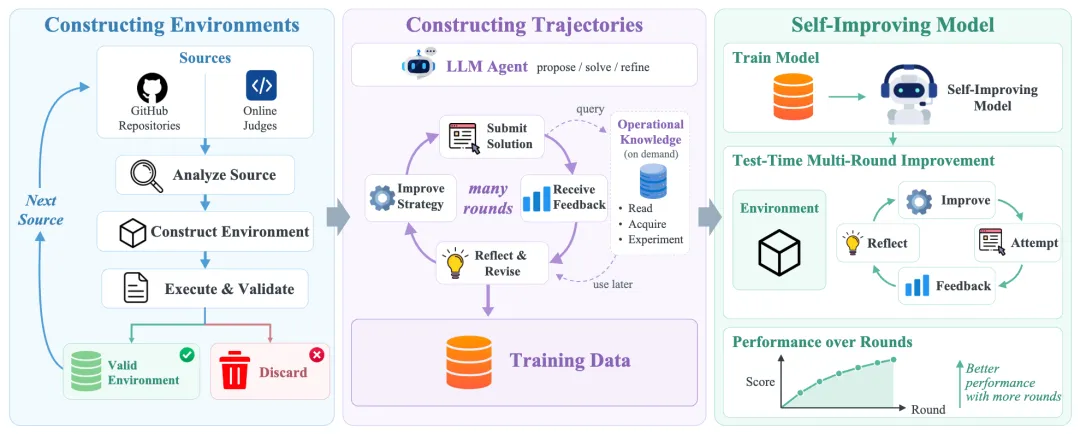
The AREX team suggests that long-term reflection is a cross-disciplinary meta-ability. If a suitable training ground can be found, models are expected to improve the methods learned in one area and apply them to other areas.
To this end, the team selected two scenarios for machine learning and algorithm programming: they are both rich in task materials and can provide clear, verifiable environmental feedback that creates the conditions for intelligent agents to continuously improve performance in multiple iterations.
Specifically, smart entities are improving models and training programs in GitHub machine learning projects, optimizing algorithmic processes in online assessment topics, and testing the results of each round of improvements by using model indicators in hidden evaluations to test the quality of proportions or solutions.
In both of these scenarios, teachers' intelligence bodies first independently construct tasks, evaluate mechanisms and operating environments, and, through actual execution, select operational environments with sufficient room for improvement. Subsequently, in sufficient time and on a rotational budget, cycle the implementation of feedback submission schemes → obtaining feedback → reflecting on improving feedback, and on-demand reviewing data, using skills and conducting experiments. Reasoning, attempting, failing and subsequent adjustments remain in the trajectory, forming training data showing how feedback continues to improve feedback.
Training for continuous improvement in machine learning and algorithmic programming benefits from in-depth research as well
In-domain ratings:27B models lead all comparison models in the MLE-bench
AREX-2 first validated this training route in machine learning and algorithmic programming tasks.
On MLE-bench Lite, 27B's AREX-2 scored 81.8, more than all of the comparison models listed in this report, including the closed-source front-end model. Of these, GPT-5.6 Sol and Kimi-K3 both scored 72.7, leading AREX-2 by 9.1 percentage points. At Frontier-CS, AREX-2 scored 70.7, leading all open-weight models that have reported this result.
This group of results illustrates that long-range improvement trajectories built around verifiable feedback can be effective training signals. Model learning includes not only how to generate initial programs, but also how to continue optimizing programs based on feedback. For tasks such as machine learning and algorithmic programming, this continuous improvement capability has been shown to be a competitive task.
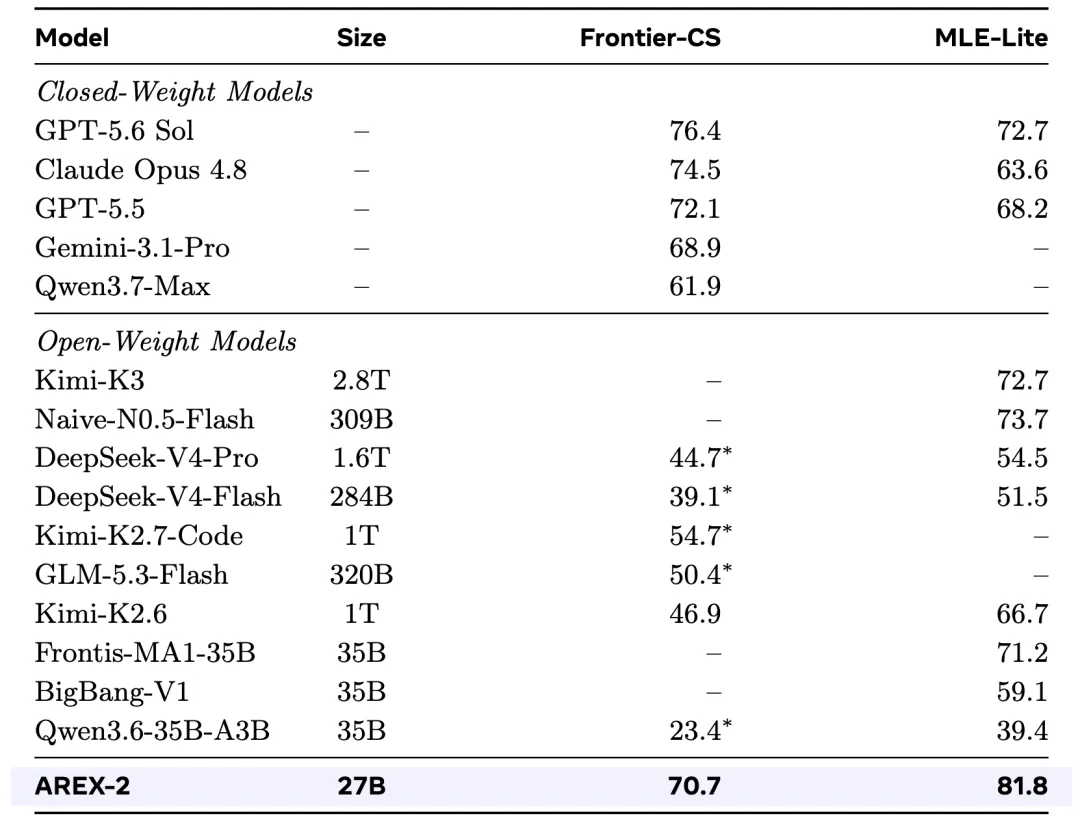
Main experiment: Machine learning and algorithmic programming. AREX-2 scored 81.8 on MLE-bench Lite and 70.7 on Frontier-CS.
Cross-domain migration: equally beneficial in deep research missions
More importantly, the continuous improvements learned in machine learning and algorithmic programming can be used for in-depth research. AREX-2 uses in-depth research data along AREX v1 and adds new synthesized long-range reflection trajectories on this basis. That is, the exploration does not rely on new in-depth research data to improve in-depth research performance, but on the ability to test whether improvement processes in other areas can provide effective results.
In the experiment, AREX-2 scored 84.0 and 52.6 on BrowseComp and HLE respectively, the highest of the 40B parameter models listed in this report.
This result supports the ability to migrate hypothesis proposed by the AREX team: long-range reflection is not only a technique for solving a particular type of task, but can also be an interdisciplinary capacity for self-improvement.
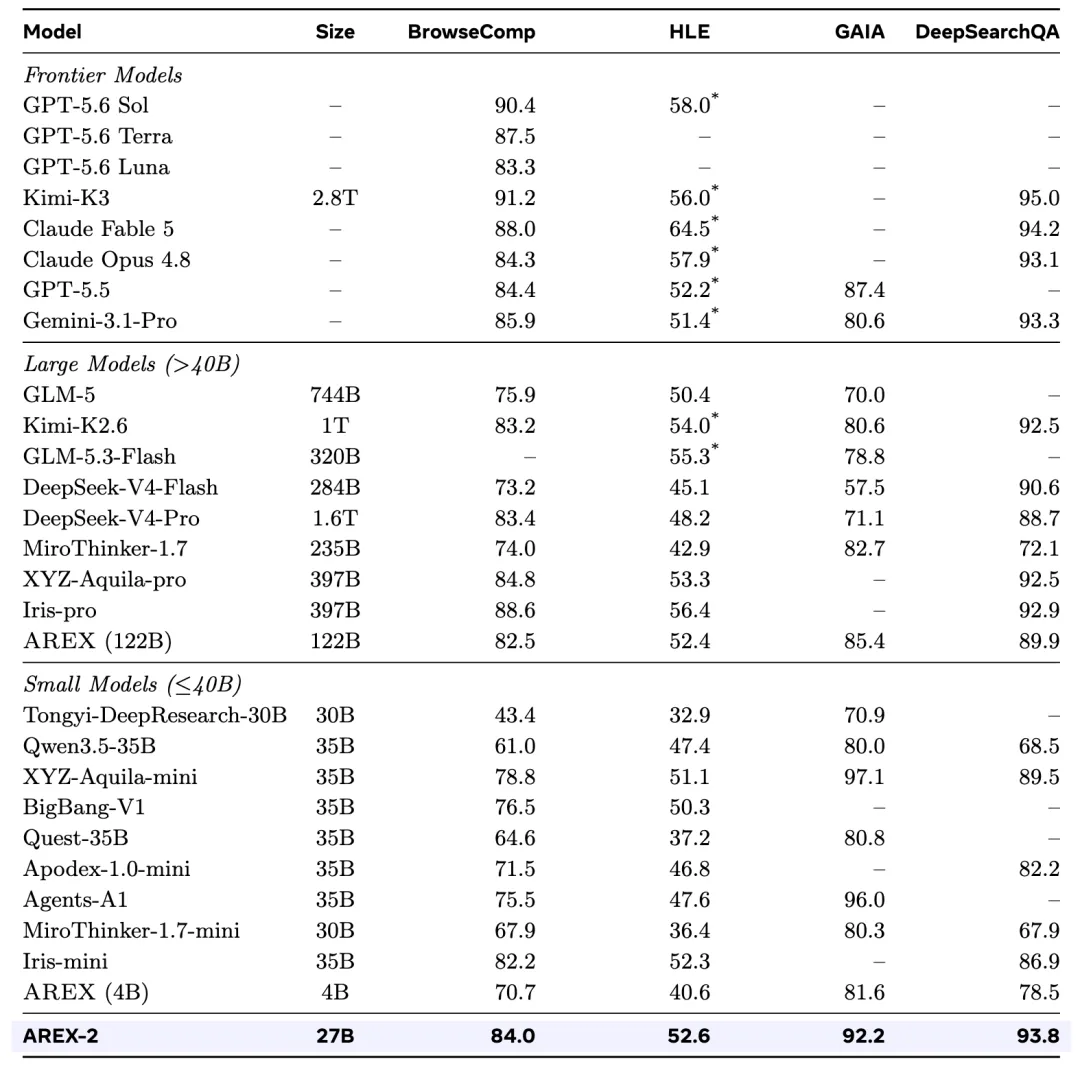
Figure 1b: Principal experiments: in-depth research and intelligent body tasks. AREX-2's BrowseComp, HLE scores are not higher than the maximum values for 40B parametric models in the graph.
Parameters and Performance: Smaller models can also enter higher capacity ranges
By combining mission performance with parametric scale, the characteristics of AREX-2 are clearer.
On the MLE-bench Lite, the AREX-2 of the 27B scored 81.8, higher than the Frontis-MA1-35B of the 35B (71.2), and higher than the Kimi-K3 (72.7) of the 2.8T. On the BrowseComp, the AREX-2 scored 84.0, higher than the Kimi-K2.6 (83.2) of the 1T, and the DeepSeek-V4-Pro (83.4) of the 1.6T.
AREX-2 is more than just a win-win. It reveals another capability enhancement pathway: In addition to expanding the scale of the model, it can be more effective in leveraging feedback, modification schemes, and accumulating iterative benefits through specialized training for continuous improvement processes.
AREX-2 demonstrates superior parametric efficiency, maintains its position on the Pareto frontier and achieves performance comparable to or exceeding larger models.
Long-term data reflection
Providing effective training routes for RSI
AREX-2's exploration suggests that long-range reflection data not only improves the model's performance in the field of training, but also hopes to help the model learn the self-improvement ability to migrate.
For the RSI, this provides a path worth exploring: allowing the model to learn to accumulate experience from each round of attempts and transform that experience into continuous progress over a longer mission process.
© THE