The discussion of the 722 mathematical manuscripts has not yet ended, and OpenAI has presented a more startling and unexpected result to scientists.
This time, it claims to overturn a hypothesis in theoretical computer science that has been widely believed for nearly 30 years. Two researchers who proposed the hypothesis that year are now preparing to organize colleagues to examine the contradictions of AI together.
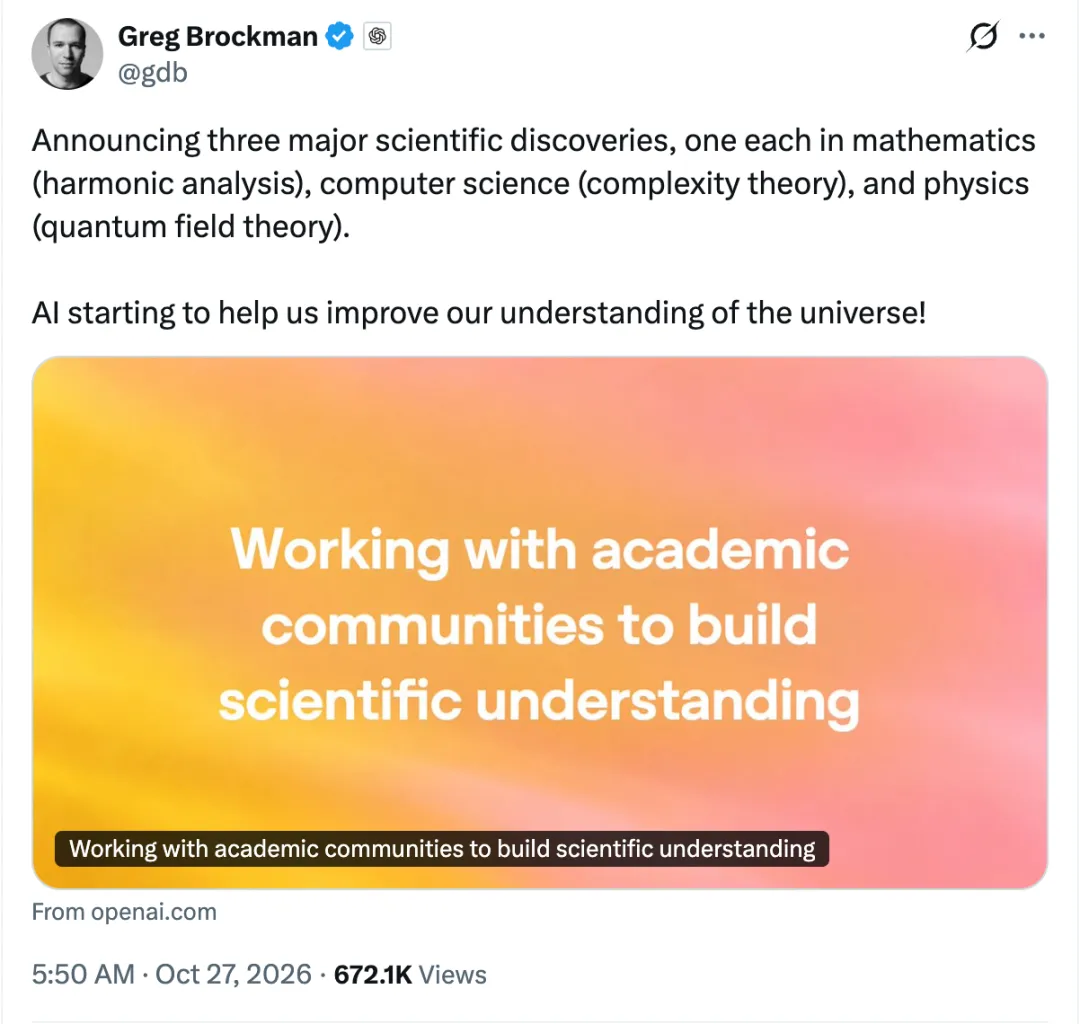
On October 26, OpenAI announced new achievements in three areas of mathematics, computer science, and physics: proving local smoothing conjectures under all dimensions, falsifying the time-index hypothesis (ETH), and establishing rigorous mathematical proofs of existence for four-dimensional quantum field theories, including quantum color dynamics. OpenAI president Greg Brockman called them three major scientific discoveries at X and praised AI for helping humans increase their understanding of the universe.
Less than three weeks ago, OpenAI just released 722 mathematical manuscripts generated by internal models, representing 372 outcomes and 17 research directions. At the time, we reviewed the list and selected 30 of the most sought-after classical puzzles.
Now, the hanging valley problem is emerging again, but it is no longer the most unexpected of these results. Another abbreviation, ETH, has drawn the entire theoretical computer science community into the discussion.
A hypothesis that's been around for almost 30 years is that there's no such thing as a free lunch.
Challenged by AI
To understand ETH, let's start with the example below.
Suppose there is a password lock, and each password can only be 0 or 1. We don't know the correct password, but we have a few clues: the first and second cannot be both 0; the second can be 0, or the third can be 0; the first, third and fourth can't all be 1.
The question is, can we find a set of numbers that satisfies all the clues at the same time?
In computer science, this option with only two values of 0 and 1 can be represented by Boolean variables, which are "false" and "true" respectively. If each clue is written as a logical condition with no more than three variables or negated by "or" connections, then the classic 3-SAT question arises as to whether a set of values can be found that establish all conditions simultaneously.
Four passwords are easy to solve, with a maximum of 16 combinations checked. But if there are 100 passwords, the possible combinations increase to 2^100. Although intelligent algorithms do not have to be tried individually, the general 3-SAT problem of how fast a computer can be is an important question in theoretical computer science.
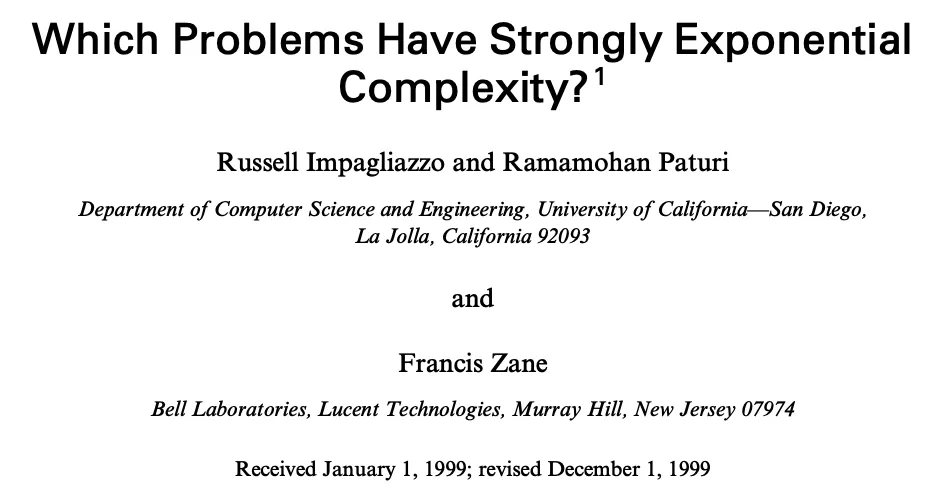
In the late 1990s, Russell Impagliazzo, Ramamohan Paturi and Francis Zane proposed the exponential time hypothesis (ETH).
Its central point is that there is no algorithm that can solve all 3-SAT problems in sub-index time. In other words, no matter how improved the algorithm is, it is impossible to reduce the runtime in the worst case to 2^{o(n)} on this scale, where n represents the number of Boolean variables.
Over the next 30 years, ETH has become an important underlying assumption in theoretical computer science. Researchers often use it to derive computational time limits in fields such as graphing algorithms, database queries, and computational biology. Hundreds of research papers have drawn conditional difficulty conclusions based on this assumption.
This time, the internal model of OpenAI gives an algorithm that could break that boundary.
According to public evidence, for the CNF Boolean formula of fixed width, the model constructs a determination algorithm that not only determines whether there are attributes that satisfy the conditions, but also accurately calculates the number of attributes that satisfy the conditions. For example, in the previous password problem, it is only necessary to find a set that satisfies the clue; while precise counts can calculate exactly how many group passwords satisfy all the conditions.
More importantly, the speed. For the problems related to the ratio of the number of subsets to the number of variables, OpenAI gives the running time interval in the form of 2^{O(n/√log n)} (excluding polynomial factors), which belongs to the sub-index time.
This does not mean that all difficult problems can be solved quickly, but a theoretical boundary that was considered impossible to cross in the past may have already been broken.
What is even more dramatic is that the next person responsible for reviewing the results.
OpenAI invited Impagliazzo, Paturi, at the University of California, San Diego, and an external research team led by Ryan Williams at MIT. The first two were the original proponents of ETH, while Williams defined long-term algorithms and computational complexity.
Scientists who proposed this hypothesis nearly 30 years ago are now personally involved in examining AI's counter-evidence.
According to a timeline published by OpenAI, the model generated ETH's natural language verification on October 16, completed its Lean formalization the following day, and officially announced the results on October 26.
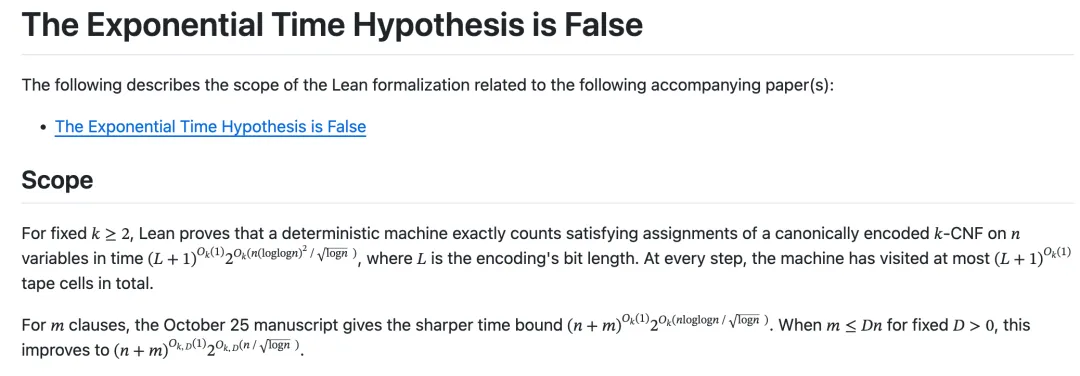
OpenAI's publicly available index time assumes that the Lean formalized proof of the ETH falsification results is presented.
A hypothesis that has been widely used by the theoretical computer science community for nearly 30 years is now likely to be rewritten by AI.
The last time was in a four-dimensional hanging valley.
This is a direct push to all dimensions.
If you look back from computer science to mathematics, an old reader will come across a familiar name: Hanging Valley (Kakeya).
In a previous 722 manuscript report, we presented a mathematical problem that originated in a needle: how much space would it take for a needle to rotate in all directions? This seemingly simple geometric problem later extended the geometric conjecture of a high-dimensional set and became deeply associated with coordination analysis and partial differential equations.
In 2025, Wang Neon and Joshua Zahl solved the three-dimensional hanging valley set hypothesis. Previously, OpenAI's 074 outcome family claimed to further prove the three-dimensional hanging valley extreme hypothesis and the four-dimensional hanging valley dimension hypothesis, while the two manuscripts did not yet have a corresponding Lean formalization proof.
This time, the entrance found by OpenAI was changed.
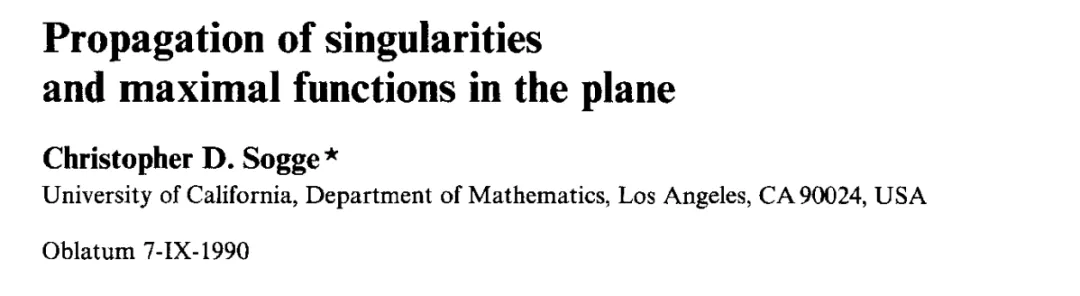
The new results were first targeted by the mathematician Christopher Sogge's Local Smoothing Conjecture in 1991. It studies how waves focus during propagation: at a given moment, waves may be at an abnormal concentration; but if the performance over a period of time is observed together, this state of extreme concentration cannot be sustained long term.
It can be thought of as a waveform encountered on the surface of water. At some point, the wavelength may be superimposed at an extremely high position, but as the waves continue to propagate, the most extreme peak will change quickly. Local smoothing is done by using precise inequalities to show how much additional regularity the time average can bring.
It's not just a mathematical game of studying waves. The behaviour of wave equations, the limit estimates in Pleiades' analysis, and the geometrical structure of the hanging valley set are linked by a set of theories.
In 2019, Larry Guth, Wang Neon, and Zhang Ruqiang proved the local smoothness conjecture under two-dimensional space. OpenAI now claims that the model has found a new auxiliary partial differential equation and thus advanced the proof to all dimensions of space. According to OpenAI, this result further solves the hanging valley conjecture under all dimensions and the Stein limitation conjecture.
From the previous three-dimensional, four-dimensional specific results, to this time claiming a unified conclusion covering all dimensions through localized smoothing, the change is quite apparent.
Time is also tight: OpenAI states that the model was certified on October 18 and completed its Lean formalization on October 19. Natural language manuscripts and formalization proofs have been made public. Unlike ETH, OpenAI does not designate a preliminary review team for the mathematical part, but allows researchers to directly access the public material and organize their own interpretation and review.
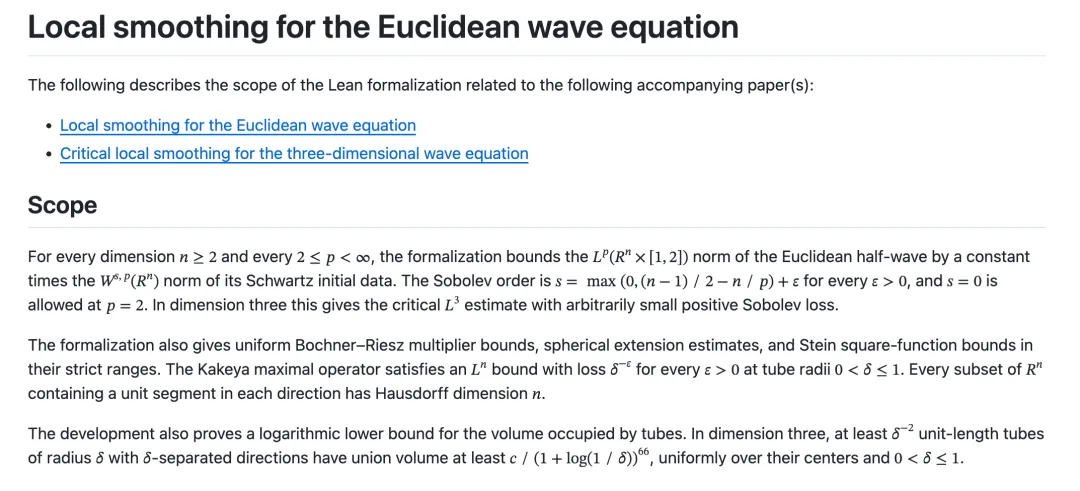
OpenAI's open local smoothing conjecture The Lean formalized proof illustrates local smoothing estimates in all two-dimensional and above spaces and demonstrates that a complete Hausdorff dimension is present in a sub-dimensional valley set accordingly.
The problem of physics:
Can the theory we use be rigorously constructed?
If ETH is concerned with how fast computing can be, how hanging valleys and local smoothing are concerned with the nature of space and waves, then the third result has directly touched the foundations of modern physics describing the microscopic world.
Quantum Chromodynamics (QCD) describes the strong interactions between quarks and neutrons. Physicists use it to study protons, neutrons, and the more basic particles that make up them, and related calculations and experiments form an important pillar of modern particle physics.
But there's an interesting caveat here: a set of theories that can be very successful in physical computation and experimentation, to be rigorously structured into quantum field theories that satisfy mathematical axioms, is another thing.
In four-dimensional space and time, the interactions between particles, the constant quantum decay on different scales, and how to move from approximate computation to strict definitions have left constructive quantum field theory facing enormous mathematical difficulties for a long time.
OpenAI claims that the internal model, along the path of mathematical physicist Tadeusz Balaban's study of constructive quantum field theory, establishes a strict proof of the existence of quantum field theory that includes the four-dimensional interaction of the norm field with Fermium, which involves QCD, as well as a unified extension of the standard model norm field and Fermium.
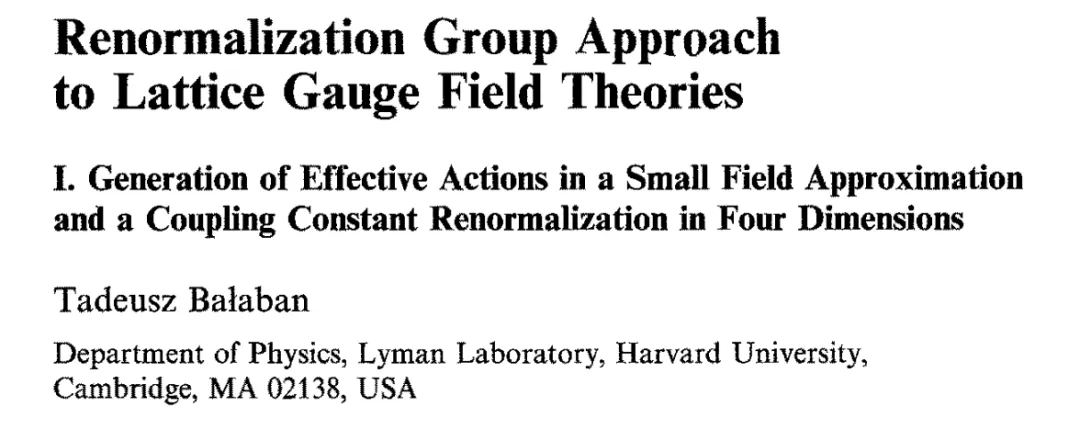
The work also contains proofs of the existence of the Yangtze Mills theory. In 2000, the Cray Mathematical Institute listed "the existence of Mills and the mass gap" as one of the Seven Millennium Mathematical Problems. The subject is not only to prove the existence of the quantum Mills theory, but also to prove that it has a positive mass gap.
The most remarkable part of physics is the list of scientists who have undertaken research.
David Gross, winner of the 2004 Nobel Prize in Physics, led a team that included Michael Douglas, Arthur Jaffe, Igor Klebanov, and Nikita Nekrasov. Gross was awarded the Nobel Prize for his work on the approximation of freedom, which is the key to understanding the interaction of forces at extremely short distances; Jaffe co-authored with Edward Witten the formal statement of the Tom Mills Millennium Problem.
This release was also different from the previous two. OpenAI revealed that the model had already generated a proof of the existence of Tommills on September 9 and a proof related to QCD on September 18. Due to the complexity of the material, the company waited until October 16 to complete the Lean formalization of the existence of Tommills to advance external collaboration.
The Physics Working Group chose to organize, understand and write their own research texts, and temporarily did not disclose the original evidence produced by AI. That is, the results that are closest to the foundations of modern physics are currently to be transformed by the expert group into peer-reviewed, judged and continued-use studies.
After the proof was written by AI,
Scientists start working on another project
Looking back at these three outcomes, it's really worth seeing changes in the way OpenAI deals with these outcomes, in addition to the scale of the problem itself.
When OpenAI published 722 manuscripts on October 6, it used a centralized public model: papers, proof papers, result directories, and partial model reasoning summaries to be placed on GitHub. Mathematicians can read them directly and face a real question: Who is going to check hundreds of manuscripts across different disciplines, who is going to explain them, and how are they going to judge which of them actually contain new ideas?
On the other hand, even with Lean formalization, the academic community still needs to figure out whether formalization theorems accurately correspond to the original assumptions, and to prove which new methods are being introduced that can migrate to other problems.
OpenAI now uses an interesting statement about these AI products: raw research data.
This positioning separates "proving" from "forming scientific understanding". The former can be done by AI; the latter requires researcher-reviewed arguments, rewriting interpretations, tracing existing work, judging contributions, and putting new tools into existing knowledge systems in the discipline.
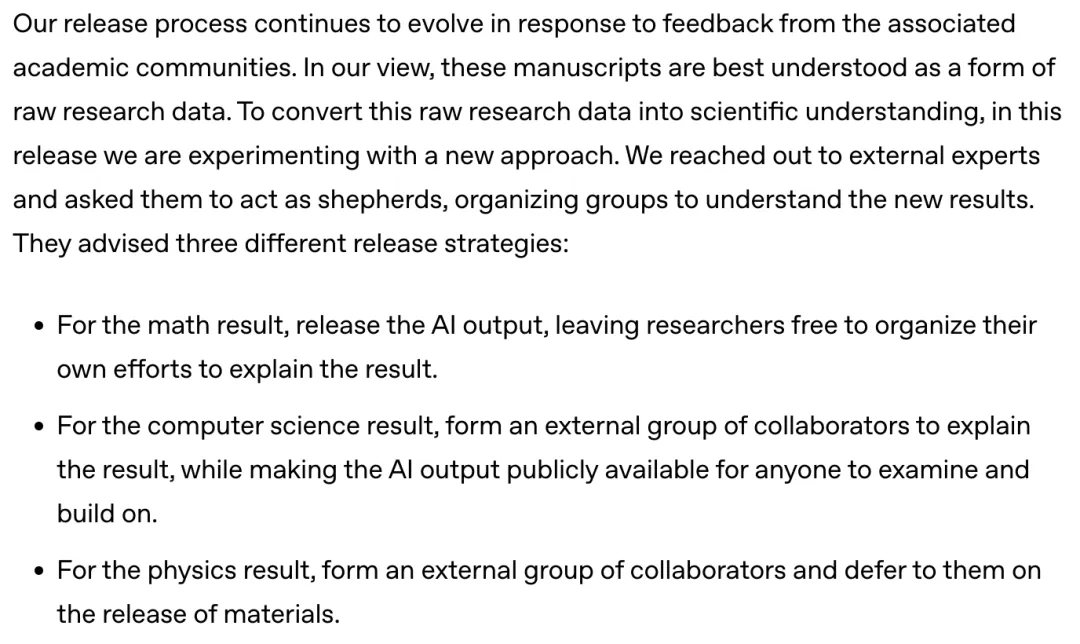
Thus, the three results of 26 October corresponded to three arrangements: the mathematical part was directly open to the public, allowing the community to organize its own research; the computer science part was open to the public, inviting the original proponents and experts in the field of ETH to organize an independent review; and the physical part handed the material over to a team of experts to decide how to publish it after it is finished.
At the same time, OpenAI proposed several principles of cooperation: external members voluntarily, independently participate, do not sign confidentiality agreements, and do not seek academic signatures for OpenAI for the discovery of models; they should be recognized for their own interpretation, proof of composition, and follow-up research. The company also pledged to support independent review and previously announced a $5 million commitment to the Simons Foundation for related programs for seminars, academic conferences, and research projects.
The three ways of publishing are essentially the same: How can the scientific community digest this new knowledge when AI is able to produce a large amount of cutting-edge research in a short period of time?
The direct public demonstration that more researchers can be immediately involved, but also means that the vast scrutiny work needs to be undertaken by the community itself. First handed to a team of experts, they can concentrate on organizing complex research results, but also allow some researchers to access the material earlier than others.
OpenAI is obviously aware of this problem as well. Compared with the unilateral release of 722 mathematical manuscripts at the beginning of October, this time it has not only published the results of the research, but has also begun to try to establish a corresponding mechanism of review and cooperation for different disciplines.
The story of ETH provides a symbolic scene.
Almost 30 years ago, Impagliazzo and Paturi contributed to the hypothesis, and hundreds of papers explored the complexity of computational problems based on it. Today, OpenAI's model claims to have found counter-evidence, and the two scientists, together with their colleagues, are re-examining the theoretical basis that they had previously worked on.
For OpenAI, the model has completed the production and formalization of proofs. For the scientific community, real research work is ongoing: reviewing algorithms, understanding new methods in proofs, and judging how these results will affect subsequent research.
From 722 mathematical manuscripts to today's work across three disciplines, OpenAI shows not only how much evidence AI can produce, but also a more practical question: how can humans translate these findings into truly comprehensible, verifiable, and evolving knowledge when AI constantly makes new scientific conclusions?
The link is as follows:
© THE